
A backlink is a hyperlink from one website pointing to a page on a different website — search engines treat it as a signal of trust, relevance, or endorsement from the linking site. The concept traces back to Google's original PageRank algorithm, which treated each link as a "vote" for the linked page; modern ranking has layered in far more nuance since then, but the underlying principle that external links carry signal is still foundational to how Google understands a page's standing on the web.
Key Takeaways
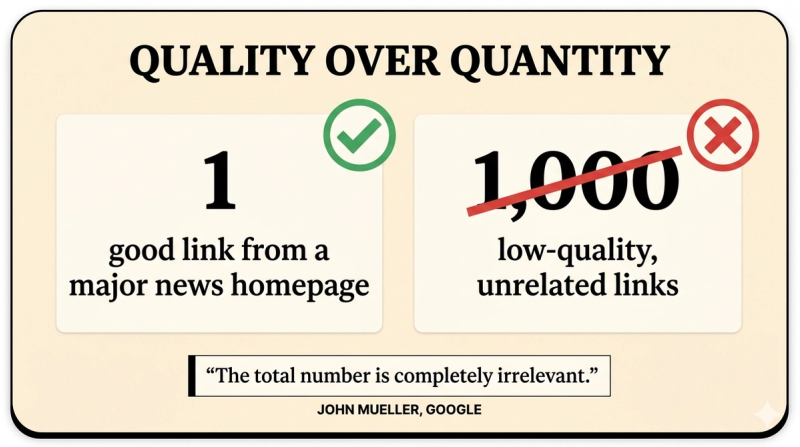
- A backlink is any external link pointing to your site — Google has explicitly stated the total number of backlinks is not something its ranking systems weigh directly.
- One highly relevant, authoritative link can outweigh thousands of low-quality ones — Google evaluates links individually, not by count.
- Backlinks can be dofollow (passing ranking signals) or nofollow/sponsored/UGC (not passing them) — see dofollow link for the full attribute breakdown.
- Toxic or spammy backlinks are rarely worth manually chasing down — disavowal is a last resort, not a routine maintenance task.
- A backlink audit reviews link quality and relevance, not raw count — the goal is identifying risk and opportunity, not maximizing a number.
John Mueller has made this point directly, more than once: at a February 2021 Search Central hangout, asked whether unique referring domains or total backlink count mattered more, he replied that "the total number essentially is completely irrelevant" to Google's ranking systems.
How Does Google Evaluate Backlink Quality?
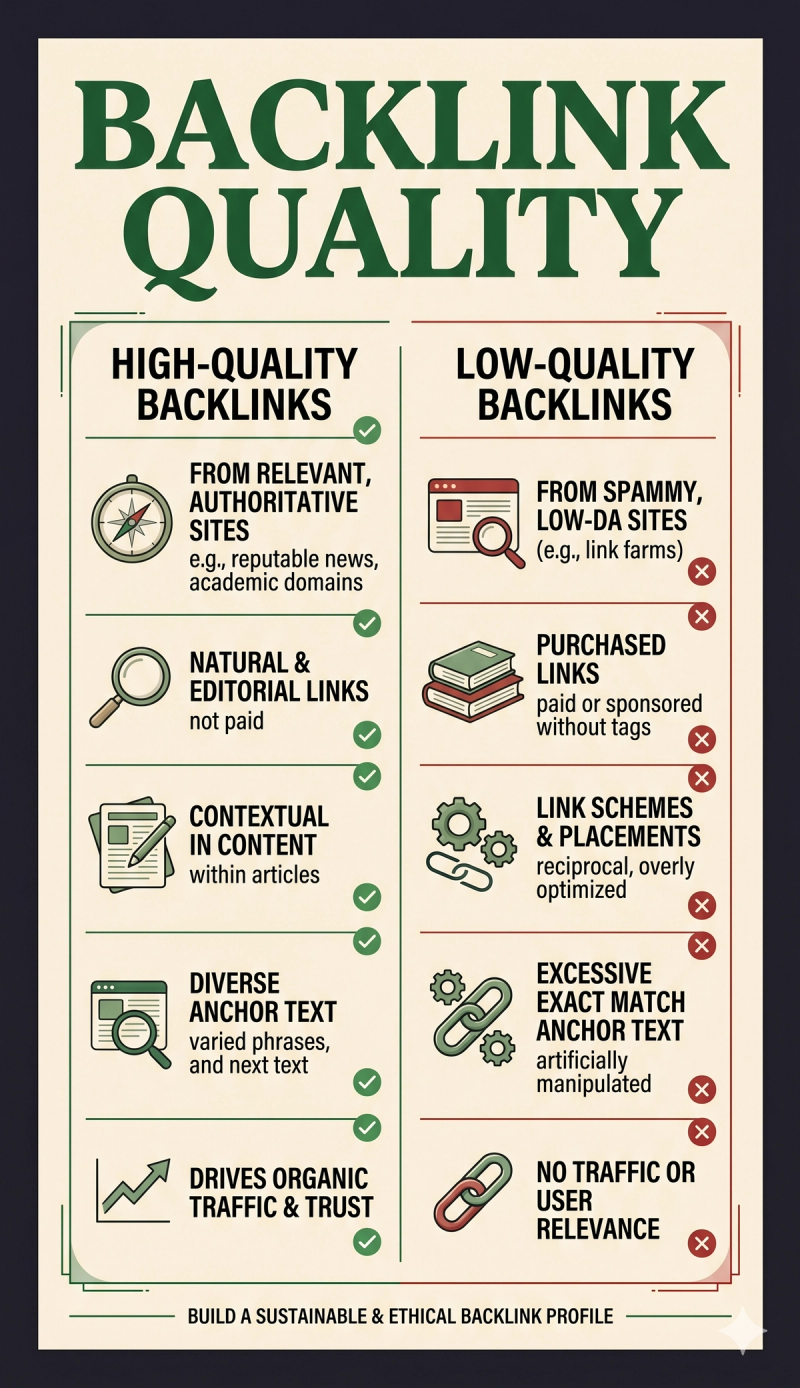
Google evaluates backlink quality primarily through relevance (does the linking page relate topically to the linked page), authority (how trusted is the linking domain itself), and placement (is the link embedded naturally in editorial content or buried in a footer or comment section). These factors matter far more than raw link count.
- Relevance: a link from a page discussing the same or a closely adjacent topic carries more contextual weight than an unrelated one.
- Authority: links from established, trusted domains generally carry more signal than links from new or low-trust domains — though this isn't measured via any public metric like Domain Authority (which isn't a Google metric).
- Placement: a link embedded naturally within the main body of editorial content is generally treated as more meaningful than one in a sitewide footer or navigation element repeated across thousands of pages.
- Anchor text: the clickable text of the link provides additional context about what the linked page is about, though over-optimized, exact-match anchor text at scale can look manipulative rather than natural.
What Are the Different Types of Backlinks?
Backlinks generally fall into a few recognizable types based on how they were acquired, and each carries a different risk/value profile:
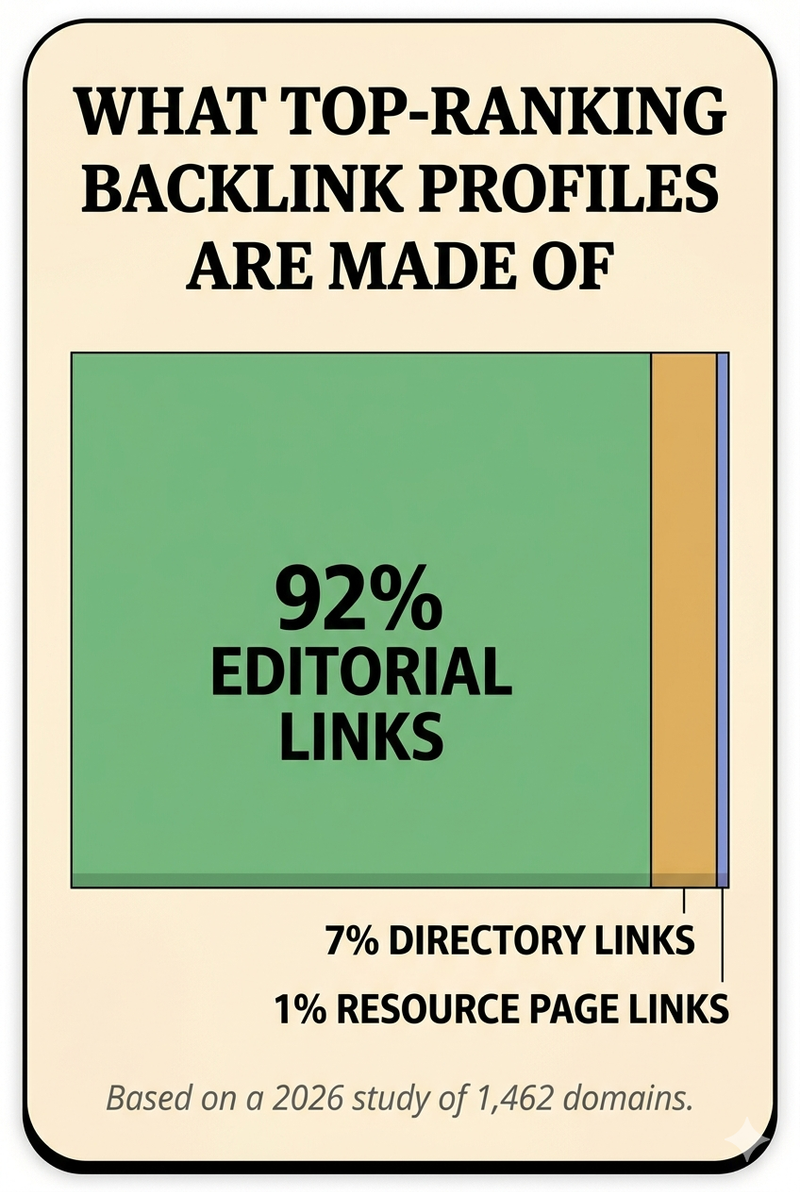
- Editorial links — earned naturally because a writer or publisher found the linked content genuinely useful or citation-worthy. Generally the highest-value type.
- Guest post links — placed within a guest-contributed article on another site. Legitimate when the content itself is genuinely valuable; risky when done purely for link acquisition at scale.
- Directory or citation links — listings in business directories, often relevant primarily for local SEO. See local citation.
- Resource page links — links from curated "resources" or "further reading" pages, often earned through direct outreach.
- Nofollow/UGC links — links from comments, forums, or user-generated platforms, typically marked to not pass ranking credit. See dofollow link for the full attribute distinction.
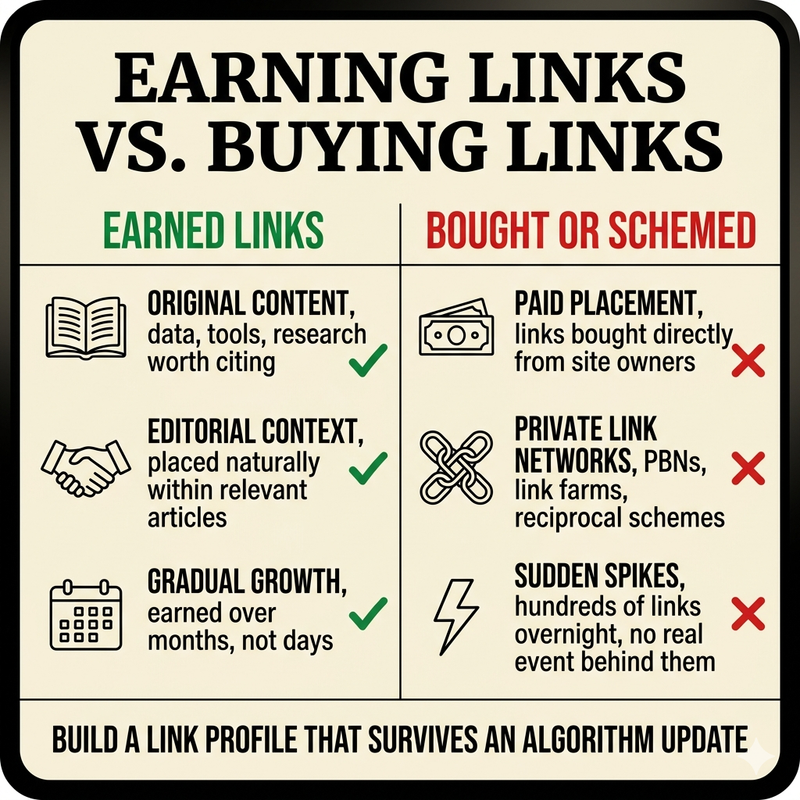
- Paid links — links exchanged for payment; must be disclosed via rel="sponsored" or nofollow per Google's link scheme guidelines, or they risk penalty for both parties.
How Do You Audit a Site's Backlink Profile?
You audit a backlink profile by reviewing the full set of external links pointing to a site, assessing quality and relevance rather than counting totals, and flagging anything suspicious or clearly manipulative. A basic audit process looks like:
- Export the full backlink list from a link-analysis tool (Ahrefs, Semrush, or Google Search Console's own Links report, which is free and directly from Google's own data).
- Sort by referring domain rather than individual link, since one domain can supply many links and inflate a raw count misleadingly.
- Flag links from clearly irrelevant, low-quality, or spammy domains for review.
- Check anchor text distribution for unnatural, over-optimized patterns concentrated on a small set of exact-match phrases.
- Decide on toxic links individually — Google has repeatedly stated most sites don't need to actively disavow links, since its systems are generally capable of ignoring low-quality links on their own.
Do Backlinks Still Matter for AI Search Visibility?
Backlinks' role in AI search citation is meaningfully different from their role in traditional Google ranking, since large language models generating answers don't appear to weight accumulated backlink signal the same way Google's ranking systems do. Citation in AI-generated answers seems to depend more on content relevance, clarity, and retrievability than on a page's link profile.
That doesn't make backlinks irrelevant to AI visibility entirely — a strong backlink profile still supports traditional crawlability, indexing, and discovery, which remain prerequisites for a page to be found and processed by AI crawlers at all. See AI share of voice for more on how AI-citation dynamics differ from traditional backlink-driven ranking.
Frequently Asked Questions
Can a backlink from a page that later gets deleted still help a site's rankings?
Once the linking page is removed or deindexed, Google stops crawling and processing it, meaning any ranking signal it contributed effectively stops too — the historical existence of a now-gone link doesn't carry forward independently.
Does the position of a backlink on a page (top vs. bottom) affect its value?
Google has indicated that link placement and context can influence weighting, with links naturally embedded in main content generally considered more meaningful than links in a footer or a list buried at the bottom of a page.
Can internal links substitute for external backlinks in a link-building strategy?
No — internal links distribute a site's own existing authority across its own pages, while external backlinks bring in new authority signal from outside domains; the two serve different, complementary purposes rather than being substitutes.
Is it possible to have "too many" backlinks pointing to a single page?
There's no meaningful ceiling on legitimate, naturally earned backlinks to one page — the risk isn't volume itself, it's a sudden, unnatural spike in low-quality links that looks manipulative rather than organic.
Do backlinks from press releases carry the same value as earned editorial links?
Press release links are generally treated as lower-value than genuinely earned editorial coverage, since press releases are self-published rather than independently vetted by a third-party editor — many press release distribution services also apply nofollow by default.
Can a competitor attack a site's rankings by pointing spammy backlinks at it?
This is commonly called a negative SEO link attack; Google has stated its systems are generally capable of recognizing and ignoring unnatural link patterns automatically, which is part of why it advises most sites not to proactively disavow every low-quality link they find pointing at them.
Does a backlink need to be a full clickable link, or can a plain-text brand mention count too?
A plain-text mention without a hyperlink doesn't function as a backlink in the traditional link-equity sense, though there's ongoing industry discussion about whether unlinked brand mentions contribute to broader entity and authority signals independent of link equity itself.
How long does it take for a new backlink to affect rankings after it's published?
There's no fixed timeline — it depends on how quickly the linking page itself gets crawled and processed, and how the new link fits into the receiving page's overall existing signal profile; effects are rarely immediate and can take weeks to become measurable.
Can a 404 error on the page a backlink points to still provide any SEO value?
A backlink pointing to a dead 404 page provides no meaningful ranking value to that specific URL, since there's no live page for the signal to attach to — redirecting the old URL to a relevant live page (a 301 redirect) can recover much of that link's value instead of losing it entirely.
Do social media profile links count as backlinks the same way a blog link does?
Most major social platforms apply nofollow to outbound links by default, meaning a social media profile link generally doesn't pass the same direct ranking signal a standard dofollow blog or editorial link would, even though it can still drive referral traffic and visibility.
Is there a difference between a backlink and a citation?
Yes — a backlink specifically requires a hyperlink, while a citation (particularly in local SEO) can be a mention of business information without any link at all; see local citation for the full distinction.


