
What is SEO?
The most common question I get from new clients is some version of: "How long before I see results?" Wrong question. The better one — the one that actually changes how you approach the work — is why organic visibility compounds the way it does, and what it actually takes to earn your way into a search result you cannot buy.
SEO stands for Search Engine Optimization. The mechanics involve improving your site's content, structure, and external credibility so Google places it above competing pages when someone searches for what you offer. But the mental model that makes SEO work is not about optimization in the clinical sense. It is about authority. Relevance. Trust.
When someone searches "how to improve my credit score" or "best cloud kitchen in Bangalore," the results they see reflect years of accumulated signals. The sites at the top did not get there by hitting a checklist. They got there by consistently proving — to Google, to users, and to the rest of the web — that they know what they're talking about.
The three pillars of SEO
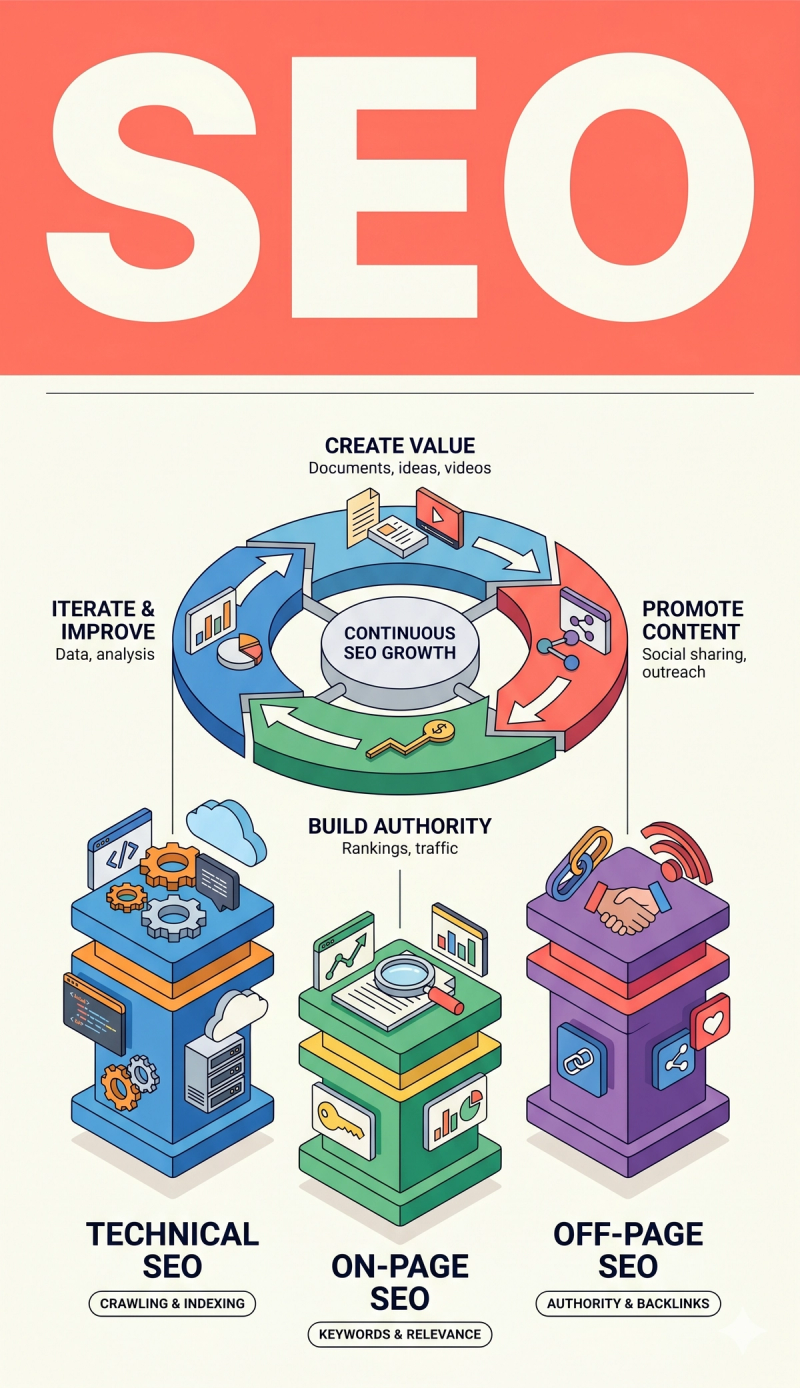
Think of SEO as a three-legged stool. Knock out any one leg and the whole thing falls.
- On-page SEO is what lives directly on your pages — the content, headings, internal links, structured data. It tells Google what each page is about and whether it genuinely satisfies what a user was looking for.
- Off-page SEO is external credibility. Backlinks from other websites pointing to yours. When the Economic Times or a niche industry publication links to your article, Google treats it as an editorial endorsement. The authority of the source matters enormously.
- Technical SEO is the infrastructure layer. Can Googlebot read your pages without obstruction? Does your site load fast enough? Are there crawl traps or duplicate content issues? Technical problems are invisible to visitors but completely block rankings.
How the ranking mechanism actually works
Google runs automated programs called crawlers — primarily Googlebot — that continuously scan the internet, reading pages and following links. When Googlebot visits your page, it evaluates three things: can it read the page clearly (technical), does the content match what someone searched for (relevance), and does the rest of the web vouch for it (authority)?
One thing I see consistently underestimated in audits: Google's ability to detect shallow expertise. A page can hit every technical checkpoint and still rank poorly if the content was assembled by synthesizing other articles rather than written by someone who actually knows the subject. Google's E-E-A-T framework — Experience, Expertise, Authoritativeness, Trustworthiness — is not a checklist. It is Google asking: does the author genuinely know this?
Why SEO compounds when ads do not
Paid search (PPC) is a faucet. You pay, you get traffic. You stop paying, traffic stops. Predictable. Expensive at scale.
Organic search is a flywheel. A page that earns strong rankings attracts readers. Readers share it and link to it. Those links raise domain authority. Higher authority improves rankings for other pages on your domain. One well-written guide published in 2023 can still be your top traffic source in 2026 — without any ongoing spend.
SEO in the AI search era
Most SEO strategies I review have not caught up to this yet. Google's AI Overviews, ChatGPT Search, Perplexity, Claude — these AI engines do not generate answers from scratch. They source content from the web. From pages that have been indexed, that demonstrate expertise, that are structured in ways machines can parse cleanly.
Strong SEO is now the foundation for AI citation visibility. You cannot appear in ChatGPT's search results if OpenAI's crawler is blocked in your robots.txt. The best GEO (Generative Engine Optimization) strategy starts with basic SEO done right.
Frequently asked questions
How long does SEO take to show results?
Three to six months is the honest answer for a site that is not starting from zero. A brand-new website in a competitive space should budget 12 months before expecting meaningful traction. Time and consistency are the inputs you cannot shortcut.
Is SEO different from SEM?
Yes. SEO is the organic component — unpaid rankings earned through relevance, authority, and quality. SEM (Search Engine Marketing) is the umbrella covering both SEO and paid search. Most serious marketing operations run both because they serve different purposes at different funnel stages.
Does SEO still matter in the age of AI search?
More than it ever has. AI engines source their answers from the same indexed, authoritative web that organic search relies on. You cannot get cited by Perplexity or appear in Google's AI Overviews if your underlying SEO is weak. AI search does not replace SEO. It raises the bar for what SEO needs to achieve.