
What is a meta description?
Of all the on-page elements I optimize for clients, the meta description is the one that gets misunderstood in the most consistent and specific way: people write it for the algorithm instead of the human who is about to decide whether to click.
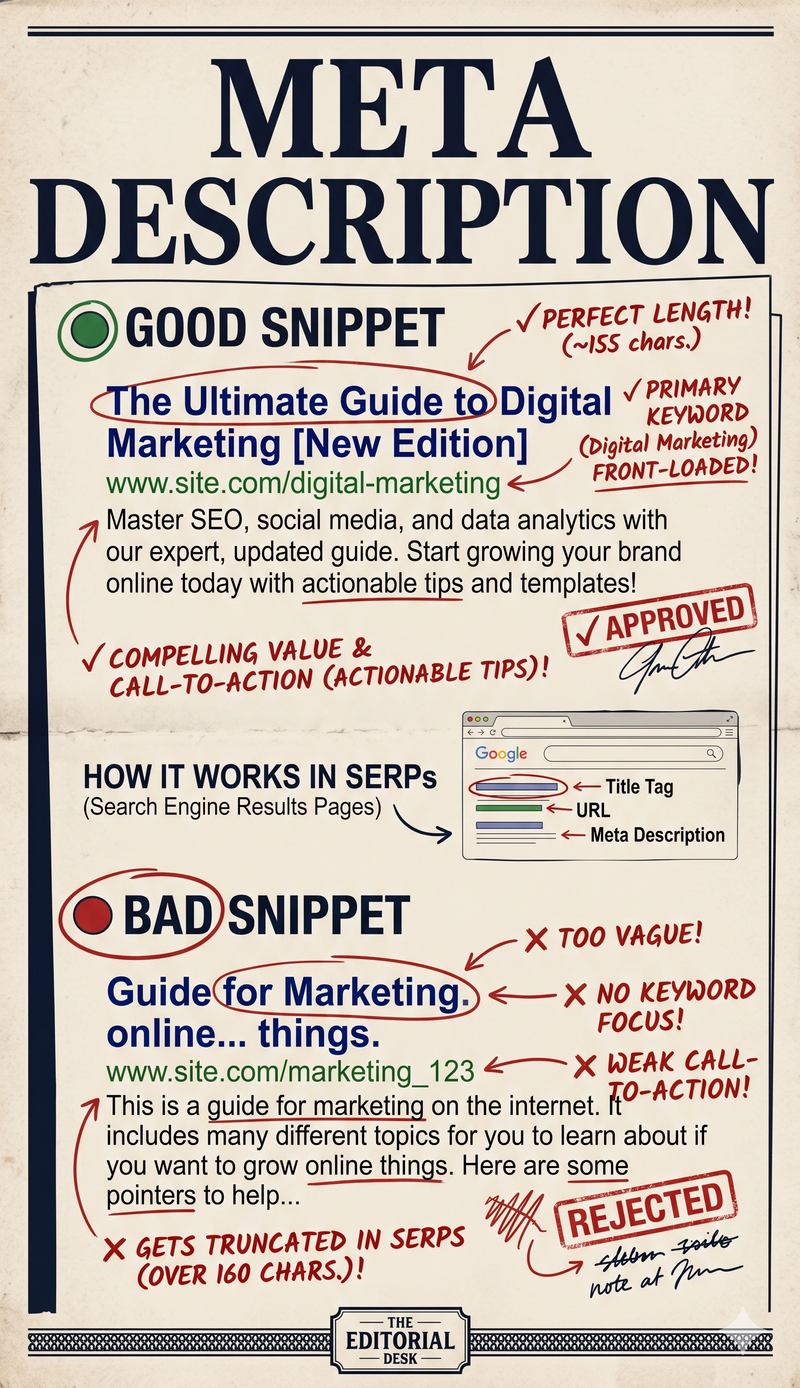
A meta description is the 150–160 character text snippet shown beneath your page title in Google's search results. It lives in the HTML head as a meta tag. Here is the uncomfortable truth: Google does not read your meta description as a ranking signal. The meta description is ad copy. Its job is to convert SERP impressions into clicks.
Why it matters more than most people treat it
Every search result is a competition for attention. Your title creates interest. Your meta description closes the click. Or does not.
A user scanning 10 results in 15 seconds is silently asking three questions: Is this what I am looking for? Why this result over the others? What will I find if I click? A well-written meta description answers all three in under 160 characters.
The CTR impact is real and indirect. Higher click-through rate sends a user engagement signal Google pays attention to. Over time, a page that earns more clicks relative to its ranking position tends to improve. The meta description does not directly affect rankings, but it influences a metric that does.
How to write one that actually works
- Under 160 characters — Google truncates anything longer. Write the core value proposition in the first 100 characters.
- Include the primary keyword naturally — When the keyword matches the search query, Google bolds it in the SERP. Bold text catches the eye.
- Active voice with a specific value proposition — "Learn how to..." and "Get a step-by-step guide to..." consistently outperform passive, hedged descriptions.
- Unique for every page — Duplicate meta descriptions are a missed opportunity. Each page has different value — describe it specifically.
- Soft call to action for informational content — "See examples," "Get the full breakdown," "Check the guide."
The 60–70% problem
Google rewrites meta descriptions in roughly 60–70% of cases, substituting text it considers more relevant to the specific query. The response I give: write them anyway, and write them well. The pages where you least want a lazily auto-generated snippet — your highest-traffic, most competitive pages — need hand-crafted descriptions most.
Frequently asked questions
Does Google always use the meta description I write?
No — it substitutes its own version roughly 60–70% of the time, using content it considers more relevant to the specific search. The solution is not to stop writing them — it is to write descriptions that align tightly with the primary query intent.
Should meta descriptions include keywords?
Yes, but as part of a naturally readable sentence. When the keyword matches the user's search term, Google bolds it in the result. That visual emphasis is worth optimizing for.
How do I add meta descriptions in WordPress?
Yoast SEO or RankMath — either plugin adds a dedicated meta description field to every page and post editor, with a live character count. You can write and preview the description without touching HTML.


