
What is on-page SEO?
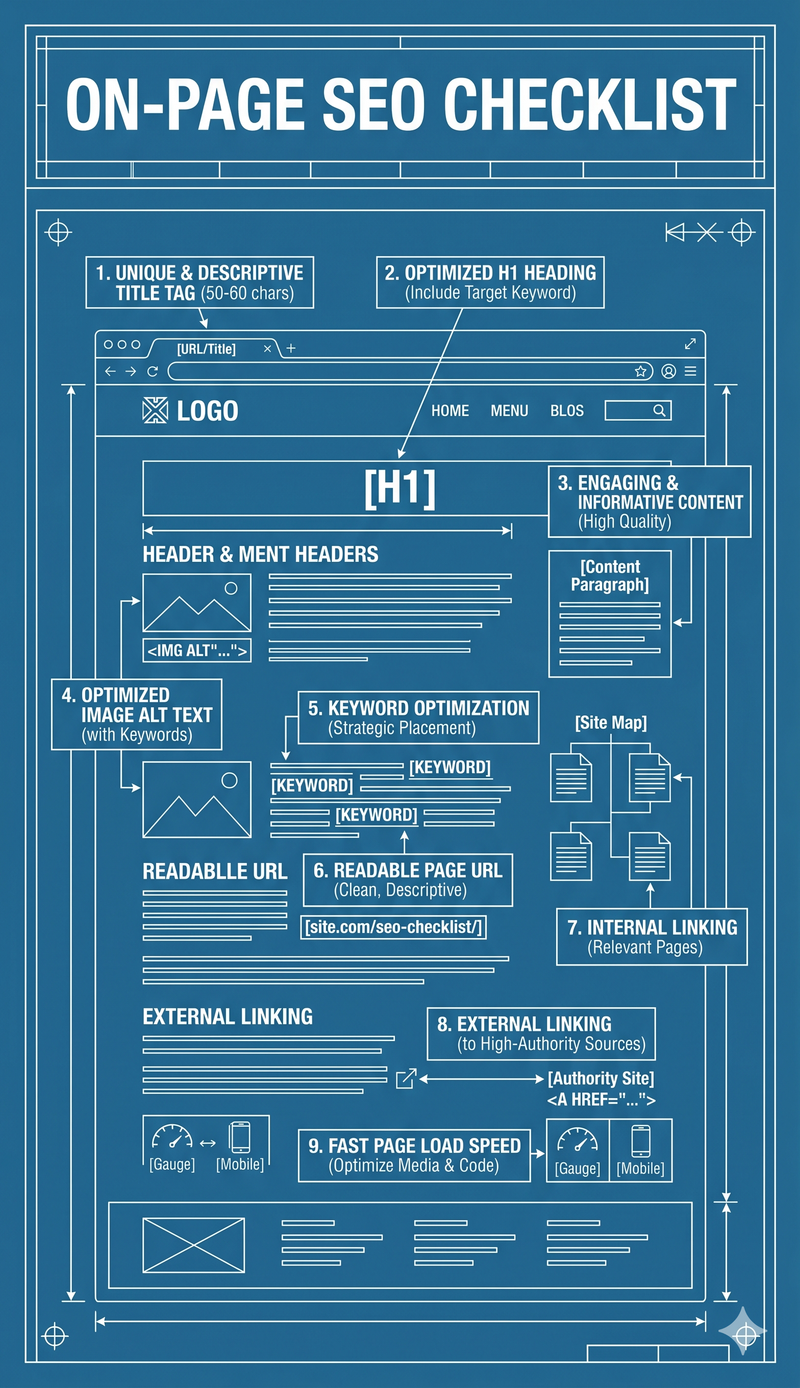
SEO has three distinct jobs. Off-page SEO builds your website's reputation with the rest of the internet. Technical SEO ensures Google can access and process your content. On-page SEO is everything you control directly on the page itself — what you say, how you structure it, and how clearly you communicate your topic to both users and search engines.
It is the one area where you have complete control. No outreach required, no waiting for someone else to link to you. On-page changes can produce measurable ranking improvements within days.
The elements that actually move rankings
Title tag
Your clickable headline in Google's search results. One of the strongest on-page ranking signals. Keep it under 60 characters, lead with the primary keyword, and write it for the human scanning the SERP.
Meta description
The 155-character summary beneath your title in the SERP. Not a direct ranking factor, but directly affects whether users click. Include your keyword, be specific about the value the page provides, and give a reason to click over the other nine results.
H1 heading
One per page. Should naturally reflect the primary search query and confirm to users that they landed in the right place.
Content quality and depth
This is the load-bearing element. Everything else supports it. A page that genuinely satisfies what a user was searching for — with specific, accurate, first-hand knowledge — will outperform a technically impeccable page with generic content. Google's E-E-A-T framework asks: does the author actually know this, or are they summarizing what others have already written?
Internal linking
Links from your page to other relevant pages on your site. Internal links distribute authority across your domain, help Google understand topical relationships, and help users navigate to related content.
Schema markup (structured data)
JSON-LD code that makes your content machine-readable. For glossary pages: DefinedTerm and FAQPage schema. For articles: Article or BlogPosting. Schema does not directly affect rankings but makes your content eligible for rich results in the SERP.
E-E-A-T — the part most on-page guides skip
Since the Helpful Content updates and the 2024 core algorithm refinements, E-E-A-T has become the quality layer that determines whether on-page optimization actually works. Technical elements are table stakes now. What differentiates pages in competitive SERPs: a named author with verifiable credentials, content that references specific observations from actual work, citations supporting factual claims.
For AI search visibility, these signals are non-negotiable. LLMs and Google's AI Overviews prefer to cite sources they can verify as authoritative and trustworthy. On-page E-E-A-T signals are what get a page into that consideration set.
Frequently asked questions
What is the most important on-page SEO factor?
Content quality and intent match. Everything else — title tags, internal links, schema markup — amplifies good content. Applied to a page that does not genuinely satisfy the search query, those optimizations add marginal value.
How often should on-page SEO be updated?
High-priority pages deserve a quarterly review. Update when key information has become outdated, your ranking has dropped without an obvious external cause, or a competitor has published something noticeably more comprehensive.
Does word count matter?
No fixed target exists. The right length is whatever fully satisfies the search query. Some queries are answered in 400 words; others require 4,000. The benchmark is the top 3 results for your target keyword. Padding content to hit an arbitrary word count is counterproductive.


