
Domain Authority (DA) is a third-party Moz metric that scores a site’s overall backlink strength on a 1–100 scale — it predicts ranking potential, but it isn’t a metric Google itself uses.
Key Takeaways
- Domain Authority (DA) is a Moz metric, not a Google ranking factor — Google has repeatedly and directly confirmed this.
- DA, Ahrefs’ Domain Rating, and Semrush’s Authority Score are three separate, non-interchangeable metrics — the same domain will show different numbers on each.
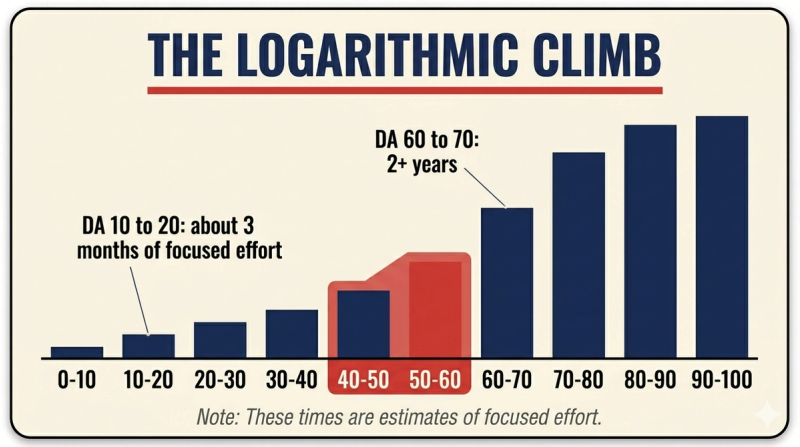
- The 1–100 scale is logarithmic — moving from DA 20 to 30 takes far less effort than moving from 70 to 80.
- DA is a lagging, backlink-derived score; it responds to link building, not content quality alone, and updates can shift a score even with zero change to a site’s own links.
- DA’s relationship to AI-citation visibility is genuinely unsettled — treat specific viral claims about it as anecdotal until a sourced, reproducible study exists.
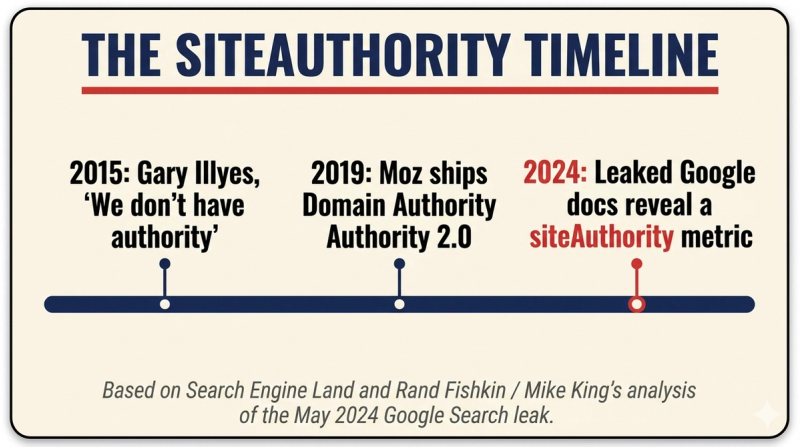
Google’s John Mueller has stated this directly, more than once: “Google doesn’t use Domain Authority at all when it comes to Search crawling, indexing, or ranking.”
How Is Domain Authority Calculated?
Domain Authority is calculated primarily from a site’s backlink profile — the number and quality of linking root domains — processed through a machine-learning model Moz trained to predict ranking potential, on a logarithmic rather than linear scale. The logarithmic scale means moving from DA 20 to DA 30 is meaningfully easier than moving from DA 70 to DA 80, since each additional point requires proportionally more link equity as the score climbs.
Moz has periodically updated the underlying model and data used to calculate DA, which means scores can shift for a domain even without any change to that domain’s actual backlink profile — a common, confusing experience for site owners tracking their score over time.
How Is Domain Authority Different From Domain Rating and Authority Score?
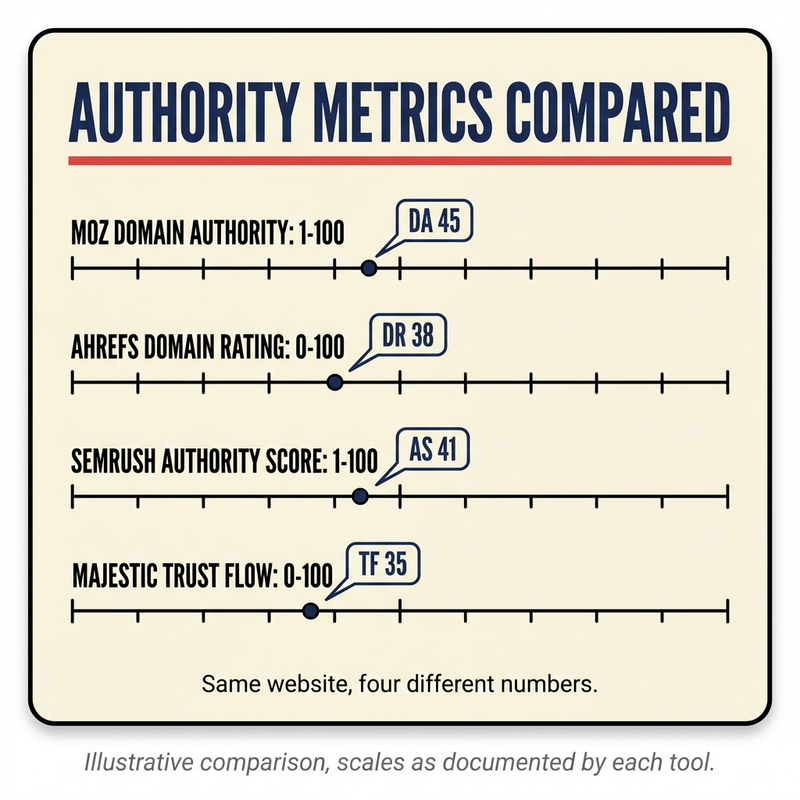
Domain Authority (Moz), Domain Rating (Ahrefs), and Authority Score (Semrush) all measure a similar underlying concept — backlink-based site strength — but use different proprietary indexes, data sets, and formulas, meaning the same domain typically shows different numbers across all three tools. None of them is objectively “more correct” than the others; they’re independent, non-interchangeable metrics.
DA vs DR vs Authority Score:
- Domain Authority (DA) — built by Moz — 1–100 logarithmic — measures predicted ranking likelihood based on backlink profile
- Domain Rating (DR) — built by Ahrefs — 1–100 logarithmic — measures backlink profile strength via Ahrefs’ own index
- Authority Score — built by Semrush — 1–100 — measures backlinks + organic traffic + spam signals combined
None of these metrics are Google ranking factors — Google has repeatedly and directly stated it does not use any third-party authority score in its ranking systems.
What Is a Good Domain Authority Score?
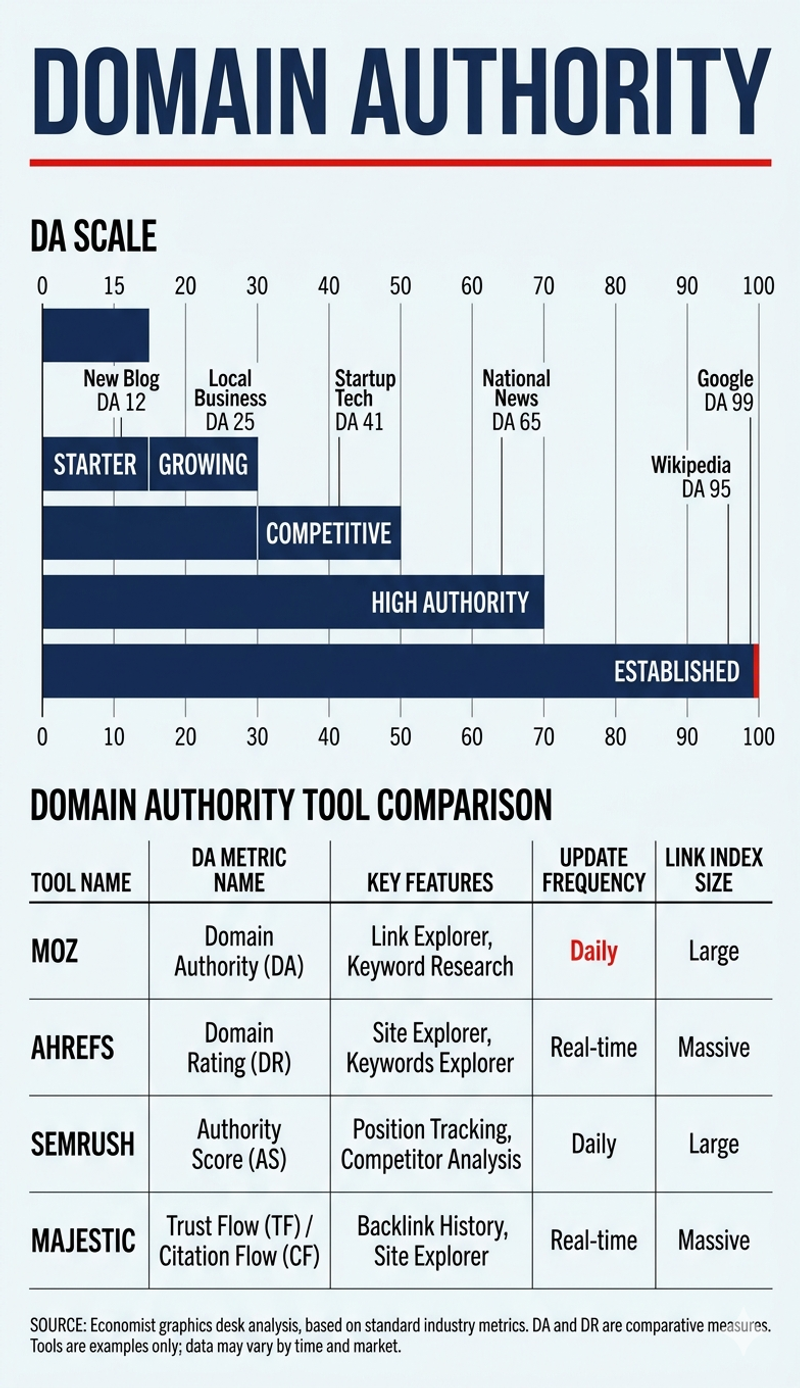
There’s no universal “good” DA score — what counts as strong depends heavily on the competitiveness of a site’s specific niche, since DA is inherently comparative rather than absolute. A DA of 40 might be excellent in a low-competition local niche and unremarkable in a highly competitive one like finance or health.
DA score benchmarks:
- 1–20 — new or very small sites
- 20–40 — growing niche sites, small businesses
- 40–60 — established mid-size sites, competitive niches
- 60–80 — strong industry players
- 80–100 — major publishers, top global domains
How Do You Increase Domain Authority?
Domain Authority increases primarily through acquiring high-quality, relevant backlinks, since DA is fundamentally a backlink-derived metric rather than a content-quality or on-page optimization score. In practice, that usually means:
- Publishing genuinely link-worthy content — original research, data, or a resource other sites want to cite (content alone doesn’t move DA; it has to earn external links).
- Earning links from domains that are themselves relevant and reasonably authoritative, rather than chasing raw link count.
- Avoiding purchased or manipulative link schemes, which risk a Google penalty independent of any DA movement.
- Disavowing genuinely toxic backlinks where they exist, primarily for penalty protection rather than as a direct DA lever.
- Being patient with the feedback loop — DA is recalculated periodically, not in real time, so new link-building activity typically takes weeks to months to show up in a published score.
What’s the Difference Between Domain Authority, Page Authority, and Topical Authority?
Domain Authority scores an entire domain’s backlink strength, Page Authority scores a single URL’s individual ranking potential, and topical authority describes how comprehensively a site covers one specific subject area — a fundamentally different, non-backlink-based concept. A high-DA domain can still have individual pages with low Page Authority, and a low-DA domain can still have strong topical authority in a narrow niche.
DA vs PA vs topical authority:
- Domain Authority — scope: entire domain — tells you: overall site-wide backlink strength
- Page Authority — scope: single URL — tells you: that specific page’s ranking potential
- Topical Authority — scope: domain × subject area — tells you: how comprehensively a site covers one topic
Does Domain Authority Matter for AI Search Visibility?
Domain Authority’s relationship to AI search citation is genuinely unsettled and actively debated, since large language models generating answers don’t cite sources using Moz’s DA score as an input — citation appears to depend more on content relevance, retrievability, and topical match to the query than on accumulated backlink-based authority. This is a distinct question from whether DA matters for traditional Google rankings, where it’s already established as a non-factor.
A specific claim circulating in SEO and GEO discourse in 2026 — that a large share of ChatGPT citations go to sites with comparatively low DA — has not been independently verified against a peer-reviewed or transparently published methodology as of this writing, and should be treated as anecdotal industry discussion rather than confirmed fact until a sourced, reproducible study is available.
Frequently Asked Questions
Why did my domain authority drop even though nothing changed on my site?
Moz periodically updates its underlying calculation model and index, which can shift a domain’s score even without any actual change to that domain’s backlink profile — this is a known, expected side effect of Moz’s model updates rather than a sign of an actual problem on the site itself.
Can a low domain authority site still outrank a competitor with much higher DA?
Yes — DA is not a Google ranking factor, so a lower-DA page with stronger content relevance, better on-page optimization, or a more precise match to search intent can and regularly does outrank a higher-DA competitor for a specific query.
How often does Moz update domain authority scores?
Moz recalculates DA on an ongoing basis as it recrawls the web and updates its link index, though the exact cadence and methodology have changed over time — checking Moz’s own current documentation is the most reliable way to confirm the present update frequency rather than relying on older, potentially outdated guidance.
Do backlinks from low-authority sites still contribute anything to domain authority?
Yes, generally in small amounts — DA calculation weighs link quality, so low-authority links contribute less than high-authority ones, but they aren’t worthless by default unless they come from a source flagged as spammy or manipulative.
Does domain authority account for internal links, or only external backlinks?
Domain Authority is calculated from external backlinks — links from other domains — not internal links within the same site; internal linking affects other things (like page authority distribution and crawlability) but doesn’t directly factor into the DA calculation itself.
Do nofollow backlinks affect domain authority at all?
Historically, nofollow links were excluded entirely from DA calculation; Moz has adjusted its handling of nofollow signals over time in line with the broader industry shift toward treating nofollow as a hint rather than an absolute directive, so checking Moz’s current stated methodology is worthwhile rather than assuming older guidance still applies exactly.
Is a subdomain’s domain authority the same as the root domain’s?
Moz calculates DA at the root domain level by default, meaning most subdomains inherit or closely reflect the root domain’s score rather than being scored as fully independent entities — this differs from Page Authority, which is calculated per individual URL regardless of subdomain structure.
Should I pay for backlinks specifically to raise domain authority?
Paying for backlinks to manipulate authority scores or rankings violates Google’s link scheme guidelines and carries real penalty risk, independent of whatever short-term DA movement it might produce — a higher DA achieved through a violation-risk tactic isn’t a stable or advisable strategy.
Does disavowing toxic backlinks actually increase domain authority?
Disavowing links primarily protects against potential Google penalty risk rather than directly increasing DA, since Moz’s own calculation may still count some disavowed links in its index depending on timing and methodology — disavowal and DA improvement are related but not the same lever.
Can a brand-new page with zero backlinks still rank well if the content is strong?
Yes, particularly for lower-competition or highly specific long-tail queries, where content relevance and precise intent match can outweigh the authority advantage a more established competitor’s page might otherwise have.
Is domain authority calculated the same way for every country or language version of a site?
Moz calculates DA at the domain level generally without separate scoring per country or language version, meaning a multi-region site’s DA reflects its overall global backlink profile rather than region-specific authority — a distinct consideration from country-specific ranking performance, which does vary by region regardless of the single DA score.


