
What Is Geotargeting?
Geotargeting is the practice of delivering different content, advertising, or user experiences to visitors based on their detected geographic location — typically determined through IP address, GPS data, or a user's explicitly stated location. It spans two related but distinct practical applications: SEO geotargeting, which involves serving the correct regional or language version of a page to match a searcher's location, and advertising geotargeting, which involves showing different ad campaigns or offers based on where a viewer is physically located. Both share the same underlying goal — matching content to a visitor's actual geographic context — but they operate through different mechanisms and serve different business purposes.
Key Takeaways
- Geotargeting spans two distinct practical uses — SEO geotargeting (serving the right regional/language page version) and advertising geotargeting (showing location-specific ad campaigns) — that share a concept but operate through different mechanisms.
- Location detection for geotargeting commonly relies on IP address geolocation, GPS data (for mobile devices), or explicit user-provided location information, each with different accuracy and reliability tradeoffs.
- IP-based geotargeting is convenient but imprecise — VPNs, corporate networks, and IP database inaccuracies can all cause a visitor to be geotargeted incorrectly.
- Geotargeting and geofencing are related but distinct: geotargeting broadly targets based on a visitor's general location, while geofencing specifically triggers based on a device crossing a defined virtual boundary around a precise physical area.
- For SEO specifically, geotargeting typically works alongside hreflang tags and appropriate URL structure (ccTLD, subdirectory, or subdomain) rather than relying on automatic location-based redirects alone, since aggressive redirects can actively block search engines from properly indexing other regional versions.
How Does Geotargeting Actually Determine a Visitor's Location?
Geotargeting systems typically rely on one or a combination of three location-detection methods: IP address geolocation (matching a visitor's IP address against a database mapping IP ranges to geographic regions), GPS data (available specifically on mobile devices with location services enabled), or explicit user input (a visitor directly selecting or confirming their location or region). Each method carries real accuracy tradeoffs — IP-based geolocation is the most common and requires no visitor action, but it's also the least precise, since VPNs, corporate proxy networks, and simply outdated or inaccurate IP-to-location databases can all place a visitor in the wrong region entirely. GPS data is far more precise but only available on devices where location services are enabled and permitted, while explicit user input is the most reliable of the three but requires the visitor to take an action many simply skip or ignore.
What's the Real Difference Between SEO Geotargeting and Advertising Geotargeting?
SEO geotargeting is about ensuring search engines serve the correct regional or language version of a page to searchers in different locations — typically implemented through hreflang tags, appropriate URL structure, and Search Console's international targeting settings — while advertising geotargeting is about showing different ad creative, offers, or campaigns to viewers based on their detected location, implemented through ad platform targeting settings rather than search-engine-facing signals. The two can and often do work together on the same site — a business might use SEO geotargeting to ensure its UK-focused page ranks correctly in UK search results, while separately running geotargeted ad campaigns showing UK-specific promotions only to visitors detected as being in the UK. Confusing the two matters practically: an aggressive IP-based redirect built for an advertising use case (immediately sending every visitor to a "localized" version) can actively harm SEO geotargeting by blocking search engine crawlers from accessing and properly indexing the other regional versions of a site.
SEO geotargeting vs. advertising geotargeting, at a glance:
- Purpose — SEO geotargeting: serve the right page version to search engines/searchers. Advertising geotargeting: show location-relevant ad campaigns.
- Primary mechanism — SEO geotargeting: hreflang tags, URL structure, Search Console settings. Advertising geotargeting: ad platform location targeting settings.
- Risk of misuse — SEO geotargeting: blocking crawlers from indexing other regions via forced redirects. Advertising geotargeting: wasted ad spend if location detection is inaccurate.
Is Geotargeting the Same Thing as Geofencing?
No — geotargeting broadly targets content or advertising based on a visitor's general geographic location (a country, state, or city), while geofencing is a more precise technique that triggers a specific action when a device crosses into or out of a defined virtual boundary around an exact physical location, like a store's parking lot or a specific venue. Geofencing requires GPS or similar precise location data and is typically used for hyper-local, real-time triggers — a notification sent the moment someone's phone enters a defined radius around a retail location, for instance — while geotargeting operates at a broader, less precise geographic level more suited to region-wide content or campaign decisions. The practical distinction matters when choosing a tool or strategy: geofencing needs genuinely precise, real-time location data and is built for proximity-triggered actions, while geotargeting works fine with broader, less precise location signals for region-level content decisions.
How Should Geotargeting Actually Be Implemented for SEO Without Hurting Crawlability?
Implementing SEO geotargeting correctly means avoiding a common and genuinely damaging mistake: forcing an automatic redirect based on detected location before a search engine crawler has a chance to access and index other regional versions of the content.
- Use hreflang tags to signal regional/language relationships between page versions, rather than relying on redirects alone to guide search engines to the right version.
- If using automatic location-based redirects for real visitors, ensure search engine crawlers specifically are excluded from that redirect logic (based on user-agent), so they can still access and index every regional version.
- Offer visitors a clear, easy way to manually switch to a different regional or language version if the automatic detection gets their location wrong — since IP-based detection is genuinely imprecise.
- Choose an appropriate URL structure (ccTLD, subdirectory, or subdomain, covered in depth on this site's international SEO page) as the foundation geotargeting signals build on top of.
- Verify geotargeting settings in Google Search Console (where available) align with the actual regional structure implemented across the site's hreflang and URL setup.
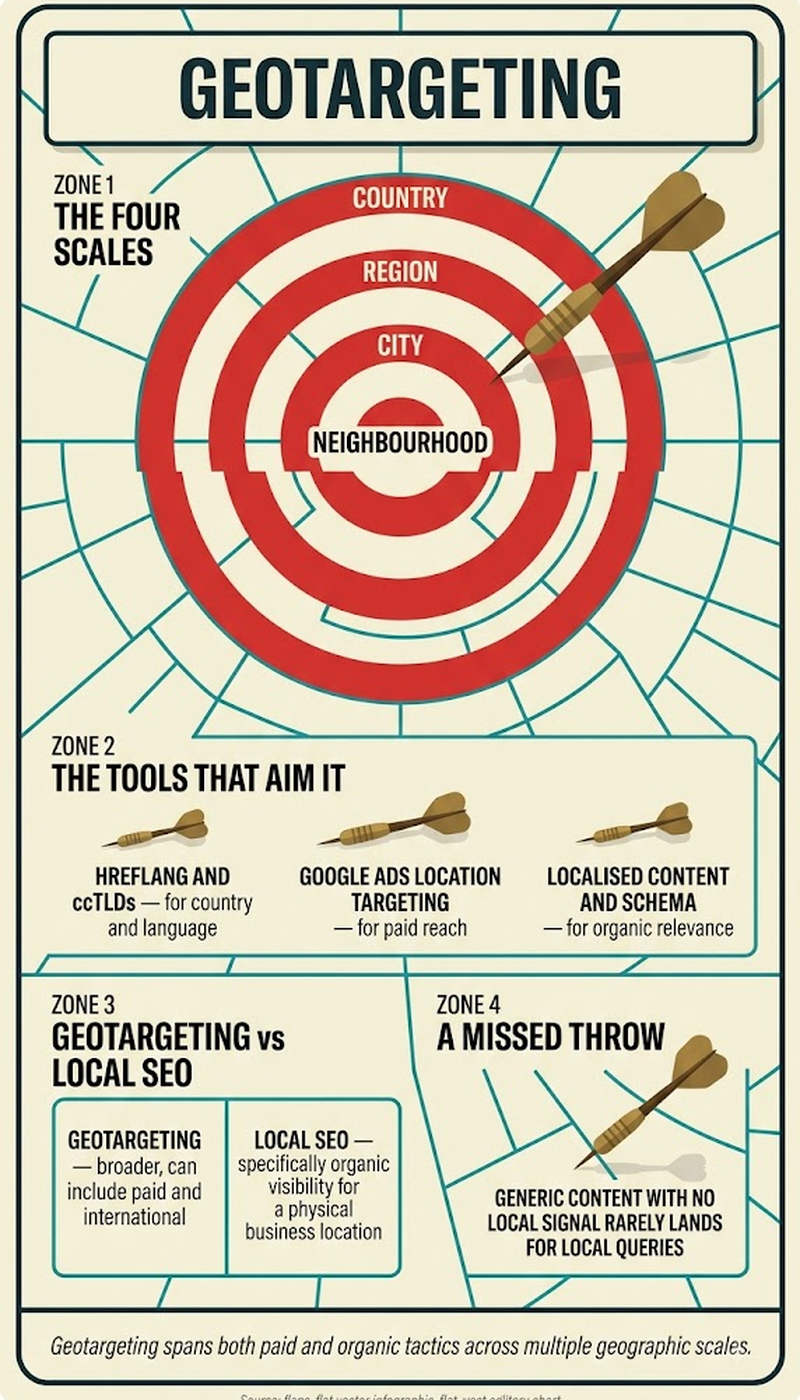
Geotargeting is the broader concept underneath the specific mechanics covered on this site's international SEO and hreflang pages — those pages go deeper on the SEO-specific implementation this page introduces at a conceptual level.
Frequently Asked Questions
Can geotargeting be based on something other than IP address or GPS, like browser language settings?
Yes — browser language settings can supplement location-based geotargeting, though they reflect a browser's configured language rather than a visitor's actual physical location, so the two signals can sometimes conflict.
Does using a VPN significantly affect geotargeting accuracy?
Yes — a VPN routes traffic through a server that can be in an entirely different location than the visitor's actual physical location, which is one of the most common causes of inaccurate IP-based geotargeting.
Is geotargeting relevant for a business that only operates in one country?
It can still matter for regional variation within a single country — different states, provinces, or cities sometimes warrant geotargeted content or campaigns even without any international component at all.
Does Google penalize sites for using automatic location-based redirects?
Google doesn't penalize the use of redirects specifically, but poorly implemented redirects that block crawlers from accessing other regional versions can significantly harm those other versions' ability to be indexed and rank at all.
Can geotargeting be implemented without any server-side technology, purely through client-side JavaScript?
Yes, technically, though client-side-only geotargeting introduces the same search-visibility risks covered on this site's client-side rendering page, since content that depends entirely on JavaScript execution to appear correctly for the right region faces indexing delay risk.
How accurate is IP-based geolocation typically, in terms of precision?
IP-based geolocation is generally reliable at the country level but becomes progressively less accurate at more granular levels (state, city), since IP-to-location databases aren't perfectly maintained or updated in real time.
Does geotargeting apply to email marketing as well as websites?
Yes — email marketing platforms often support geotargeting to send location-relevant content or offers within a broader campaign, using similar underlying location-detection logic.
Can a single page be geotargeted for multiple different regions simultaneously, or does each region need a separate page?
Best practice for SEO geotargeting generally involves separate, dedicated pages per targeted region, connected through hreflang, rather than trying to dynamically serve entirely different content to different regions from one single URL.
Does mobile app geotargeting work differently than website geotargeting?
Mobile apps typically have access to more precise GPS-based location data (with user permission), making app-based geotargeting generally more accurate than website geotargeting, which more often relies on less precise IP-based detection.
Is there a standard, universal way to test how a geotargeting setup actually behaves for different regions?
Testing typically involves using a VPN or a dedicated location-testing tool to simulate visits from different regions, combined with checking search results from those simulated locations to confirm the correct version is actually being served.


