
What Is a ccTLD?
A ccTLD (country code top-level domain) is a domain extension representing a specific country or territory — like .de for Germany, .jp for Japan, or .in for India — assigned according to the ISO 3166-1 alpha-2 country code standard. It's distinct from a gTLD (generic top-level domain) like .com or .org, which carries no inherent geographic association. ccTLDs serve two overlapping purposes. They signal a strong, explicit geographic connection to search engines and users alike. And in many cases, they're specifically restricted to registrants with a genuine connection to that country or territory.
Key Takeaways
- A ccTLD is a two-letter domain extension tied to a specific country or territory, assigned per the ISO 3166-1 alpha-2 standard — distinct from generic TLDs like .com that carry no geographic meaning.
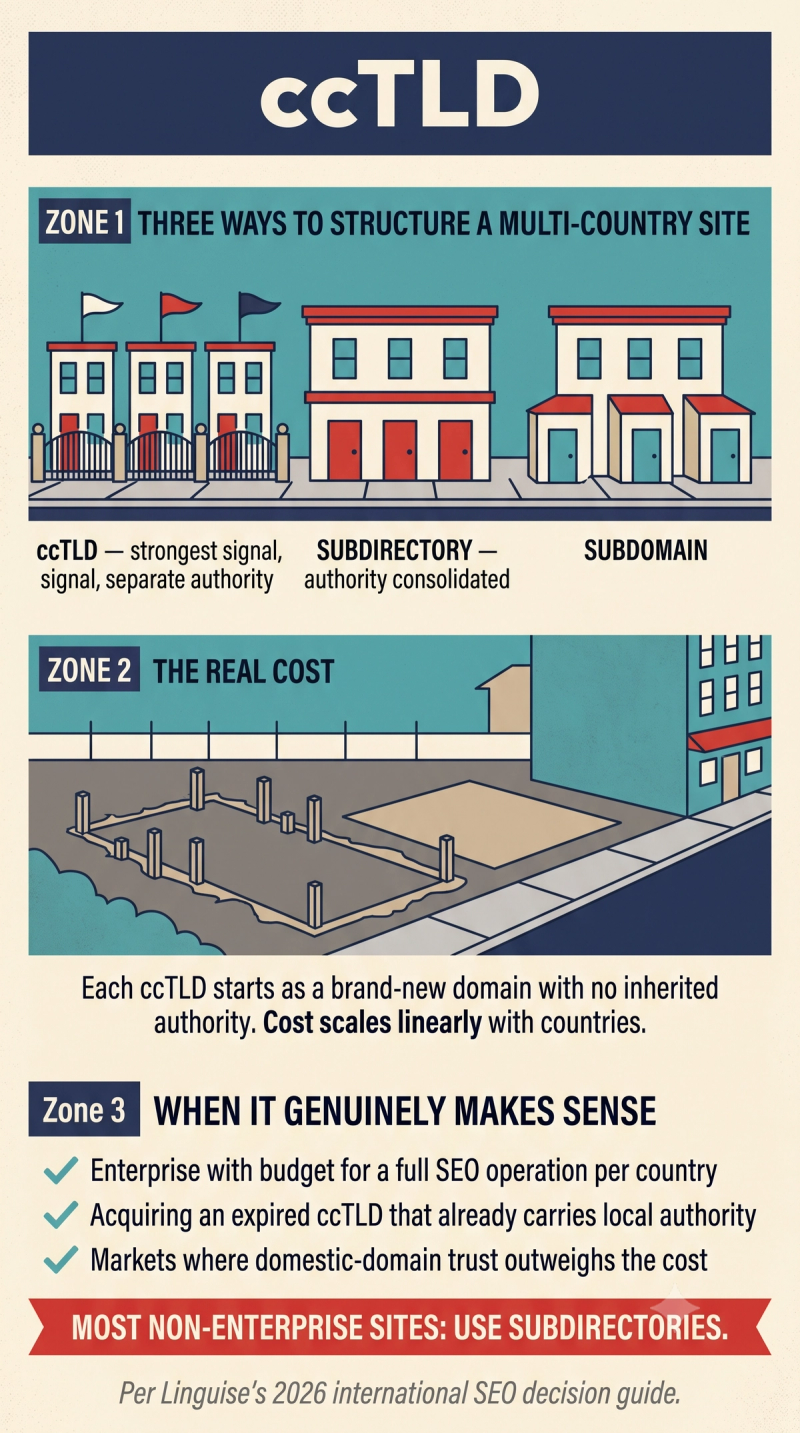
- ccTLDs send the strongest possible geographic signal to search engines, among the three common international SEO URL structures (ccTLD, subdirectory, subdomain). But they require building domain authority separately for each country-specific domain.
- Many ccTLDs have registration restrictions requiring a genuine local connection (a local business address, local citizenship, or local company registration) to that specific country or territory.
- Some ccTLDs have been adopted for purposes entirely unrelated to their original country association — .io (British Indian Ocean Territory) and .co (Colombia) are widely used by tech startups and businesses with no actual connection to those territories.
- Google generally treats a ccTLD as a strong, explicit signal that a site is specifically intended for that country's audience, which is why choosing one is a more binding, geography-specific commitment than a subdirectory or subdomain structure would be.
How Is a ccTLD Actually Different From a gTLD?
A ccTLD is tied to a specific country or territory through the ISO 3166-1 alpha-2 two-letter country code standard. A gTLD (generic top-level domain), like .com, .org, or .net, carries no inherent geographic meaning and is available for registration regardless of where the registrant is located. This distinction matters directly for SEO. Choosing a ccTLD sends search engines an explicit, strong signal that a site is intended specifically for that country's audience. A gTLD requires other signals, like hreflang tags, a subdirectory structure, or content localization, to communicate geographic targeting — since the domain extension itself doesn't convey that information on its own.
ccTLD vs. gTLD, at a glance:
- Geographic meaning — ccTLD: explicit, tied to a specific country/territory. gTLD: none inherent.
- Example — ccTLD: .de (Germany), .jp (Japan), .in (India). gTLD: .com, .org, .net.
- Registration restrictions — ccTLD: often requires local connection. gTLD: generally open to anyone.
- SEO geo-signal strength — ccTLD: strongest of the three URL structure options. gTLD: requires other signals (hreflang, content).
Why Do Some ccTLDs Get Used for Completely Unrelated Purposes?
Some ccTLDs have become popular for reasons entirely disconnected from their original country association, typically because the two-letter code happens to spell or evoke something meaningful in a different context. .io (officially the British Indian Ocean Territory) has become closely associated with technology startups, because "io" evokes "input/output." .co (Colombia's ccTLD) is widely used as a shorter alternative to .com by businesses with no actual Colombian connection. This creates a genuine practical distinction worth understanding. While these ccTLDs are still technically country-code domains, their real-world usage pattern has diverged from an actual geographic signal. Search engines' treatment of them can reflect that divergence, rather than treating every ccTLD as an equally strong, literal geographic indicator.
Does Registering a ccTLD Always Require a Genuine Local Connection?
No. Registration requirements vary significantly by ccTLD, ranging from completely open registration (anyone, anywhere can register) to strict requirements demanding a local business registration, local citizenship, or a physical local address within that specific country or territory. Germany's .de, for instance, has historically required an administrative contact within Germany. .io has no such requirement, despite being an official ccTLD — part of why it's been so widely adopted by companies with no actual connection to its associated territory. Anyone considering a ccTLD purely for its SEO geo-signal value, rather than because the business genuinely operates in that country, needs to check that specific ccTLD's actual registration requirements first. Assuming uniform rules across all ccTLDs is a common and easily avoidable mistake.
How Does Choosing a ccTLD Actually Affect International SEO Strategy?
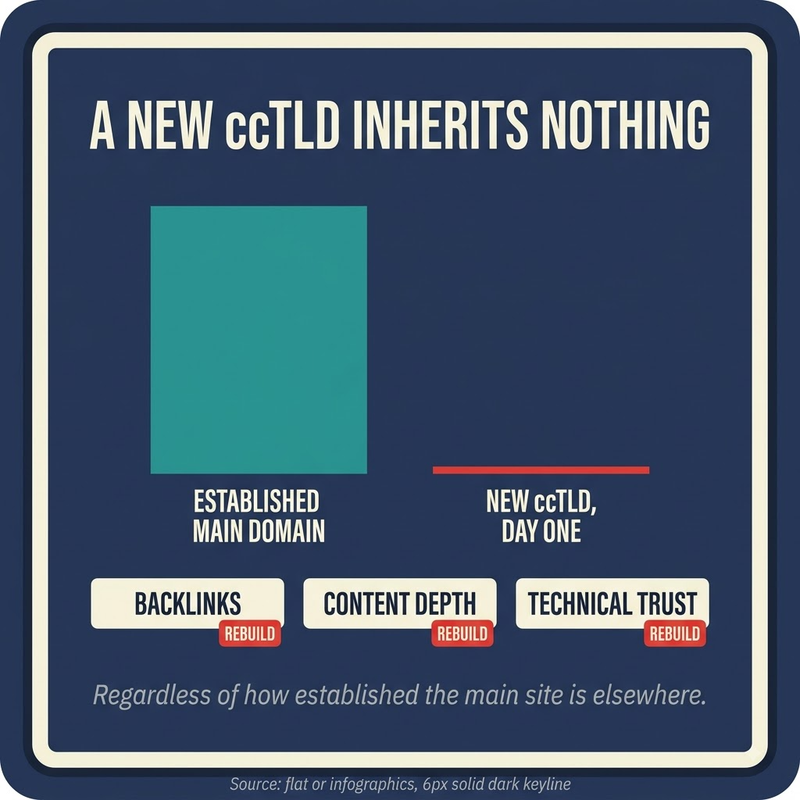
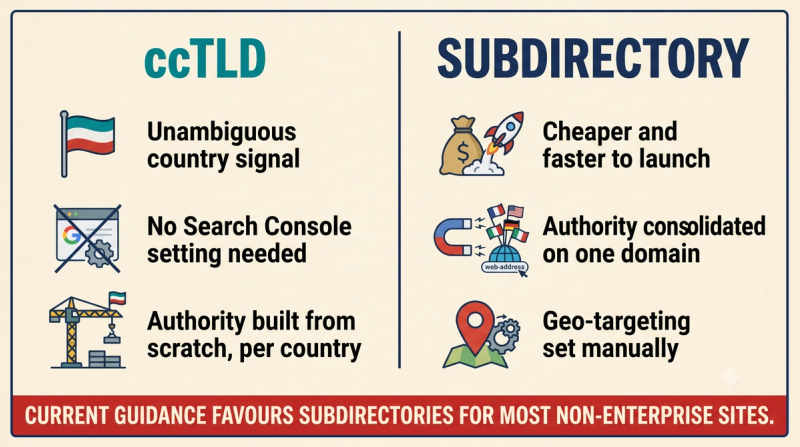
Choosing a ccTLD is one of three common URL structure approaches for international SEO, alongside subdirectories and subdomains. It carries the strongest explicit geographic signal of the three. But that comes at the cost of needing to build domain authority separately for each individual country-specific domain, rather than consolidating authority under one shared domain.
- Confirm the target ccTLD's registration requirements before committing, since some require genuine local business presence that may not be feasible for every market a business wants to target.
- Weigh the SEO benefit of a strong geographic signal against the practical cost of building separate domain authority, backlinks, and brand recognition for each country-specific ccTLD independently.
- Consider whether a subdirectory structure might achieve sufficient geographic targeting (combined with hreflang) without the administrative and authority-building overhead multiple ccTLDs require.
- If already using unrelated ccTLDs (like .io for a tech product) for branding reasons unrelated to geography, don't assume they carry the same geo-targeting SEO benefit an actual country-specific implementation would.
- Ensure hreflang tags are still correctly implemented even when using ccTLDs, since the domain signal alone doesn't fully replace the need for explicit language/region pairing across a multi-country site.
ccTLD selection is one of the three structural choices covered on this site's international SEO page, and correctly targeting a specific country via a ccTLD still typically benefits from the hreflang implementation that page covers in depth.
Frequently Asked Questions
How many ccTLDs currently exist?
There are roughly 250 ccTLDs corresponding to countries and territories recognized under the ISO 3166-1 standard, though the exact count shifts occasionally as territories or their status change.
Can a ccTLD be transferred or sold like a generic domain name?
Individual domain names registered under a ccTLD can typically be transferred between registrants, subject to that ccTLD's specific registration requirements. The ccTLD extension itself (like .de) isn't something an individual business owns or controls.
Does using a ccTLD guarantee better rankings in that specific country's search results?
Not automatically — a ccTLD sends a strong geographic signal, but content quality, relevance, and other ranking factors still determine actual ranking performance within that country's search results.
What happens to a ccTLD if the associated country or territory's political status changes?
This has happened historically — ccTLDs have been retired or reassigned following territorial or political changes. It introduces a genuine long-term risk consideration for businesses building significant investment around a specific ccTLD.
Are all ccTLDs two letters, or do some have different lengths?
All ccTLDs are exactly two letters, following the ISO 3166-1 alpha-2 standard specifically — this is what visually distinguishes them from most generic TLDs, which vary in length.
Can a single business use a ccTLD for one market and a shared gTLD subdirectory structure for other markets simultaneously?
Yes — a hybrid approach like this is common, using a ccTLD for a market with major strategic importance while using subdirectories under a shared gTLD for smaller or less prioritized markets.
Does Google treat a "misused" ccTLD (like .io for a non-territory-related tech company) as a geographic signal anyway?
Google has generally been understood to treat certain widely-repurposed ccTLDs (like .io) more like generic domains in practice, given how disconnected their actual usage pattern is from genuine geographic targeting.
Is it more expensive to register and maintain a ccTLD compared to a standard gTLD?
Costs vary significantly by specific ccTLD — some are comparably priced to standard gTLDs, while others carry premium pricing or additional administrative requirements that increase the overall cost of registration and maintenance.
Can a ccTLD be used for a subdomain-style regional structure instead of a full separate domain?
No — a ccTLD is by definition the top-level domain extension itself (like the ".de" in example.de); it can't be used as a subdomain prefix within a different top-level domain.
Does switching from a gTLD with subdirectories to a ccTLD structure require a full site migration?
Yes. Moving from a subdirectory structure to separate ccTLD domains is a significant technical migration. It requires careful redirect planning, hreflang updates, and rebuilding domain authority signals for each new ccTLD.


