
Hreflang is an HTML attribute that tells search engines which language and regional version of a page exists, so the correct version gets served to searchers based on their language and location. It's written as a language-region code pair, like en-us for US English or fr-ca for Canadian French, placed either in a page's <head>, in an XML sitemap, or in HTTP headers. A hint, not a directive — that distinction matters more than it sounds. Google treats hreflang as a strong signal about which page to serve to which audience, one correctly implemented hreflang meaningfully improves, but never guarantees outright.
Key Takeaways
- Hreflang tags use a language-region code pair (like en-gb or es-mx) to tell search engines which version of a page matches which audience.
- Every page in an hreflang set needs a self-referencing tag pointing to itself, in addition to tags pointing to every other version — a step commonly missed, since it's easy to remember outbound references and forget the self-reference.
- An x-default tag can specify a fallback page for searchers whose language or region doesn't match any specific version in the set.
- Hreflang is a hint to Google, not a guaranteed directive — a properly implemented setup dramatically improves the odds of the right version showing up, but doesn't strictly force it.
- Hreflang errors are often invisible in normal site health checks; they tend to surface only when the wrong regional or language version starts ranking in the wrong market.
Hreflang is the specific technical mechanism underneath the broader international SEO strategy this site covers separately, and correct implementation directly supports the geotargeting goals a multi-region site is trying to achieve.
How Does an Hreflang Tag Actually Work?
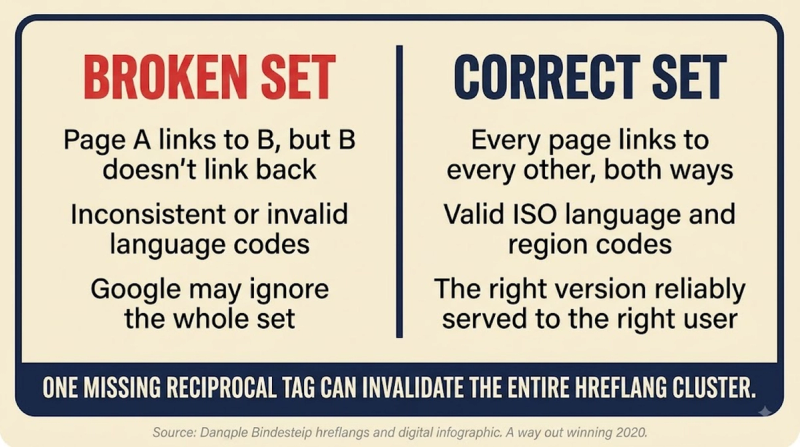
An hreflang tag pairs a language code (and optionally a region code) with a specific URL, telling search engines that URL is the appropriate version for that language/region combination — and every page in a hreflang set needs to reference every other page in that set, itself included. A typical implementation in a page's <head> looks like a series of link rel="alternate" hreflang="..." tags, one per language/region version, each pointing to the corresponding URL. Google reads these annotations across the whole set together — it's not enough for Page A to reference Page B; ideally the reciprocal reference (Page B referencing Page A) needs to exist too, since inconsistent or one-directional tagging is one of the most common sources of hreflang errors.
What Does the x-default Tag Actually Do?
The x-default tag specifies a fallback page to serve when a searcher's language or region doesn't match any of the specific versions defined in the hreflang set — commonly a language-selector page, or a default version like the site's primary English page. Without an x-default, a searcher whose language/region falls outside every explicitly tagged version has no clearly designated version to land on, and Google has to make its own judgment call about which page to serve, or whether to serve one at all. It's optional, technically, but recommended for any site with more than one or two language/region versions, since it closes a genuine gap in coverage rather than leaving it to inference.
The four elements and their common mistakes:
- Language-region pair (en-us) — identifies the specific audience for a URL. Common mistake: wrong or malformed code (e.g., en_US instead of en-us).
- Self-reference — confirms the current page's own hreflang identity. Common mistake: omitting the page's reference to itself.
- Reciprocal tagging — each page in the set references every other page. Common mistake: one-directional references (A→B but not B→A).
- x-default — fallback for unmatched language/region combinations. Common mistake: missing entirely, leaving no defined fallback.
Is Hreflang a Ranking Factor, or Just a Targeting Signal?
Hreflang isn't a ranking factor in the sense of directly boosting or lowering a page's position — it's a targeting signal that determines which version of a page Google is likely to serve to a given searcher, which is a meaningfully different function. A page can rank well and still show up incorrectly for the wrong regional audience if hreflang is missing or broken; conversely, correct hreflang doesn't make a page rank higher, it makes the right version more likely to be the one that shows up at all. This distinction matters because sites sometimes chase hreflang fixes expecting a ranking lift, when the actual, more immediate benefit is serving the correct page to the correct audience — which does affect engagement and conversion, just not through a direct ranking mechanism.
How Do You Check for and Fix Hreflang Errors?
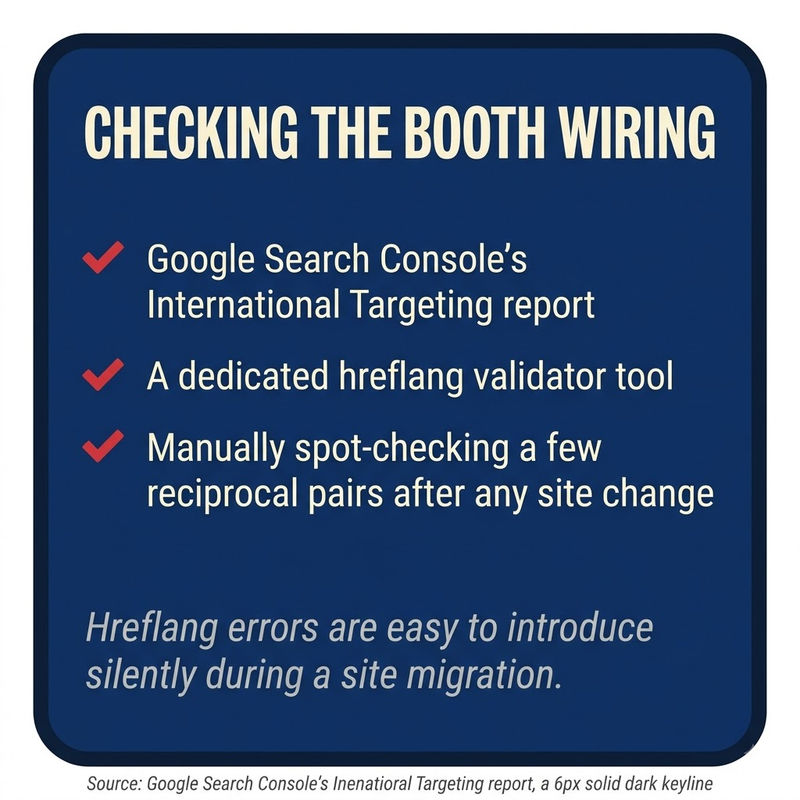
Hreflang errors tend to be invisible in routine site checks, since a broken implementation doesn't usually throw a visible error to a normal site visitor — it just quietly serves the wrong version to some searchers:
- Use a crawler that reports hreflang tag pairs directly (most major SEO crawlers support this) to export every tag and check for missing self-references or broken reciprocal links.
- Check Google Search Console's International Targeting report where available, though it doesn't surface every hreflang issue centrally, so it should be treated as one input rather than a complete audit.
- Validate language and region codes against the correct ISO standards — a malformed code like an underscore instead of a hyphen invalidates the tag entirely.
- Test by searching from different simulated locations or using a location-specific rank checker to see which version actually surfaces for each target audience.
- Confirm hreflang tags aren't contradicting canonical tags — a canonical pointing all versions back to one "main" page while hreflang tries to distinguish them separately sends Google conflicting signals.
Frequently Asked Questions
Can hreflang be implemented through an XML sitemap instead of HTML tags?
Yes — hreflang annotations can be placed in an XML sitemap as an alternative to in-page HTML tags, which is often more practical for very large sites with many language/region versions.
Does hreflang work for content within a single language but different regions (like US vs. UK English)?
Yes — hreflang supports region-only distinctions within the same language, which is exactly the scenario for serving different pricing, spelling, or region-specific content to US versus UK English speakers.
What happens if two different pages both have identical hreflang tags pointing to the same language/region?
This creates a conflict Google has to resolve on its own, since it isn't clear which page is actually meant to serve that audience — this typically results in an hreflang error and unpredictable page selection.
Does hreflang need to be redone after a site migration or URL structure change?
Yes — every URL referenced in an hreflang set needs to be updated to match new URLs after a migration, since outdated hreflang references pointing to old, redirected, or removed URLs will generate errors.
Can hreflang be combined with a canonical tag on the same page without conflict?
Yes, when implemented correctly — each page's canonical tag should generally point to itself (self-canonical) within an hreflang set, rather than pointing to a different language version, which would undermine the hreflang signal.
Is there a limit to how many language/region versions a single hreflang set can include?
There's no strict published limit, though very large sets can become harder to maintain accurately, and errors compound faster as the number of reciprocal reference pairs grows.
Does hreflang help with duplicate content issues between similar language versions?
Yes — properly implemented hreflang tells Google these are intentionally similar, region-targeted versions rather than accidental duplicates, which helps avoid the wrong version being suppressed as duplicate content.
Can a hreflang checker tool catch every possible implementation error?
Most hreflang checker tools catch common structural errors (missing self-reference, broken reciprocal links, invalid codes) reliably, but they can't always confirm that Google is actually respecting the signal in live search results, which requires separate manual verification.
Does WordPress require a plugin to implement hreflang correctly?
Native WordPress doesn't include built-in hreflang support, so most WordPress sites rely on an SEO or multilingual plugin to generate and manage the tags correctly.
Is hreflang relevant for AI-powered search features, or only traditional Google search results?
AI-generated search features still draw from the same underlying indexed content and language/region signals, so a correct hreflang setup continues to support serving the right version even as AI search surfaces grow.
Can incorrect hreflang cause a page to be removed from search results entirely?
Incorrect hreflang doesn't typically cause outright removal from search results — the more common effect is the wrong regional version surfacing for a given audience, rather than the page disappearing entirely.


