
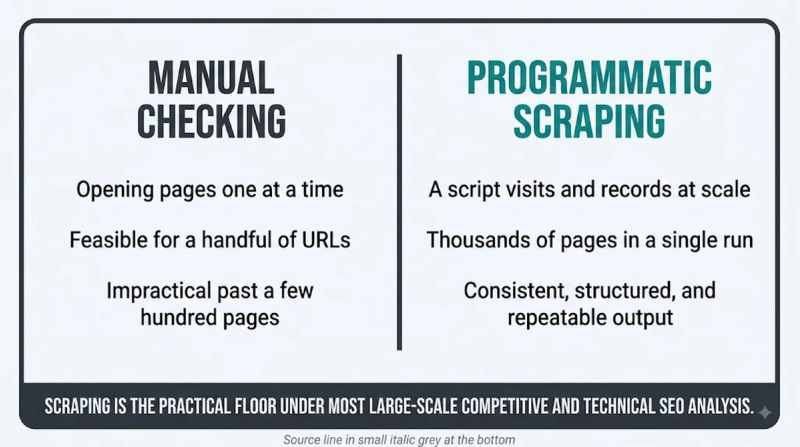
Web scraping for SEO is the automated extraction of data — rankings, competitor content, backlink profiles, SERP features, pricing, structured page data — from websites or search results, using scripts or dedicated tools instead of manual collection. SEO teams lean on it to power rank tracking, competitor content audits, technical site audits, and SERP feature analysis at a volume manual research simply can't match. It sits in a legal and technical gray zone that's shifted substantially in 2025-2026. Mostly because AI companies started scraping content for training and real-time answer generation, and the rest of the web pushed back.
Key Takeaways
- Scraping publicly available, non-personal data is generally legal in the US and most of Europe, but the surrounding legal landscape shifted meaningfully in 2025-2026 — this is general information, not legal advice for a specific project.
- robots.txt is a voluntary protocol, not a legal access control; a 2025 US court ruling (Ziff Davis v. OpenAI) found it isn't binding under the DMCA, while EU regulators still treat ignoring it as evidence of bad faith under GDPR.
- Cloudflare now blocks many declared AI crawlers by default and offers a Pay-Per-Crawl model (using an HTTP 402 "Payment Required" response) that lets publishers charge for automated access.
- llms.txt — a proposed alternative to robots.txt for signaling AI-specific crawl permissions — has not been adopted in production by major AI companies as of 2026, despite growing SEO-community interest.
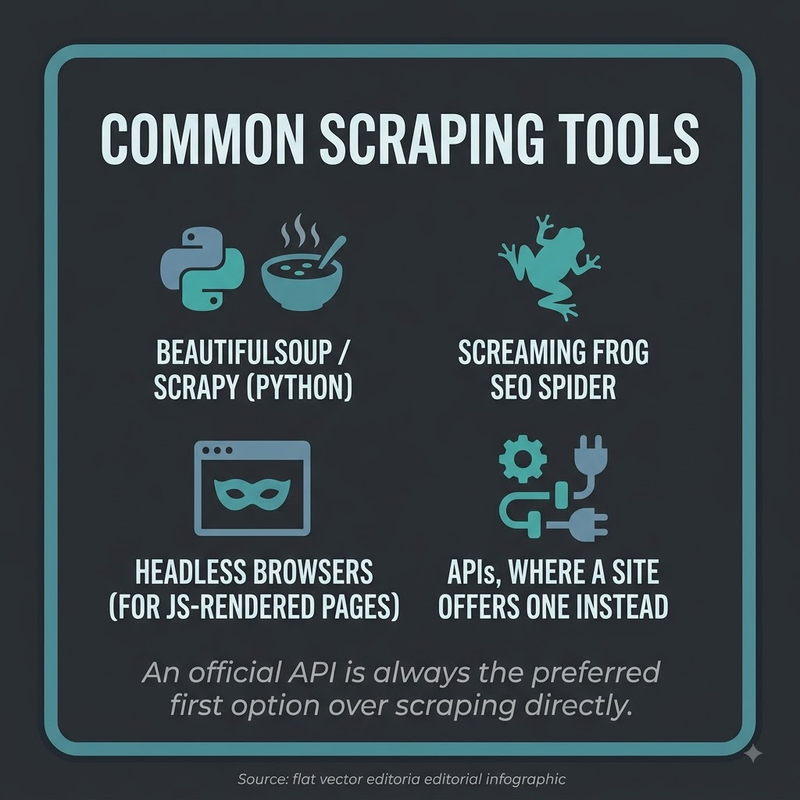
- For SEO-specific scraping (SERP tracking, competitor audits), most practitioners use commercial APIs (DataForSEO, SERPAPI-style services) rather than building raw scrapers, since these handle rate-limiting, proxy rotation, and ToS compliance already.
For sites running technical SEO audits at scale, scraped data typically feeds directly into crawl budget analysis and keyword research workflows, since both depend on collecting the same kind of large-scale page and SERP data.
Which SEO Tasks Actually Rely on Web Scraping?
Rank tracking, competitor content audits, backlink profile analysis, and SERP feature monitoring are the four SEO tasks most commonly built on scraping infrastructure, whether or not the practitioner running them is writing raw scraper code themselves. Rank tracking tools scrape search results pages repeatedly to record where a target URL appears for a given keyword over time. Content audit tools scrape competitor pages to extract word counts, header structures, and schema markup at scale. Backlink tools like Ahrefs and Semrush maintain enormous scraping infrastructure that continuously crawls the open web to discover and index link relationships. Most SEO professionals interact with scraped data through these commercial tools rather than running scrapers directly — but understanding what's happening underneath explains both the value and the limitations of that data.
Is Web Scraping for SEO Actually Legal?
Scraping publicly available, non-personal web data is generally legal in the US and most of Europe as of 2026, but that legality depends heavily on what's scraped, how it's accessed, and what happens to the data afterward — this is a general legal landscape summary, not legal advice for any specific situation. US courts have repeatedly found that scraping public pages doesn't violate anti-hacking statutes like the Computer Fraud and Abuse Act, and a 2025 ruling in Ziff Davis v. OpenAI specifically found that robots.txt isn't a legally binding technical access control under the DMCA. The picture shifts once personal data or copyrighted content enters the mix, or once a login wall or CAPTCHA is bypassed to reach it — those moves cross from a gray area into much higher legal risk.
Risk factors at a glance:
- Access method — Lower risk: public pages, no login required. Higher risk: bypassing login/CAPTCHA.
- Data type — Lower risk: prices, facts, public specs. Higher risk: personal data, copyrighted text.
- Request pattern — Lower risk: rate-limited, human-like timing. Higher risk: high-frequency, bulk simultaneous requests.
- robots.txt — Lower risk: honored. Higher risk: deliberately ignored.
- Downstream use — Lower risk: internal analysis. Higher risk: resale or republishing as-is.
Does Ignoring robots.txt Get You Sued?
Not automatically, no. Ignoring robots.txt doesn't create US legal liability on its own, but it can weaken your position if a dispute does land in court, and EU regulators read it very differently than US courts do. robots.txt is a voluntary signal, not a statute — a 2025 US ruling found it isn't a binding DMCA access control, meaning ignoring it alone isn't the violation some practitioners still assume it is. The EU tells a different story: a July 2026 European Data Protection Board guideline update treats robots.txt non-compliance as evidence of bad faith that can weaken a company's legitimate-interest defense under GDPR. So the actual risk here isn't one answer — it depends entirely on which jurisdiction's regulators or courts end up looking.
How Has AI Changed the Scraping Landscape in 2026?
AI companies scraping content for model training and real-time answer generation have triggered a wave of new blocking infrastructure that didn't exist a few years ago, shifting enforcement from the honor-system robots.txt file to network-layer controls. Cloudflare now blocks many declared AI crawlers by default and runs a Pay-Per-Crawl system, using the HTTP 402 "Payment Required" status code to let publishers charge AI companies for access rather than blocking them outright. Millions of sites now explicitly disallow AI training crawlers in their robots.txt files — though a meaningful share of AI traffic reportedly ignores that signal entirely, which is precisely why the enforcement is moving to firewalls (WAF rules) and IP/user-agent blocking instead of a text file nobody's required to obey.
llms.txt gets talked about constantly in SEO circles. It's a proposed markdown alternative meant to describe a site's content for AI systems. The problem: almost none of the AI companies it's meant to inform were actually reading it in production as of early 2026. Interesting idea, thin adoption — that gap matters more than the spec itself right now. The practical lesson for anyone running a content site: robots.txt is still the baseline signal worth setting correctly, but it's one layer in a stack that now includes CDN-level bot management and, increasingly, commercial licensing terms nobody was negotiating three years ago.
What Are the Practical Rules for Scraping Responsibly?
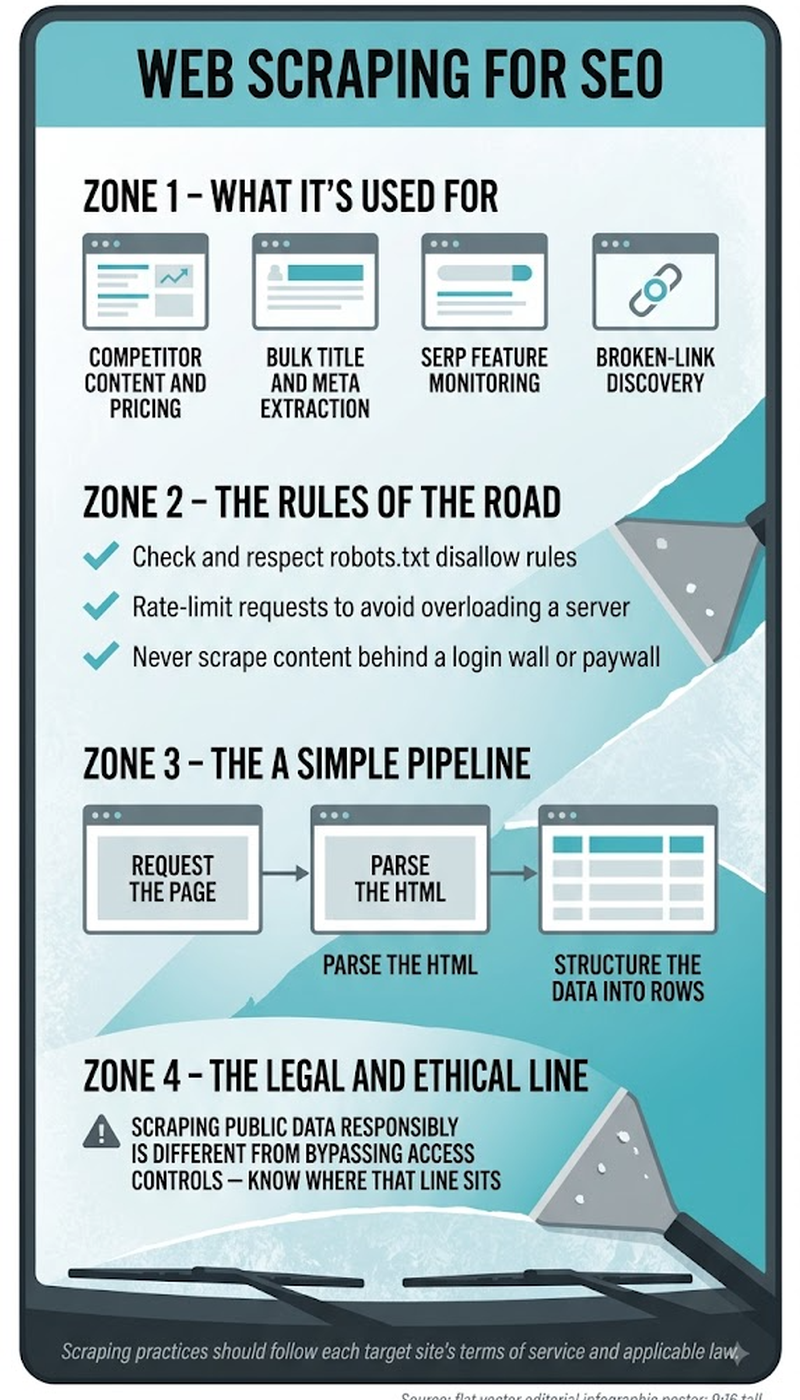
Following a few consistent practices keeps scraping activity in the lower-risk category and avoids degrading the sites being scraped:
- Check and honor robots.txt for every path touched, even though it's not legally binding — it's the clearest signal of a site owner's intent and matters for good-faith arguments in disputes.
- Rate-limit requests to mimic human browsing patterns rather than firing rapid, simultaneous requests that can trigger blocking or strain the target server.
- Avoid collecting personal data (names tied to identifiable individuals, emails, private profile data) without a documented lawful basis, especially for any project touching EU users.
- Use unauthenticated, publicly visible pages only — bypassing a login wall or CAPTCHA moves a project into meaningfully higher legal risk regardless of jurisdiction.
- Read the target site's Terms of Service before scraping at scale; violating ToS isn't automatically illegal on its own, but it can strengthen a legal claim against the scraper if a dispute develops.
- For SEO-specific data (rankings, SERP features, keyword volume), default to a commercial API rather than building a raw scraper — it's usually faster, more reliable, and already handles the compliance groundwork.
Frequently Asked Questions
Can scraping a competitor's pricing page for competitive intelligence get a business sued?
Scraping publicly visible pricing pages with no login and no personal data collected is among the lowest-risk scraping use cases, with no widely documented federal enforcement actions against it in the US.
Does using a residential proxy for scraping change its legal status?
Using a proxy doesn't change the legal status of what's being scraped — it primarily affects whether the scraping is detected and blocked, not whether the underlying activity is lawful.
Is scraping Google's own search results pages against Google's Terms of Service?
Google's Terms of Service do restrict automated querying of its search results, which is why most rank-tracking tools rely on licensed data partnerships or dedicated SERP APIs rather than direct scraping of google.com.
What's the difference between a scraper and a crawler in SEO tooling?
A crawler systematically follows links to discover pages across a site or the web, while a scraper extracts specific structured data from pages it's pointed at — most SEO tools combine both functions.
Can scraped competitor content be legally republished on your own site?
Republishing another site's actual content, rather than extracting factual data points from it, raises copyright concerns distinct from the access-legality question and generally requires separate permission.
Does GDPR apply to scraping if the business doing the scraping isn't based in the EU?
GDPR can still apply if the scraped data includes personal information about EU residents, regardless of where the company doing the scraping is headquartered.
How does Cloudflare's Pay-Per-Crawl system actually work technically?
It uses the HTTP 402 "Payment Required" status code to signal that a crawler must complete a payment transaction before Cloudflare will serve the requested content.
Do search engines like Google scrape sites differently than commercial SEO tools do?
Google's own crawler (Googlebot) operates under different rules than third-party tools since site owners implicitly grant it access by wanting to be indexed; third-party SEO scrapers have no such implicit permission and rely on robots.txt and ToS as their only guidance.
Can a website legally block all scraping entirely, including SEO tools?
A site can technically block scraping via robots.txt, IP blocking, or CAPTCHAs, though doing so also blocks legitimate SEO monitoring tools and can make it harder to track the site's own search visibility.
Does the 2025 Ziff Davis v. OpenAI ruling apply outside the US?
No — it's a US court decision interpreting US law (the DMCA); it has no direct legal force in the EU or other jurisdictions, which continue to apply their own frameworks.
Is it worth building a custom scraper versus paying for a commercial SEO data API?
For most SEO teams, a commercial API is more cost-effective once proxy infrastructure, rate-limit handling, and ongoing maintenance are factored in — custom scrapers typically only make sense for highly specific, ongoing data needs no existing tool covers.


