
Keyword research is the process of discovering, analyzing, and prioritizing the specific words and phrases people actually type into search engines when looking for information, products, or answers related to a topic — using that data to guide what content gets created and how it's structured. It's the foundational research step underneath nearly every other SEO discipline. Content strategy, on-page optimization, even understanding how people phrase questions to AI search assistants — all of it traces back to genuinely understanding real search demand and intent, rather than guessing at what an audience wants based on internal assumptions.
Key Takeaways
- Keyword research combines three core data points for any given term — search volume (how often it's searched), competition (how hard it is to rank for), and intent (what the searcher actually wants) — and all three matter more together than any one alone.
- High search volume doesn't automatically mean a keyword is worth targeting — a high-volume term with unclear intent or brutal competition can be a worse target than a lower-volume term with obvious commercial intent and less competition.
- Search intent generally falls into four categories — informational, navigational, commercial, and transactional — and mismatching content type to intent is one of the most common keyword research mistakes.
- Long-tail keywords (longer, more specific phrases) typically carry lower individual volume but clearer intent and less competition than short "head" terms, making them frequently more efficient targets, especially for newer or smaller sites.
- Keyword research increasingly extends beyond traditional search-box queries to cover how people phrase questions to AI assistants — a related but distinct research process covered on this site's dedicated prompt journey mapping page.
Long-tail keyword covers the specific strategic value of targeting longer, lower-competition phrases this page's competition-versus-volume discussion connects to directly. Search intent goes deeper on the intent-matching concept this page introduces at a summary level.
What Are the Actual Core Data Points Behind Keyword Research?
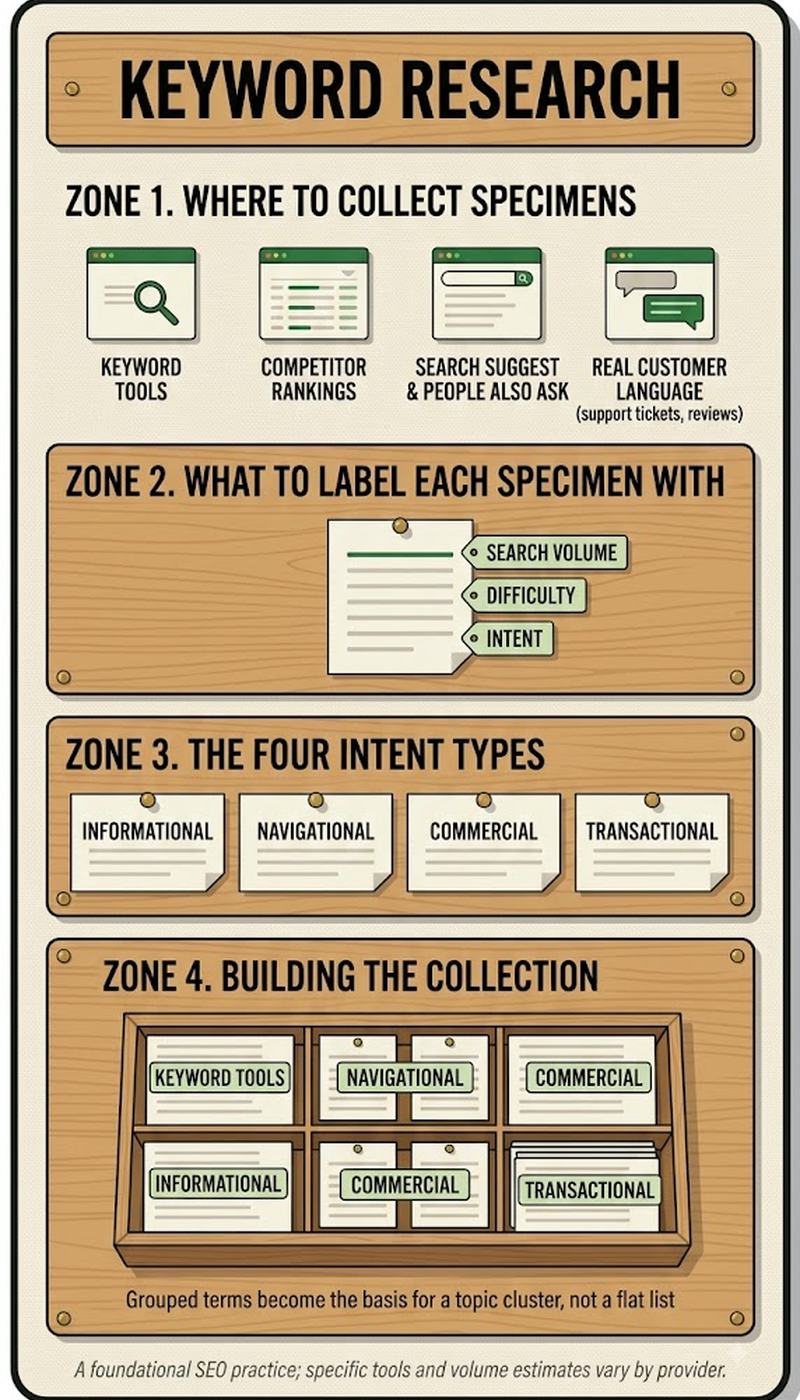
Search volume, competition, and intent are the three data points that actually matter for keyword research, and evaluating them together — rather than fixating on volume alone — is what separates effective targeting from simply chasing the biggest number a keyword tool reports. Search volume shows how often a term is searched, typically averaged monthly, but says nothing about whether ranking for it would actually benefit the business. Competition reflects how difficult ranking for that term realistically is, based on the authority and content quality of pages already ranking. Intent — what the searcher actually wants when they type that phrase — is often the most overlooked of the three, and getting it wrong (targeting an informational keyword with a sales page, for example) can mean a page technically ranks but never converts.
The three data points:
- Search volume — shows how often the term is searched. Common mistake: chasing high volume regardless of relevance.
- Competition — shows how hard ranking realistically is. Common mistake: ignoring competition, targeting terms out of reach.
- Intent — shows what the searcher actually wants. Common mistake: mismatching content type to what intent requires.
How Do the Four Types of Search Intent Actually Shape Keyword Targeting?
Search intent generally sorts into four categories — informational (seeking knowledge), navigational (looking for a specific site or page), commercial (researching before a purchase decision), and transactional (ready to complete an action like buying) — and the type of content a page offers needs to genuinely match the intent behind the keyword it's targeting, or the page will struggle to satisfy searchers regardless of how well it ranks. A keyword like "what is keyword research" carries clear informational intent — a searcher wants an explanation, not a product pitch. "Best keyword research tools" leans commercial — someone comparing options before choosing one. "Keyword research tool" (without "best" or "free") could split between commercial and transactional, depending on how close the searcher already is to a decision. Misreading this — building a hard-sell landing page for a clearly informational query, for instance — tends to produce a page that ranks poorly or converts poorly even if it does rank, since it doesn't actually satisfy what the searcher came looking for.
Does Higher Search Volume Always Mean a Keyword Is a Better Target?
No — a keyword's raw search volume says nothing on its own about whether that traffic would actually be valuable, and chasing volume without considering intent and competition is one of the most common keyword research mistakes, especially for newer or resource-constrained sites. A high-volume term with ambiguous intent (multiple very different things a searcher could mean by it) or dominated by established, high-authority competitors can be a genuinely worse target than a lower-volume term with obvious, specific intent and realistic competition. This is exactly the logic behind long-tail keyword strategy — accepting individually smaller search volume in exchange for clearer intent and a more realistic path to actually ranking and converting.
How Do You Actually Conduct Keyword Research From Scratch?
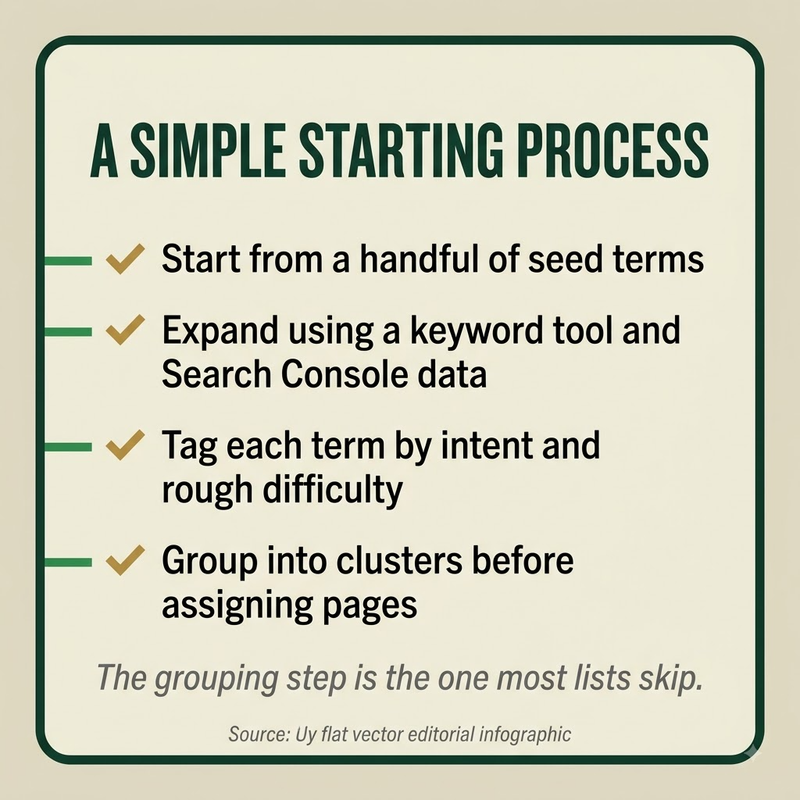
A structured keyword research process moves from broad discovery to prioritized, actionable targets rather than jumping straight to content creation:
- Start with a small set of seed terms directly relevant to the topic or business, then use a keyword research tool to discover related variations, questions, and long-tail phrases branching from those seeds.
- Pull search volume, competition, and any available intent signals for the full expanded list, rather than relying on the seed terms' data alone.
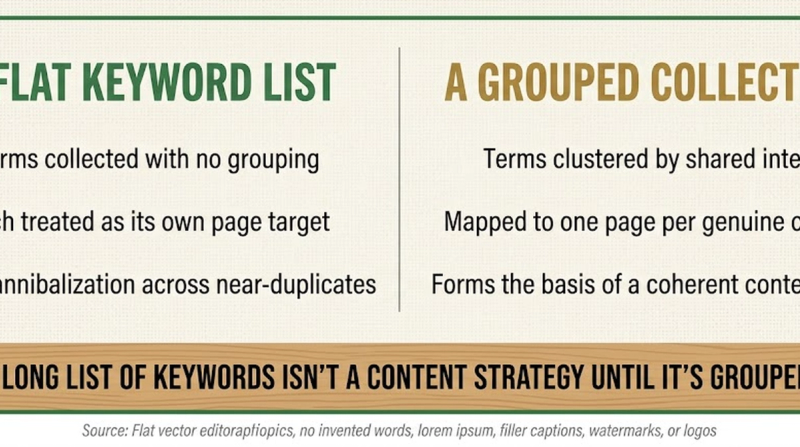
- Group related keywords into topic clusters rather than treating each one as an isolated, standalone target — this reveals which broader topics have genuine depth worth building comprehensive content around.
- Prioritize targets by weighing volume against competition and realistic ranking potential, rather than defaulting to the highest-volume terms regardless of difficulty.
- Map each prioritized keyword or cluster to a specific content type that actually matches its underlying intent, confirming the planned content will satisfy what searchers are actually looking for.
Does Keyword Research Still Matter the Same Way for AI-Search Visibility?
Traditional keyword research remains foundational, but AI-search visibility adds a related, distinct layer — understanding how people phrase actual conversational prompts to AI assistants, which often differs meaningfully from how they type traditional search-box queries. This site covers that specific extension in depth on its dedicated prompt journey mapping page — the short version is that AI prompts tend toward longer, more natural, more specific phrasing than traditional keywords, which overlaps significantly with long-tail keyword thinking but isn't identical to it. Traditional keyword research and AI-prompt research increasingly work best as complementary processes rather than one fully replacing the other.
Frequently Asked Questions
How often should keyword research be redone for an established site?
There's no fixed universal schedule, though periodic review (at least annually, more often for fast-changing industries) helps catch shifting search behavior and new opportunities that weren't relevant during the original research.
Do free keyword research tools provide accurate enough data, or is a paid tool necessary?
Free tools can provide directionally useful data for many purposes, though paid tools generally offer more comprehensive competitive and historical data — the right choice depends on the scale and precision a specific project actually needs.
Can keyword research be done without any specialized tool at all?
To a limited extent — Google's autocomplete suggestions, "People Also Ask" sections, and related searches all provide genuine keyword insight without a dedicated tool, though this approach doesn't provide volume or competition data the way a dedicated tool does.
Does keyword research differ meaningfully between B2B and B2C businesses?
Yes — B2B keyword research often deals with lower search volumes and more specialized, technical terminology, while B2C keyword research more frequently involves higher-volume, broader consumer language.
Should keyword research be done before or after deciding on content topics?
Keyword research should generally inform topic selection rather than follow it, since starting with assumed topics and only checking keywords afterward risks missing genuine search demand or misreading actual searcher language.
Can two very similarly worded keywords actually have completely different search intent?
Yes — subtle wording differences (adding "best," "how to," "buy," or "vs") can signal meaningfully different intent even when the core topic looks nearly identical, which is why intent analysis needs to go beyond just the base term.
Does keyword difficulty (as reported by SEO tools) perfectly predict how hard ranking will actually be?
No — keyword difficulty scores are useful estimates based on competitor authority signals, but they don't account for factors like a specific site's existing authority in that topic area or recent SERP changes, so they should inform rather than fully determine targeting decisions.
Is it worth targeting a keyword with zero measured search volume?
Sometimes — genuinely emerging topics or niche terms can show zero or near-zero volume in keyword tools while still representing real, growing demand not yet reflected in historical search data, though this should be a deliberate strategic bet rather than the default approach.
How does seasonal search behavior affect keyword research?
Seasonal keywords show volume that fluctuates predictably across the year, so relying on a single point-in-time volume check can significantly misrepresent a term's actual year-round or peak-season demand.
Can competitor keyword analysis reveal opportunities a standalone keyword tool might miss?
Yes — reviewing which keywords competitors already rank well for can surface genuinely relevant terms that wouldn't necessarily surface through generic seed-term expansion alone.
Does keyword research apply differently to video content (like YouTube) than to written web content?
Yes — video platforms have their own distinct search behavior and ranking factors, meaning keyword research for video content generally requires platform-specific tools and consideration rather than directly applying web-search keyword data.


