
A long-tail keyword is a longer, more specific search phrase — typically three or more words — that has lower individual search volume than a short, generic "head" term but usually carries clearer intent and less ranking competition. "Shoes" is a head term: broad, high-volume, brutally competitive. "Best waterproof hiking shoes for wide feet" is long-tail: far fewer total searches, but whoever's typing it knows almost exactly what they want. That specificity is the entire value proposition — long-tail traffic converts better precisely because it's self-selecting.
Key Takeaways
- Long-tail keywords are longer, more specific phrases with lower individual search volume but typically clearer intent and less competition than short "head" terms.
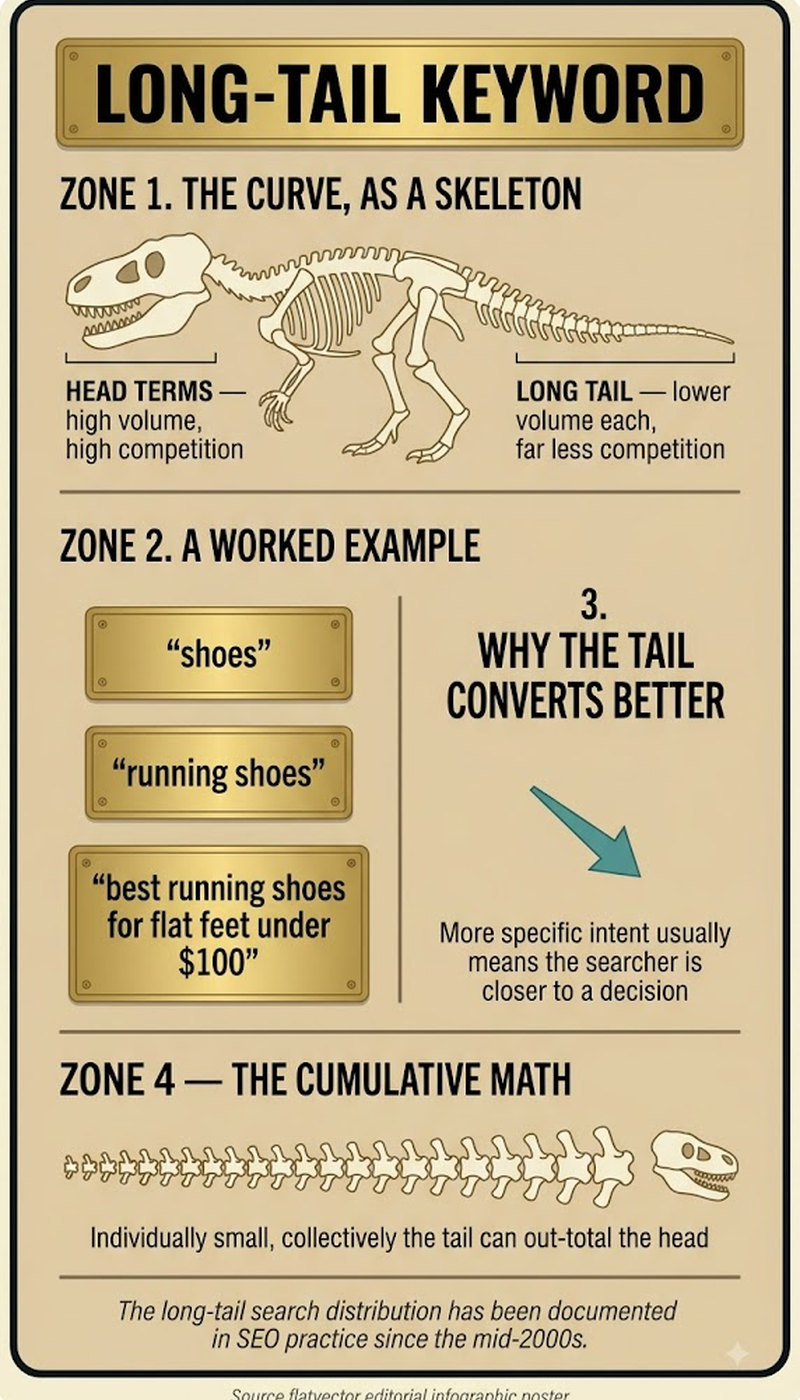
- The "tail" in long-tail refers to the shape of a search-demand curve — a small number of high-volume head terms, followed by a very long tail of thousands of lower-volume, highly specific variations.
- Long-tail keywords often convert better than head terms precisely because the specificity itself signals a more defined intent — someone searching a 6-word phrase usually knows more precisely what they want than someone searching a single generic word.
- Ranking for a handful of well-chosen long-tail terms is frequently more achievable for smaller or newer sites than competing directly for high-volume head terms dominated by established competitors.
- Long-tail phrasing maps more naturally to how people type conversational queries into AI search assistants, which makes long-tail keyword thinking increasingly relevant to AI-search visibility, not just traditional SEO.
Keyword research is the broader discipline long-tail targeting sits within, and search intent is the concept that explains why long-tail specificity tends to convert better — the phrase itself reveals more about what the searcher actually wants.
Why Is It Called "Long-Tail" in the First Place?
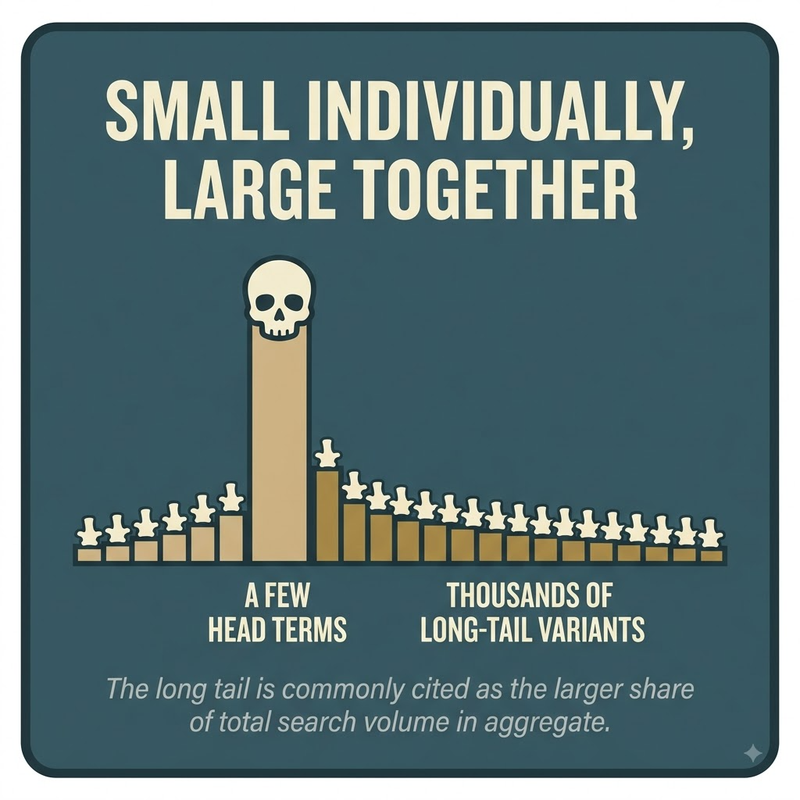
The term comes from the shape of a search-demand curve when plotted by volume: a small number of short, generic "head" terms account for enormous search volume individually, followed by an extremely long tail of thousands upon thousands of more specific phrases, each searched relatively rarely on its own. Picture the curve — a steep spike on the left for head terms, then a long, flattening line stretching far to the right representing every specific variation someone might type. Individually, each long-tail term looks negligible. Collectively, that long tail often represents more total search volume than the head terms do, just spread across far more distinct phrases.
How Do Long-Tail Keywords Actually Differ From Short-Tail Terms?
Comparing the two:
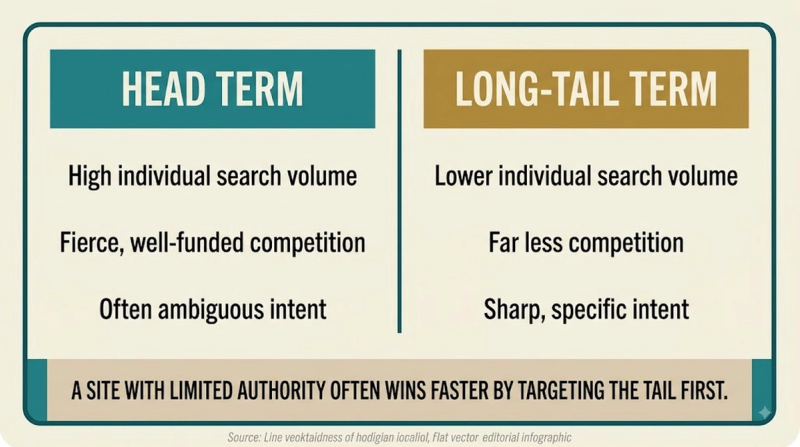
- Length — Short-tail: 1-2 words. Long-tail: 3+ words, often a full phrase.
- Search volume — Short-tail: high per term. Long-tail: low per term, but many terms.
- Competition — Short-tail: very high. Long-tail: generally lower.
- Intent clarity — Short-tail: broad, ambiguous. Long-tail: specific, well-defined.
- Conversion rate — Short-tail: typically lower. Long-tail: typically higher.
A search for "shoes" could mean almost anything — buying, browsing, researching a brand, checking sizing charts. A search for "best waterproof hiking shoes for wide feet under $150" leaves very little ambiguity about what the searcher actually wants and where they are in their decision process. That clarity is exactly why long-tail traffic tends to convert at a higher rate: the keyword itself has already done a chunk of the qualifying work before the visitor even lands on the page.
Does Chasing Long-Tail Keywords Actually Make Sense for a Smaller Site?
Yes, generally — competing directly for high-volume head terms against established, high-authority competitors is often unrealistic for smaller or newer sites, while a strategy built around a large set of well-chosen long-tail terms can accumulate meaningful traffic with a fraction of the competition. This isn't a consolation-prize strategy; it's frequently the more efficient path even for larger sites, since long-tail content tends to convert better per visitor even when it draws fewer total visitors. The tradeoff is volume of effort: ranking for one head term might require enormous authority-building, while ranking for a hundred long-tail terms requires enough distinct, well-targeted content to cover each one — a different kind of work, not necessarily less work overall.
How Do You Actually Find Good Long-Tail Keywords to Target?
Long-tail keyword research draws on a mix of tools and direct observation, and the most useful sources are often the ones that reflect actual phrasing rather than generic keyword-tool suggestions:
- Check "People Also Ask" and related-search sections in Google's own results for a head term — these frequently surface the exact long-tail phrasing real searchers use.
- Use autocomplete suggestions by typing a head term into Google's search box and noting what it suggests completing the phrase with.
- Mine site search data, if available, for the exact phrases visitors type when searching within a site — this reflects genuine intent rather than inferred keyword-tool estimates.
- Use a dedicated keyword research tool to pull long-tail variations and their approximate volume, cross-referencing against competition level to prioritize accessible opportunities.
- Review customer support tickets, sales call transcripts, or community forum questions in the relevant space — these often contain the exact specific phrasing a keyword tool alone wouldn't surface.
Do Long-Tail Keywords Matter for AI Search, Not Just Traditional Google Results?
Yes, arguably more so — conversational queries typed or spoken into AI assistants tend to be naturally longer and more specific than traditional search-box queries, which means long-tail keyword thinking maps closely onto how people actually phrase questions to AI systems. Someone querying an AI assistant is far more likely to ask "what's the best budget laptop for video editing under two hours of battery drain" than to type a bare two-word head term the way they might into a traditional search box. Content built around genuinely specific, long-tail-style questions and answers is, in effect, already structured for the kind of query phrasing AI search increasingly rewards.
Frequently Asked Questions
Is there an exact word-count threshold that defines a keyword as "long-tail"?
No fixed threshold exists — three or more words is a common informal guideline, but the more meaningful defining characteristic is lower individual search volume combined with higher specificity, not word count alone.
Can a two-word phrase ever be considered long-tail?
Rarely, but yes, if it's specific and low-volume enough relative to a broader head term in the same space — word count is a rough proxy for long-tail status, not a strict rule.
Do long-tail keywords require less content depth than head-term content?
Not necessarily — a long-tail page still needs to thoroughly answer the specific question it targets; "long-tail" describes the keyword's specificity and volume, not a license for thinner content.
How many long-tail keywords should a single page realistically target?
A single page can naturally rank for many related long-tail variations if it comprehensively covers a topic, rather than needing a separate page built for each individual long-tail phrase.
Does targeting long-tail keywords mean ignoring head terms entirely?
No — a well-rounded strategy typically includes both, using head terms for broad topical authority and awareness, and long-tail terms for capturing specific, high-intent traffic more efficiently.
Are long-tail keywords more or less affected by algorithm updates than head terms?
There's no universal rule, though long-tail rankings for smaller sites can sometimes be more volatile since they often depend more heavily on specific content matches rather than broad domain authority that tends to buffer larger sites.
Can voice search be considered a long-tail keyword phenomenon?
Voice queries do tend to be longer and more conversational than typed searches, which overlaps significantly with long-tail keyword patterns, though voice search and long-tail keywords aren't strictly the same concept.
Does long-tail keyword volume ever get large enough to rival head-term volume?
Individually, rarely — but the aggregate volume across all long-tail variations for a topic frequently exceeds the head term's volume, even though no single long-tail phrase comes close on its own.
Is keyword difficulty always lower for long-tail terms than for head terms?
Generally yes, but not universally — a highly specific long-tail term in a competitive commercial niche (like a specific product comparison) can still carry meaningful competition despite its lower volume.
Do e-commerce sites benefit more from long-tail strategy than content/blog sites?
Both benefit, though e-commerce sites often see the conversion advantage more directly, since long-tail product-specific searches frequently indicate someone close to a purchase decision.
Can long-tail keyword research reveal content gaps a site didn't know it had?
Yes — mapping out the long-tail variations around a core topic frequently surfaces specific questions or angles a site hasn't yet addressed, which is one of the more practical uses of long-tail research beyond direct targeting.


