
TL;DR. LSI keywords is the SEO industry's name for a myth, not a real Google ranking mechanism, and Google's own John Mueller has said so more than once. The term borrows from Latent Semantic Indexing, a mathematical technique patented on June 13, 1989 for a completely different purpose than modern search ranking, granted to Bell Communications Research and expired since 2008, a decade before Google even existed. What Google actually uses today, RankBrain, BERT, and entity-based Knowledge Graph systems, works on entirely different principles.
What are LSI keywords?
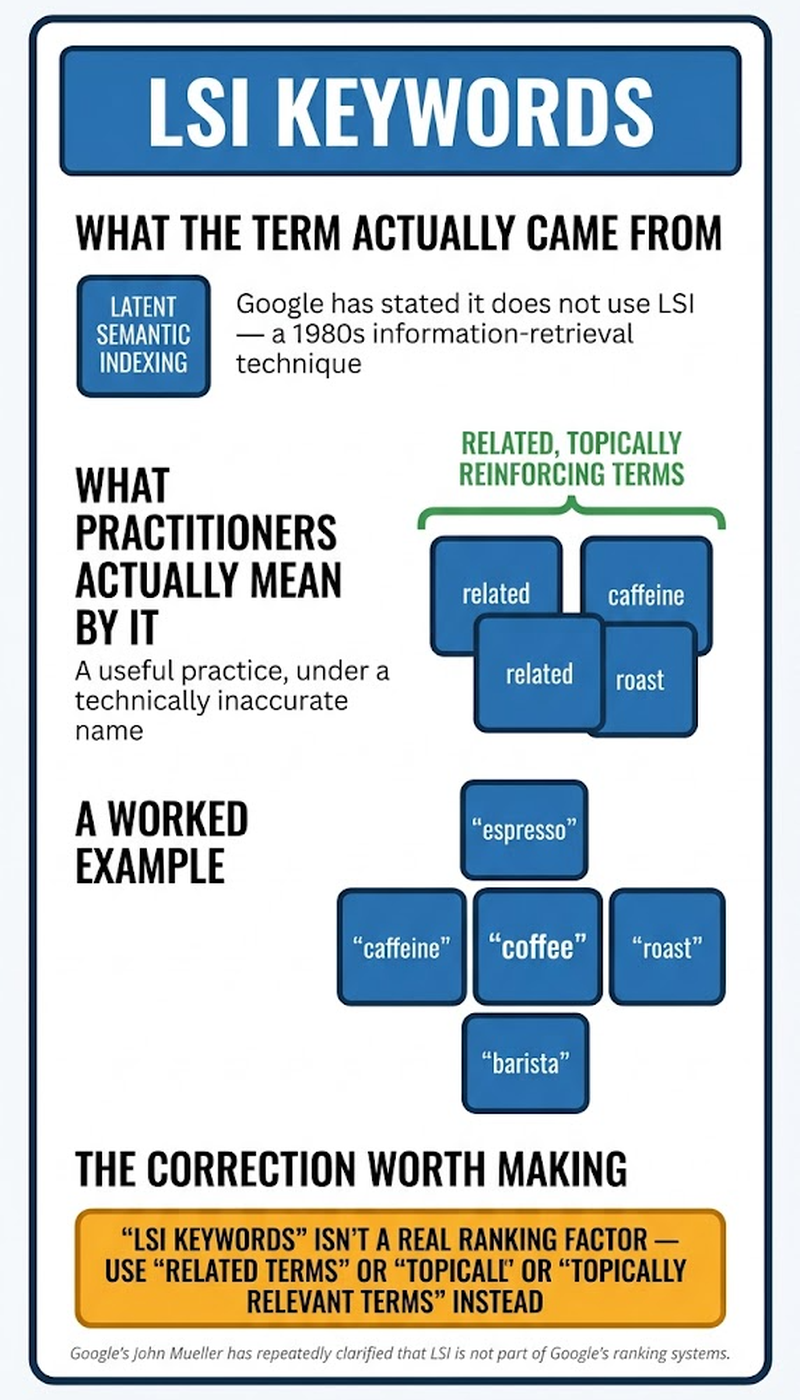
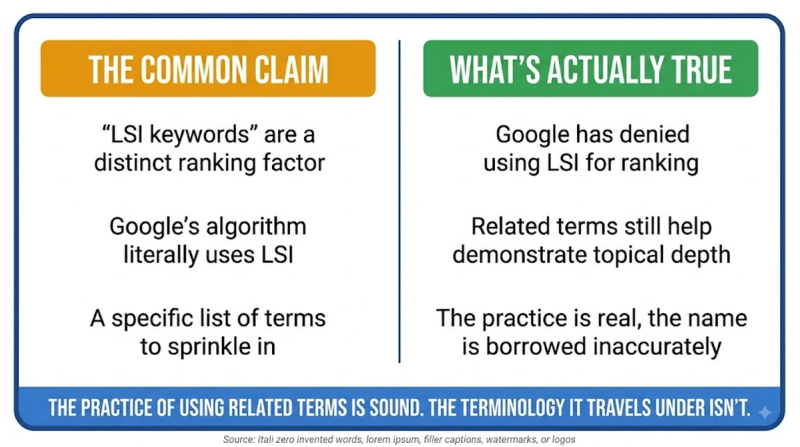
LSI keywords is the label the SEO industry gave to words and phrases assumed to be semantically related to a target keyword, marketed for years as a way to signal topical relevance to Google. The name borrows from Latent Semantic Indexing, a real technique, but the way SEO content teaches the term describes something Google has publicly and repeatedly denied using to rank web pages. That makes LSI keywords, as commonly taught, a misapplied label rather than an actual mechanism inside Google's ranking systems.
Key highlights
- Search Engine Journal's reporting documents John Mueller confirming, on multiple separate occasions, that Google never adopted the original Latent Semantic Indexing technique for ranking search results.
- The actual patent, titled Computer information retrieval using latent semantic structure, was filed September 15, 1988 and granted June 13, 1989 to Bell Communications Research. It expired in 2008, a full decade before Google's 1998 founding even puts the two anywhere near the same timeline, per SEO by the Sea's patent history.
- What Google runs instead is RankBrain, which converts text into mathematical vectors representing meaning, a fundamentally different approach engineered to handle a dataset the size of the modern web, something the 1980s technique was never built to manage.
- The myth's most likely origin traces to the popularity of buzzwords like semantic analysis and semantic search, reinforced by Ask Jeeves' semantic search technology and Google's own acquisition of the semantic analysis company Applied Semantics, per RankTracker's myth analysis.
- Early keyword tools then built entire paid features branded as LSI keyword generators, which did more than any blog post to cement the myth into standard SEO advice, regardless of its connection to how Google actually processes language.
The real history of Latent Semantic Indexing
Latent Semantic Indexing is a real, patented technique, just not one built for or ever used in modern web search ranking. Scott Deerwester, Susan Dumais, George Furnas, Richard Harshman, Thomas Landauer, Karen Lochbaum, and Lynn Streeter filed the original patent on September 15, 1988, assigned to Bell Communications Research, describing a method for finding statistical associations between documents through shared word patterns. It was granted June 13, 1989 and expired in 2008. It predates Google by a decade and was never part of Google's ranking infrastructure at any point.
Why the myth outlived the patent
Semantic terminology sounds technically credible, and commercial incentives did the rest. Tools built entire paid features branded as LSI keyword generators, giving the term a permanent home in mainstream SEO advice regardless of accuracy, and the broader rise of phrases like semantic search and semantic analysis made LSI sound like it belonged in the same category as tools Google genuinely does use.
What to research instead
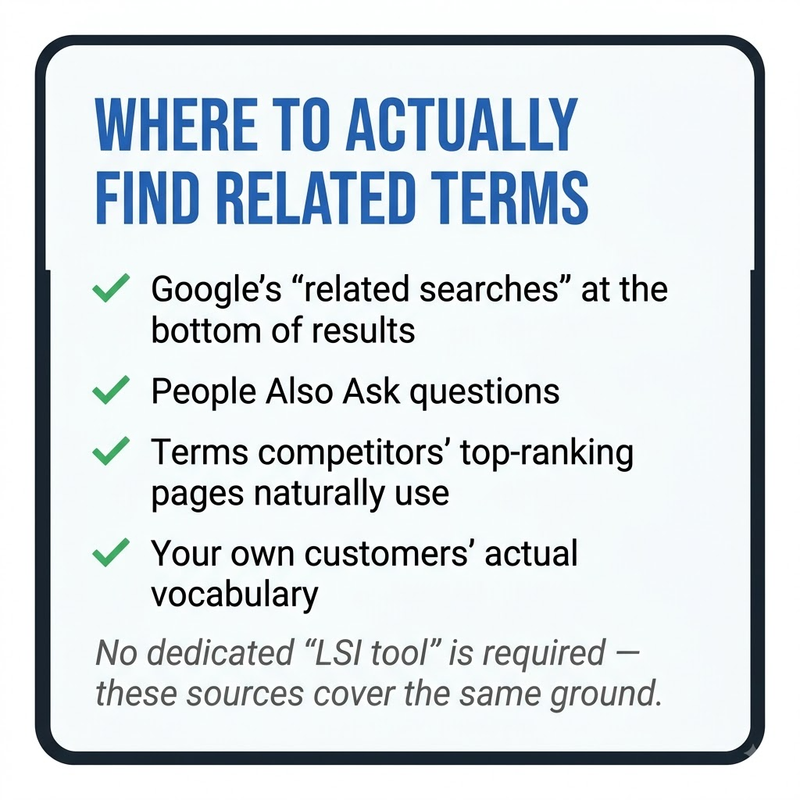
Anyone chasing what LSI keywords was always meant to represent, genuinely related terms that demonstrate topical depth, is better served working directly with the systems Google actually uses. Semantic SEO and entity-based content planning, informed by what real top-ranking pages already cover, produce the same practical outcome, natural topical breadth, without leaning on a mislabeled 1980s patent that was never part of Google's ranking system to begin with.
Frequently asked questions
What are LSI keywords?
LSI keywords is an SEO industry term for words assumed to be semantically related to a target keyword, based on a misapplied reference to Latent Semantic Indexing, a real but unrelated 1980s patent that Google has confirmed it never used for ranking.
Has Google confirmed it doesn't use LSI keywords?
Yes. John Mueller has said so multiple times, and Google instead relies on systems like RankBrain, BERT, and its Knowledge Graph to read meaning and entities, none of which are Latent Semantic Indexing.
When was Latent Semantic Indexing actually patented?
The patent was filed September 15, 1988 and granted June 13, 1989 to Bell Communications Research, describing a statistical document-association technique. It expired in 2008, a decade before Google's founding.
If Google never used it, why do so many SEO guides still teach LSI keywords?
Early keyword tools built commercial features branded as LSI keyword generators, and the semantic-sounding terminology gave it enough surface credibility to survive in standard SEO advice long after the underlying claim was shown to be false.
What should replace LSI keyword research in a content workflow?
Semantic SEO and entity-based content planning replace it directly, using an analysis of what genuinely top-ranking pages already cover to find real topical gaps, rather than mechanically inserting terms pulled from a mislabeled keyword list.


