
A knowledge graph is a structured database of real-world entities — people, places, organizations, concepts — and the relationships between them, which search engines use to understand context beyond simple keyword matching. Google's own Knowledge Graph, launched publicly in 2012, was its large-scale implementation of this idea, built to move search beyond keyword matching toward understanding what a searcher actually means — recognizing "Paris" as potentially a city, a person, or a movie title based on context, rather than treating it as one undifferentiated string of text.
Key Takeaways
- Google's Knowledge Graph launched in 2012 and powers features like the knowledge panel — the info box that appears for well-recognized entities.
- A knowledge graph represents entities and their relationships (e.g., "this person is the CEO of this company"), which is structurally different from a traditional keyword-based index.
- Structured data markup (schema.org) helps a site's own entities get correctly recognized and connected within Google's Knowledge Graph.
- Entity clarity — being unambiguous about what a page or brand actually is — directly affects both traditional knowledge panel eligibility and modern AI-citation performance.
- A knowledge panel isn't purchasable or directly controllable — it's generated automatically based on Google's confidence in an entity's identity and public information about it.
This connects directly to the GEO concept of entity clarity discussed on answer engine optimization — a brand or concept that's ambiguously named or inconsistently described across the web faces the same resolution problem whether the system trying to understand it is a traditional knowledge graph or a modern large language model.
How Does a Knowledge Graph Work?
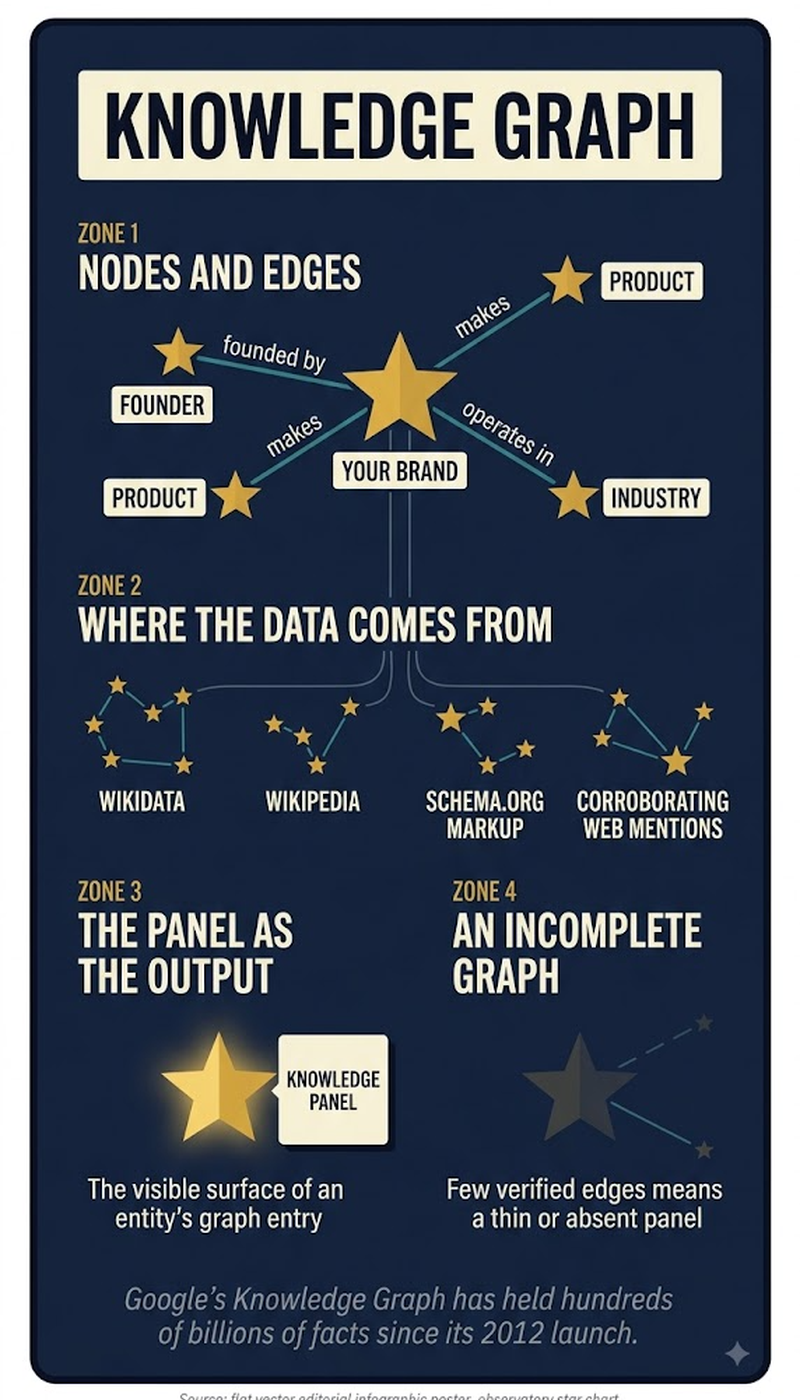
A knowledge graph works by storing information as "triples" — subject, predicate, object statements like "Company X (subject) is headquartered in (predicate) City Y (object)" — and linking these statements together into a connected web of relationships that a search engine can traverse to answer complex queries.
- Entities are the nodes in the graph — people, places, organizations, products, concepts.
- Relationships are the connections between entities — "works at," "located in," "founded by," "part of."
- Attributes are properties of a single entity — a person's birth date, a company's founding year.
- This structure lets a search engine answer questions that require connecting multiple facts together, rather than just matching keywords in a single document.
Google's own engineer Amit Singhal described the shift at launch as moving search from "things, not strings" — from matching text strings to understanding actual real-world entities. At launch in May 2012, the Knowledge Graph already contained over 500 million entities and 3.5 billion facts, built initially from public sources including Freebase, Wikipedia, and the CIA World Factbook. It grew fast: within seven months it had roughly tripled to 570 million entities and 18 billion facts; by mid-2016, Google reported 70 billion facts, answering "roughly one-third" of its then-100 billion monthly searches; by May 2020, Google's official figures put it at 500 billion facts on 5 billion entities.
What Is a Knowledge Panel and How Is It Different From the Knowledge Graph?
A knowledge panel is the visible information box that appears on a search results page for a well-recognized entity, while the Knowledge Graph is the underlying structured database that powers it — the panel is the visible output; the graph is the data infrastructure behind it. Not every entity in the graph gets its own visible panel.
Knowledge panels typically show a short description, key facts, and often an image, sourced from a mix of Google's own Knowledge Graph data, Wikipedia, and other structured sources. See SERP for how the knowledge panel fits alongside other SERP features.
How Do You Get a Business or Brand Recognized in the Knowledge Graph?
There's no direct submission process to force entry into Google's Knowledge Graph, but a business can improve its odds of accurate recognition through a combination of consistent structured data and corroborating external signals:
- Add Organization or relevant entity schema markup to the business's own website, consistently across pages.
- Maintain a verified, consistent Google Business Profile, if the entity is a local or physical business.
- Ensure consistent naming and identifying details across the business's own site and any external profiles (social media, review platforms, industry directories).
- Build genuine, corroborating third-party coverage — press mentions, a Wikipedia page if the entity meets Wikipedia's notability standards, and citations from other recognized entities.
Free Chrome extension
A free AI citation checker for ChatGPT and Gemini
CitoSkeleton passively captures fan-out queries, cited and fetched sources, and brand mentions behind an AI answer — then tracks your GEO visibility against named competitors. 100% local, no account, no server.
- Be patient — Knowledge Graph recognition tends to build gradually as corroborating signals accumulate, not from any single action.
How Does the Knowledge Graph Relate to AI Search and GEO?
The entity-relationship model underlying Google's Knowledge Graph shares conceptual DNA with how modern AI systems build and reason about knowledge, since both rely on resolving ambiguous references to specific, well-defined entities before generating a confident answer. Entity clarity that helps knowledge panel eligibility tends to help AI-citation eligibility too, for largely the same underlying reason.
Frequently Asked Questions
Can two different entities with the same name get confused within the Knowledge Graph?
Yes — this is a common entity-resolution problem, particularly for common names or generic terms; disambiguating content (clear descriptions, distinct structured data, and consistent context) helps Google's systems correctly separate similarly-named entities.
Does having a knowledge panel improve a site's traditional search rankings?
A knowledge panel itself isn't a direct ranking factor for organic search results — it's a separate SERP feature reflecting entity recognition, though the underlying signals that support panel eligibility (clarity, consistency, corroboration) often correlate with broader site quality signals that can indirectly support rankings.
Can a business request removal or correction of incorrect information in its knowledge panel?
Yes — Google provides a feedback mechanism for suggesting edits to knowledge panel information, particularly for panels tied to a verified, claimed entity like a business with a Google Business Profile.
Is the Knowledge Graph the same across different countries or languages?
Knowledge Graph data and panel availability can vary by country and language, since entity recognition and information sourcing draw partly on region-specific data and Google's confidence in that region's information sources.
Do smaller, local businesses ever get knowledge panels, or is this only for large brands?
Smaller and local businesses can and do get knowledge panels, particularly when connected to a verified Google Business Profile — panel presence isn't exclusively reserved for large, globally recognized brands.
What's the difference between a knowledge panel and a rich result?
A knowledge panel represents a recognized entity itself, sourced from the Knowledge Graph, while a rich result is a standard organic listing enhanced with additional structured-data-driven visual elements (ratings, prices) — they're generated through different underlying mechanisms.
Can AI-generated or low-quality content on a site hurt its entity's standing in the Knowledge Graph?
Widespread low-quality or inconsistent content can undermine the corroborating signals Google's systems use to build confidence in an entity's identity and facts, though the Knowledge Graph draws on many sources beyond any single site, softening the impact of one site's content quality issues alone.
Does Wikipedia data always take priority in knowledge panels over a business's own website?
Google draws from multiple sources and doesn't apply a single fixed priority order publicly documented in detail — Wikipedia is a commonly used, trusted source for many entity types, but a business's own verified profile data (like Google Business Profile) is also directly incorporated for business entities specifically.
Can a personal brand or individual (not a company) have a knowledge panel?
Yes — individuals who meet Google's notability and recognition thresholds (authors, public figures, professionals with substantial public presence) can have their own knowledge panels, following similar entity-recognition principles as business entities.
How is entity data in the Knowledge Graph kept accurate and up to date over time?
Google's systems continuously reprocess and update entity information as new corroborating data becomes available across the web, meaning outdated information in a panel typically self-corrects over time as fresher, more accurate signals accumulate — though this isn't instantaneous and can lag real-world changes.


