
In short: AEO is the practice of structuring content so AI answer systems — ChatGPT, AI Overviews, voice assistants — can extract and cite it directly, rather than optimizing only for a traditional ranked link.
Key Takeaways
- AEO structures content so AI answer systems can extract, synthesize, and cite it directly — the goal shifts from “get clicked” to “get quoted.”
- AEO builds on foundational SEO (crawlability, indexing, structured data) — it doesn’t replace it, and weak technical SEO undermines AEO just as much as it undermines traditional ranking.
- Winning content states a direct, complete answer in the first sentence or two of a section and uses question-format headers — the same structural discipline this glossary applies to itself.
- There’s no equivalent of Google Search Console for AI-citation tracking yet — measurement today is a mix of manual prompt testing and emerging third-party tools.
- Entity clarity — disambiguating exactly what a term refers to — is foundational to AEO; ambiguous terms (like “SERP”) suppress citation eligibility before content quality even becomes a factor.
What Does Answer Engine Optimization Mean?
More precisely, the core shift AEO represents is from "get clicked" to "get quoted" as the primary success metric. Content is optimized to be synthesized and cited inside a generated answer, not just to rank a link a user then clicks.
AEO emerged as a distinct discipline as answer engines like ChatGPT, Perplexity, Google’s AI Overviews, and voice assistants started generating synthesized responses instead of returning ranked links. Where traditional SEO optimizes for a searcher clicking through to a page, AEO optimizes for content being selected as source material for an answer the user may never click through to see in full.
How Is AEO Different From SEO?
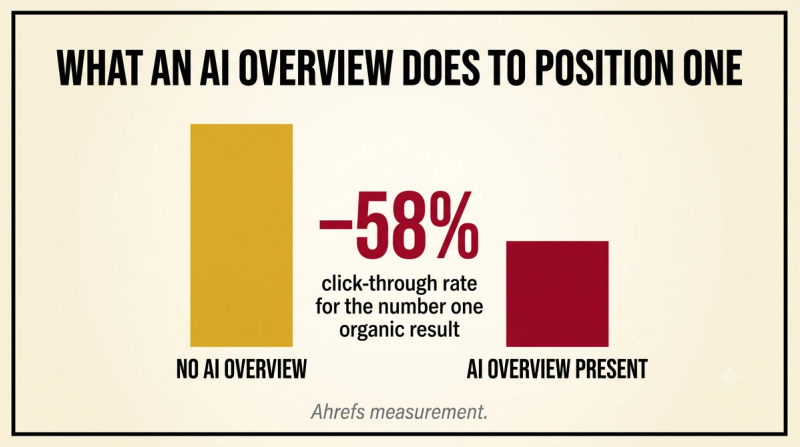
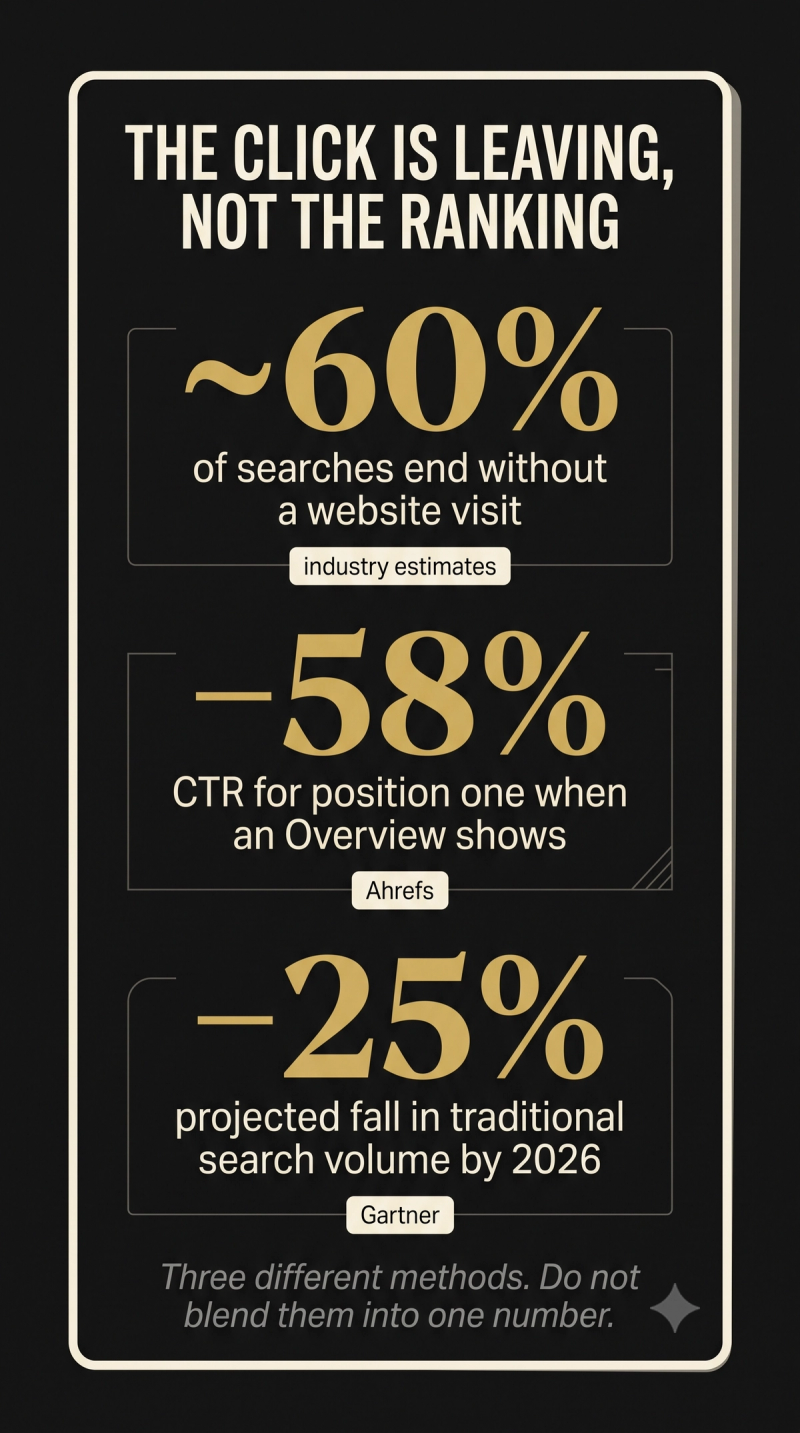
AEO differs from SEO in its unit of success. SEO measures rankings, clicks, and traffic to a page. AEO measures whether content gets selected, cited, or paraphrased inside a generated answer, regardless of whether a click ever happens. The two aren't opposing disciplines; AEO builds on foundational SEO (crawlability, indexing, structured data) but adds requirements SEO alone doesn't optimize for.
The practical difference shows up in content structure. SEO content is often written to keep a reader scrolling and engaged (supporting ad revenue or conversion goals). AEO content is written to be maximally extractable in isolation: a self-contained answer that makes sense even lifted out of its original page context and dropped into a chat response. That's a genuinely different writing discipline than crafting an engaging, narrative-driven article.
SEO vs. AEO writing comparison:
- Traditional SEO writing — builds context gradually across a long intro — optimized to keep readers scrolling on-page — headers can be stylistic
- AEO-friendly writing — states the answer in the first sentence — optimized to be extractable in isolation — headers mirror real question phrasing
What Makes Content “Answer Engine Friendly”?
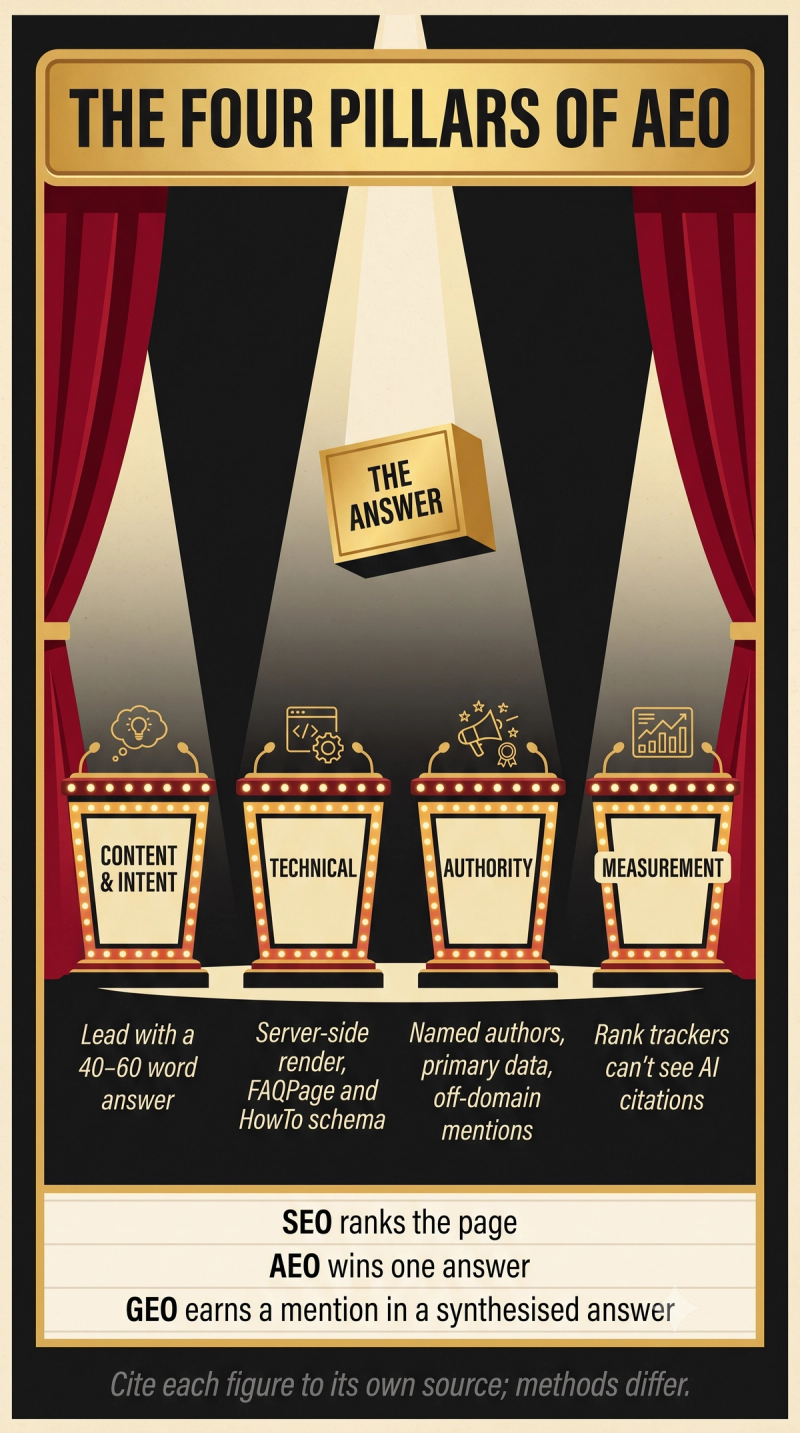
Content becomes answer-engine friendly through a specific set of structural choices, not a rewrite of the underlying research:
- State a direct, complete answer in the first sentence or two of every section.
- Use explicit question-format headers that mirror real search phrasing.
- Break content into extractable, self-contained chunks rather than long unstructured paragraphs.
- Add structured data (FAQPage, HowTo, DefinedTerm schema) to give answer engines a machine-readable signal about what the content is actually answering.
- Disambiguate ambiguous terms early, before diving into detail.
This is the same underlying principle this glossary site's own page architecture is built around. AEO isn't a separate content type — it's a set of structural disciplines layered onto otherwise well-researched content.
Does AEO Replace Traditional SEO Work?
AEO does not replace traditional SEO. Crawlability, indexing, technical health, and topical authority remain prerequisites, because an answer engine still has to discover, crawl, and trust a page before it can extract anything from it. Content invisible to traditional search infrastructure is equally invisible to answer engines built on similar underlying crawl and index systems.
A page can rank well traditionally while still performing poorly in AEO terms, if it isn't structured for extraction. Conversely, a page with strong AEO structure but weak backlink or authority signals may still struggle to be crawled, indexed, and trusted enough to be cited in the first place. The two disciplines are additive, not substitutive.
How Do You Measure Whether AEO Is Working?
Measuring AEO success requires tracking citation and mention frequency across AI platforms directly. Traditional analytics (organic clicks, position tracking) don't capture whether content was used inside a generated answer without a click. This typically means manually or programmatically querying target AI platforms with relevant prompts and logging whether and how a domain gets cited.
Free Chrome extension
A free AI citation checker for ChatGPT and Gemini
CitoSkeleton passively captures fan-out queries, cited and fetched sources, and brand mentions behind an AI answer — then tracks your GEO visibility against named competitors. 100% local, no account, no server.
This measurement gap is a genuine, unsolved problem across the industry right now. There is no single, universally trusted analytics platform equivalent to Google Search Console for AI-citation tracking yet. That means most AEO measurement today is a mix of manual prompt testing, emerging third-party tools, and proxy signals, like referral traffic appearing from AI platform domains in standard web analytics.
Is AEO the Same Thing as GEO (Generative Engine Optimization)?
AEO and GEO overlap heavily and are often used interchangeably. GEO is typically the broader umbrella term covering optimization for any generative AI system's outputs, while AEO more specifically emphasizes the "answer" framing tied to direct question-answering use cases. In practice, most practitioners treat the terms as closely related enough to use somewhat interchangeably depending on context.
The terminology in this space is still actively settling. Expect continued overlap and inconsistent usage across the industry as the discipline matures, similar to how "SEO" itself absorbed and consolidated several earlier, more narrowly defined terms during its own early years.
What Role Does Entity Clarity Play in Answer Engine Optimization?
Entity clarity, making it unambiguous which real-world person, organization, product, or concept a piece of content refers to, plays a foundational role in AEO. Answer engines need to resolve ambiguous terms correctly before confidently citing a source. A page discussing "SERP" without disambiguating it from unrelated uses of the same acronym is a concrete example of an entity-clarity failure that directly suppresses citation eligibility.
This connects AEO to the broader discipline sometimes called entity SEO or knowledge graph optimization. It means using consistent naming, structured data, and explicit definitions to help both traditional search engines and generative AI systems build a confident, unambiguous model of what a page is about. Weak entity clarity doesn't just hurt AEO performance in isolation — it compounds with the ranking difficulty of competing against unrelated, higher-volume interpretations of the same term.
Frequently Asked Questions
Can a page be optimized for AEO without any code or schema changes, using content structure alone?
Yes. Structural choices like question-format headers and front-loaded direct answers improve extractability without requiring any schema markup. Adding structured data (FAQPage, DefinedTerm) provides an additional, complementary signal on top of good content structure alone.
Do different AI platforms favor different content structures, or is one AEO approach universal?
Different platforms use different underlying retrieval and citation mechanisms, so relative performance can vary somewhat by platform. But the core principles, direct answers, clear structure, entity clarity, tend to benefit extractability across all of them, rather than requiring platform-specific rewrites.
Does AEO content need to be updated more frequently than standard SEO content to stay cited?
Answer engines that prioritize current, accurate information may deprioritize stale content when a more recently updated source is available. That makes regular review and refresh more consequential for AEO performance, than it traditionally has been for stable, evergreen SEO content.
Can a smaller or newer website realistically compete for AI citations against large, established publishers?
Yes, more realistically than in traditional organic ranking. Citation appears to weight content relevance and clarity more heavily relative to accumulated domain authority. A smaller site with precisely on-topic, well-structured content has a meaningfully better shot at AI citation than at outranking major publishers organically for the same competitive term.
Do AI answer engines ever cite a source without a direct link back to it?
Yes. Some AI-generated answers reference or paraphrase a source's information without providing a clickable citation link, particularly in voice interfaces or conversational responses where a URL isn't naturally presented. That's part of why traditional click-based analytics can't fully capture AEO performance.
Is there a risk of AI answer engines misrepresenting or subtly altering content when citing it?
Yes. AI systems synthesize and paraphrase rather than quote verbatim, so there's inherent risk of nuance loss or inadvertent misrepresentation. That's one of the reasons entity clarity and unambiguous, precisely worded source content matters — vaguer source material gives more room for drift during synthesis.
Does having a Wikipedia page or major press coverage meaningfully help AEO performance?
Broad, corroborating coverage across multiple trusted sources appears to support the kind of entity confidence and knowledge-graph presence that helps AI systems confidently resolve and cite an entity. This remains an area though without fully transparent, published methodology from the major AI platforms.
Can duplicate or near-duplicate content across multiple pages hurt a site’s chances of being cited?
Yes. Ambiguity about which page is the canonical, authoritative source for a given claim can reduce citation confidence, in the same way it can hurt traditional indexing and ranking. That makes the technical SEO fundamentals underlying AEO once again relevant.
Do answer engines prefer long-form comprehensive pages or short, single-purpose pages for citation?
Answer engines appear to favor whichever content most precisely and directly answers the specific question being asked, regardless of overall page length. A comprehensive page structured with clear, extractable sections can serve both a broad head-term citation and multiple narrower long-tail citations simultaneously.
Is AEO relevant for e-commerce and product pages, or mainly for informational/glossary-style content?
AEO principles apply to product content too, particularly for comparison and specification-style queries. The extraction and citation patterns for transactional, product-focused content differ somewhat though, from the informational, definition-style content AEO discussion most often centers on.
Can inconsistent naming of the same concept across a site’s own pages hurt AEO performance?
Yes. Referring to the same concept by different names or abbreviations across a site's own content can create the same entity-resolution ambiguity that hurts citation from external sources. That makes internal naming consistency a practical, controllable part of AEO strategy.


