
TL;DR. An AI citation is your brand's name, or a link to it, surfacing inside a generated answer as the source for a specific claim. Only about 11 percent of domains get cited by both ChatGPT and Perplexity, and brand mentions now correlate roughly three times more strongly with AI visibility than backlinks do.
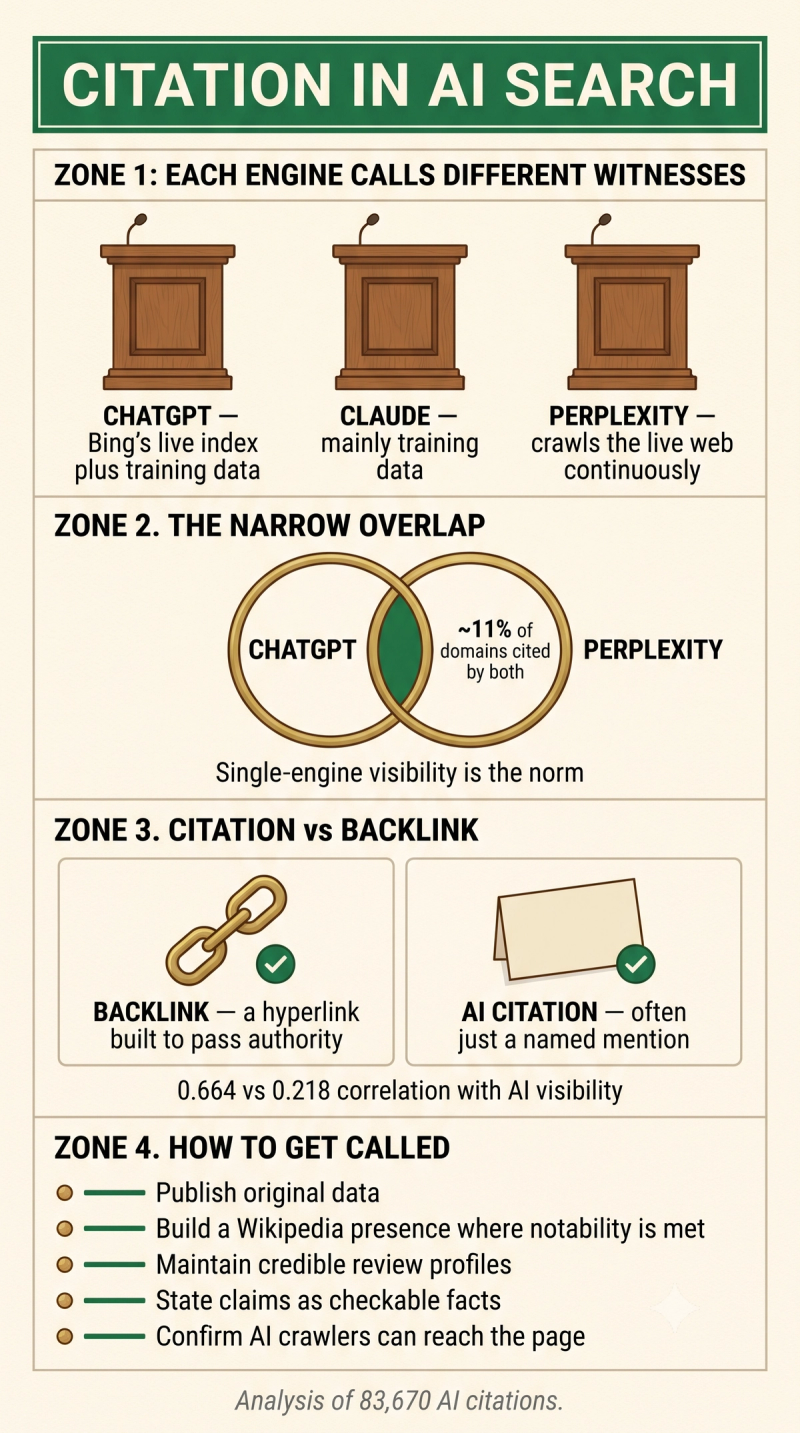
What is a citation in AI search?
A citation in AI search is any reference to your brand or content that an engine includes while generating an answer, whether that is a clickable source link or just a name dropped into the prose. It tells the reader, and you, exactly which source the engine leaned on for that particular claim.
An AI citation functions like the new search ranking, except the reward is getting quoted inside the answer itself rather than listed underneath it.
Key highlights
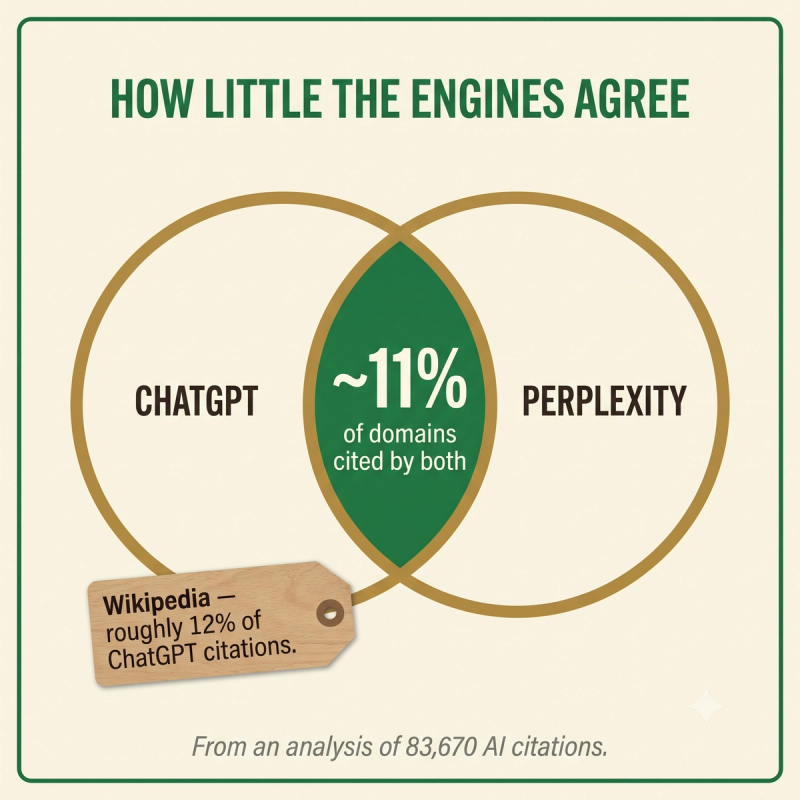
- An analysis of 83,670 AI citations found only about 11 percent of domains get cited by both ChatGPT and Perplexity, a narrow overlap that makes single-engine visibility the norm, not the exception.
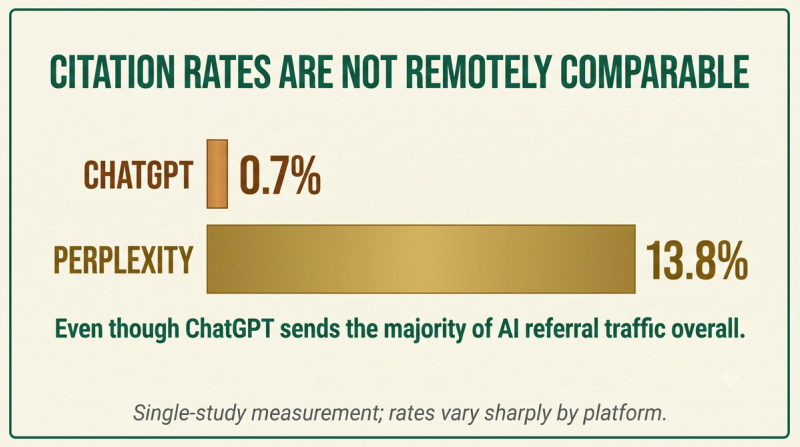
- One study measured ChatGPT's citation rate at 0.7 percent versus Perplexity's 13.8 percent, despite ChatGPT sending the majority of AI referral traffic overall.
- Brand mentions correlate with AI visibility at roughly 0.664, versus 0.218 for backlinks, a gap of about three times in strength.
- Wikipedia accounts for roughly 12 percent of ChatGPT citations, while Claude and Perplexity lean on it far less, or barely at all.
How AI engines actually pick sources
AI engines choose sources by retrieving the passages most relevant to a query, then favoring the ones that read as clear, current, and corroborated elsewhere. Each engine sources differently though: ChatGPT leans on Bing's real time index plus its training data, Claude relies mainly on training data alone, and Perplexity crawls the live web continuously.
Consensus counts for as much as any single page. Engines scan for agreement across multiple independent sources, so a claim repeated on Reddit, review sites, and industry coverage earns more trust than the same claim sitting only on your own site.
AI citation vs backlink
A backlink is a hyperlink another site places to yours, built specifically to pass ranking authority through the link graph. An AI citation can be a link, but it is often just a plain named mention with no hyperlink attached at all, since models train on raw text rather than on link structure.
That gap is exactly why unlinked mentions on Reddit, review platforms, and forums can move AI visibility even though they would do almost nothing for a classic backlink profile.
How to get cited by ChatGPT and Perplexity
- Publish original data. A single original benchmark or study can earn mentions across a dozen independent publications at once.
- Build a Wikipedia presence where notability standards are met, since it feeds a large share of ChatGPT's training data and citations.
Free Chrome extension
A free AI citation checker for ChatGPT and Gemini
CitoSkeleton passively captures fan-out queries, cited and fetched sources, and brand mentions behind an AI answer — then tracks your GEO visibility against named competitors. 100% local, no account, no server.
- Maintain active, credible review profiles on platforms like G2 or Capterra for B2B categories.
- State claims as clear, checkable facts; a data point only your site has is a genuinely strong reason for a model to cite you specifically.
- Confirm AI crawlers can actually reach your pages, since an uncrawled page cannot be cited no matter how good it is.
How to track AI citations
Run a fixed set of prompts your buyers actually ask across ChatGPT, Perplexity, and Google AI Overviews every month, logging whether you are named, which page gets cited, and how you are described. That panel becomes your AI share of voice baseline.
Frequently asked questions
What is a citation in AI search?
It is any reference to your brand or content inside an AI generated answer, a clickable link or just a plain named mention, that shows which source the engine relied on for a specific claim. It is the primary mechanism through which brands earn visibility inside AI generated responses now.
How do AI engines choose which sources to cite?
Each engine sources answers differently, which is why the same query can pull different citations depending on which one you ask. ChatGPT leans on Bing's index and its training data, Claude relies mainly on training data, and Perplexity crawls the live web continuously, but all three favor sources that read as clear, current, and corroborated elsewhere.
Are AI citations the same thing as backlinks?
No, and treating them the same is a common mistake. A backlink is a hyperlink built to pass ranking authority through a link graph; an AI citation is often just a plain named mention with no link at all, since models train on raw text. Research shows brand mentions correlate roughly three times more strongly with AI visibility than backlinks do.
What is the fastest way to earn AI citations?
Original data tends to move fastest, since a single benchmark or study can get picked up by a dozen independent sites at once, and those independent mentions are exactly what engines look for as corroboration. Wikipedia presence and active review profiles compound that effect but take longer to build.
Do AI citations actually drive traffic?
Yes, though the volume runs smaller than classic organic traffic, and citation rates vary sharply by platform, Perplexity cites far more per mention than ChatGPT does. Even unlinked mentions build brand recall that can influence a buyer's decision well before any click happens.
Why isn't my brand being cited by AI at all?
The usual suspects are blocked AI crawlers, no independent corroboration of your claims anywhere else, thin or inconsistent brand mentions across the web, and content that buries the actual answer instead of stating it clearly near the top. Auditing crawlability first, then your third party mention footprint, usually surfaces the gap fast.


