
AI share of voice measures how often a brand, product, or domain gets mentioned or cited across AI-generated answers, relative to competitors, for a defined set of relevant prompts. It's a relative, comparative metric, not an absolute score. The concept borrows directly from traditional marketing's "share of voice," which measured a brand's relative visibility across advertising, media coverage, or search rankings. AI share of voice applies that same comparative logic to a new surface: AI chat interfaces, AI Overviews, and other generative answer systems.
Key Takeaways
- AI share of voice is the GEO-era equivalent of traditional "share of voice" in SEO or PR — but measured in AI-generated answers instead of search rankings or media mentions.
- There's no standardized, universally agreed calculation method yet — different tools and agencies define and measure it somewhat differently.
- Measuring it requires running a defined set of prompts against target AI platforms repeatedly and logging citation/mention frequency, since no platform currently offers this as a built-in analytics report.
- A domain can have strong traditional SEO share of voice and weak AI share of voice, or vice versa — the two aren't guaranteed to correlate.
- This is a genuinely new and actively evolving discipline — treat any specific benchmark numbers circulating in the industry with appropriate skepticism until backed by transparent, reproducible methodology.
How Is AI Share of Voice Different From Traditional SEO Share of Voice?
Traditional SEO share of voice is typically calculated from ranking position and estimated click-through across a keyword set. AI share of voice, by contrast, is calculated from citation or mention frequency across a prompt set. That's a fundamentally different unit of measurement, since AI answers don't have a "position 1 through 10" the way a SERP does.
Traditional vs. AI share of voice:
- Unit measured — Traditional: ranking position across keywords — AI: citation/mention frequency across prompts
- Data source — Traditional: rank tracking tools, Search Console — AI: manual or automated prompt testing across AI platforms
- Standardization — Traditional: well-established methodology — AI: still forming, no industry-standard method yet
- Click data available — Traditional: yes, via Search Console — AI: generally no — most AI answers don't report clicks the way search does
How Do You Measure AI Share of Voice for a Brand?
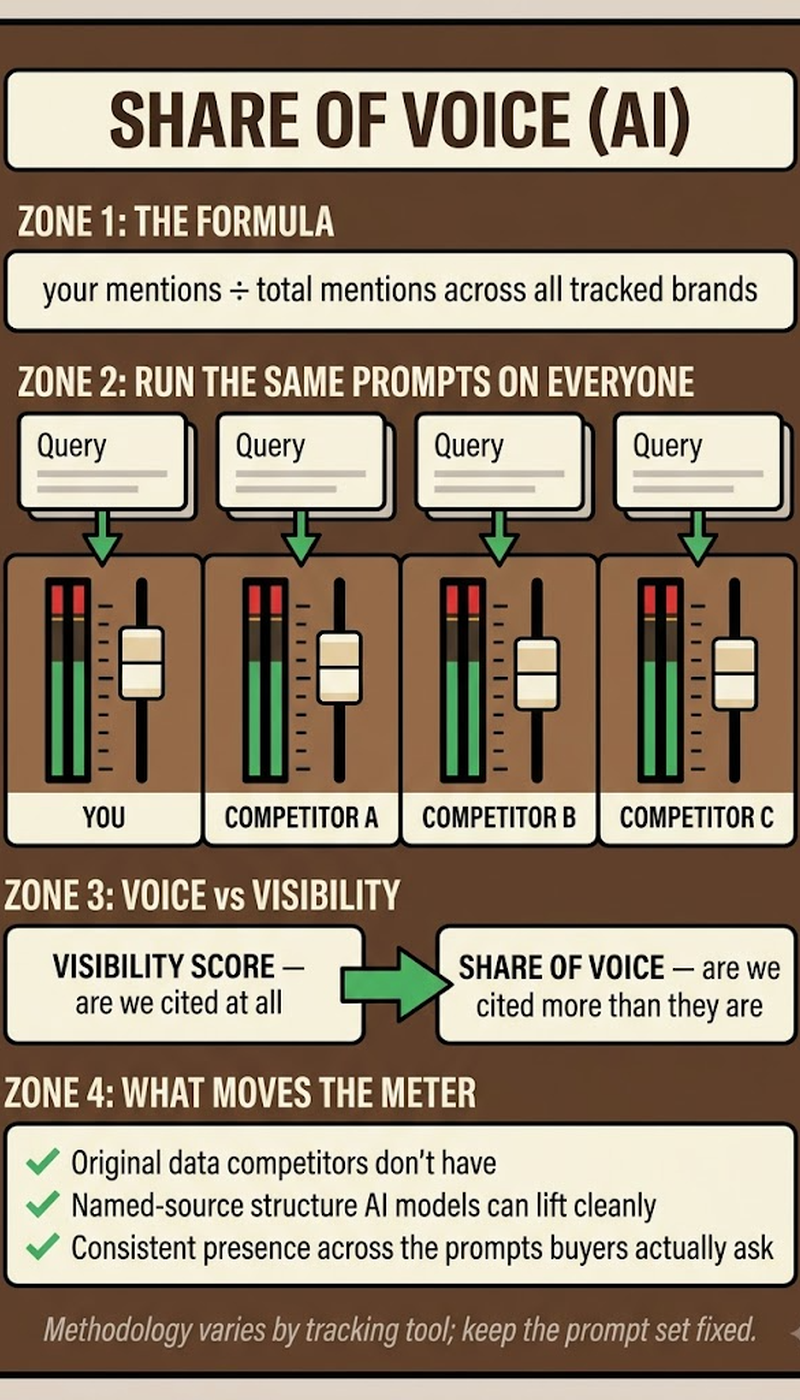
Measuring AI share of voice requires building a defined prompt set relevant to the brand's category. Run those prompts repeatedly against target AI platforms, then log whether and how the brand is mentioned relative to competitors. A concrete worked example: test 200 relevant category prompts. If your brand appears in 50 of the resulting answers while your top competitor appears in 80, your AI share of voice is 25% against their 40% for that prompt set.
- Define a realistic set of prompts a potential customer might actually ask (not just branded queries — category and comparison-style prompts matter more here).
- Run the same prompt set against each target AI platform (ChatGPT, Perplexity, Google AI Overviews, Gemini, etc.) on a recurring schedule, since answers can change over time.
- Log each response, noting whether the brand is mentioned, cited with a link, or absent entirely.
- Do the same for named competitors using the identical prompt set, so the comparison is apples-to-apples.
- Calculate share of voice as the brand's mention frequency divided by total mentions across all tracked brands for that prompt set.
This remains a largely manual or semi-automated process industry-wide. There's no single trusted analytics platform equivalent to Google Search Console for this yet. Platform behavior varies enough that single-platform measurement gives a misleading picture: an analysis of over 2.4 million AI responses found Perplexity and Copilot include external source links in over 77% of responses, while ChatGPT does so in roughly 31%. That means a brand's citation rate can look completely different depending on which platform is measured. Only about 11% of cited domains appear as citations on both ChatGPT and Perplexity for the same prompts.
Why Does AI Share of Voice Matter Right Now?
It matters now because AI-mediated discovery has grown fast enough to be a real consideration channel, not a future hypothetical. AI search visits are estimated to have grown roughly 42.8% year-over-year between Q1 2025 and Q1 2026, from about 15.6 billion to 27.4 billion visits. As of early 2026, an estimated 73% of B2B buyers report using AI tools somewhere in their research process. Most brands are starting from a weak position on this metric. One industry benchmark found most B2B brands appear in under 30% of relevant category prompts, regardless of how strong their traditional SEO already is. That means AI share of voice and organic search visibility are genuinely separate battles, not the same one measured twice.
The term itself is still settling. "Share of Model" was used as an earlier, now less common synonym by some early platforms in the category, before "AI Share of Voice" consolidated as the standard label. It connects more intuitively to the traditional marketing metric teams already understand.
Does a High AI Share of Voice Guarantee More Traffic or Revenue?
No — AI share of voice measures visibility within generated answers, not clicks, conversions, or revenue. A citation inside an AI answer frequently doesn't include a click-generating link the way a traditional search result does.
Free Chrome extension
A free AI citation checker for ChatGPT and Gemini
CitoSkeleton passively captures fan-out queries, cited and fetched sources, and brand mentions behind an AI answer — then tracks your GEO visibility against named competitors. 100% local, no account, no server.
This mirrors a long-standing tension in traditional PR and brand marketing measurement: visibility and revenue are related but not the same thing. Treating AI share of voice as a proxy for direct traffic risks the same measurement mistake marketers have made with traditional media share of voice for decades.
What Factors Influence AI Share of Voice?
AI share of voice appears to be influenced by content clarity and structure, entity resolution (how unambiguously an AI system can identify what a brand actually is), and topical depth of coverage. These factors don't map cleanly onto traditional SEO ranking factors like backlink count or Domain Authority.
- Content structure: clear, directly-answerable content (see answer engine optimization) appears more likely to be extracted and cited.
- Entity clarity: an AI system needs to confidently resolve what a brand or product actually is before citing it — ambiguous naming hurts this. A related metric some platforms now track separately is "entity salience": how strongly an AI system associates a brand with a specific topic. Several 2026 industry sources report entity salience correlating more strongly with AI citation likelihood than traditional technical SEO signals do.
- Topical depth: comprehensive coverage of a subject area may support citation likelihood more than a single isolated page.
- Traditional authority signals: their exact role is still unsettled — see domain authority for the specific, ongoing debate about whether accumulated backlink authority matters the same way for AI citation as it does for traditional ranking.
Frequently Asked Questions
Is AI share of voice the same thing as AI citation frequency?
They're closely related but not identical. Citation frequency is typically a raw count of how often a source is cited. Share of voice frames that count comparatively against competitors, expressing it as a relative percentage rather than an absolute number.
Can a small or newly launched brand realistically compete on AI share of voice against established competitors?
Potentially more realistically than in traditional SEO, since AI citation appears to weight content relevance and clarity more heavily relative to accumulated domain authority. But this remains an evolving area without fully transparent methodology from the major AI platforms.
Does AI share of voice vary significantly between different AI platforms for the same brand?
Yes. Each platform uses different underlying retrieval, training data, and citation mechanisms, so a brand can show meaningfully different share of voice on ChatGPT versus Perplexity versus Google's AI Overviews, for the same prompt set.
Is there a standardized industry benchmark for what counts as a good AI share of voice?
No — measurement methodology itself isn't standardized across tools and agencies yet. Comparing a specific benchmark number across different sources or vendors isn't reliable, unless you confirm they used the same prompt set and measurement approach.
Do negative or critical mentions count toward AI share of voice the same way positive ones do?
Basic share of voice as a visibility metric typically counts any mention regardless of sentiment, though more sophisticated measurement approaches increasingly separate mention frequency from mention sentiment as two distinct dimensions worth tracking separately.
Can paid advertising or sponsorships influence AI share of voice the way they influence traditional search ads?
Current-generation AI answer systems generally don't have a paid placement mechanism comparable to search advertising. That means AI share of voice today is closer to organic/earned visibility than a purchasable metric — though this is an area of rapid, ongoing platform development.
How often should AI share of voice be re-measured to stay meaningful?
Given how frequently underlying AI models and their training or retrieval data can change, periodic re-measurement — commonly monthly or quarterly in current industry practice — is more reliable than a single one-time snapshot.
Does having a Wikipedia page or extensive press coverage meaningfully improve AI share of voice?
Broad, corroborating coverage across multiple trusted sources appears to support the entity confidence AI systems seem to rely on when resolving and citing a brand. But this connection remains an area without fully transparent, published methodology from the major platforms.
Is AI share of voice relevant for B2C brands only, or does it matter for B2B as well?
The concept applies to both. B2B buyers increasingly research vendors and category comparisons using AI tools the same way B2C consumers research products, which makes AI share of voice relevant across both categories rather than being consumer-specific.
Can a brand actively improve its AI share of voice, or is it purely a passive measurement?
It can be actively influenced through the same content-structure and entity-clarity practices central to answer engine optimization — meaning it functions as both a measurement and, indirectly, a set of actionable levers rather than being purely passive tracking.


