
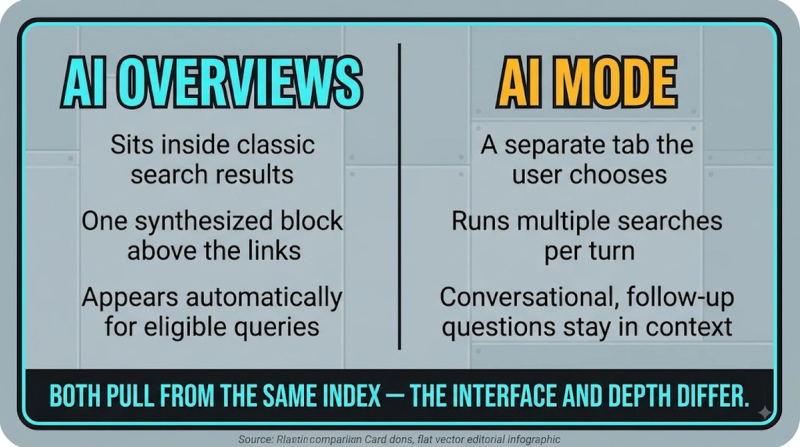
Google AI Mode is a conversational search experience built into Google Search, powered by Google's Gemini models. It lets users ask complex, multi-part questions and get a synthesized AI-written answer with source links, instead of a traditional list of ranked results. It launched in Search Labs in March 2025, rolled out fully to all US users at Google I/O in May 2025, and by Google I/O 2026 had reportedly passed one billion monthly users across close to 200 countries. Unlike AI Overviews, which sits as a summary above standard search results, AI Mode replaces the entire page. Full conversation, not a summary bolted onto a results list.
Key Takeaways
- AI Mode is a distinct product from AI Overviews and the standalone Gemini app. AI Overviews summarizes on top of normal results. AI Mode replaces the whole search experience with a conversation. Gemini is a separate assistant, not built into Search.
- Google reported AI Mode passing one billion monthly users by its 2026 developer conference, running across nearly 200 countries and roughly 98 languages at no charge.
- The current default engine (as of mid-2026) is Gemini 3.5 Flash, with a "Thinking with 3 Pro" option available for harder queries using the more capable Gemini 3 Pro model.
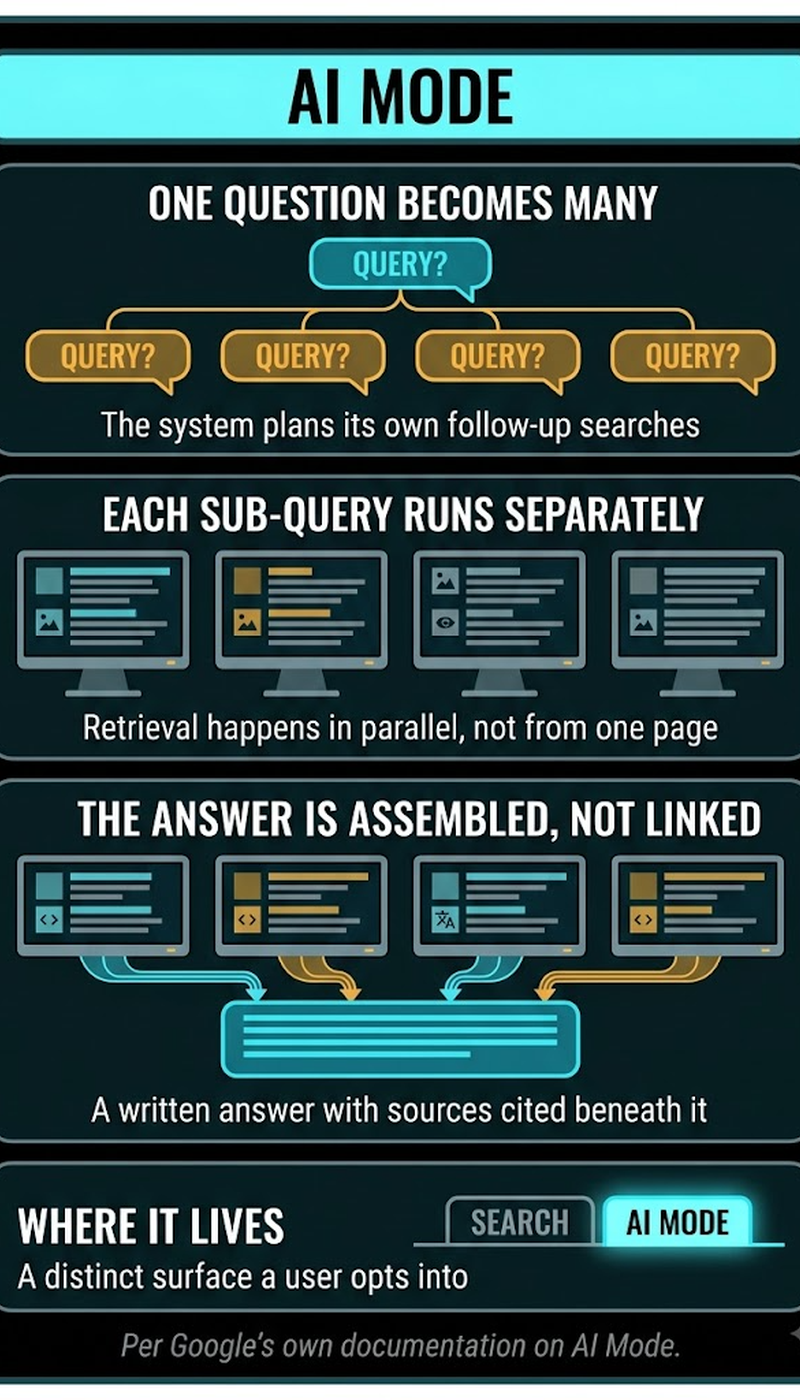
- AI Mode's core mechanism is "query fan-out" — breaking one user question into multiple sub-queries run in parallel across the web, then synthesizing the results into one integrated answer.
- An opt-in "Personal Intelligence" feature, launched January 22, 2026, lets AI Mode reference connected Gmail, Photos, Calendar, and Drive data during response generation for more personalized answers.
AI Mode's query fan-out mechanism connects directly to how this site's answer engine optimization and AI share of voice pages frame visibility across AI-generated search surfaces generally.
How Is AI Mode Different From AI Overviews and the Gemini App?
AI Overviews is a generated summary that appears above traditional search results, while the rest of the results page stays intact. AI Mode replaces the entire search experience with an ongoing back-and-forth conversation. The Gemini app is a fully separate AI assistant that isn't part of Google Search at all. This distinction matters for SEO and content strategy, because each surface pulls from and displays sources differently. AI Overviews sits alongside organic rankings, while AI Mode's conversational format means a page's content needs to hold up as a citable, extractable source across an entire multi-turn conversation, not just a single query.
What Is Query Fan-Out and Why Does It Matter for Content?
Query fan-out is the technique AI Mode uses to answer a question by breaking it into multiple related sub-queries: definitions, comparisons, examples, counterarguments. It runs them simultaneously, then synthesizes the combined results into one response instead of a single ranked list. One broad question, several searches happening behind the scenes. That's the mechanism. It means a page can get pulled into an AI Mode answer by matching any one of those sub-queries well, not necessarily the original literal phrasing someone typed into the box. The real implication for content strategy gets missed constantly: stop optimizing for one exact keyword phrase, and start covering a topic's likely sub-questions comprehensively. Any single one of them could be the angle that actually gets a page cited.
What Model Powers AI Mode, and How Often Does Google Change It?
Twice. Within 2026 alone. That pace says a lot about how quickly this particular product is evolving, compared to more stable parts of Google Search — and it's a big reason this page carries an explicit re-verify-before-publish flag. Gemini 3 became the active AI Mode model on January 22, 2026, alongside the Personal Intelligence launch. Gemini 3.5 Flash then replaced it as the default engine by May 2026, fine-tuned specifically for retrieval-augmented generation and citation handling rather than general conversation. A "Thinking with 3 Pro" option remains available for queries that need deeper reasoning, running the more capable Gemini 3 Pro model instead of the faster default.
What Is Personal Intelligence in AI Mode?
Personal Intelligence is an opt-in AI Mode feature, launched January 22, 2026. It connects a user's Gmail, Google Photos, Calendar, and Drive to generate more personalized responses, by referencing that person's actual bookings, receipts, itineraries, and saved images during a conversation. A user planning a trip, for example, can get an AI Mode response that accounts for flights they've already booked or reservations already confirmed in their Gmail, rather than generic trip-planning advice. By Google I/O 2026, Google had expanded Personal Intelligence to nearly 200 countries and about 98 languages, and removed an earlier subscription requirement, making it broadly available at no charge. Users choose which apps to connect and can disconnect at any time.
How Should Content Be Structured for AI Mode Visibility?
Content built for AI Mode citation benefits from the same fundamentals as AI Overview and answer-engine visibility generally, applied with query fan-out specifically in mind:
- Cover a topic's genuine sub-questions comprehensively (definitions, comparisons, common follow-ups) rather than optimizing narrowly for one exact search phrase, since fan-out queries can surface a page through any sub-topic it covers well.
- Answer each section's implicit question directly and early, in extractable, self-contained passages. AI Mode's synthesis pulls specific passages, not full pages, so burying the answer in the fourth paragraph reduces citation odds.
- Use clear, factual statements with genuine specificity (real numbers, named sources, dated facts) rather than vague generalities, since these are easier for a retrieval-and-synthesis system to extract and attribute confidently.
- Maintain genuinely accurate, current information, since AI Mode's citation-focused model build is specifically tuned for grounding responses in retrieved content rather than generating from its own training data alone.
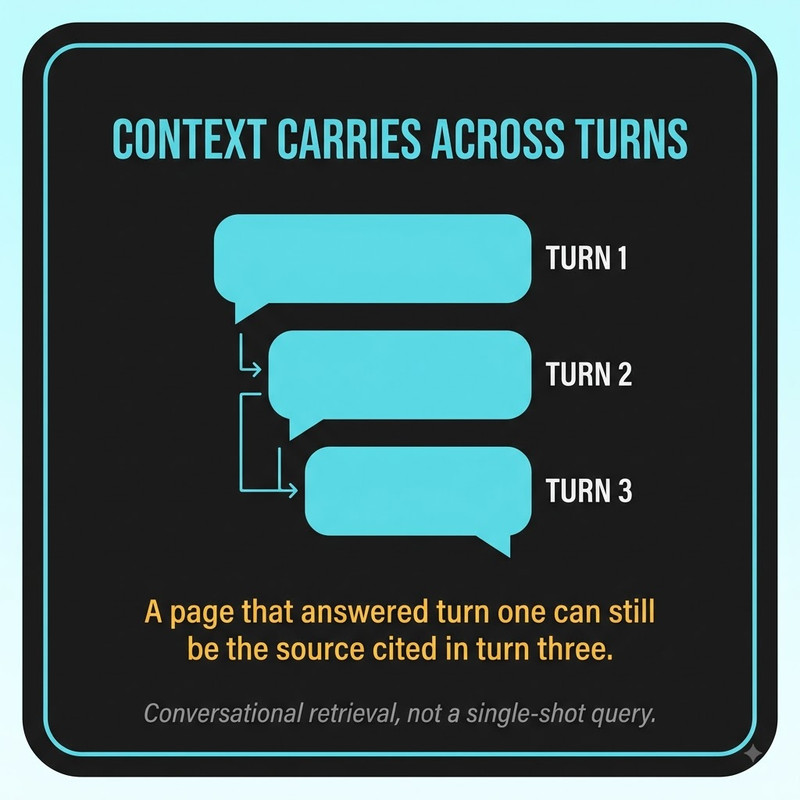
- Structure content so it holds up as a standalone source across a multi-turn conversation, not just for the literal first query. A page that only answers a narrow initial question well may not get referenced again as the conversation continues.
Free Chrome extension
A free AI citation checker for ChatGPT and Gemini
CitoSkeleton passively captures fan-out queries, cited and fetched sources, and brand mentions behind an AI answer — then tracks your GEO visibility against named competitors. 100% local, no account, no server.
Frequently Asked Questions
Is AI Mode available outside the United States, or still US-only as of 2026?
AI Mode expanded well beyond the US during 2026, reaching close to 200 countries and roughly 98 languages by Google's 2026 developer conference.
Does using AI Mode cost anything, or does it require a Google One subscription?
AI Mode is available at no charge as of 2026. An earlier requirement tying some features to a Google One AI Premium subscription during the 2025 Labs testing phase has since been removed for general availability.
Can website owners see when their content gets cited inside an AI Mode conversation?
Google Search Console doesn't currently provide AI-Mode-specific citation reporting the way it reports standard organic impressions and clicks, making direct citation tracking difficult without third-party AI-visibility monitoring tools.
Does AI Mode replace the traditional "All" search results tab, or run alongside it?
AI Mode runs as a separate, dedicated tab alongside the traditional All, Images, Videos, and News tabs. It doesn't replace standard search — users choose which experience to use per query.
How does session memory in AI Mode affect what content gets referenced in a follow-up question?
Because AI Mode maintains context across a session, a follow-up question can pull in additional sources beyond what the first query surfaced. A page might get cited later in a conversation, even if it wasn't relevant to the opening question.
Is there a way to opt a website out of appearing in AI Mode responses specifically?
There's no AI-Mode-specific opt-out separate from standard search visibility controls. A site's general crawlability and indexing settings (robots.txt, robots meta tags) govern whether it can appear across Google's search surfaces broadly.
Does AI Mode's "Thinking with 3 Pro" option run automatically for complex queries, or does a user need to select it manually?
It's presented as a selectable option for users who want deeper reasoning on a specific query, rather than something that switches on automatically based on query complexity alone.
Can AI Mode generate images or only text-based answers?
AI Mode includes generative UI capabilities beyond plain text for certain query types, and image generation features require the user to be signed in to access.
Does AI Mode's Search Live camera feature affect SEO or content strategy at all?
Search Live is a visual, camera-and-voice search mode focused on real-time object and scene identification, rather than text-based web content retrieval. It has limited direct relevance to traditional content or SEO strategy.
How is Google's "agentic" AI Mode capability, announced at I/O 2026, different from the standard conversational feature?
The agentic capability lets AI Mode handle multi-step tasks, like planning and booking assistance, rather than just retrieving and synthesizing information. It moves beyond answering questions into executing actions on the user's behalf.
Does content need to be indexed in traditional Google Search to appear in AI Mode responses?
Yes. AI Mode draws from the same underlying web index and live retrieval infrastructure as standard Google Search. A page unindexed in traditional search has no separate path into AI Mode visibility.
Is AI Mode usage growth actually reducing organic click-through rates for publishers?
Industry reporting through 2026 has associated the broader shift toward AI-generated, zero-click search experiences, AI Mode included, with declining referral traffic for many publishers. Isolating AI Mode's specific contribution from AI Overviews' effect is difficult though, given how closely the two features are used together.


