
TL;DR. An AI hallucination arrives dressed as fact, a fake statistic, an invented court case, stated with total confidence. Research puts the rate at roughly 31 percent of real world model interactions, and OpenAI's 2025 paper argues models hallucinate because training rewards a confident guess over an honest admission of not knowing.
What is an AI hallucination?
An AI hallucination is false or fabricated content that a language model states as fact, often complete with a citation, a source, or a specific number that simply does not exist. Nothing in the sentence signals a problem. Fluent, confident phrasing is exactly what makes hallucinated text dangerous, since there is no textual cue warning a reader the model just invented the claim.
Hallucinations range from a single wrong date to a fabricated legal citation with a realistic docket number attached. For anyone doing AI search work, this is the central trust problem, because a hallucinated fact about your brand can circulate through AI answers well before you ever notice it.
Key highlights
- Peer reviewed research puts the hallucination rate at roughly 31 percent across real world LLM interactions, climbing toward 60 percent in complex or specialized domains.
- A Stanford study found leading models hallucinating on 69 to 88 percent of specific legal queries, a gap wide enough to sink a court filing.
- OpenAI's research, Why Language Models Hallucinate, argues the root cause sits in training itself: standard benchmarks score a confident wrong answer higher than an honest admission of uncertainty, so models learn guessing beats silence.
- Grounding closes most of the gap. Retrieval grounded summarization systems reach about 1 percent hallucination, next to the double digit rates typical of unaided generation.
- Hallucination is not a bug waiting on a patch. It is a byproduct of next word prediction, present to some degree in every model, reducible but not removable.
Why large language models hallucinate
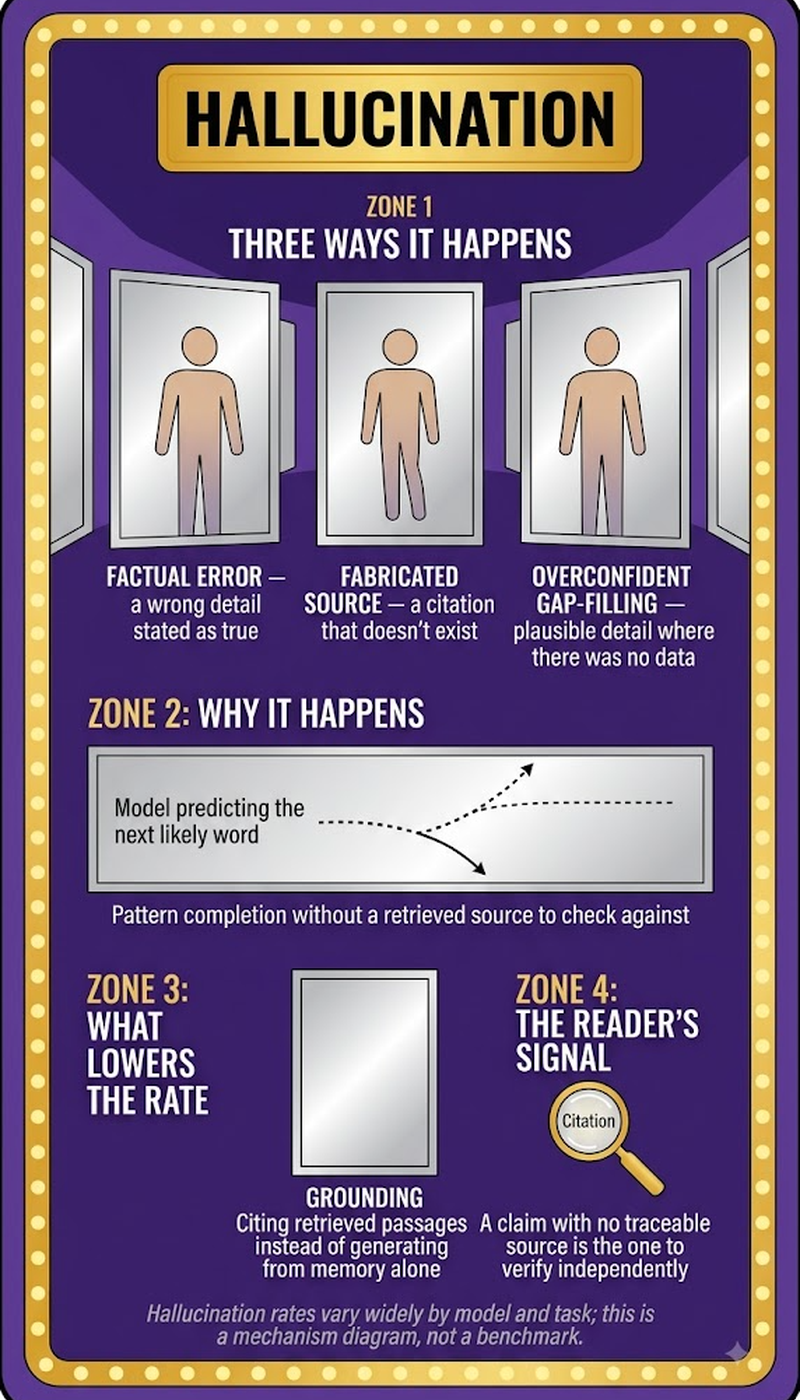
Large language models hallucinate because next word prediction, not fact checking, is the mechanism actually doing the work. There is no internal lookup against ground truth running in the background. When training data thins out or a question turns niche, the model does not stop; it fills the gap with whatever completion looks statistically plausible.
OpenAI's researchers push this further: benchmarks reward a guess over a blank, so a large language model stays in permanent test-taking mode. A wrong answer scores the same as no answer under most evaluation setups, which makes guessing the rational strategy the training process ends up selecting for.
Two more triggers matter specifically for search. A knowledge cutoff leaves a model confidently wrong about anything after its training data ends, and ambiguous entities get blended, two companies sharing a name can merge into one hallucinated hybrid.
Types of AI hallucination
- Factual: a wrong date, number, or claim stated as settled fact.
- Fabricated sources: citations, studies, or URLs that read as real but were never published.
- Intrinsic: the answer directly contradicts the source material it was given.
- Extrinsic: the answer adds detail that cannot be checked against any source at all.
How to reduce AI hallucinations
- Feed the model trusted documents at answer time through retrieval augmented generation so it quotes real sources instead of memory.
Free Chrome extension
A free AI citation checker for ChatGPT and Gemini
CitoSkeleton passively captures fan-out queries, cited and fetched sources, and brand mentions behind an AI answer — then tracks your GEO visibility against named competitors. 100% local, no account, no server.
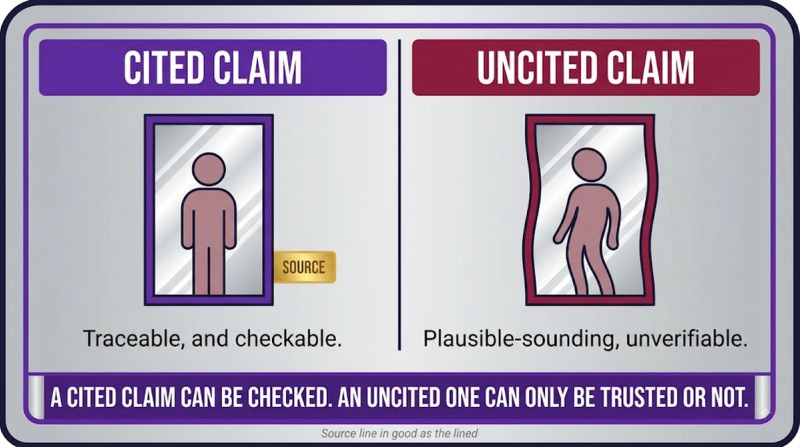
- Ask for citations, then verify every one against the primary source before trusting it.
- Use structured prompts that instruct the model to answer only from the supplied context and to say plainly when it does not know.
- Lower the temperature setting for anything factual; creativity and accuracy trade off directly.
- Keep a human reviewer in the loop for legal, medical, or financial claims, no exceptions.
The thread running through all five is grounding: the more an answer stays tethered to a real, retrievable source, the less room the model has left to invent.
AI hallucinations and your brand
Hallucinations are not only a risk when you use AI. They are a risk when AI describes your brand to someone about to buy from you.
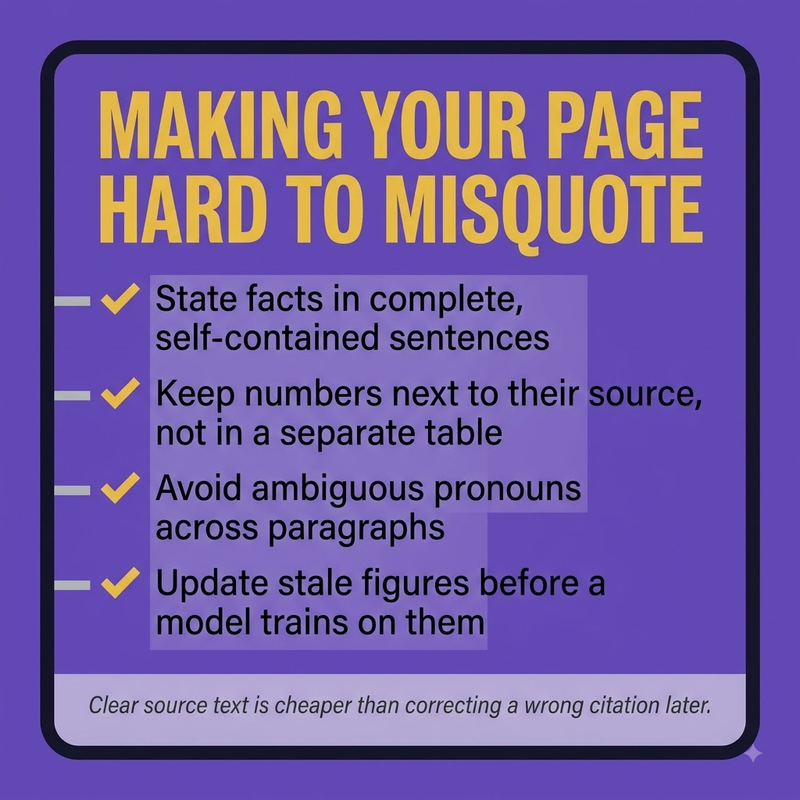
Engines that cannot resolve who you are will guess, and a wrong price or feature becomes a confident, fluent answer. The defense is entity SEO plus corroboration, consistent facts about your brand repeated across trusted sources, so the model has a correct answer sitting there to retrieve.
Track how AI engines actually describe you, and treat a wrong AI citation as a fire to put out immediately, not a curiosity to note for later.
Frequently asked questions
Why do large language models hallucinate?
The short version: guessing scores better than silence. OpenAI's 2025 research traces the behavior to how models get evaluated; benchmarks that mark 'I don't know' wrong the same as any other wrong answer end up training models to never say it. Thin training data and ambiguous entities make individual hallucinations worse, but the scoring incentive is the root cause.
What do AI hallucinations actually look like in practice?
Common patterns include invented statistics, fabricated academic citations, product features that were never built, and fake legal cases complete with realistic docket numbers. The 2023 Mata v. Avianca matter is the textbook case: lawyers filed a brief citing six ChatGPT generated cases that turned out not to exist, and the court sanctioned them for it.
What is the single most effective fix?
Grounding, by a wide margin. Tying an answer to a real, retrieved document instead of the model's memory is what took grounded summarization systems down to roughly 1 percent hallucination. Verification, structured prompts, and lower temperature all help, but none close the gap the way grounding does.
Can AI hallucinations be fully eliminated?
No, and that is worth internalizing rather than fighting. Hallucination is a statistical byproduct of how text gets generated, so it can be reduced sharply with grounding and better prompts but not removed entirely. Even well grounded systems leave a share of statements unsupported, which is exactly why verification still matters for anything with real consequences.
Why does the hallucination rate swing so wildly, from 1 percent to 88 percent?
Because the rate tracks task difficulty and grounding, not the model itself. Tightly grounded summarization sits near 1 percent, general real world use runs around 31 percent, and open ended legal research, where a specific case either exists or it does not, climbed as high as 88 percent in Stanford's testing. The range is a better diagnostic than any single number in it.


