
A large language model (LLM) is an AI system trained on massive volumes of text to predict and generate human-like language, built on a neural network architecture called a transformer that lets it weigh relationships between words across long stretches of text. "Large" refers to two things at once: training data volume, and parameter count — the internal values the model adjusts during training, which for modern LLMs run into the billions or more. Scale is the whole story here. It's what separates an LLM from earlier, narrower language models — what gives it the flexibility to handle open-ended tasks nobody explicitly programmed it for.
Key Takeaways
- LLMs are built on transformer architecture, a design that lets the model weigh relationships between words across long passages rather than processing text strictly left-to-right.
- "Large" refers to scale on two dimensions: training data volume and parameter count — both have grown by orders of magnitude across successive model generations.
- LLMs generate text through next-token prediction, repeatedly estimating the most probable next word or word-fragment given everything that came before it in the sequence.
- An LLM's raw, un-grounded output can be confidently wrong (a hallucination) since the model is optimized for plausible-sounding language, not verified fact — pairing it with retrieval-based grounding is the standard fix.
- LLM-powered search (ChatGPT, Perplexity, Google's AI Mode, and similar) increasingly determines whether a piece of content gets cited at all, making LLM behavior directly relevant to SEO and content strategy, not just an AI-industry curiosity.
Grounding is the direct mechanism that connects LLM output to verifiable sources, and understanding it explains why some content gets cited reliably in AI answers while comparable content doesn't. For content specifically optimized for AI retrieval, answer engine optimization covers the practical strategy layer this page's technical foundation supports.
How Does an LLM Actually Generate Text?
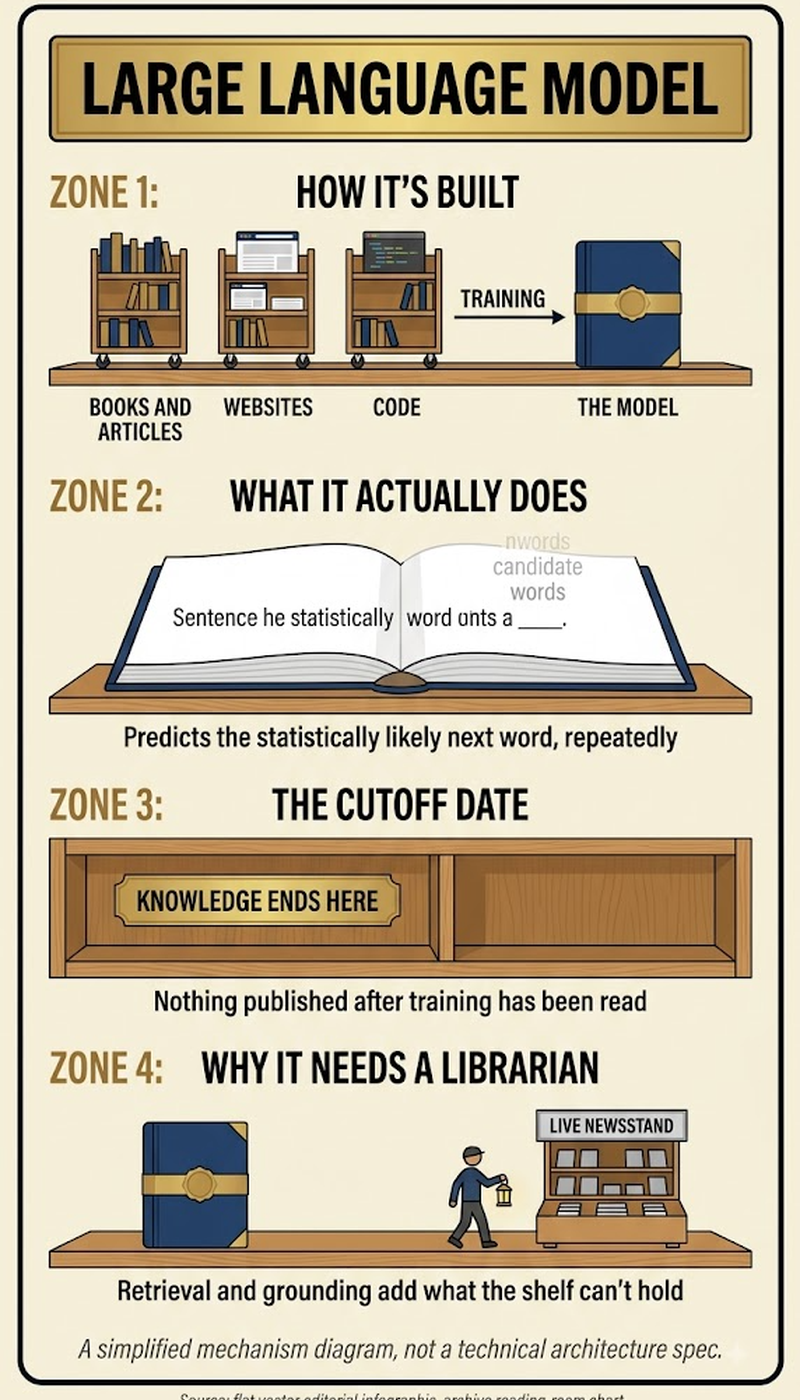
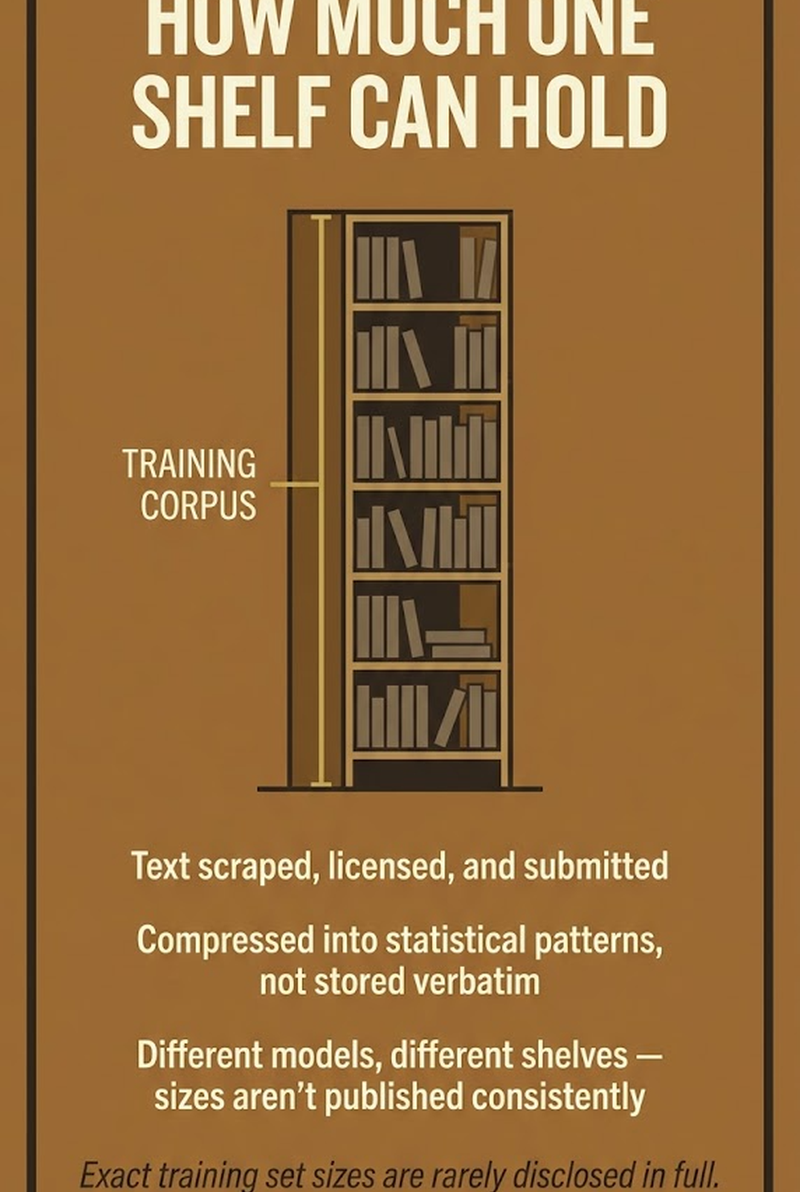
An LLM generates text through next-token prediction — repeatedly estimating the most probable next word or word-fragment based on everything that's come before it in the current sequence, one token at a time, until the response is complete. Training happens in a pre-training phase on massive, largely static text datasets — books, articles, websites, code — which gives the model its broad language ability and general knowledge, frozen at whatever point that training data was collected. That's the source of a limitation worth stating plainly: a model's raw knowledge has a cutoff, and anything after that point simply isn't in its training data unless it's been given external access to retrieve it.
What's the Actual Difference Between an LLM and "Generative AI"?
Generative AI is the broader category covering any AI system that creates new content — text, images, audio, video — while an LLM is specifically the subset built for language, meaning every LLM is generative AI but not every generative AI system is an LLM. An image generator and a large language model are both generative AI, built on related but distinct underlying architectures serving fundamentally different output types. The distinction matters practically because the strengths, failure modes, and evaluation criteria differ meaningfully across categories — a claim about LLM accuracy doesn't automatically transfer to an image model's accuracy, and treating "generative AI" and "LLM" as interchangeable terms tends to blur genuinely different technical discussions.
How the terms relate:
- Generative AI — broad category, any AI creating new content. Example output: text, images, audio, video, code.
- LLM — specific subset focused on language. Example output: text generation, conversation, summarization.
- Multimodal model — handles multiple input/output types together. Example output: text + image understanding combined.
Why Do LLMs Sometimes Generate Confidently Wrong Information?
LLMs are optimized to produce plausible, fluent language based on patterns in training data — not to verify factual accuracy against a live source of truth — which is exactly why a model can generate a confident, well-formed, and entirely incorrect answer. This behavior, commonly called hallucination, isn't a bug in the traditional sense; it's a direct consequence of how the underlying prediction mechanism works. The model doesn't "know" it's wrong because it isn't checking against anything external by default — it's generating the statistically likely continuation of the text, and a fluent wrong answer and a fluent right answer look structurally identical to the mechanism producing them. Retrieval-augmented generation (RAG) — connecting a model to a live, verifiable data source at query time — is the standard mitigation, though it reduces rather than eliminates the risk.
How Does LLM Behavior Actually Affect SEO and Content Strategy?
LLM-powered search tools decide what to cite based on how well a piece of content can be extracted, trusted, and attributed — which means understanding how these models process content has become directly relevant to visibility strategy, not just an academic AI question. A few practical implications follow directly from how LLMs work:
- Content needs to be genuinely extractable — clear, self-contained passages that answer a specific question — since LLMs pull and synthesize from retrieved passages rather than reading a full page the way a human does.
- Factual accuracy and specificity matter more than ever, since a model grounding its answer in retrieved content is only as reliable as the sources it's pulling from.
- Structured, well-organized content (clear headers, direct answers, genuine specificity) tends to retrieve and cite more reliably than vague, generalized writing — the same qualities that help a human skim also help a retrieval system extract.
Free Chrome extension
A free AI citation checker for ChatGPT and Gemini
CitoSkeleton passively captures fan-out queries, cited and fetched sources, and brand mentions behind an AI answer — then tracks your GEO visibility against named competitors. 100% local, no account, no server.
- Being the source an LLM actually cites, rather than merely being indexed, is an increasingly distinct goal from traditional ranking — visibility in an AI-generated answer doesn't guarantee a click the way a traditional search result does.
Frequently Asked Questions
Do all LLMs use the exact same transformer architecture, or does it vary meaningfully between models?
The core transformer concept is shared, but specific implementations, training techniques, and architectural refinements vary significantly between developers and model generations, which is part of why different LLMs behave differently even on similar tasks.
Can an LLM access the internet in real time, or is it limited to its training data?
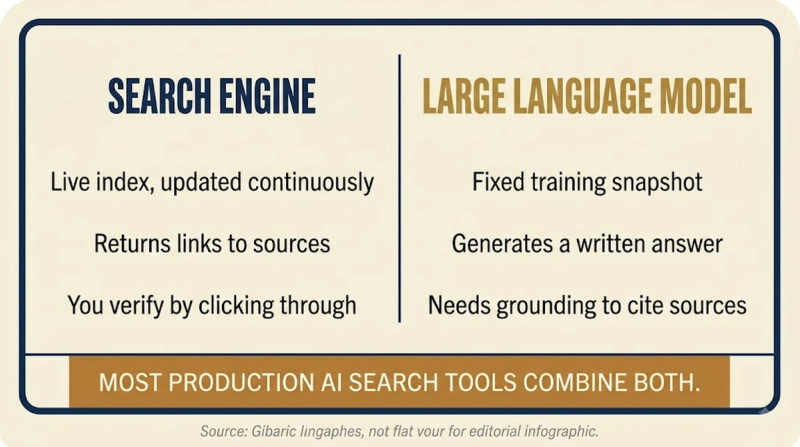
By default, a base LLM is limited to its training data; internet access requires an explicit added capability (like a browsing tool or retrieval system) connected to the model rather than being inherent to the LLM itself.
What does "context window" mean for an LLM, and why does it matter?
The context window is the amount of text (measured in tokens) a model can consider at once during a single interaction — a larger context window lets it reference more surrounding information, which affects both accuracy and the length of conversation it can meaningfully track.
Does a larger parameter count always mean a better-performing LLM?
Not necessarily — parameter count is one factor among several (training data quality, architecture refinements, fine-tuning) that determine real-world performance, and smaller, well-trained models sometimes outperform larger, less-refined ones on specific tasks.
How is an LLM different from a traditional chatbot built with rule-based scripting?
A rule-based chatbot follows explicitly programmed decision trees and can only respond to anticipated inputs, while an LLM generates novel responses to inputs it was never specifically programmed to handle, based on patterns learned during training.
Can LLMs be fine-tuned for a specific company's or industry's data?
Yes — fine-tuning adjusts a pre-trained LLM using a narrower, domain-specific dataset, which is a common way businesses adapt a general-purpose model to specialized terminology and use cases without training an entirely new model from scratch.
Does using an LLM for content writing count as AI-generated content that search engines penalize?
Search engines have generally clarified that AI-assisted content isn't penalized purely for being AI-assisted; what matters is whether the final content is accurate, valuable, and meets quality standards, regardless of the tools used to help produce it.
What is "temperature" in the context of LLM outputs?
Temperature is a setting that controls how predictable versus varied an LLM's word choices are — a lower temperature produces more conservative, predictable text, while a higher temperature produces more varied, sometimes more creative but less consistent output.
Do open-source LLMs work fundamentally differently than proprietary ones like those from major AI labs?
The underlying transformer-based mechanism is generally similar; the meaningful differences tend to be in training data, scale, fine-tuning approach, and how much of the system is publicly inspectable rather than a fundamentally different generation process.
Can an LLM explain its own reasoning, or is that explanation itself just generated text?
An LLM's explanation of its reasoning is itself generated output using the same prediction mechanism as any other response, which means it can sound like genuine introspection while not necessarily reflecting the model's actual internal computation.
How does multilingual capability work in a large language model?
Multilingual LLMs are trained on text data spanning multiple languages simultaneously, which allows the model to generate and often translate across those languages, though performance quality typically varies by how much training data existed for each specific language.


