
Grounding is the process of connecting an AI model's output to verifiable, external, or real-world information — rather than letting the model rely purely on patterns learned during training — to make its responses more accurate, current, and trustworthy. An LLM's training data is static, frozen at whatever point it was collected, and full of patterns rather than checked facts. Grounding is the fix: giving the model access to specific, current, verifiable sources at the moment it generates a response, instead of asking it to answer entirely from memory.
Key Takeaways
- Grounding and retrieval-augmented generation (RAG) aren't the same thing — grounding is the goal (accurate, verifiable output), RAG is the most common technique used to achieve it.
- An un-grounded model answers purely from patterns learned during training, which is static and can be outdated, incomplete, or simply wrong on specifics it was never trained on accurately.
- Grounding reduces hallucination risk but doesn't eliminate it entirely — a grounded response is only as reliable as the source it's grounded in.
- Google's AI-powered search features (AI Overviews, AI Mode) rely on grounding to tie generated answers back to indexed web content, which is the direct mechanism connecting content quality to AI-search citation.
- Gartner has predicted that a majority of AI projects will be scrapped specifically due to poor grounding — underscoring that this isn't a minor technical detail but a central reliability problem in applied AI.
Grounding sits directly underneath large language model behavior and connects to hallucination as the failure mode grounding is specifically designed to reduce. For content strategy, grounding is the mechanism that makes chunk retrievability matter in the first place — a system can only ground a response in content it can actually retrieve and trust.
What's the Actual Difference Between Grounding and RAG?
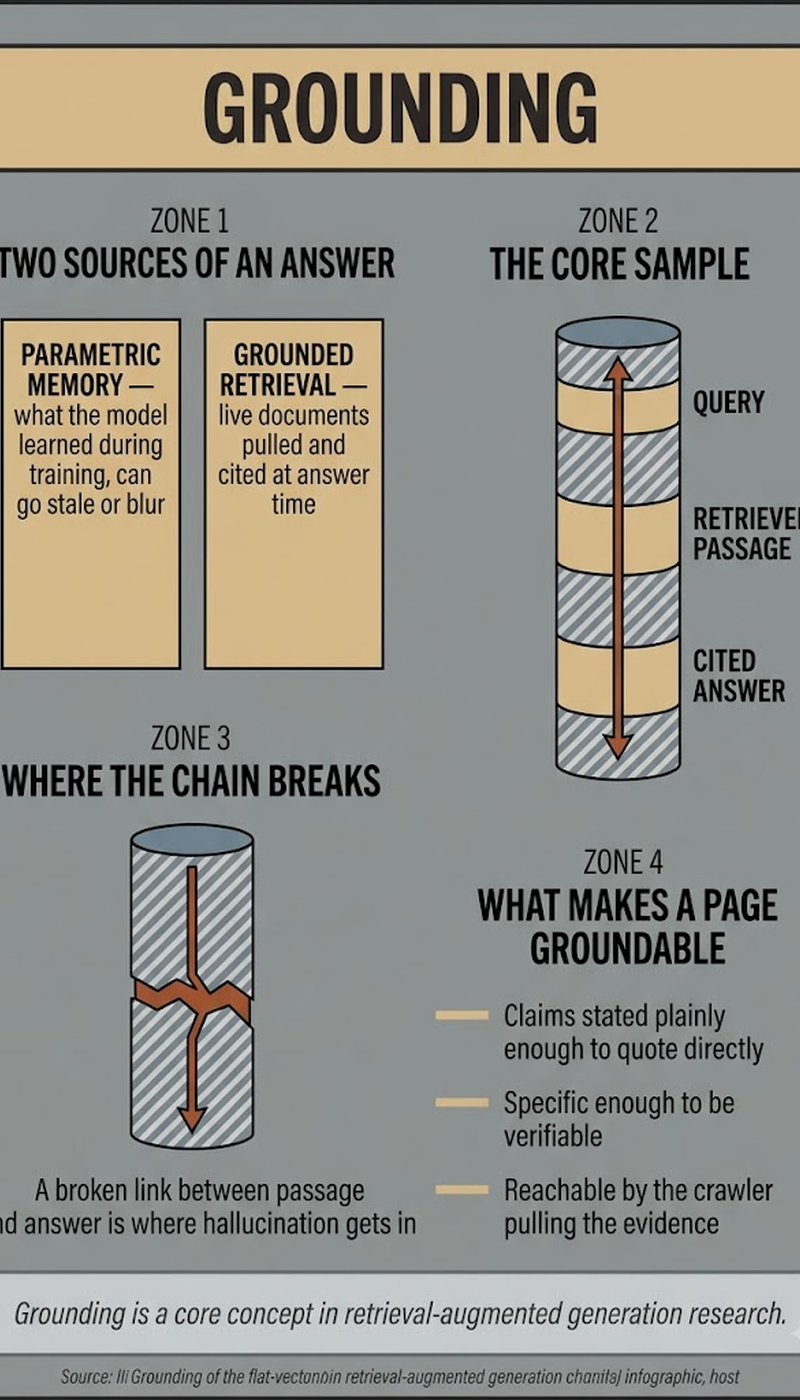
Grounding is the outcome — an AI response that's accurate, verifiable, and tied to real information — while retrieval-augmented generation (RAG) is the specific technique most commonly used to achieve that outcome, and the two terms get used interchangeably far more often than they should be. RAG works by retrieving relevant documents or data from an external source at the moment of a query, then feeding that retrieved content to the model as additional context before it generates a response. Grounding is the broader goal RAG serves; fine-tuning on domain-specific data is another, less common technique that can also contribute to grounding without being RAG at all. Conflating the two obscures a useful distinction — asking "is this grounded" is a different question than asking "does this use RAG."
How Does Grounding Actually Reduce AI Hallucination?
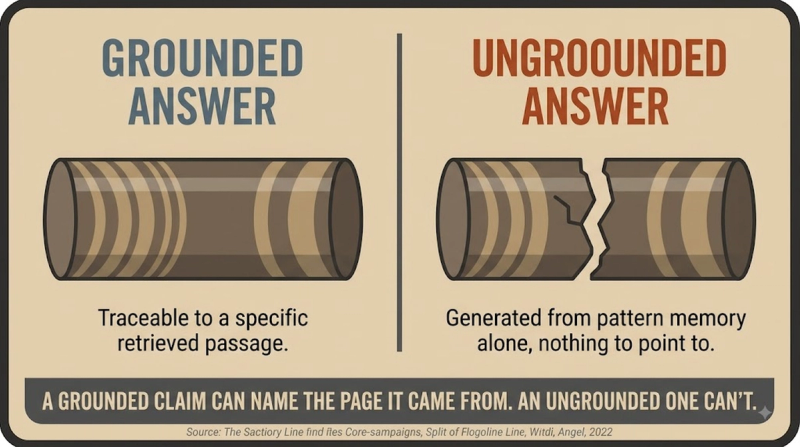
Grounding reduces hallucination by constraining what the model generates to content it can actually point back to, rather than letting it generate purely from the statistical patterns learned during training — where a fluent, confident, and entirely wrong answer is structurally indistinguishable from a fluent, correct one. An un-grounded model has no built-in mechanism to check its own output against anything external; it's optimized to produce plausible language, not verified fact. A grounded system, by contrast, retrieves specific source material and generates a response using that material as context, which gives it something real to reference and, often, cite directly. This meaningfully lowers hallucination risk — it doesn't eliminate it. A grounded model can still misinterpret or misrepresent the source it was given; grounding improves the odds, it doesn't guarantee accuracy.
Comparing approaches:
- Un-grounded (base model) — source of information: training data patterns only. Hallucination risk: higher. Currency: frozen at training cutoff.
- RAG-grounded — source of information: retrieved external documents at query time. Hallucination risk: lower. Currency: current, as fresh as the source.
- Fine-tuned — source of information: additional training on domain-specific data. Hallucination risk: moderate. Currency: current as of fine-tuning date.
How Does Grounding Connect to Google's AI-Powered Search Features?
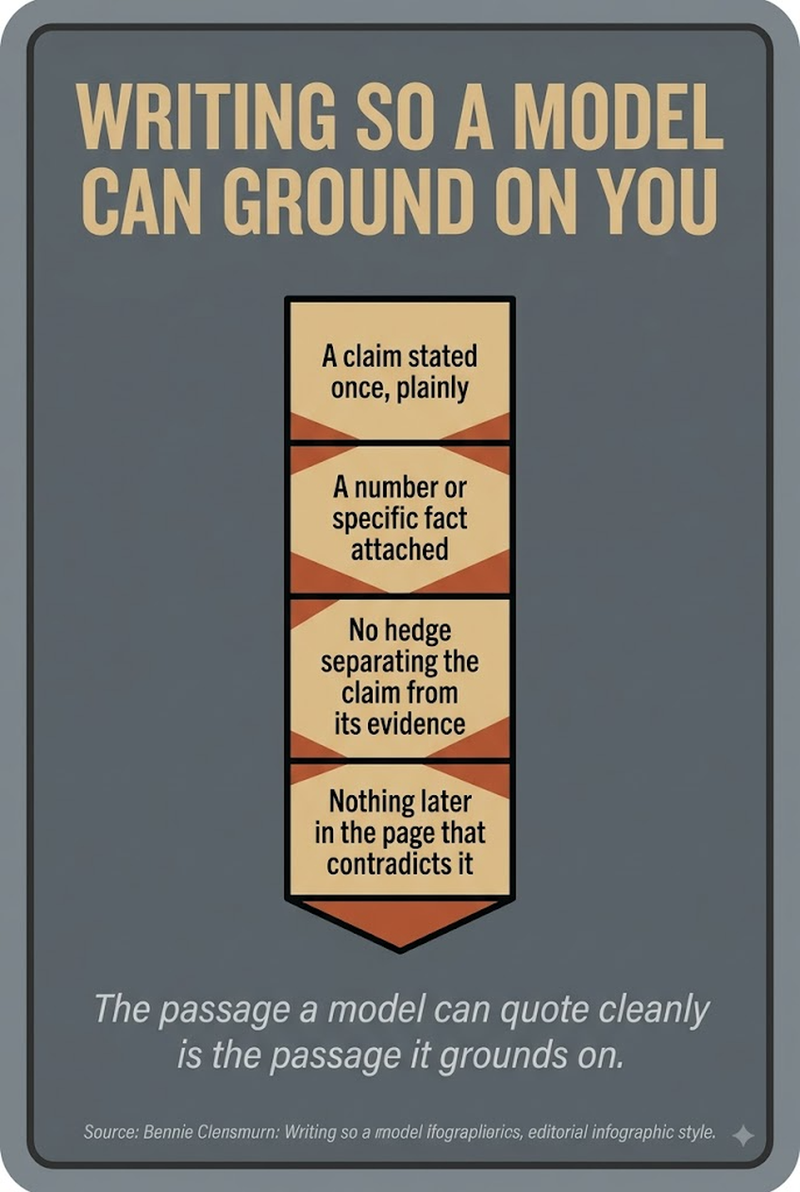
Google's AI-generated search features — AI Overviews and AI Mode among them — rely on grounding to tie generated answers back to real, indexed web content rather than letting the underlying model answer purely from its training data, which is exactly the mechanism that determines whether a specific page gets cited in an AI-generated response. When a system retrieves and grounds its answer in a specific page's content, that page has a chance at citation; content that's vague, unverifiable, or poorly structured for extraction is simply less useful as grounding material, regardless of how well it might otherwise read to a human. This is the direct, practical link between content quality and AI-search visibility — grounding isn't just an AI-engineering concern, it's the mechanism that decides which sources show up in an AI-generated answer at all.
Why Does Poor Grounding Matter So Much in Practice?
Gartner has publicly predicted that a majority of AI projects will be scrapped specifically because of poor grounding — a figure worth taking seriously, since it frames grounding as a central reliability problem rather than a minor technical footnote. Ungrounded AI tools that hallucinate outdated product specs, invented policies, or fabricated data erode trust fast, and the failure mode is often silent until someone catches a specific wrong answer in production. For businesses building or evaluating AI tools, a few practical grounding checks matter:
- Confirm whether a given AI tool retrieves live, current data or relies purely on a static training snapshot — the answer changes what kinds of questions it's safe to trust it with.
- Check whether the tool cites its sources directly, since visible citations are a strong signal the response is actually grounded rather than generated from pattern alone.
- Test the tool against a known, verifiable fact it would need current or specific data to answer correctly — a wrong answer here is a fast, practical grounding check.
Free Chrome extension
A free AI citation checker for ChatGPT and Gemini
CitoSkeleton passively captures fan-out queries, cited and fetched sources, and brand mentions behind an AI answer — then tracks your GEO visibility against named competitors. 100% local, no account, no server.
- Treat any AI-generated output involving specific numbers, dates, or claims as unverified until grounding is confirmed, especially for anything customer-facing.
Frequently Asked Questions
Can a model be partially grounded, or is grounding an all-or-nothing property?
Grounding exists on a spectrum — a response can be partially grounded (some claims tied to retrieved sources, others generated from training patterns), which is part of why fact-checking AI output remains important even when grounding is in use.
Does grounding require internet access, or can it work with private, internal data?
Grounding works with any external, verifiable data source — internet access, internal company documents, or a private database — the defining feature is that the model retrieves and references real data at query time, not that the data is public.
Is fine-tuning a substitute for grounding, or a completely separate approach?
Fine-tuning can contribute to grounding by giving a model deeper, more current domain-specific knowledge, but it's generally considered less dynamic than RAG-based grounding since fine-tuned knowledge is also frozen as of the fine-tuning date.
How can an ordinary user tell if an AI tool's answer is actually grounded?
Visible citations, source links, or explicit references to specific documents are the clearest practical signal; an answer with no citations and no indication of where the information came from should be treated with more caution.
Does grounding slow down an AI system's response time compared to an ungrounded model?
Yes, generally — retrieving external data before generating a response adds a processing step that ungrounded generation skips, though the delay is often small enough to be imperceptible in well-optimized systems.
Can grounding introduce new errors if the retrieved source itself is wrong or outdated?
Yes — grounding is only as reliable as what it's grounded in, so a system retrieving from an inaccurate or stale source can confidently generate a wrong answer that looks well-sourced.
Is "grounding" used the same way across all major AI companies, or does terminology vary?
The core concept is broadly consistent, though specific companies sometimes use their own branded terminology for their particular grounding implementation or feature.
Does every AI chatbot use grounding by default, or is it an optional add-on feature?
It varies — many consumer AI chatbots now include some form of grounding (web search, retrieval) by default, but base/raw model access, especially via API, is often ungrounded unless explicitly configured otherwise.
How does grounding relate to a model's training data cutoff date?
Grounding is specifically what allows a model to provide accurate, current information beyond its training cutoff, since the retrieved external source can be as current as the moment of the query rather than limited to when training data was collected.
Can grounding be applied to creative or subjective tasks, or is it only relevant for factual questions?
Grounding is most relevant for factual, verifiable claims; creative or subjective tasks (writing style, brainstorming) don't typically benefit from grounding the same way since there's no external "correct" source being verified against.
Does poor grounding specifically explain why some AI search tools cite outdated statistics?
Yes — if a tool retrieves from a stale or infrequently updated source, or fails to retrieve at all and falls back to training-data patterns, outdated statistics are a direct, predictable symptom of that grounding gap.


