
Chunk retrievability is how easily an AI retrieval system can independently locate, extract, and cite a specific self-contained segment of content — a "chunk" — in response to a relevant query, without needing the surrounding page for context. It combines two established AI-engineering concepts: chunking, the practice of breaking content into smaller, logical segments for retrieval-augmented generation (RAG) systems, and retrievability, how well a given segment matches and surfaces for the queries it's actually relevant to. Higher chunk retrievability means a passage stands on its own well enough that an AI system can pull it out, understand it, and cite it accurately — without the reader (or the retrieval system) needing anything else on the page to make sense of it.
Key Takeaways
- Chunk retrievability isn't a single-coined term from one study — it's a practical combination of "chunking" (segmenting content for AI retrieval) and "retrievability" (how well a segment matches relevant queries), both established RAG/AI-engineering concepts.
- Many AI systems process content in chunks bounded by headings, paragraph breaks, and list structures rather than reading a full page linearly the way a human does.
- Google has explicitly stated that content chunking isn't necessary for visibility in its own AI systems — this matters, since overclaiming it as a universal Google requirement would misrepresent the actual guidance.
- A common failure mode called the "pronoun penalty" happens when a chunk relies on pronouns ("the company," "this approach") instead of named entities, making the chunk unclear when retrieved on its own, outside its original context.
- There is currently no meaningful measured search volume for this term — it's written here for concept coverage and positioning ahead of demand, not because keyword data shows current search interest.
Chunk retrievability connects directly to answer engine optimization as part of the broader practice of structuring content for AI-search visibility, and to large language model for the underlying mechanism (retrieval-augmented generation) that makes chunk-level retrieval relevant in the first place.
Why Do AI Systems Process Content in Chunks Instead of Whole Pages?
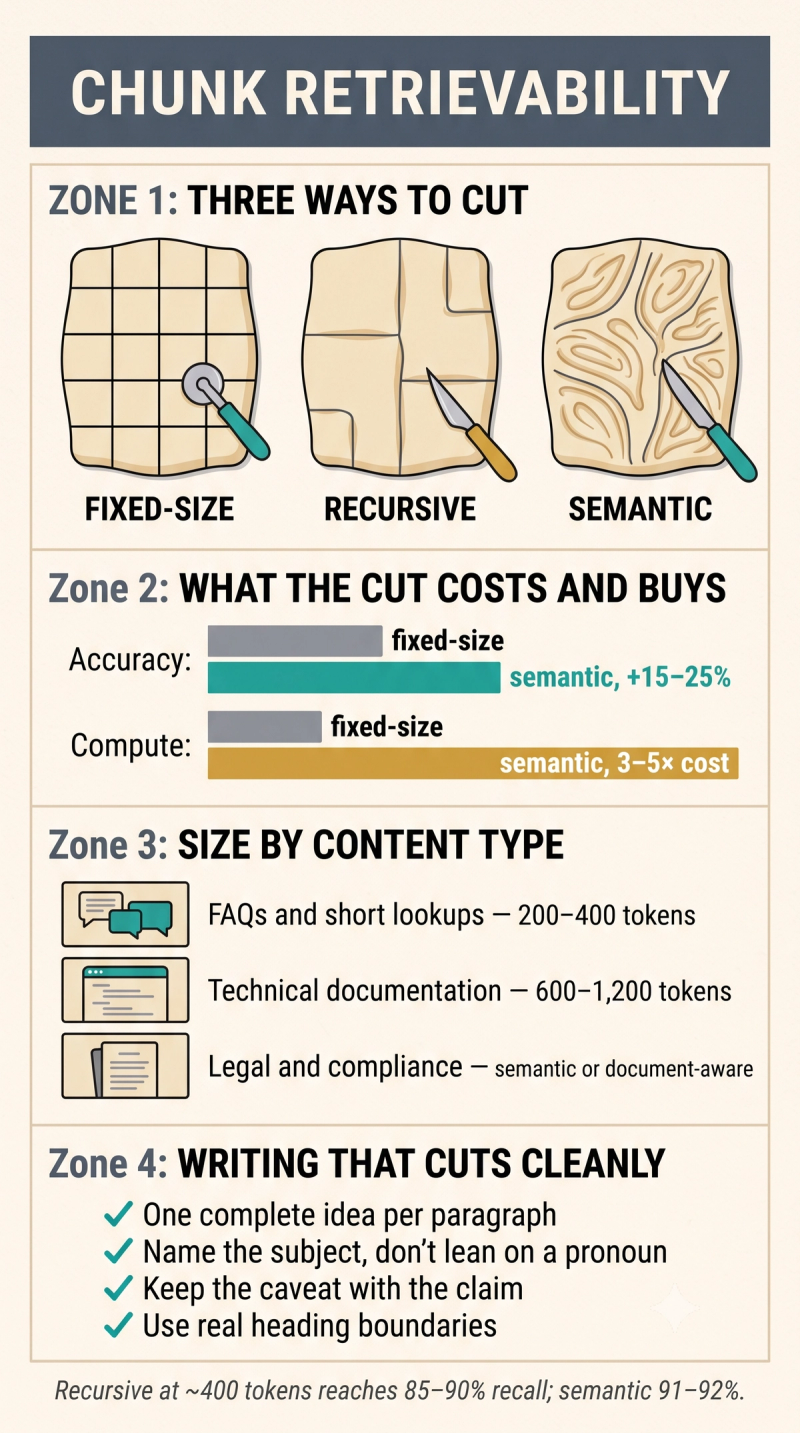
Most AI retrieval systems don't read an entire page the way a human visitor does — they break content into smaller, independently indexed segments bounded by structural markers like headings, paragraph breaks, and list items, because that's what makes fast, targeted matching against a specific query possible at scale. Searching across full, undivided pages for every query would be computationally expensive and imprecise; a focused passage is far more likely to match a specific question cleanly than an entire page is. This is the same underlying logic behind retrieval-augmented generation (RAG) systems generally — index granular pieces, retrieve only the relevant ones, then generate a response grounded in what got retrieved.
Does Content Actually Need to Be "Chunked" for Google's AI Systems Specifically?
No, not according to Google directly — Google has said content chunking isn't necessary for visibility in its own AI search systems, even though structuring content this way remains genuinely useful for broader GEO and AEO strategy across other AI platforms. That's a distinction worth holding onto rather than collapsing into a blanket "you must chunk your content" claim. What Google's own guidance suggests is that passage-level clarity still matters — Google's systems can identify and surface relevant passages within a page without requiring the page to be literally pre-segmented into discrete chunks. Chunking becomes more directly relevant for RAG-based tools and other AI platforms that explicitly retrieve and cite smaller passages as their core mechanism.
What Makes a Chunk of Content Actually Retrievable?
A retrievable chunk answers a specific question clearly, names its own entities explicitly, and makes sense as a standalone passage without requiring the rest of the page for context — three conditions that sound simple but get violated constantly in ordinary web writing.
Low vs. high retrievability:
- Entity references — low: "The company grew revenue 3%." High: "Acme Corp grew Q3 2026 revenue 3%."
- Self-containment — low: assumes prior paragraph's context. High: complete, standalone meaning.
- Structural boundary — low: buried mid-paragraph. High: bounded by a clear heading.
- Specificity — low: vague, general claim. High: named figures, dates, sources.
The "pronoun penalty" is the most common failure pattern: a chunk that reads "the company's revenue grew by 3% over the previous quarter" makes perfect sense within its original paragraph, but retrieved on its own — which is exactly how a chunk-based system uses it — it's ambiguous. Which company? Which quarter? Repeating the actual entity name and specific timeframe inside each chunk, rather than relying on a pronoun that only makes sense in the original flow, is the practical fix.
How Do You Structure Content for Better Chunk Retrievability?
Structuring for retrievability doesn't require rebuilding a site's content strategy from scratch — it's mostly disciplined editing:
- Use clear, descriptive headings that bound each logical section, since headings are one of the primary structural markers AI systems use to identify chunk boundaries.
- Name entities explicitly within each section rather than relying on pronouns that only resolve correctly when read in full context.
Free Chrome extension
A free AI citation checker for ChatGPT and Gemini
CitoSkeleton passively captures fan-out queries, cited and fetched sources, and brand mentions behind an AI answer — then tracks your GEO visibility against named competitors. 100% local, no account, no server.
- Keep each section's core claim self-contained — a reader (or retrieval system) landing on just that section should be able to understand it without scrolling up.
- Use Q&A-style formatting where it fits naturally, since a direct question-answer pair maps closely to how users actually phrase queries to AI systems.
- Avoid burying a key fact mid-paragraph when it could instead anchor its own clearly headed section — retrievability rewards structural clarity over dense prose.
Frequently Asked Questions
Is chunk retrievability the same concept as featured snippet optimization?
They're related but distinct — featured snippet optimization targets one specific Google SERP feature with its own formatting rules, while chunk retrievability is a broader concept applying to how any AI retrieval system processes and extracts passages.
Does a longer, more comprehensive article hurt chunk retrievability compared to a shorter, more focused one?
Not inherently — a long article can retrieve well if it's internally structured into clear, self-contained sections; the risk is a long article written as one continuous, unstructured narrative rather than length itself.
Can images or video content be "chunked" the same way text can?
Multimodal chunking exists for structured multimedia content, though the mechanics differ from text chunking and are less standardized across current AI retrieval systems as of 2026.
Does chunk retrievability apply differently to product pages versus long-form articles?
The underlying principle (self-contained, entity-clear passages) applies to both, though product pages tend to have naturally more structured, chunkable content (specs, pricing, features) than narrative articles do.
Is there a specific ideal chunk length in words for maximum retrievability?
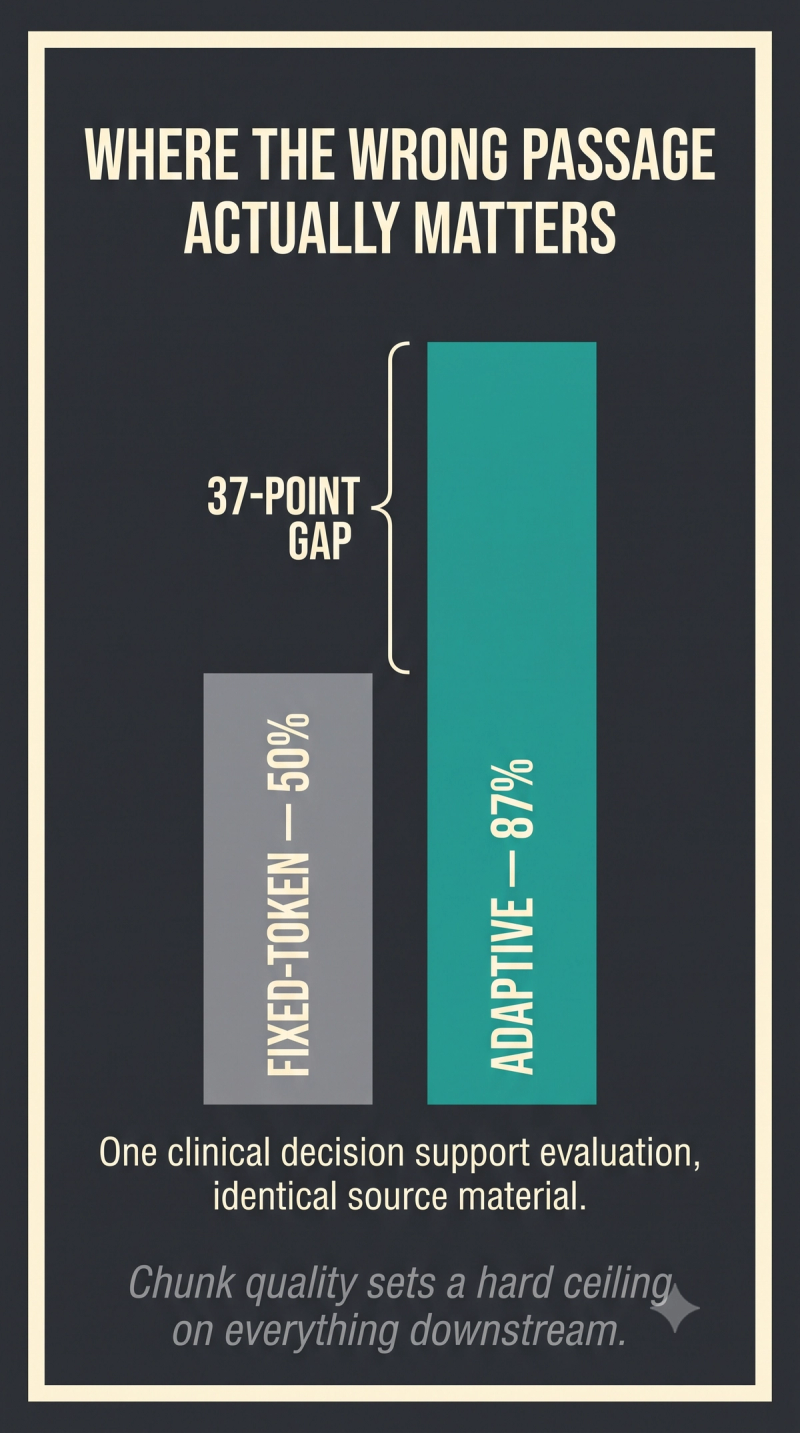
There's no single universally agreed number; general guidance in current GEO practice suggests roughly 100–300 words per self-contained chunk, though this varies by content type and the specific retrieval system involved.
Do FAQ sections naturally perform well for chunk retrievability?
Yes — a well-written FAQ's question-answer format inherently creates bounded, self-contained chunks that map closely to how users phrase queries, which is part of why FAQ content tends to retrieve well in AI-generated answers.
Can poor chunk retrievability cause content to be cited inaccurately by an AI system, rather than just not cited at all?
Yes — if a retrieval system extracts an ambiguous, pronoun-dependent chunk without enough context, it can generate an inaccurate or misattributed summary based on that unclear passage, not just fail to retrieve it.
Does adding schema markup improve chunk retrievability?
Structured data doesn't directly create chunk boundaries the way headings do, but it does provide additional machine-readable context that can help retrieval systems correctly interpret ambiguous content.
Is chunk retrievability something that can be measured directly with an existing SEO tool?
As of 2026, there's no standardized, widely adopted tool that directly scores chunk retrievability; most current practice relies on manual structural review and testing how content performs when queried directly in AI search tools.
How does chunk retrievability relate to internal linking strategy?
They're largely independent — internal linking connects whole pages to each other for site-wide authority flow, while chunk retrievability concerns how a single page's content is structured internally for passage-level extraction.


