
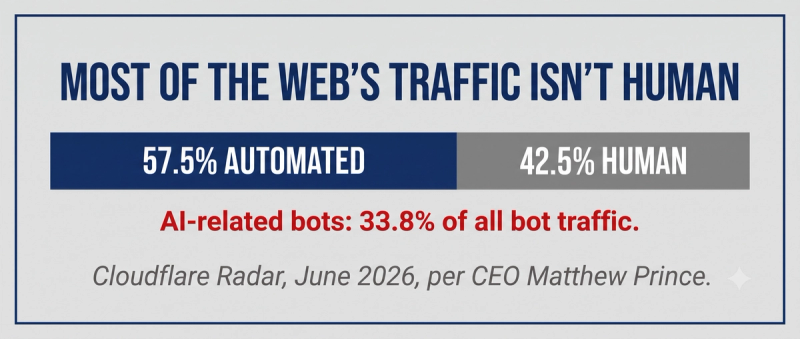
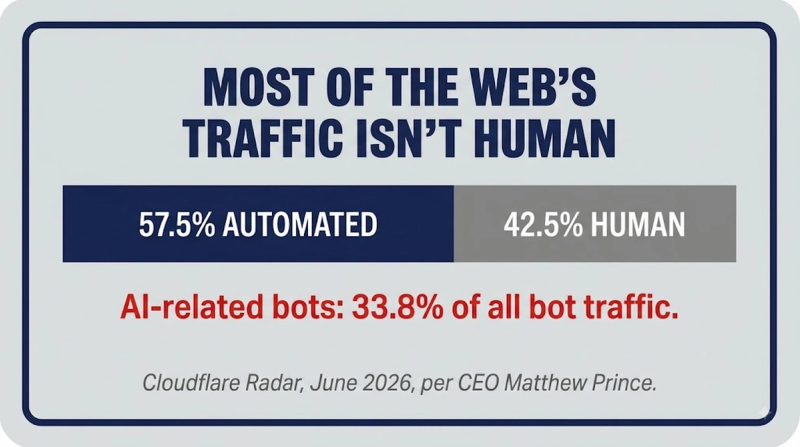
TL;DR. AI bots identify themselves through a user agent string, GPTBot, ClaudeBot, PerplexityBot, the automated program a company sends out to fetch pages for either model training or live AI-search retrieval, announcing itself in the same HTTP header traditional search crawlers have used for decades. Cloudflare Radar data from June 2026 found automated requests make up 57.5% of HTML traffic to web content, and AI-related bots account for 33.8% of all bot traffic, numbers that make user-agent identification the starting point for any decision about what to let in.
What is an AI bot (user agent)?
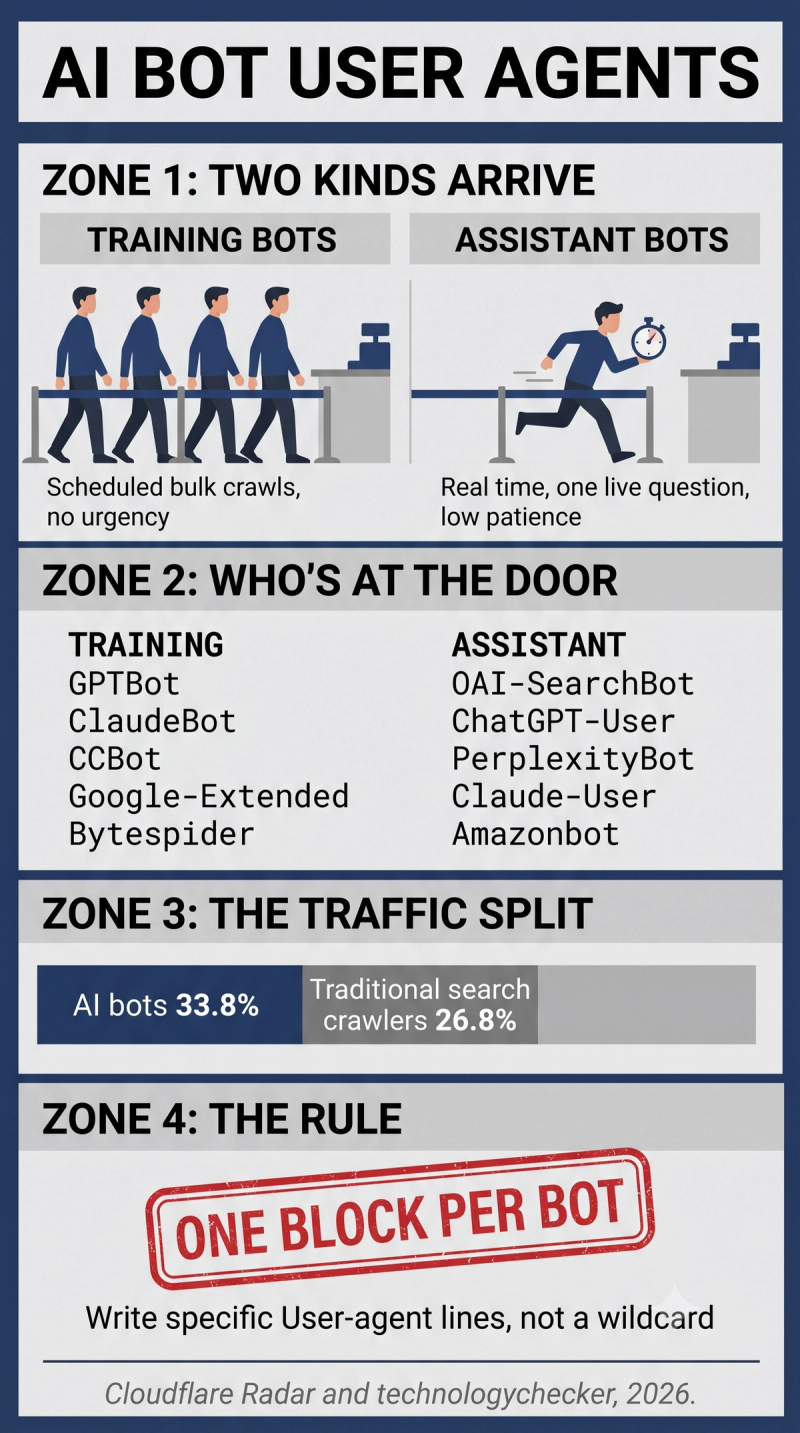
An AI bot is an automated crawler run by an AI company, self-identifying through a user agent string in its HTTP requests, the same mechanism traditional search engines like Googlebot have relied on for decades. Each AI bot exists for one of two broad purposes: some fetch pages to build the dataset behind a foundation model, others fetch pages in real time to answer one specific user's question inside a chat or search interface. Server logs and robots.txt rules both key off this same string, which is exactly why correctly telling one bot from another matters before deciding what to allow.
Key highlights
- Cloudflare Radar data from June 2026 found automated requests make up 57.5% of HTML traffic to web content, against 42.5% from humans, per CEO Matthew Prince.
- AI-related bots account for 33.8% of all bot traffic, with crawlers, assistants, and AI search combined now rivaling traditional search-engine crawlers at 26.8%, per technologychecker's 2026 AI crawler statistics.
- Cloudflare's May 2026 data found 51.8% of AI crawler requests exist for training purposes, while only 9.3% are for search.
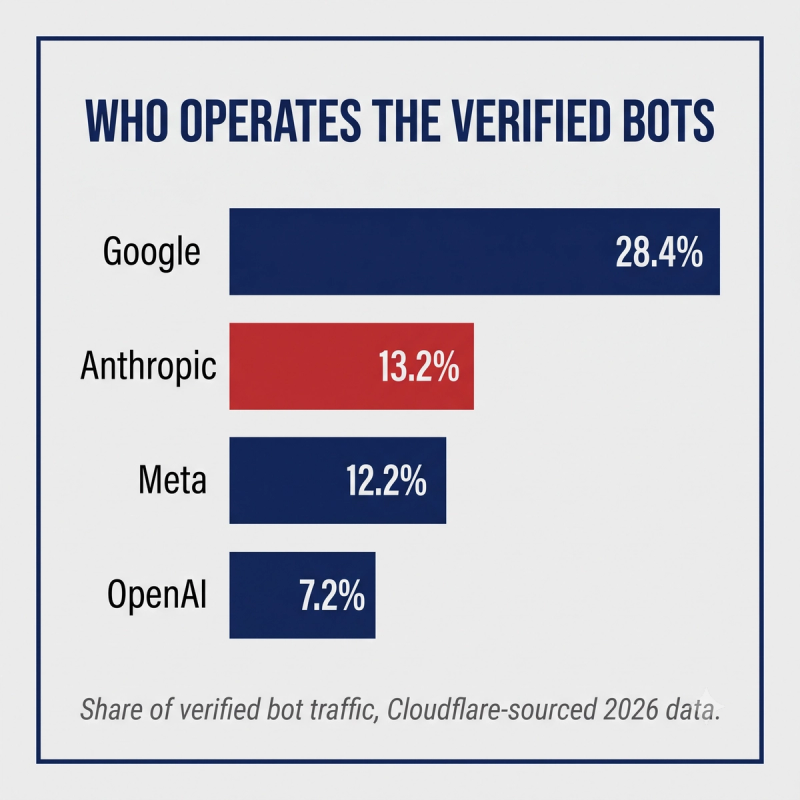
- Anthropic runs the number-two bot operator at 13.2% of verified bot traffic, ahead of Meta's 12.2% and nearly double OpenAI's 7.2%, with only Google's 28.4% outrunning it.
- Imperva's Bad Bot Report 2026 found automated traffic reached 53% of all web traffic in 2025, up from 51% the year before.
Major AI bot user agents
Training bots: GPTBot (OpenAI), ClaudeBot and anthropic-ai (Anthropic), CCBot (Common Crawl), Google-Extended (Google), Applebot-Extended (Apple), Bytespider (ByteDance), and AI2Bot (Allen Institute for AI).
Assistant and retrieval bots: OAI-SearchBot and ChatGPT-User (OpenAI), PerplexityBot and Perplexity-User (Perplexity), Claude-User and Claude-SearchBot (Anthropic), and Amazonbot (Amazon).
Training bots vs assistant bots
Training bots crawl in large, scheduled batches to build a foundation model's underlying dataset, with no urgency tied to any one user, and they consistently respect robots.txt.
Assistant bots work differently. They fetch pages in real time because a specific person just typed a specific question, arrive scattered throughout the day rather than in batches, and carry far less patience for a slow or redirect-heavy page, since whatever delay happens there is felt directly by the person waiting on an answer.
Identifying and managing AI bots
Free Chrome extension
A free AI citation checker for ChatGPT and Gemini
CitoSkeleton passively captures fan-out queries, cited and fetched sources, and brand mentions behind an AI answer — then tracks your GEO visibility against named competitors. 100% local, no account, no server.
- Check server access logs for the User-Agent header on incoming requests, since every legitimate AI bot identifies itself openly rather than disguising itself as a browser.
- Cross-reference the exact string against a maintained bot list, since operators periodically add new bots and small naming variants.
- Decide per bot, not with one blanket rule, whether to allow training bots, assistant bots, both, or neither, since the trade-off between broad future visibility and immediate citations differs by bot.
- Write specific User-agent blocks in robots.txt for each bot rather than a single wildcard rule, since a wildcard disallow can silently block bots a site actually wanted to let through.
- Re-check the bot list on a schedule, since major new AI bot user agents show up two to four times a year as companies ship new products.
Frequently asked questions
What is an AI bot user agent?
An AI bot user agent is the self-identifying string an AI company's crawler sends with its HTTP requests, GPTBot or ClaudeBot for example, telling a server exactly which company and product is making the request. Server logs and robots.txt rules both key off that string to allow or block specific bots.
Which AI bot user agents show up most often?
GPTBot and OAI-SearchBot from OpenAI, ClaudeBot and Claude-User from Anthropic, PerplexityBot and Perplexity-User from Perplexity, Google-Extended from Google, and CCBot from Common Crawl, which itself feeds training sets for a number of different AI companies at once.
What share of web traffic is actually AI bots at this point?
AI-related bots account for 33.8% of all bot traffic as of 2026, according to Cloudflare-sourced data, while automated requests overall make up 57.5% of HTML traffic to web content, per Cloudflare Radar.
Training bot versus assistant bot, what is the practical difference?
A training bot, GPTBot for example, crawls in bulk to build a model's training dataset without urgency. An assistant bot, PerplexityBot or OAI-SearchBot for example, fetches a page in real time to answer one specific live query, with much less tolerance for a slow page or a redirect.
How does a site actually block or allow one specific bot?
Blocking or allowing a specific bot means adding a dedicated User-agent line for that exact bot name in robots.txt, with an Allow or Disallow rule underneath it, rather than leaning on one wildcard rule that would sweep in every bot indiscriminately.


