
TL;DR. An XML sitemap hands search engines a direct list of a site's important URLs instead of leaving discovery entirely to link-following. Properly built ones lift crawl efficiency by as much as 35 percent and cut time to index for new pages by up to 70 percent, though Google caps each file at 50,000 URLs and 50 MB.
What is an XML sitemap?
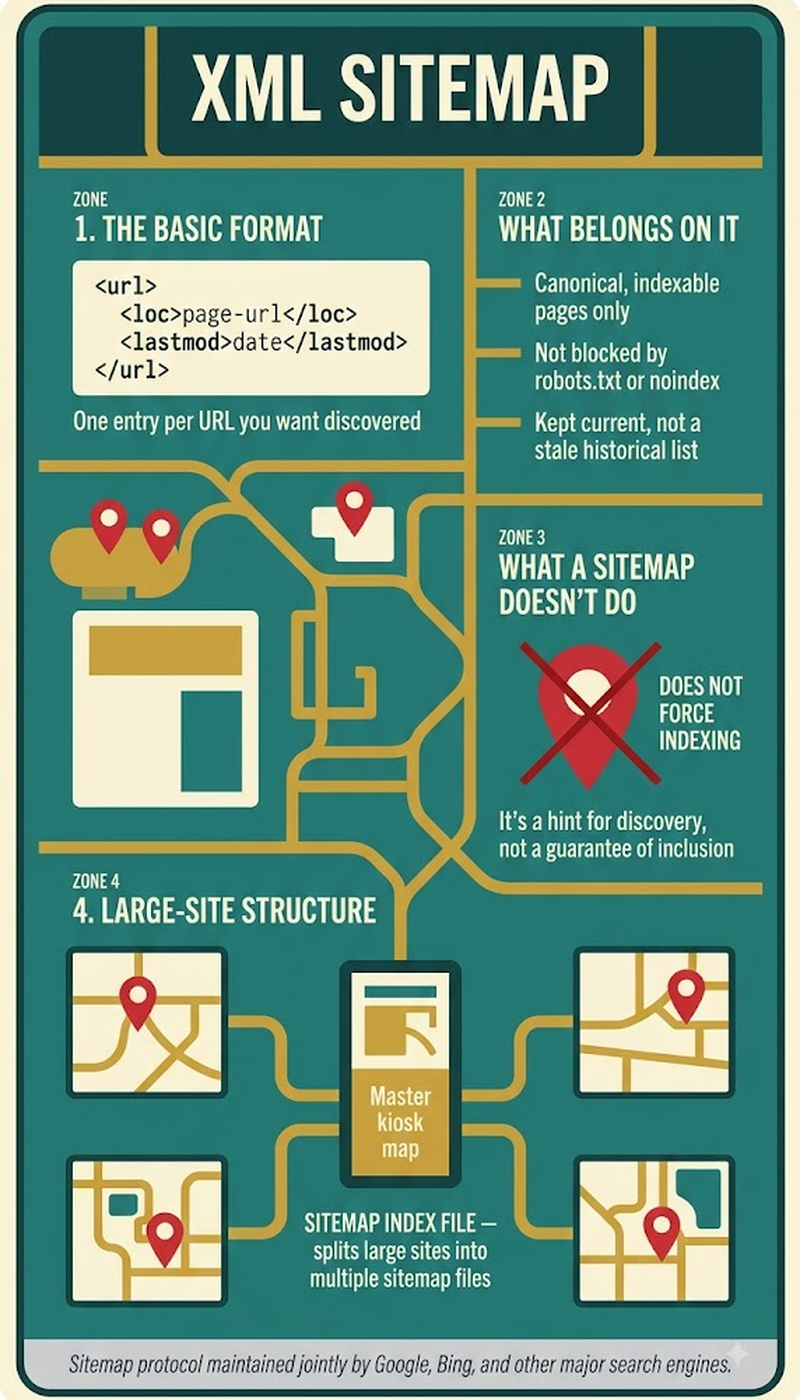
An XML sitemap is a structured file listing the URLs a site wants search engines to find, each entry carrying metadata like when the page last changed. Think of it as a map handed directly to crawlers rather than something they have to piece together by following links.
A sitemap does not guarantee indexing on its own. What it removes is discovery as the bottleneck, which matters most on sites with deep structures, thin internal linking, or content that changes on a regular clock.
Key highlights
- Crawl efficiency climbs by as much as 35 percent on properly optimized sitemaps, and time to index for new pages can drop by up to 70 percent.
- Google enforces a hard ceiling of 50,000 URLs and 50 MB uncompressed per file. Sites with more content than that need a sitemap index chaining multiple files together rather than one oversized list.
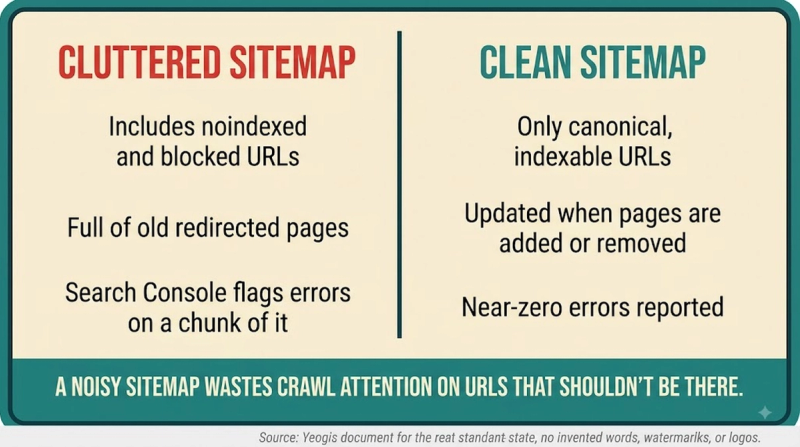
- Sitemaps carrying more than 10 percent error URLs, broken links, redirects, noindex pages mixed in, show measurably slower indexing for whatever new content sits alongside the mess.
- Google was processing over 1.2 trillion sitemap entries daily across the web as of February 2026, a volume that only works because most of those entries are accurate.
What belongs in a sitemap
A sitemap entry carries the URL, its last modified date, and optionally a change frequency and priority value. Google has confirmed it treats an accurate lastmod date as a genuine crawling signal, while change frequency and priority provide no meaningful SEO benefit at all.
A minimal entry looks like this:
<url>
  <loc>https://example.com/about</loc>
  <lastmod>2026-07-01</lastmod>
</url>
Only the clean, canonical version of each page belongs here. Noindex pages, redirects, 4xx URLs, and duplicate parameter variants dilute the sitemap's value as a discovery signal rather than adding to it.
How to create and submit an XML sitemap
- Generate it through a CMS plugin, framework, or a crawler tool like Screaming Frog.
- Strip out noindex, redirected, broken, and non-canonical URLs before publishing it.
- Split anything over 50,000 URLs into multiple files chained by a sitemap index.
- Reference the sitemap's location in robots.txt with a Sitemap colon directive.
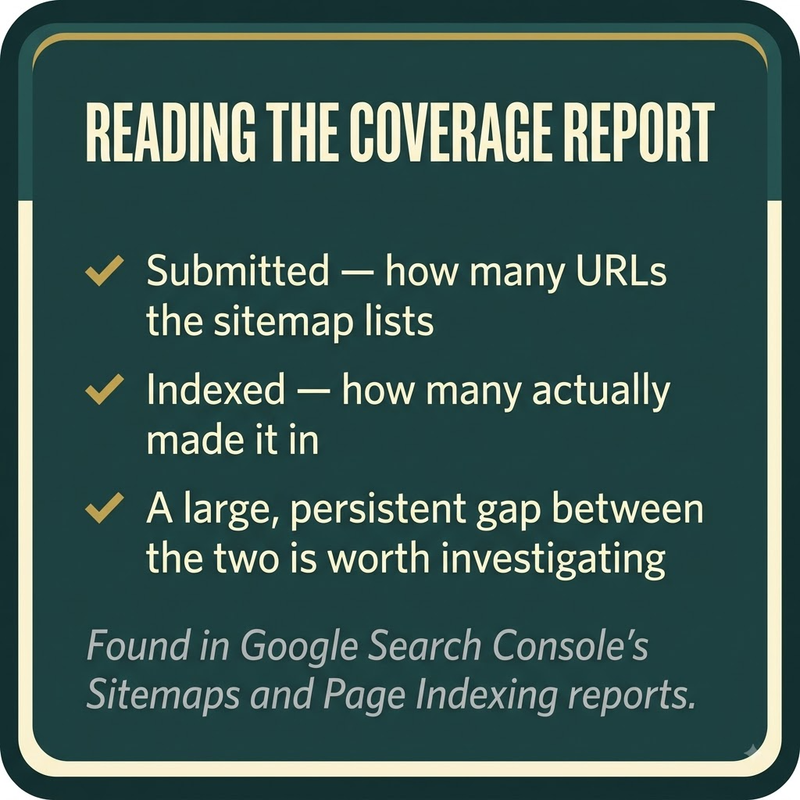
- Submit it through Google Search Console's Sitemaps report and Bing Webmaster Tools.
XML sitemap vs HTML sitemap
An XML sitemap is built for machines, a format crawlers parse quickly and without ambiguity. An HTML sitemap is built for people, a browsable page a visitor can actually click through. Most sites benefit from having both, since the two serve audiences that never overlap.
Frequently asked questions
When does an XML sitemap actually matter?
Large sites, sites with content that changes often, and sites with weak internal linking see the biggest benefit, since a sitemap compensates for exactly what those situations lack: an obvious, well-linked path for crawlers to follow on their own.
How do I get a sitemap in front of Google?
Open the Sitemaps report in Search Console, add the sitemap's URL, and submit it. Also reference the sitemap's location inside robots.txt, so any crawler can find it without needing Search Console access at all.
What should never appear in a sitemap?
Noindex pages, redirected URLs, broken links, and duplicate parameter variants all work against the sitemap's purpose. Sitemaps carrying more than 10 percent of these error URLs show measurably slower indexing, even for the legitimate pages sitting right beside them.
Do the priority and changefreq fields do anything?
Practically nothing. Google has said directly that both fields provide no meaningful SEO benefit and are largely ignored. Lastmod is the one metadata field that actually functions as a crawling signal, and only when its value can be trusted as accurate.


