
TL;DR. Crawl depth counts the link hops a crawler takes from the homepage to reach a given page, and pages sitting three clicks or fewer away get crawled more often and tend to rank better even after controlling for content and links. Google's John Mueller has said click depth may matter more for ranking than URL structure itself, and one documented fix produced a 127 percent revenue jump.
What is crawl depth?
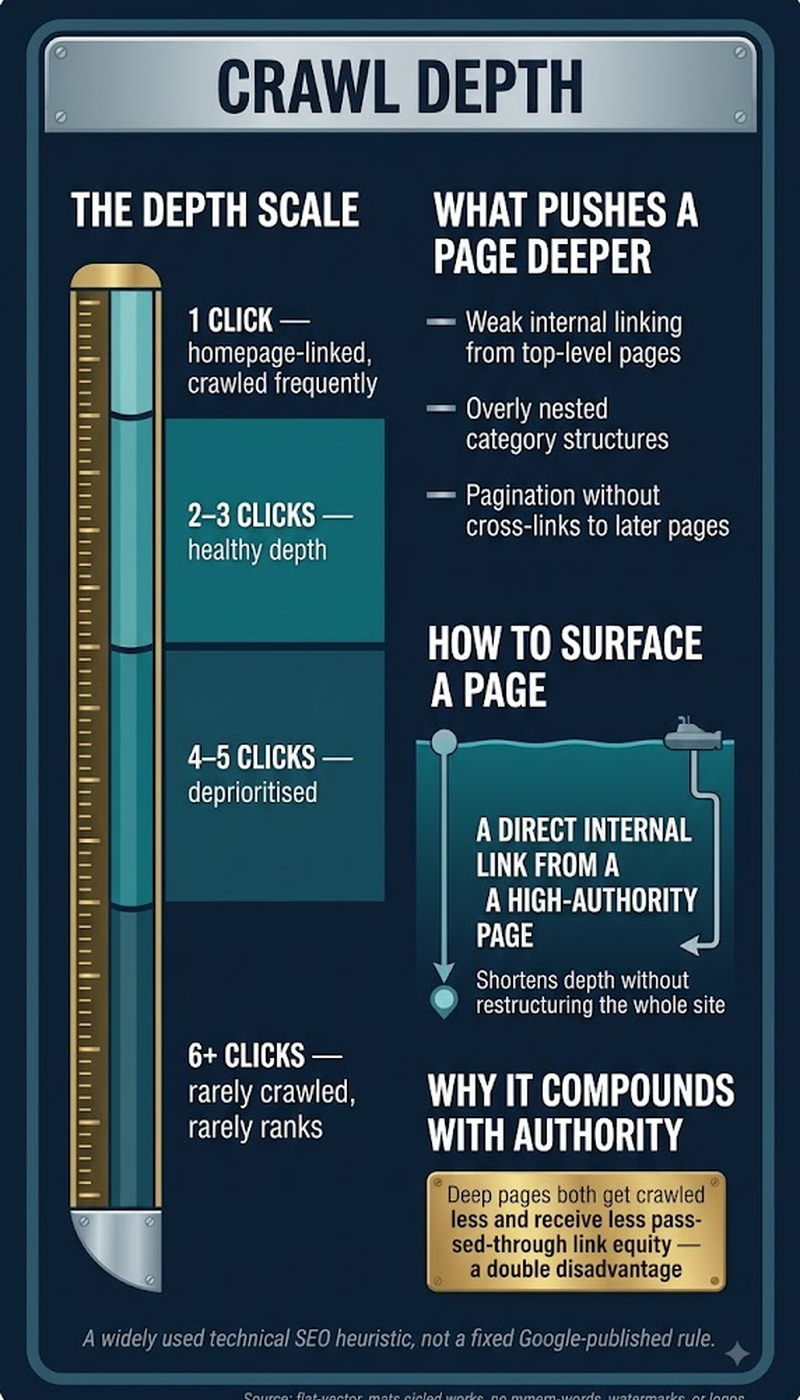
Crawl depth counts the link hops a search engine crawler takes, starting from the homepage, to arrive at a specific page. A page linked straight from the homepage sits at depth one, a page reachable only after three links in sits at depth three, and so on outward.
Crawl depth functions as a rough proxy for importance in Google's eyes. Pages reached fast, through short, well-linked paths, read as more central to a site than pages buried many clicks down.
Key highlights
- Pages with a click depth of three or fewer consistently perform better in search results, even after controlling for content quality and external links separately.
- Google's John Mueller has stated click depth may carry more ranking weight than URL structure itself, a claim that runs against a lot of conventional SEO advice about clean folder paths.
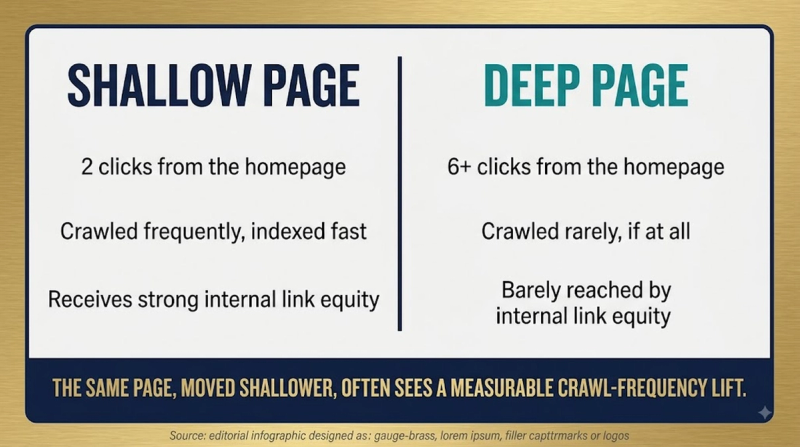
Search bots discover pages by following links from page to page, and anything buried beyond roughly three clicks tends to get crawled far less often, when it gets crawled at all.
- One documented case saw revenue jump 127 percent after fixing click depth on previously buried, high value pages.
Crawl depth vs click depth vs page depth
These terms get used interchangeably more often than they should. Crawl depth describes the path a crawler actually took to find a page. Click depth, or page depth, describes the shortest possible path a user could take from the homepage, regardless of how the crawler happened to discover it.
A well-linked site keeps the two numbers close together, since a short theoretical path only helps if the crawler's real path is just as short.
How site architecture shapes crawl depth
A flat architecture keeps every important page within two or three clicks of the homepage, leaning on category hubs, strong internal linking, and navigation that surfaces deep content early instead of nesting it under endless subcategories.
A deep architecture, where content sits five, six, or more clicks out, spreads crawl attention thin and dilutes the link equity that would otherwise reach those pages directly.
How to reduce crawl depth
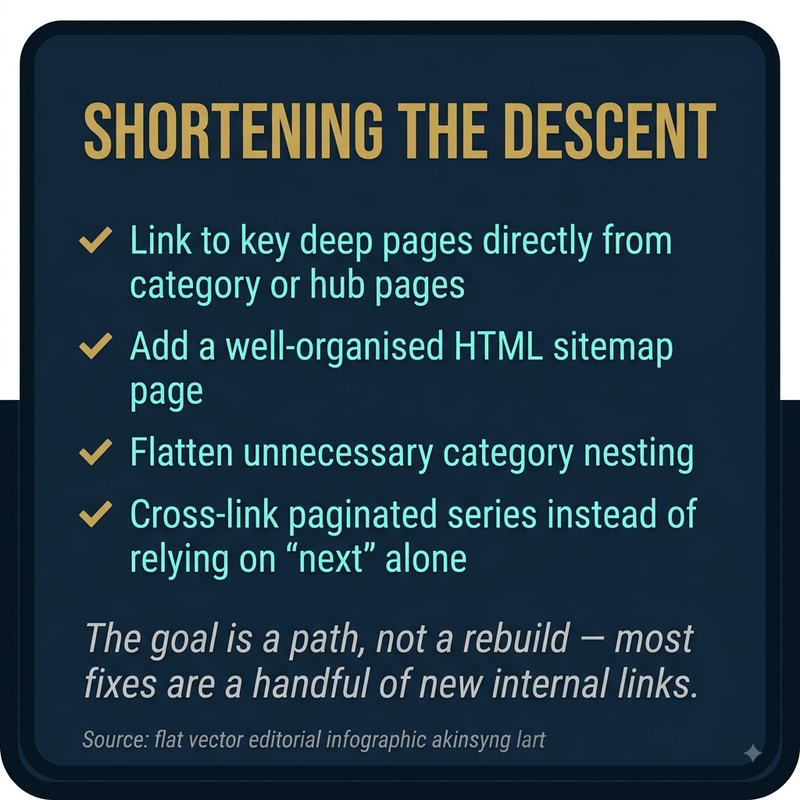
- Add links from the homepage or top-level category pages straight to the most valuable deep content.
- Strengthen internal linking between related pages so crawlers find shortcuts instead of depending only on main navigation.
- Flatten subcategory layers that exist for organizational tidiness rather than usability.
- Add HTML sitemaps or hub pages that link out to deep content in one place.
- Audit deep pages with a crawler tool and prioritize the fixes carrying real commercial or informational value.
Frequently asked questions
How many clicks from the homepage is too many?
Three is the commonly cited ceiling for anything important. Beyond that, crawling and indexing both get noticeably less reliable, and Google's John Mueller has suggested click depth may outweigh URL structure as a ranking consideration entirely.
Are crawl depth and click depth actually the same thing?
Not quite. Crawl depth is the path a crawler actually took. Click depth, sometimes called page depth, is the shortest path a user could theoretically take from the homepage. The two usually line up on a well-structured site but can drift apart when internal linking is inconsistent.
What's the fastest way to shorten crawl depth without a redesign?
Internal links, almost always. Adding links from related articles or hub pages creates shortcuts that bypass a rigid navigation hierarchy entirely, letting a crawler reach a deep page without clicking through every intermediate category first.
How do I find which pages are buried too deep?
Crawl the site with a tool like Screaming Frog, which reports each page's depth from the start URL directly. Cross reference that list against the pages carrying the most commercial or informational value to decide what actually needs fixing first.
Does fixing crawl depth really move revenue, or just rankings?
Both, in at least one documented case. Restructuring navigation so buried case studies sat within three clicks instead of four or five produced a 127 percent revenue jump, tied directly to those pages ranking and converting again, not just showing up higher in a report.


