
TL;DR. HTTP status codes are the three digit responses a server sends back with every request, 200 for success, 301 for a permanent move, 404 for gone, 500 for a server failure, and crawlers read them as instructions rather than trivia. Getting them wrong is expensive: one documented case saw soft 404s and related indexing bugs keep roughly 500,000 pages out of Google's index across 13 domains, with one site's traffic collapsing 90 percent.
What are HTTP status codes?
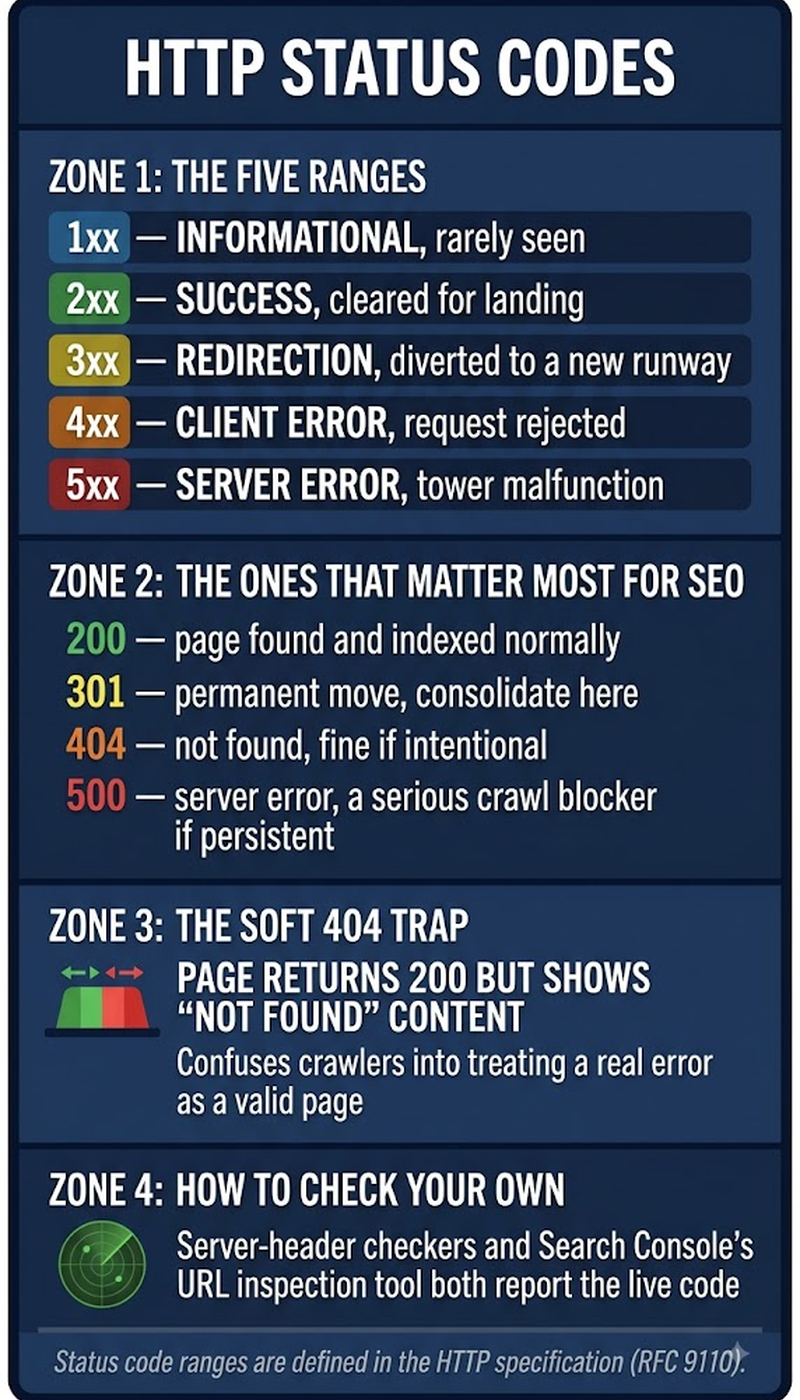
HTTP status codes are three digit numbers a server attaches to every response, sorting the outcome into success, redirection, client error, or server error. Search engines read these codes to decide whether a URL gets indexed, followed to somewhere else, or dropped entirely.
Status codes stay invisible to almost every visitor and decisive for every crawler. Get the wrong one on a page and Google quietly does the wrong thing with it, no error message, no warning, just a slow fade out of search.
Key highlights
- A documented case spanning 13 domains found soft 404s and related indexing issues had kept roughly 500,000 pages out of Google's index.
- One site in that case watched its soft 404 count fall from about 120,000 pages to under 20,000, an 83 percent reduction, once the underlying status code bug was actually fixed.
- Google's John Mueller wrote in a 2025 post that soft 404s carry no quality or SEO signal on their own, and that serving a real 404 is significantly better than serving a 200 for a page that no longer exists.
- Search Console keeps soft 404s in a separate report from true 404 not found errors, since the two problems need entirely different fixes.
The status codes that matter most for SEO
- 200 OK: the page loaded successfully and is eligible for indexing, the status every live, important page should carry.
- 301 Moved Permanently: a permanent redirect that passes ranking signals forward. Covered in full at 301 redirect.
- 302 Found: a temporary redirect, detailed at 302 redirect, that has no business standing in for a change meant to be permanent.
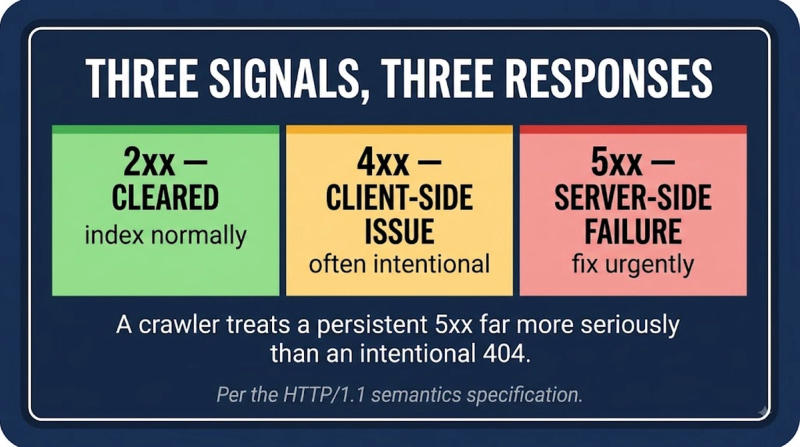
- 404 Not Found: the resource genuinely isn't there. Search engines eventually drop the URL, the correct outcome for content that's actually gone.
- 410 Gone: signals deliberate, permanent removal more forcefully than a 404, which can speed up deindexing for content meant to stay gone.
- 500 Internal Server Error / 503 Service Unavailable: persistent server errors read to Google as an unreliable site, and can suppress crawling and rankings the longer they go unfixed.
What a soft 404 actually is
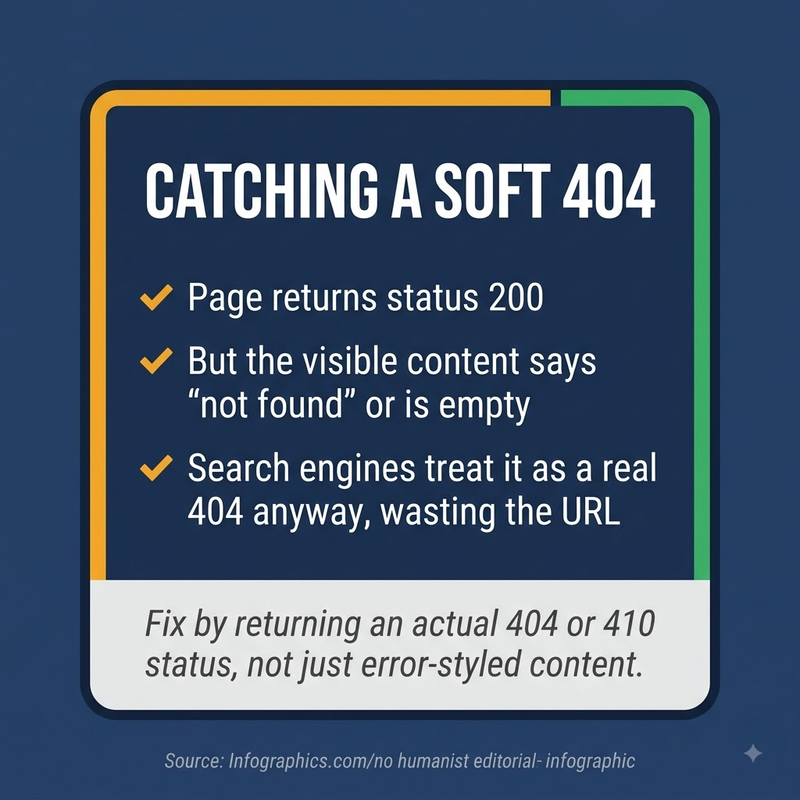
A soft 404 is a page displaying error-like content, empty, missing, not found messaging, while still returning a 200 OK instead of an honest 404. Google catches the mismatch algorithmically and treats the page as not found anyway, but the confusion along the way wastes crawl budget and makes the underlying problem harder to diagnose.
Soft 404s do more damage than an honest 404 precisely because they hide what's wrong. The page reads as broken to a person and looks fine in a server log, right up until Google's own detection quietly strips it out of search regardless.
How to check a page's status code
- Use the URL Inspection Tool in Search Console to see the crawled status code directly.
- Run a full site crawl with Screaming Frog to catch status codes at scale across every URL.
- Check the Coverage and soft 404 reports in Search Console for pages Google has already flagged.
- Test manually with browser developer tools or a header checking tool for anything suspected of being misconfigured.
Frequently asked questions
Why is a soft 404 worse than a normal one?
Because it hides the actual problem. A page returning 200 while displaying error content looks fine to any automated check that only reads the status code, and the damage only surfaces once Google's own detection catches the mismatch and quietly deindexes it anyway, often long after the fact.
What did the 500,000 page case actually reveal?
Soft 404s and related indexing bugs, spread across 13 domains, kept roughly half a million pages out of Google's index. One site in that group saw its soft 404 count drop from about 120,000 to under 20,000, an 83 percent cut, once the status code bug behind it was fixed.
What's the point of using 410 instead of 404?
A 410 states permanent, deliberate removal more forcefully than a 404 ever does, which tends to speed up how quickly search engines actually deindex it. A 404 leaves room for ambiguity, temporary or permanent, that a 410 closes off entirely.
Do occasional 500 errors during maintenance hurt rankings?
Not meaningfully, if they're brief and rare. What actually damages rankings is a pattern of persistent server errors, which reads to Google as an unreliable site and can suppress both crawl rate and rankings over time. Fix the underlying server issue rather than treating any one error page as a one-off.
What's the fastest way to audit status codes across a whole site?
Crawl it with a tool like Screaming Frog rather than checking pages one at a time. Cross reference the results against Search Console's Coverage and soft 404 reports, which already surface anything Google itself has flagged as problematic.


