
TL;DR. Internal linking is the one part of SEO a site fully controls: hyperlinks between its own pages that move authority, guide crawlers, and reveal how content actually relates. Internal linking can lift search rankings by up to 40%, improve crawl efficiency by 40 to 70%, and drive traffic increases of 31% or more within a few months, and 2025 research from Wellows and Yext found bi-directional internal linking increases AI citation probability by 2.7 times.
What is internal linking?
Internal linking adds hyperlinks between pages on the same website, connecting related content, guiding search engine crawlers through a site's structure, and passing link equity from stronger pages to weaker ones. Unlike backlinks from external sites, internal links sit entirely within a site owner's control, which makes internal linking one of the few SEO levers that can be improved immediately without waiting on any outside cooperation.
Key highlights
- Internal linking can lift search rankings by up to 40%, improve crawl efficiency by 40 to 70%, and drive traffic increases of 31% or more within a few months, per Upward Engine's 2026 best practices guide.
- Best-practice guidance recommends 2 to 5 contextual internal links per 1,000 words, while keeping a page's total outbound links under roughly 150 to preserve the link equity each one carries.
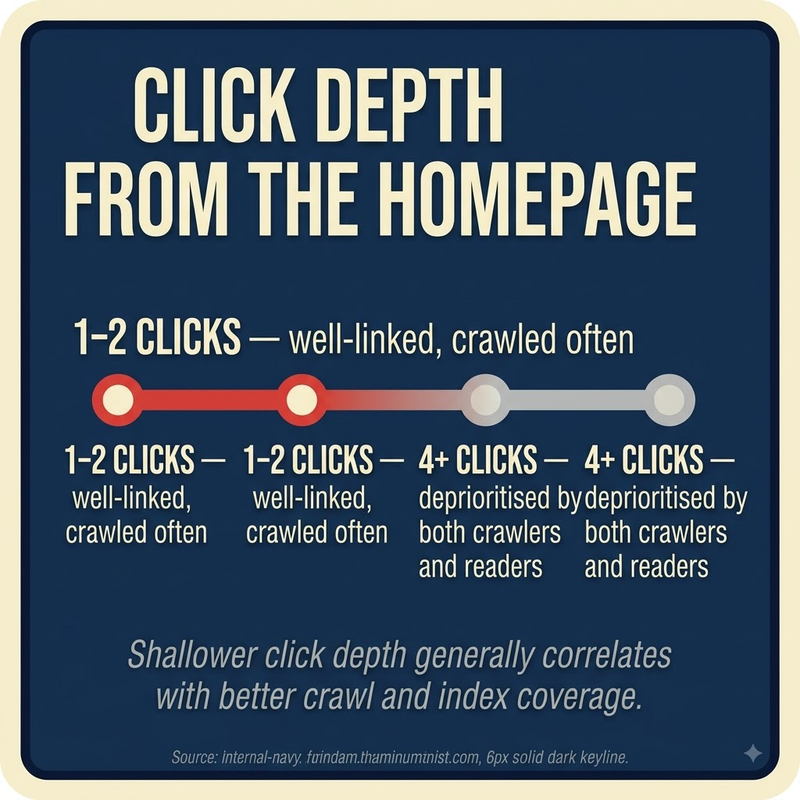
- Priority pages should be reachable within 3 clicks from the homepage, since click depth beyond that point correlates with weaker crawl frequency and lower ranking authority.
- 2025 research from Wellows and Yext found bi-directional internal linking increases AI citation probability by 2.7 times, per MentionLayer's coverage.
- An arXiv study of 55,393 trending queries from March to April 2026 found AI Overviews activated for 13.7% of queries overall, jumping to 64.7% for queries phrased as questions, and cited a median of 8 reference URLs per answer.
Click depth's effect on crawling
Click depth measures how many clicks it takes to reach a page starting from the homepage, and it directly affects both crawl frequency and the amount of link equity a page receives. Pages buried five or six clicks deep tend to get crawled less often and accumulate less authority than pages reachable within three clicks, regardless of the content's actual quality, which is why site architecture and internal linking need to be planned together rather than left to grow organically.
Internal linking inside AI search (GEO)
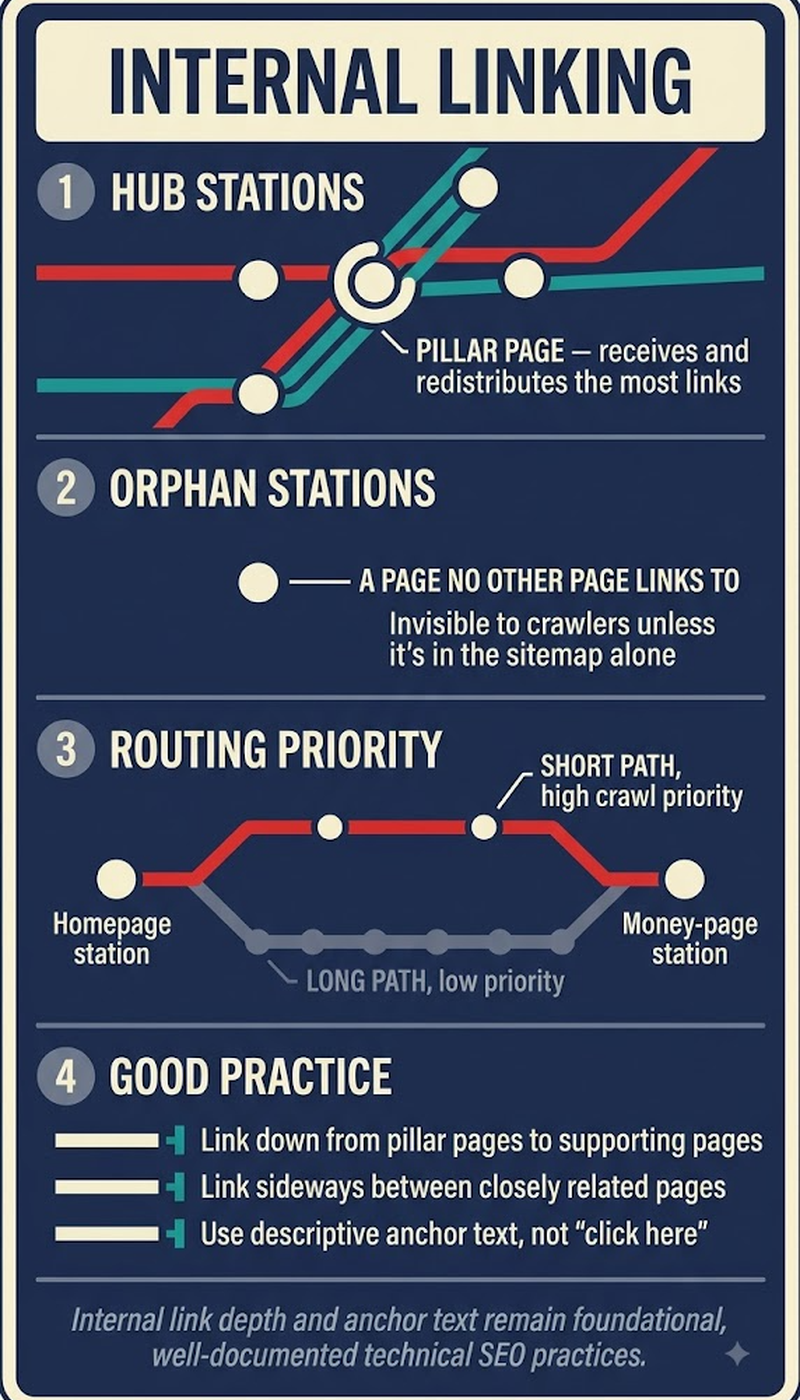
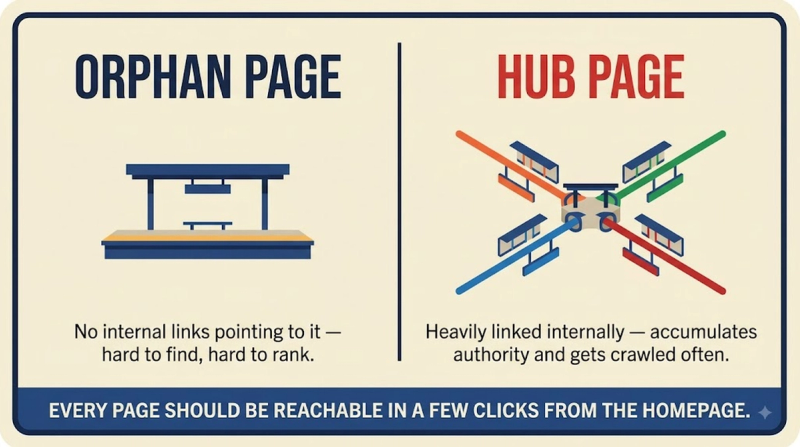
Internal linking now shapes visibility in AI answer engines much the way it shapes traditional crawl and ranking behavior. Orphan pages, ones with zero or minimal internal links pointing to them from topically related content, are effectively invisible to the kind of AI clustering that groups a site's content into a coherent topic network. Consistent, semantically coherent internal linking signals topical clusters and entity relationships that AI systems use to judge a site's depth of expertise, part of why bi-directional linking measurably increases AI citation probability.
Building the strategy
- Map site architecture so priority pages sit within 3 clicks of the homepage.
- Add 2 to 5 contextual internal links per 1,000 words of content, pointing to genuinely related pages.
- Use descriptive, varied anchor text for internal links rather than generic phrases like click here.
- Link in both directions between related pages, not just from newer content back to older cornerstone pages.
- Audit the site periodically for orphan pages with zero or minimal internal links pointing to them, and add links from topically related content to bring them into the site's structure.
Frequently asked questions
What is internal linking?
Internal linking connects pages within the same website through hyperlinks, helping search engines crawl the site, distributing link equity between pages, and helping readers navigate to related content.
How many internal links should a page realistically have?
Generally 2 to 5 contextual internal links per 1,000 words, with total outbound links kept under roughly 150, to keep link equity concentrated rather than diluted across too many destinations.
What is an orphan page and why does it matter?
An orphan page has zero or minimal internal links pointing to it from other site content, making it harder for search engines to discover and crawl, and effectively invisible to AI systems that cluster content by topic based on internal link structure.
Does internal linking actually affect whether AI engines cite a site?
Yes. AI systems use link structure to understand topical clusters and entity relationships, and research found bi-directional internal linking increases AI citation probability by 2.7 times.
How close to the homepage do important pages need to sit?
Within 3 clicks. Pages buried deeper tend to be crawled less frequently and accumulate less link equity, regardless of how good the underlying content actually is.


