
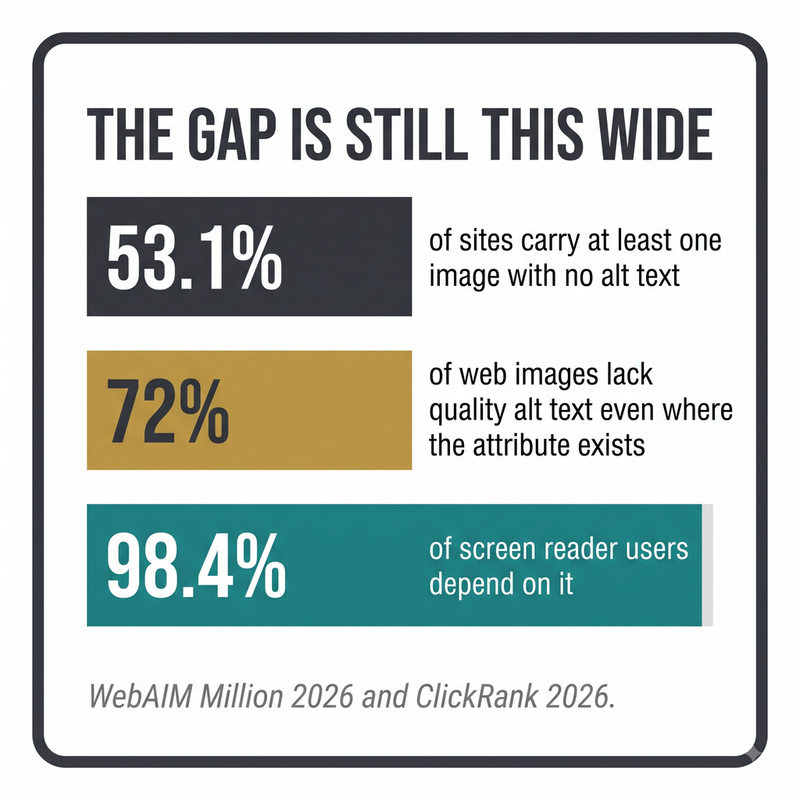
TL;DR. Alt text sits at an odd intersection: skip it and a screen reader user gets nothing, an image crawler gets nothing, and an AI shopping answer has nothing to point to. WebAIM's Million 2026 report found 53.1% of websites carry at least one image missing alt text, averaging more than 10 invisible images per page, while ClickRank's 2026 image SEO guide found images with optimized alt text pull in 8.2 times more impressions in image search. One missing attribute, three audiences losing out at once.
What is alt text?
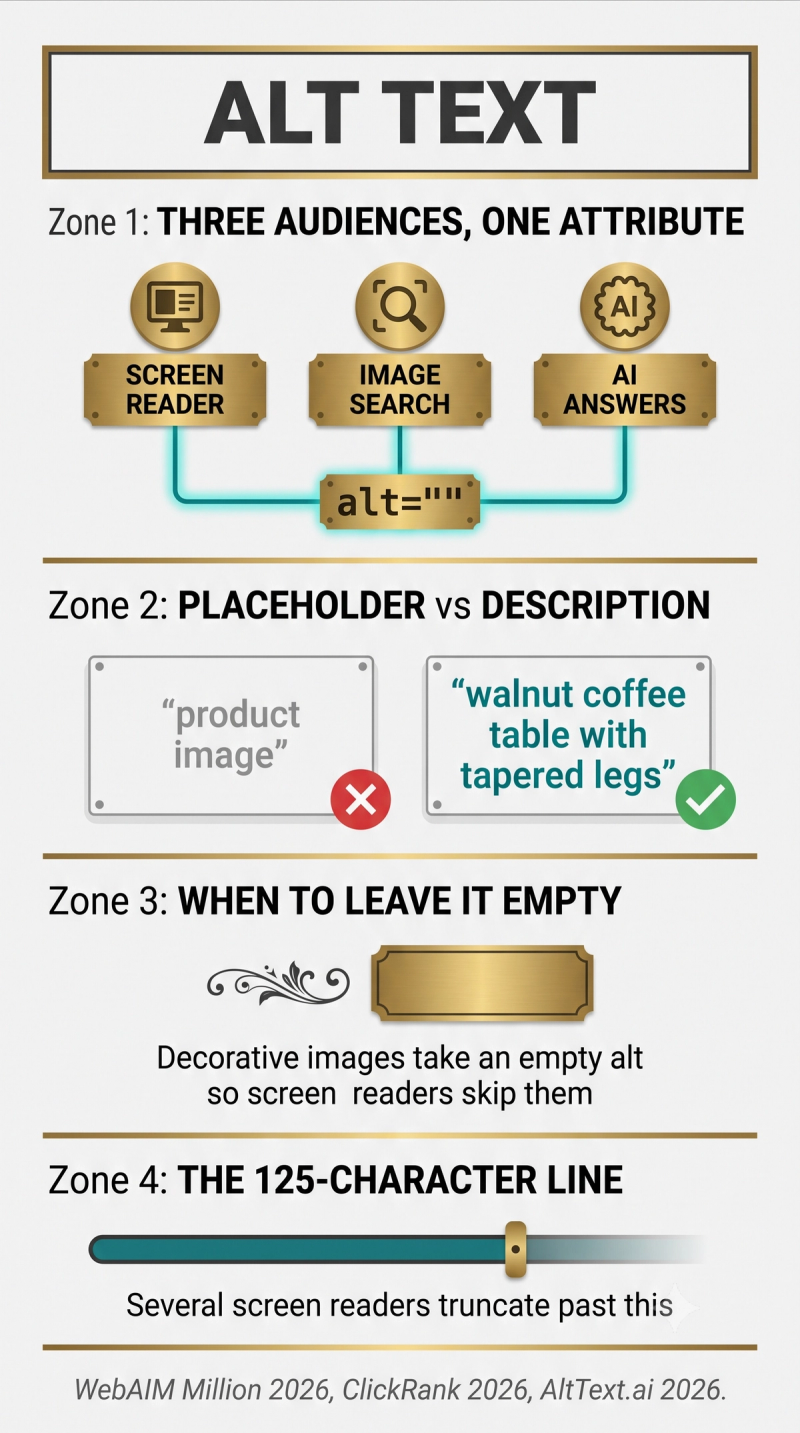
Alt text is the written description sitting inside an image's HTML alt attribute, read aloud by screen readers and parsed by search engines and AI systems that cannot process raw pixels directly. Skip the attribute entirely and a screen reader typically falls back to reading the filename, announcing the bare word image, or ignoring the element altogether, none of which tell a blind or low-vision visitor anything real about what's on the page. The same gap costs a page its shot at image search and AI-generated visual answers too.
Key highlights
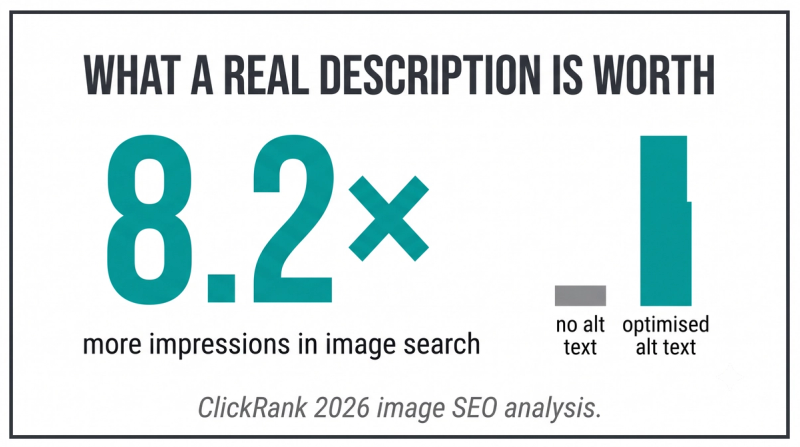
- WebAIM's Million 2026 report found 53.1% of websites carry at least one image missing alt text, averaging more than 10 invisible images per page.
- Having an alt attribute and having a useful one turn out to be different problems. ClickRank's 2026 image SEO guide found 72% of web images lack quality alt text even where the attribute is technically present.
- Screen readers can't guess at an image's content, they can only read what's there. ClickRank's accessibility research puts the share of screen reader users who depend on alt text at 98.4%.
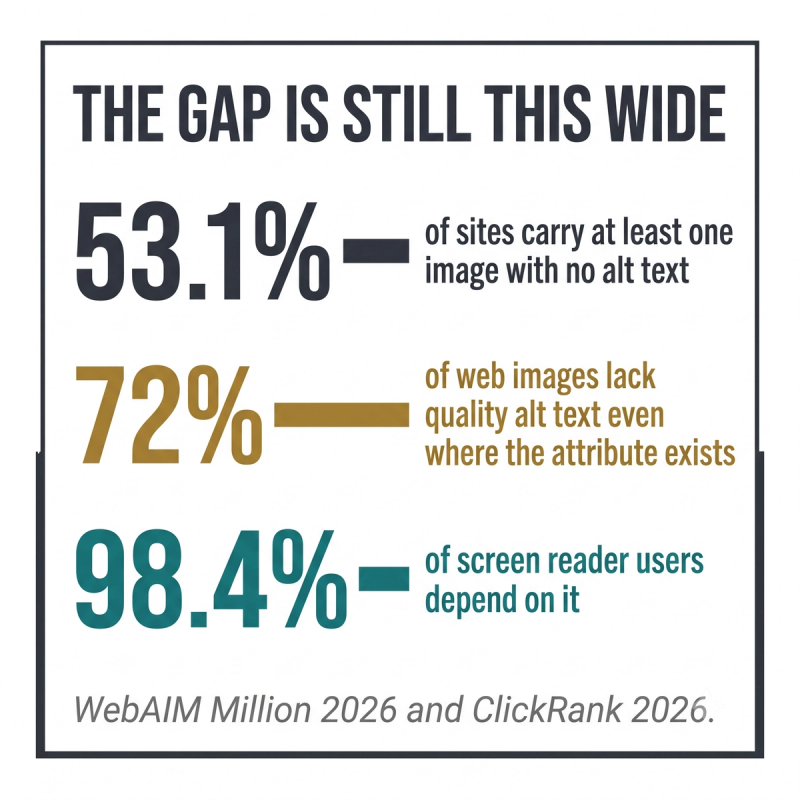
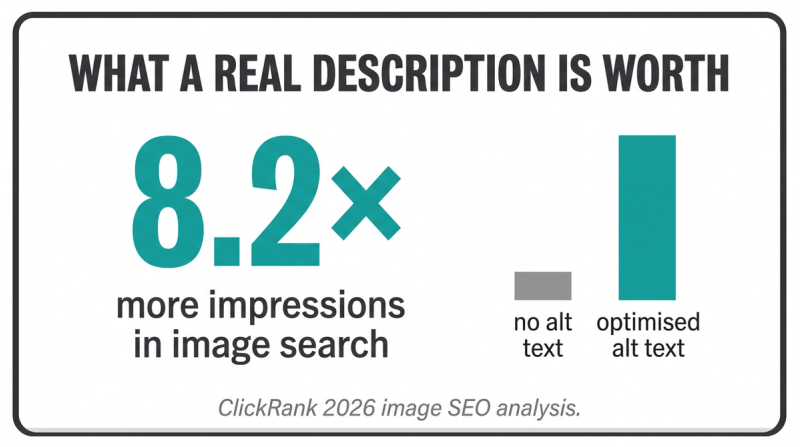
- Optimized alt text moves the needle in image search specifically: the same ClickRank analysis found an 8.2 times jump in impressions for images carrying a specific, accurate description.
- AltText.ai's 2026 best practices guide caps recommended length at roughly 125 characters, since longer descriptions get truncated by a number of screen readers before they finish.
What separates a real description from a placeholder
A product photo needs enough specificity to convey color, material, and whatever detail actually distinguishes it, red leather ankle boot with a buckle detail, not the meaningless product image. Good alt text answers one question and one question only: what would someone miss if they couldn't see this. Vague filler defeats the purpose just as thoroughly as leaving the field blank, it just does it less obviously.
Why AI shopping and image answers depend on this one attribute
AI systems retrieving and displaying images can't reliably interpret raw pixels the way a human eye does, so they lean on whatever text description sits attached to the file. A product image with a precise, accurate alt description stands a far better chance of surfacing in an AI-generated shopping answer or an image citation than one left blank or stuck with a generic filename like IMG_4021.
When to leave the alt attribute empty on purpose
Purely decorative images, the ones adding zero information, a border flourish, a spacer graphic, should carry an empty alt attribute rather than a description. An empty attribute tells a screen reader to skip the element entirely. Filling it in anyway forces a user to sit through a description of something that was never meant to convey anything in the first place.
Writing alt text that actually works
- Describe the image's specific content and function, not its general category, so a description like walnut coffee table with tapered legs beats the vague shoe photo or product image.
- Stay under roughly 125 characters, since several screen readers truncate anything longer.
- Work in a target keyword only where it genuinely belongs, since forced keyword stuffing reads as spam to users and search engines alike.
- Leave the alt attribute empty for decorative images that carry no real information.
- Skip phrases like image of or picture of, since a screen reader already announces the element as an image before it reads the description.
Frequently asked questions
What is alt text?
Alt text is the description sitting inside an image's HTML alt attribute, standing in for the image itself whenever it can't be seen, loaded, or processed by a screen reader, search engine, or AI system.
Does alt text actually need a keyword in it?
Alt text benefits from a keyword only when the word genuinely describes what's in the image. Stuffing a keyword into a description that doesn't fit reads as spam to both search engines and the screen reader users the attribute exists for in the first place, and it tends to do more harm than leaving the field slightly less optimized.
What happens when a screen reader hits an image with no alt attribute?
Screen reader software falls back to whatever it can find, usually the raw filename, the bare word image, or nothing at all if the element gets skipped outright. None of those options tell a blind or low-vision visitor what the image actually shows, which is the entire gap alt text exists to close.
Should every single image on a page have alt text?
Every image that conveys real information needs alt text. Purely decorative images, the kind adding no content of their own, are the exception, and those should carry an empty alt attribute so a screen reader skips them rather than announcing something meaningless.
Can good alt text really move image search rankings?
Good alt text moves image search rankings measurably. ClickRank's 2026 analysis found images with optimized alt text receive 8.2 times more impressions in image search results than images without it, since most AI and search image systems lean on the text description rather than the pixels themselves.


