
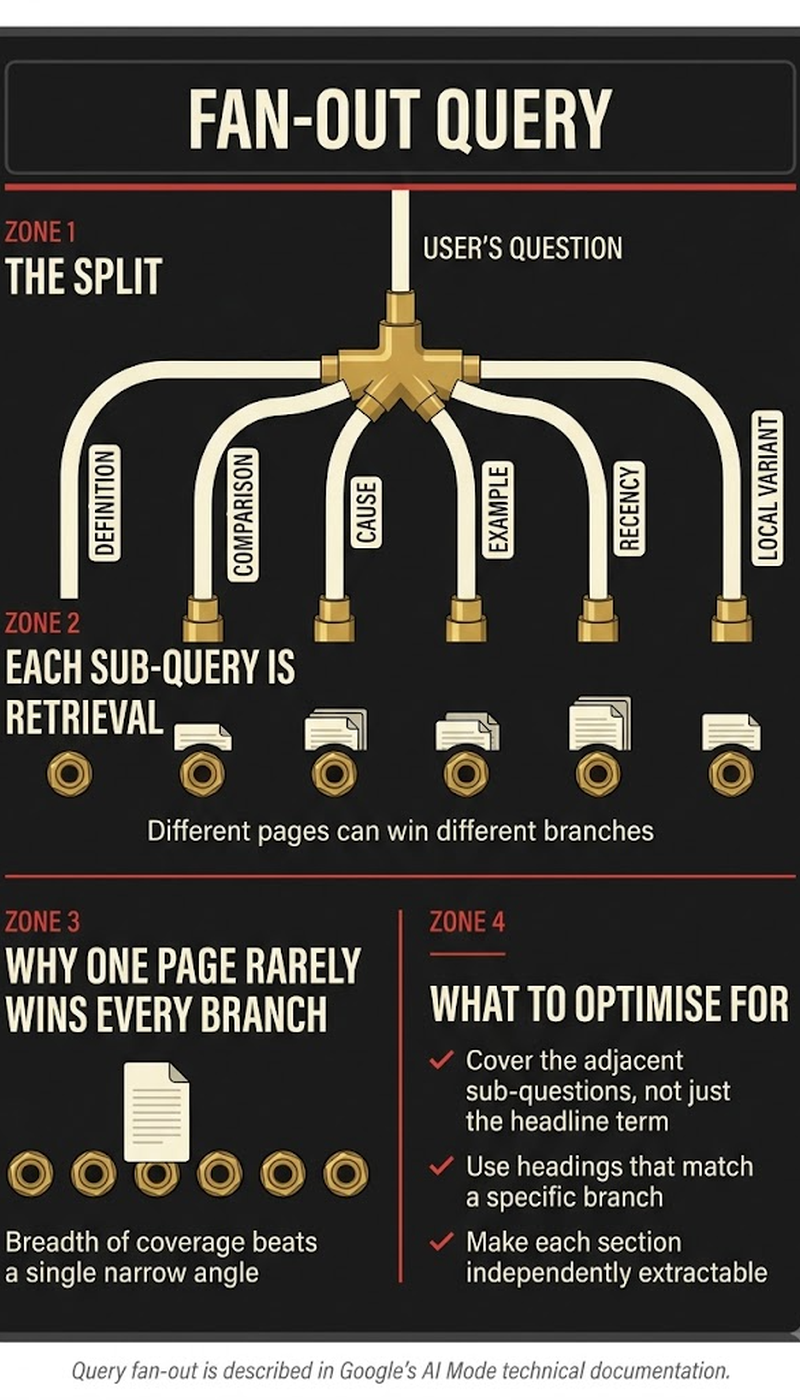
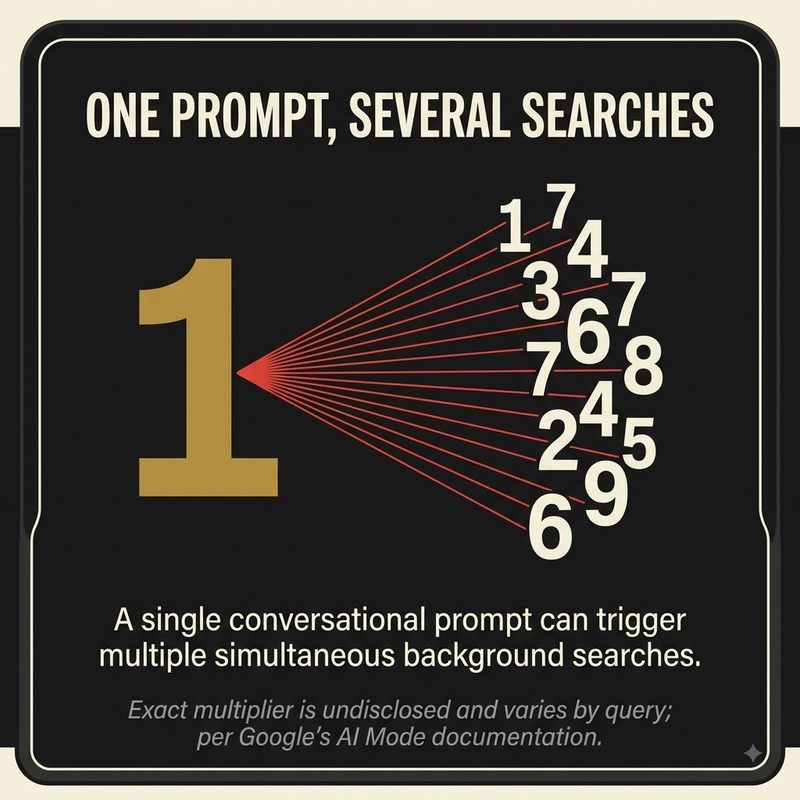
A fan-out query is the technique an AI search system uses to answer a single user question by decomposing it into multiple related sub-queries — covering definitions, comparisons, examples, and related angles — running them simultaneously against its index, then synthesizing the combined results into one unified response. Google's AI Mode is the most visible current example: a single question a user types effectively triggers several parallel searches behind the scenes, each targeting a different facet of what's actually being asked, before the system combines everything into a single generated answer.
Key Takeaways
- Fan-out queries decompose one user question into multiple related sub-queries — run in parallel, not sequentially — before synthesizing the results into a single response.
- Google's AI Mode is the most documented production example of this technique, using fan-out as its core mechanism for handling complex, multi-part questions.
- A page can get pulled into an AI-generated answer by matching any single sub-query in the fan-out set well, not just the literal phrasing a user originally typed.
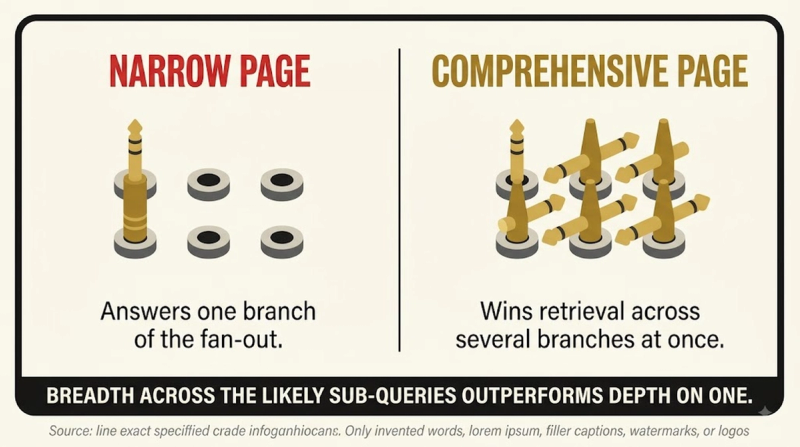
- The practical content-strategy implication is comprehensive topic coverage — addressing a subject's likely sub-questions thoroughly matters more than optimizing narrowly for one exact keyword phrase.
- Fan-out is closely related to, but distinct from, query decomposition research in academic information retrieval — the AI-search industry term draws on that older research tradition without being identical to any single formal academic definition.
Fan-out queries are the specific retrieval mechanism underneath AI Mode, and building content resilient to fan-out decomposition connects directly to the broader answer engine optimization strategy this site covers separately — comprehensive, question-based coverage is the practical response to both.
How Does Fan-Out Actually Differ From a Traditional Single Search Query?
A traditional search query matches a user's typed phrase against an index and returns a ranked list of results for that specific phrase, while a fan-out query breaks the underlying question into several distinct sub-queries — each potentially phrased quite differently from the original — searches each one, and combines what comes back before generating a single synthesized response. Someone asking "what's the best budget laptop for video editing" through a fan-out-based system might trigger separate underlying searches for laptop specifications relevant to video editing, current budget laptop comparisons, and software performance benchmarks — sub-queries the user never typed but that the system inferred were necessary to actually answer the question well. This is a fundamentally different retrieval model than matching one phrase to one set of results.
Why Does Fan-Out Matter for Content Strategy?
Fan-out matters because a page can get pulled into a synthesized AI answer by matching any single sub-query in the decomposed set well, not necessarily the exact phrase a user originally typed — which shifts the practical optimization target from one precise keyword match toward comprehensive coverage of a topic's likely sub-questions. Content built narrowly around one exact phrase risks missing every fan-out sub-query except the one it directly targets, while content that genuinely covers a topic's definitions, comparisons, and common follow-up angles has more surface area to be pulled into the synthesis regardless of which specific sub-query a system generates. This is a real, practical shift in how "keyword targeting" should be thought about for AI-search visibility specifically, distinct from traditional single-query SEO thinking.
Comparing the two models:
- Traditional search: one query, matched directly. Fan-out query: one question decomposed into several sub-queries.
- Traditional search: results returned as a ranked list. Fan-out query: sub-query results synthesized into one response.
- Traditional search: optimization target is exact phrase match. Fan-out query: optimization target is comprehensive sub-topic coverage.
- Traditional search: sequential, single retrieval pass. Fan-out query: parallel, multi-query retrieval pass.
Is Fan-Out Query Decomposition a New Concept, or Built on Older Research?
Fan-out as an AI-search production technique draws directly on an older academic tradition in information retrieval called query decomposition — breaking a complex information need into simpler sub-queries has been studied in IR research for years before AI-generated search answers made the technique visible to a mainstream audience through products like Google's AI Mode. What's genuinely new isn't the underlying decomposition idea itself, but its production-scale application combined with generative synthesis — taking the decomposed results and using a language model to combine them into one coherent, cited answer, rather than simply returning multiple separate result sets for a user to manually reconcile.
How Can You Actually Test Whether Content Is Being Picked Up Through Fan-Out?
Testing fan-out visibility requires a slightly different approach than traditional rank tracking, since there's no single ranking position to check:
- Identify a broad question relevant to the target content, and ask it directly in an AI Mode-style search interface rather than checking traditional keyword rankings alone.
- Note which specific angle or sub-topic of the response, if any, appears to draw from the target content — this reveals which sub-query (not the literal original phrase) the content actually matched.
Free Chrome extension
A free AI citation checker for ChatGPT and Gemini
CitoSkeleton passively captures fan-out queries, cited and fetched sources, and brand mentions behind an AI answer — then tracks your GEO visibility against named competitors. 100% local, no account, no server.
- Test multiple phrasings of the same underlying question, since different phrasings can trigger different fan-out decompositions and surface different sub-queries.
- Track this over time rather than as a one-time check, since the specific sub-queries a system generates for a given topic can shift as underlying models and retrieval systems get updated.
- Compare which competing sources get cited for sub-queries the target content isn't currently winning, to identify specific content gaps rather than treating the whole topic as one undifferentiated target.
Frequently Asked Questions
Does every AI search platform use fan-out queries, or is it specific to Google's AI Mode?
Google's AI Mode is the most documented production example, though the underlying decomposition-and-synthesis approach is conceptually similar to techniques other AI search and retrieval-augmented systems use, even without every platform using the exact same "fan-out" terminology.
Can a fan-out query generate sub-queries the original searcher never intended?
Yes — since the system is inferring likely relevant sub-topics rather than following an explicit user instruction, a fan-out decomposition can sometimes surface tangential angles the original question wasn't specifically asking about.
Does fan-out querying slow down response time compared to a single-query search?
Running multiple sub-queries in parallel (rather than sequentially) is specifically what keeps fan-out from being dramatically slower than a single query, though there's still some additional processing overhead compared to a simple single-match search.
Is fan-out query the same thing as retrieval-augmented generation (RAG)?
They're related but distinct — RAG describes the broader technique of grounding an AI response in retrieved external content, while fan-out specifically describes the query decomposition step that can feed into a RAG-style retrieval process.
Can a website intentionally structure content to target specific fan-out sub-queries?
Yes, in principle — by comprehensively covering a topic's likely sub-questions (definitions, comparisons, examples) rather than one narrow phrase, content has more surface area to match whatever specific sub-queries a fan-out system happens to generate.
Does fan-out querying explain why AI search answers sometimes cite multiple different sources for one response?
Yes — since each sub-query can retrieve from different top sources, a single synthesized answer combining several sub-queries naturally tends to draw from and cite multiple distinct sources rather than just one.
How many sub-queries does a typical fan-out decomposition generate?
This isn't publicly documented as a fixed number by Google or other AI search providers, and likely varies based on the complexity of the original question rather than following one consistent count.
Does fan-out query analysis require special tools, or can it be tested manually?
It can be tested manually by directly querying AI search interfaces with varied phrasings and noting which content gets cited for which apparent sub-topic, though dedicated AI-visibility tracking tools can help systematize this at scale.
Can a poorly structured page still get picked up through fan-out if it happens to match one sub-query well?
Yes — a page doesn't need to comprehensively cover an entire topic to get pulled into a synthesized answer; matching even one specific sub-query well can be enough for that specific passage to be cited.
Is fan-out query decomposition transparent to the end user, or does it happen entirely behind the scenes?
It happens behind the scenes by default — end users typically see only the final synthesized answer, not the individual sub-queries the system generated and ran to produce it.


