
Extractability is how easily an AI system can pull, parse, and reuse a specific passage of content when generating a response — distinct from retrieval, which is simply whether that content gets found and considered in the first place. One industry framing puts the relationship precisely: citation rate is a function of retrieval rate multiplied by extractability. Getting retrieved is necessary but not sufficient — a page can be found and still get discarded if its structure makes the actual answer hard to isolate cleanly. Extractability is the property that determines whether a passage survives that final step.
Key Takeaways
- Extractability and retrieval are distinct — retrieval gets a page into an AI system's consideration; extractability determines whether that system can actually pull a clean, usable answer from what it found.
- Content that buries the answer under long introductions, vague claims, or context-dependent phrasing is harder to extract, even if it's genuinely relevant and well-researched.
- Independently corroborated research (Aggarwal et al., 2024) found content with clear structure, cited statistics, and authoritative sourcing was cited meaningfully more often in AI-generated responses than comparable unstructured content.
- One industry source (The GEO Lab, March 2026) reported a substantial citation-rate gap between declarative and narrative content structure in a specific internal study — a notable finding, but from a single source not yet independently corroborated elsewhere.
- Extractability is closely related to, but distinct from, chunk retrievability — extractability is the broader property of a passage being usable once found; chunk retrievability specifically concerns how content gets segmented and located in the first place.
Extractability is the broader property chunk retrievability specifically addresses at the content-segmentation level, and both connect directly to answer engine optimization as the overarching content strategy discipline built around making content genuinely usable for AI-generated answers.
How Is Extractability Actually Different From Retrieval?
Retrieval is the process by which an AI system finds and pulls a piece of content into consideration for a given query, while extractability is a separate property determining whether the system can actually isolate a clean, usable, accurate answer from that retrieved content — the two operate at different stages and a page can succeed at one while failing at the other. A page might rank well and get retrieved reliably for a relevant query, yet still fail to generate a citation because the actual answer is buried inside a long paragraph, relies on pronouns that only make sense with surrounding context, or never states the answer plainly at all. One source frames this multiplicatively: citation rate equals retrieval rate times extractability — a page retrieved 100% of the time but with near-zero extractability still produces essentially zero citations, since the multiplication of a real number by zero stays zero.
What Actually Makes Content More or Less Extractable?
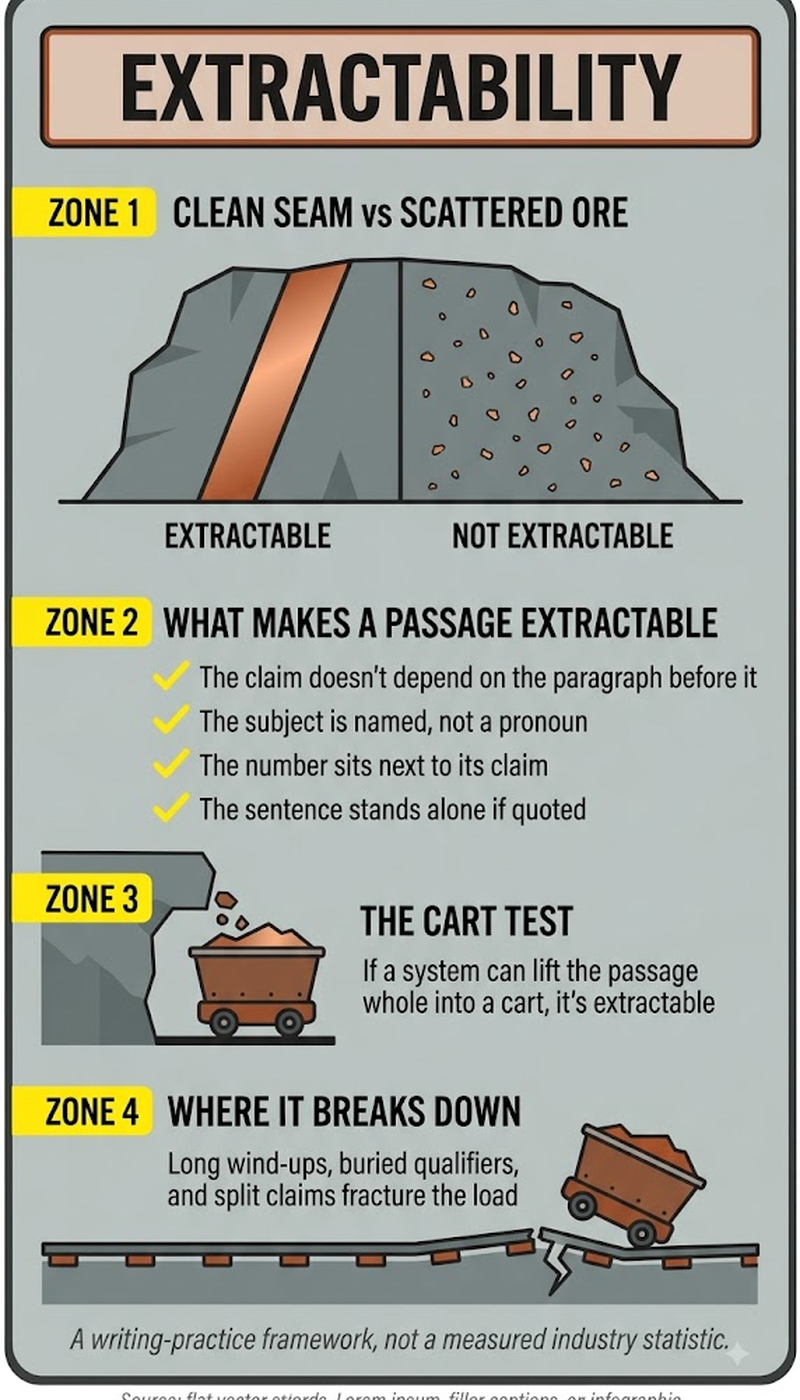
Content that states its answer clearly and early, defines key terms explicitly, and provides enough surrounding context to be understood without requiring the rest of the page tends to be significantly more extractable than content that requires piecing together meaning across multiple paragraphs or relies on unstated assumptions.
Lower vs. higher extractability:
- Answer placement — lower: buried mid-paragraph or late in section. Higher: stated directly and early.
- Entity clarity — lower: relies on pronouns ("the company," "this approach"). Higher: names specific entities explicitly.
- Structure — lower: long, undifferentiated narrative prose. Higher: clear headers, direct statements, defined terms.
- Evidence — lower: vague claims without support. Higher: cited statistics, named sources.
Research from Aggarwal et al.'s 2024 GEO paper — corroborated across multiple independent sources discussing the study — found content structured with clear organization, cited statistics, and authoritative sourcing was cited meaningfully more often in AI-generated responses than comparable content lacking those features, even when underlying topical relevance was held constant. The structural difference, not the underlying subject matter, was what moved citation likelihood.
Is There Real Data on How Much Structure Actually Affects Citation Rates?
One industry source, The GEO Lab, reported in a March 2026 internal study ("Experiment 001") that declarative content structure produced a 61% citation rate compared to 37% for narrative structure — a substantial gap attributed specifically to structural differences. Worth being precise about the sourcing here: this specific figure comes from one industry analysis, not an independently peer-reviewed or cross-corroborated study, so it's presented as one data point from one source rather than an established industry-wide statistic. The broader directional finding — that clear, declarative structure outperforms narrative, context-dependent structure for AI citation — does align with the independently corroborated Aggarwal et al. research, even though the exact percentages in the GEO Lab figure specifically haven't been independently verified elsewhere.
How Do You Actually Improve a Page's Extractability?
Improving extractability is largely an editing discipline rather than a rewrite-from-scratch project — most fixes involve restructuring existing content rather than researching new material:
- Move the direct answer to the front of each section rather than building up to it through a lengthy introduction or setup.
- Replace pronoun references ("the company," "this method") with the specific named entity, especially in any passage that might be extracted and read in isolation from its surrounding context.
Free Chrome extension
A free AI citation checker for ChatGPT and Gemini
CitoSkeleton passively captures fan-out queries, cited and fetched sources, and brand mentions behind an AI answer — then tracks your GEO visibility against named competitors. 100% local, no account, no server.
- Break long, undifferentiated paragraphs into clearer sections with descriptive headers that signal exactly what question each section answers.
- Add specific, cited statistics and named sources where claims are currently vague or unsupported — specificity is consistently what the corroborated research points to as the differentiating factor.
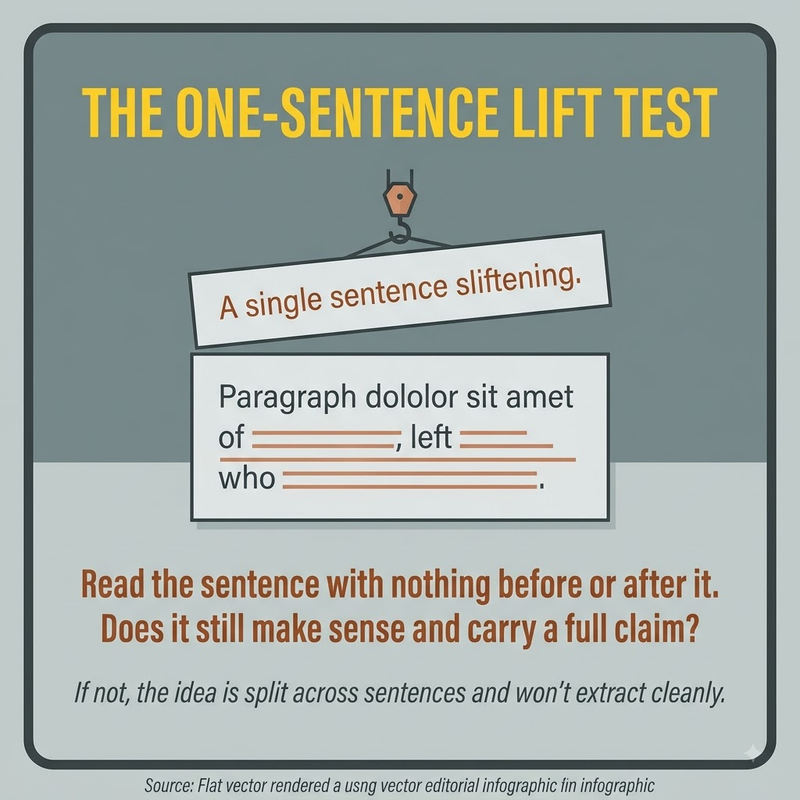
- Test extractability directly by pasting a specific passage into an AI system and checking whether it can accurately summarize just that passage without needing surrounding context to make sense of it.
Frequently Asked Questions
Can a page have perfect extractability but still never get retrieved at all?
Yes — extractability and retrieval are independent properties; a beautifully structured, highly extractable page still produces zero citations if it never gets retrieved for relevant queries in the first place.
Does extractability apply only to text content, or also to data in tables and charts?
The concept extends to structured data like tables, though the specific mechanics differ — a well-labeled table with clear headers tends to be more extractable than the same data embedded in unstructured prose.
Is extractability the same thing as readability for human visitors?
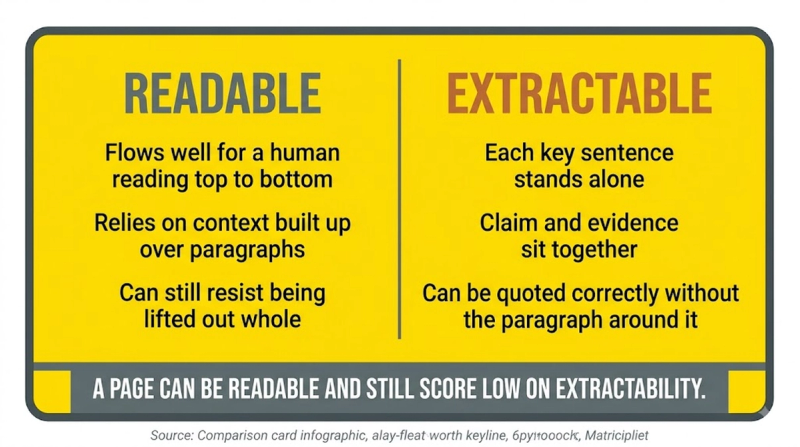
Related but distinct — a passage can be readable and pleasant for a human to read while still being hard for an AI system to extract cleanly if it relies on context, tone, or implication a human reader picks up naturally but a retrieval system doesn't.
Does adding more words to a passage improve or hurt extractability?
Neither length alone — the research consistently points to structural clarity and directness as the driving factor, meaning a longer passage with clear structure can be just as extractable as a shorter one, and unnecessary length without added clarity doesn't help.
Can schema markup improve extractability?
Schema markup provides additional machine-readable context but isn't a substitute for extractable prose structure itself — one source's data found schema had comparatively little independent effect on citation rates relative to the actual text structure.
Does extractability matter differently across different AI platforms (ChatGPT vs. Perplexity vs. Google AI Overviews)?
The underlying principle of clear, self-contained structure appears to help broadly across platforms, though the specific retrieval and citation mechanics do differ by platform in ways not yet fully documented publicly.
Is there a standardized tool or score for measuring a page's extractability?
No single standardized, universally adopted extractability scoring tool exists as of 2026; some individual GEO-focused tools and services offer proprietary extractability analysis, but there's no industry-standard metric comparable to something like a Core Web Vitals score.
Does extractability apply to FAQ-formatted content particularly well?
Yes — a well-written FAQ's question-answer format inherently creates self-contained, extractable passages, which is part of why FAQ content tends to perform well for AI citation specifically.
Can poor extractability cause an AI system to misrepresent content rather than simply not cite it?
Yes — if a system extracts an ambiguous or context-dependent passage without enough clarity, it can generate an inaccurate or misattributed summary based on that unclear extraction, not just fail to cite it at all.
How does extractability relate to the U-shaped attention pattern some research describes in how AI systems weigh content?
Research on this pattern suggests AI systems weigh content at the beginning and end of a section more heavily than the middle, which reinforces why leading with the direct answer (rather than burying it mid-passage) specifically improves extractability.


