
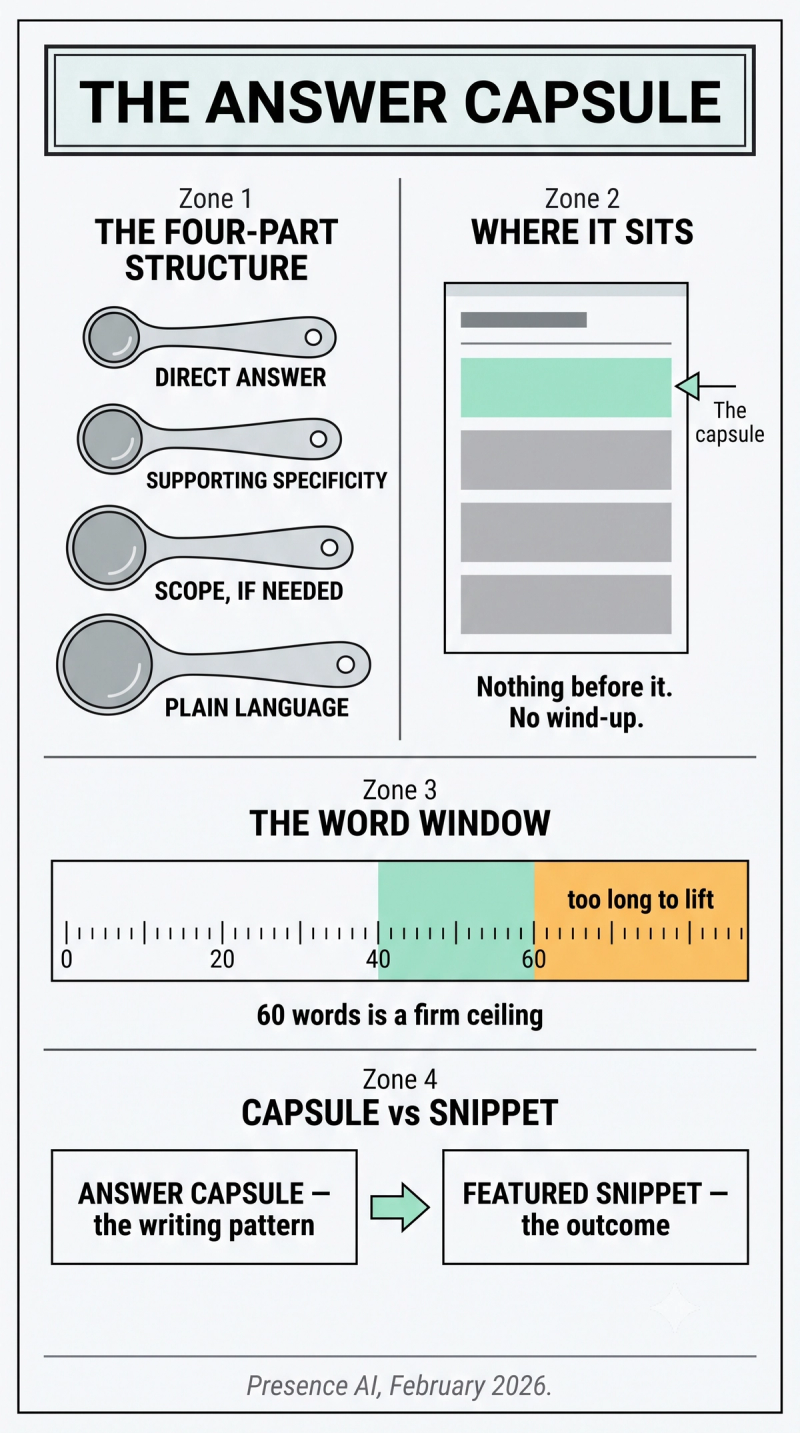
An answer capsule is a short, self-contained block of text placed directly beneath a heading — usually one phrased as a question — that answers that question completely on its own, without requiring the reader or an AI system to read surrounding paragraphs for context. It's a GEO-specific formatting practice, distinct from a featured snippet: a featured snippet targets Google's "position zero" result box using structured formatting Google's algorithm looks for, while an answer capsule targets how large language models parse and extract content when deciding what to cite in a generated answer. Worth being upfront about something: multiple sources researching this practice explicitly note the term itself still lacks a standardized definition industry-wide. What follows reflects the converging characteristics across current sources, not one settled specification.
Key Takeaways
- An answer capsule is a short, self-contained passage beneath a heading that answers the heading's question completely on its own — sources vary on exact length, with cited ranges from roughly 20-25 words up to 40-60 words.
- Answer capsules and featured snippets are related but distinct — featured snippets target Google's specific position-zero formatting requirements, while answer capsules target the broader extraction behavior of LLMs across multiple AI platforms.
- The term lacks a single standardized industry definition as of 2026 — this is stated explicitly by researchers studying the practice, not a gap in this page's research.
- Research tracking real AI citations found answer capsules were overwhelmingly link-free — more than nine in ten capsules in one analyzed dataset contained no links at all.
- Independent research (Aggarwal et al., "GEO: Generative Engine Optimization," 2024) found content with clear structure, cited statistics, and authoritative sourcing was cited meaningfully more often in AI-generated responses than comparable unstructured content — the underlying evidence base answer capsule practice draws on.
Answer capsules are one specific tactic within the broader answer engine optimization discipline this site covers separately, and the underlying extraction mechanism they're built for connects directly to extractability as the broader property answer capsules are trying to optimize for.
How Is an Answer Capsule Actually Different From a Featured Snippet?
A featured snippet is built to satisfy Google's specific criteria for its position-zero result box — structured formatting like numbered lists, definition-style openings, and table markup Google's algorithm has historically favored — while an answer capsule is built for how large language models parse and extract passages generally, across platforms that don't necessarily share Google's specific snippet criteria. The two share real DNA — both reward a direct, structured answer close to a heading — but treating them as identical is a mistake researchers studying the practice have flagged directly. A page can be well-optimized for featured snippets and still perform poorly for LLM citation if its structure doesn't hold up as a standalone passage once separated from the page around it, which is closer to what actually matters for answer capsule extraction.
Comparing the two:
- Target — Featured snippet: Google's position-zero result box. Answer capsule: LLM extraction across AI platforms.
- Formatting driver — Featured snippet: Google's specific algorithmic criteria. Answer capsule: general self-contained passage clarity.
- Typical length — Featured snippet: varies, often 40-60 words. Answer capsule: sources cite ranges from ~20-60 words.
- Where it lives — Featured snippet: usually the page's primary answer. Answer capsule: can appear under every major heading.
Does Adding Answer Capsules Actually Improve AI Citation Rates?
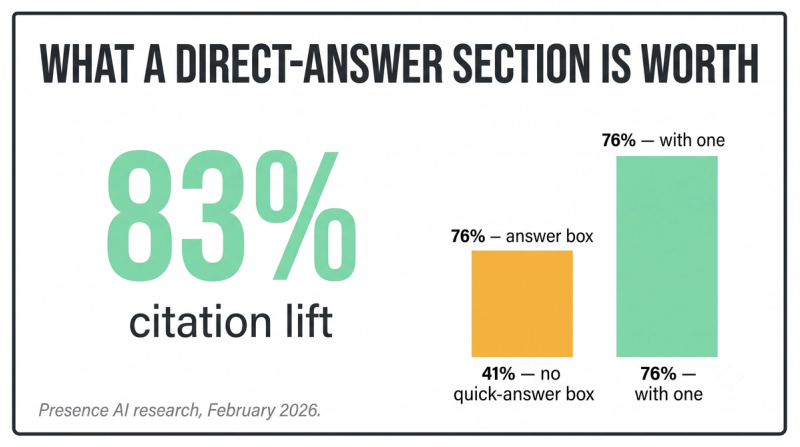
The evidence is genuinely mixed and depends heavily on query type — one analysis of published research found answer capsules provide meaningful benefit for informational queries but little to no benefit for discovery and comparison queries, which together account for a substantial share of total AI search traffic. The most-cited supporting research, Aggarwal et al.'s 2024 "GEO: Generative Engine Optimization" paper, reported visibility gains on a custom benchmark engine the authors built specifically for testing — gains that a separate analysis found don't fully replicate on production AI platforms the same way. That gap matters. It doesn't mean the underlying idea is wrong, but it does mean the "format an answer capsule, get cited" pitch some agencies use oversimplifies what the actual research supports.
What Does an Answer Capsule Actually Look Like in Practice?
An effective answer capsule leads immediately with the answer, avoids throat-clearing openers, and stands alone well enough that pulling it out of the page and reading it in isolation still makes complete sense:
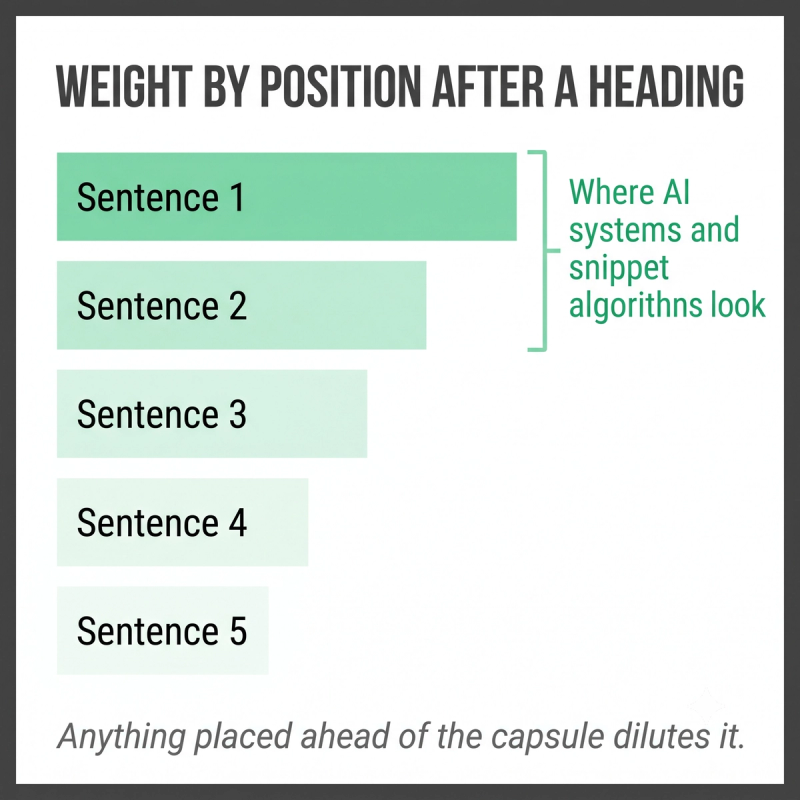
- Open with the direct answer to the heading's question in the first sentence — not a setup sentence like "many people wonder about this" or "in this section we'll cover."
- Name specific entities explicitly rather than relying on pronouns that only resolve correctly within the surrounding paragraph.
- Keep it tight — most sources converge somewhere in the 20-to-60-word range, though there's no single agreed exact number.
- Avoid hedging language ("might," "could," "may") that weakens the directness of the answer being extracted.
Free Chrome extension
A free AI citation checker for ChatGPT and Gemini
CitoSkeleton passively captures fan-out queries, cited and fetched sources, and brand mentions behind an AI answer — then tracks your GEO visibility against named competitors. 100% local, no account, no server.
- Follow the capsule with supporting detail and context for human readers, rather than trying to cram everything into the capsule itself.
Where Should Answer Capsules Actually Be Placed on a Page?
Answer capsules work best directly beneath the page's main heading and beneath each major subheading framed as a question — cornerstone pages and topic hubs in particular benefit from giving every major section its own capsule, since AI systems increasingly retrieve at the section level rather than reading a full page top to bottom. A glossary or definition page benefits especially from this pattern at the very top, since the opening paragraph functions as the page's primary capsule and is disproportionately likely to be what gets extracted first. For longer content — podcast transcripts, long-form guides, extensive FAQ pages — retrofitting existing material into capsuled sections under clear question-based headers is a common and practical way to make otherwise low-extractability content usable for AI citation without creating anything new.
Frequently Asked Questions
Is there an exact word count every answer capsule needs to hit?
No — sources cite different ranges (roughly 20-25 words in one study, 40-60 in another), and there's no single industry-agreed exact number; the more consistent principle across sources is completeness and self-containment rather than a specific count.
Do answer capsules need to include links to be effective?
Research tracking real AI citations found the opposite pattern common — more than nine in ten analyzed answer capsules contained no links at all, suggesting link-free, self-contained text tends to be the norm rather than a weakness.
Can a page have too many answer capsules?
There's no established upper limit, though a page where every single sentence tries to function as a standalone capsule can read awkwardly for human visitors — balancing extractability with natural readability matters.
Does Google's AI Overview feature specifically require answer capsule formatting?
Not specifically — Google has stated its own AI systems pull from the same index as traditional search and don't require content chunking as a strict requirement, though passage-level clarity still tends to help across AI platforms generally, Google's included.
Are answer capsules more useful for B2B or B2C content?
The practice applies to both; the more relevant factor is query type — informational queries tend to benefit more from capsule formatting than discovery or comparison-style queries, regardless of B2B/B2C context.
Can schema markup substitute for writing an actual answer capsule?
No — one dataset analysis found schema markup had little measurable effect on AI citation rates on its own, while the answer capsule's actual text structure was the factor that moved citation likelihood.
Does an answer capsule need to be the very first sentence on the page, or can it come after an introduction?
Leading with the capsule works best — content that opens with a setup like "many people wonder about this" before getting to the actual answer measurably underperforms content that answers first.
Is the answer capsule concept specific to text content, or does it apply to video/audio transcripts too?
It applies well to transcribed audio and video content specifically — pulling the real, specific answers out of a long conversational transcript and restructuring them into capsuled, question-headed sections is a common practical use case.
How is an answer capsule different from a standard dictionary-style definition?
A definition explains what a term means; an answer capsule can do that but also applies more broadly to any question-headed section — a "how to" heading, a comparison heading — where the goal is a complete, standalone answer, not just a term definition.
Does adding answer capsules to existing content require rewriting the whole page?
Not necessarily — retrofitting existing headers and their opening sentences into capsule format is often possible without restructuring the rest of the page's content or research.


