
Prompt journey mapping is the practice of identifying and organizing the specific prompts a potential customer might type into an AI assistant — like ChatGPT, Perplexity, or Google's AI Mode — across each stage of their buying journey, from early awareness through final decision, in order to find where a brand is visible or invisible in AI-generated answers. It's a direct extension of traditional customer journey mapping, adapted for a world where a meaningful share of research now happens as a conversation with an AI system instead of a sequence of typed search-box queries. Worth naming plainly: this isn't a single industry-coined term with one canonical origin. It's this glossary's label for a real, increasingly discussed practice that shows up across current GEO and AEO content under several different phrasings.
Key Takeaways
- Prompt journey mapping combines traditional buyer journey stages (awareness, consideration, decision) with the newer practice of tracking which specific AI prompts real buyers use at each stage.
- The term isn't a single, industry-standardized label — related practices appear across current GEO/AEO sources under various names, all describing the same underlying idea.
- A common mistake is over-indexing on bottom-funnel, comparison-style prompts ("best X vs Y") while ignoring the earlier awareness-stage prompts where a brand needs to be part of the AI's frame of reference to begin with.
- Unlike traditional keyword research, prompt journey mapping benefits from real conversation data — sales call transcripts, support tickets, actual buyer questions — since these better reflect how people phrase questions to AI than keyword-tool suggestions do.
- There is no measurable current search volume for this term or its close variants — it's covered here for concept positioning ahead of demand, the same rationale applied to other emerging GEO terms on this site.
AI share of voice is the measurement layer prompt journey mapping feeds into — mapping the prompts is the research step, tracking visibility across them over time is the measurement step. Answer engine optimization is the broader content-strategy discipline this research directly informs.
How Is Prompt Journey Mapping Different From Traditional Keyword Research?
Traditional keyword research organizes search terms by volume and competition within a search-engine framework, while prompt journey mapping organizes the actual conversational prompts someone might use with an AI assistant, sequenced across the stages of their buying journey rather than sorted primarily by volume. A keyword tool surfaces "best CRM software" as a phrase with a certain search volume; prompt journey mapping asks a different question — what does someone actually type into ChatGPT when they don't yet know CRM software is the category they need, and what do they ask once they've narrowed it to three finalists? The stages matter as much as the individual prompts, since a brand invisible at the awareness stage may never make it into the consideration set an AI assistant later compares.
What Are the Actual Stages a Prompt Journey Typically Covers?
The three stages:
- Awareness — the buyer is realizing they have a problem, exploring the category. Typical prompt style: "What's causing X problem" / "How do teams usually handle Y".
- Consideration — the buyer is comparing named solutions or approaches. Typical prompt style: "Best tools for X" / "X vs Y for [specific use case]".
- Decision — the buyer is narrowing to a final choice, seeking validation. Typical prompt style: "Is [specific product] good for [specific need]" / "[Product] pricing and reviews".
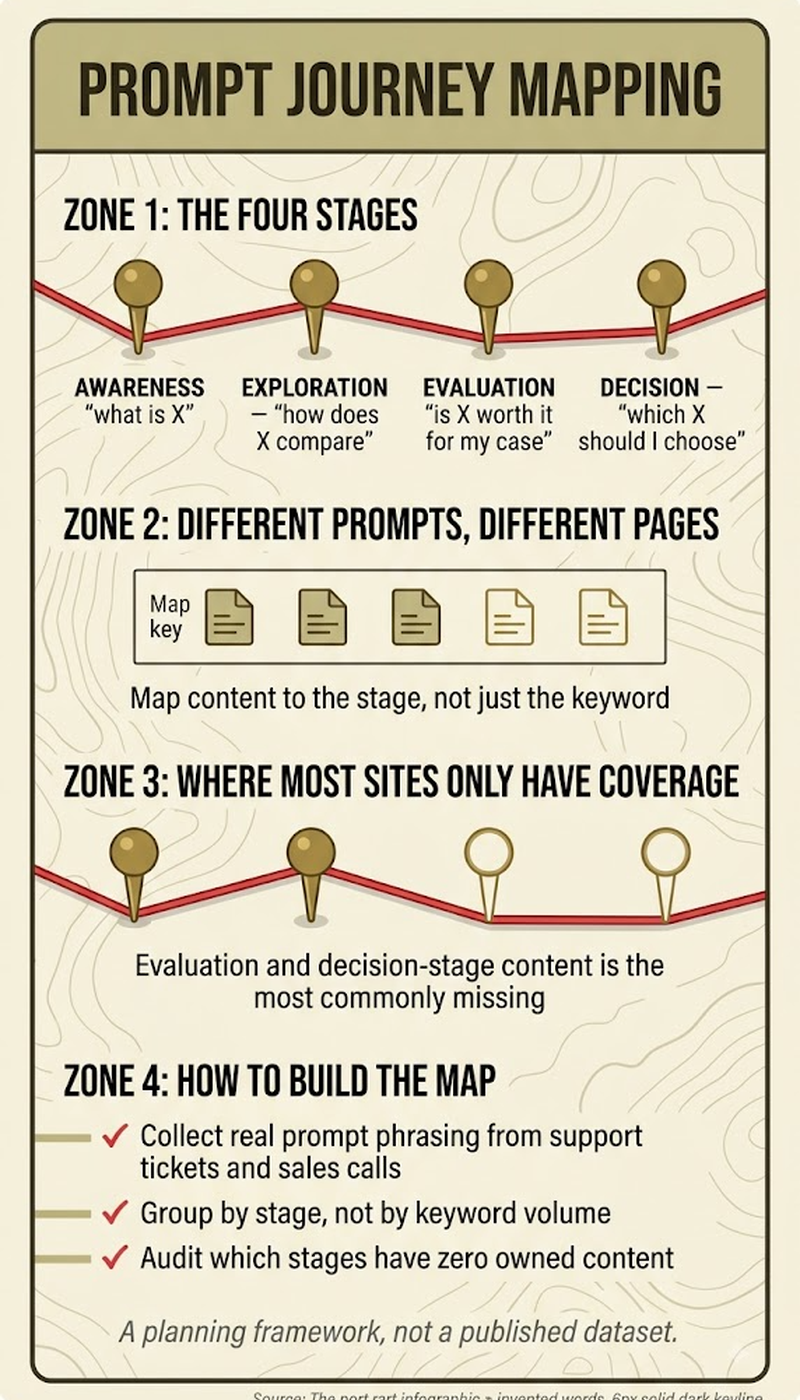
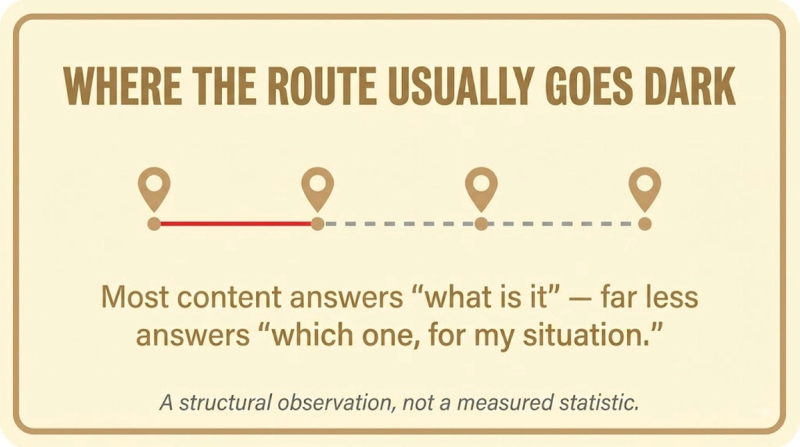
Most brands, based on current GEO practice, over-index on tracking bottom-funnel, comparison-style prompts and under-track the earlier awareness-stage questions — which is a real strategic gap, since an AI assistant that never encountered a brand during the awareness stage has no reason to include it later, no matter how strong that brand's comparison-page content is. Being present at the stage where the category itself gets defined matters as much as winning the final head-to-head comparison.
Where Does the Actual Prompt Data Come From?
Real conversation data — sales call transcripts, customer support tickets, community forum questions, and actual sales objections — tends to reveal genuine prompt phrasing far more reliably than keyword-tool suggestions do, since these sources capture how people actually ask questions rather than how a keyword tool infers they might search. A support ticket asking "why does my [product category] keep doing X" reflects real, specific phrasing an AI assistant user might type almost verbatim. Building a workable prompt journey map generally means:
- Pulling recurring questions and phrasing from sales calls, support tickets, and forum discussions rather than relying solely on keyword-tool output.
- Sorting collected prompts into awareness, consideration, and decision stages based on what the person asking clearly already knows versus what they're still figuring out.
- Testing a representative set of prompts directly in the AI platforms a target audience actually uses (not every platform equally — prioritizing where the audience concentrates).
- Recording whether and how a brand appears in each response, including whether it's named, described accurately, or absent entirely.
- Prioritizing content fixes for the stages and prompts where a brand is genuinely missing, rather than only reinforcing stages where it already shows up well.
Free Chrome extension
A free AI citation checker for ChatGPT and Gemini
CitoSkeleton passively captures fan-out queries, cited and fetched sources, and brand mentions behind an AI answer — then tracks your GEO visibility against named competitors. 100% local, no account, no server.
Does Prompt Journey Mapping Replace Traditional SEO Keyword Strategy?
No — it complements traditional keyword strategy rather than replacing it, since search-box queries and AI-assistant prompts overlap significantly but aren't identical, and a site still needs to rank in traditional search results even as it works to be cited accurately in AI-generated answers. The practical shift is additive: alongside standard keyword targeting, a prompt journey map identifies where AI-specific visibility gaps exist that traditional keyword rankings alone wouldn't reveal — a page can rank well in traditional search while remaining invisible or misrepresented across AI assistants covering the same topic.
Frequently Asked Questions
How many prompts does a realistic prompt journey map typically need to cover?
There's no fixed number, but current GEO practice generally suggests a representative set in the range of a few dozen prompts spanning all three funnel stages is more useful than either a handful of prompts or an unmanageably large list.
Should every AI platform (ChatGPT, Perplexity, Gemini, AI Mode) be tracked equally in a prompt journey map?
No — prioritizing the two or three platforms where a specific target audience actually concentrates tends to be more practical than spreading tracking evenly and thinly across every available AI platform.
Does prompt journey mapping require expensive specialized software, or can it be done manually?
It can be done manually by directly testing prompts across AI platforms and logging results, though dedicated AI-visibility tracking tools can automate and scale the process once a brand's prompt set is established.
Can prompt journey mapping reveal that a competitor is being recommended instead of a brand?
Yes — this is one of the most direct and actionable findings from the practice, since it identifies specific prompts where a competitor is named and a brand isn't, pointing to a clear content gap to address.
How often should a prompt journey map be refreshed?
Given how frequently underlying AI models and their outputs change, periodic re-testing (quarterly is a reasonable practical cadence for most brands) is more useful than treating a prompt journey map as a one-time exercise.
Does prompt journey mapping apply to B2B businesses, or mainly B2C?
It applies to both — B2B buying journeys tend to be longer and more research-heavy, which if anything makes mapping the specific prompts used at each research stage more valuable, not less.
Is there a meaningful difference between how a prompt is phrased and how a traditional keyword is phrased?
Yes — prompts tend to be more conversational, more specific, and often phrased as full questions, whereas traditional keywords are frequently fragments optimized for a search box rather than natural conversation.
Can a brand be "invisible" at one funnel stage but well-represented at another?
Yes, and this is a common and specifically actionable finding — a brand might be well-cited in decision-stage comparison prompts while being completely absent from earlier awareness-stage prompts about the underlying problem category.
Does prompt journey mapping account for the fact that different users phrase similar questions very differently?
A thorough prompt journey map should include multiple phrasing variations per stage and intent, rather than assuming one representative prompt captures how everyone at that stage actually asks.
How does prompt journey mapping data actually translate into content changes?
Gaps identified at specific stages typically translate into new or revised content addressing that stage's actual questions directly, structured for extractability so an AI system can retrieve and cite it accurately.


