
Search is shifting under our feet. Gartner forecasts that traditional search engine volume will fall 25 percent by 2026 as people move their questions to AI assistants. Pew Research reported in 2025 that on searches showing an AI summary, users clicked a result about 8 percent of the time, against 15 percent when no summary appeared. The click is drying up. The mention is the new prize.
Generative engine optimization, GEO, is the work of earning your brand a place inside those AI answers. Not a blue link hoping for a click. A sentence, a citation, a named recommendation, delivered by ChatGPT, Perplexity, Google AI Overviews, or Gemini at the moment someone is deciding.
Here is my position, and it is not the popular one. GEO is not a new department. It is SEO with the mask off. The same three forces that always decided rankings, relevance, authority, and trust, now decide citations too. What changed is the unit of victory, from the page to the passage.
How generative engine optimization works
Generative engine optimization works by making your content easy for a language model to retrieve, quote, and trust. The engine breaks the open web into passages, scores each one against the query, and stitches the strongest into a single answer that names its sources.
Under the hood, almost every AI answer runs on retrieval augmented generation. A retriever turns the query and your content into vectors, finds the closest passages, and hands them to the model, which writes prose grounded in what it received. If your passage is not retrieved, it cannot be cited, no matter how good it is.
The three gates every passage passes
- Retrievability. The engine's crawler has to reach your page, and the passage has to be clean enough to isolate. A fact buried inside a 300 word paragraph is far harder to lift than the same fact stated in its own two sentences.
- Extractability. The model needs a self contained claim it can quote without editing. Answers that depend on the previous three paragraphs for context get passed over for ones that stand alone.
- Corroboration. Engines prefer claims that other trusted sources repeat. A number that appears only on your page reads as a risk. The same number echoed across three reputable sites reads as fact.
Miss any one gate and you are invisible in the answer, even while you rank well in the classic results below it.
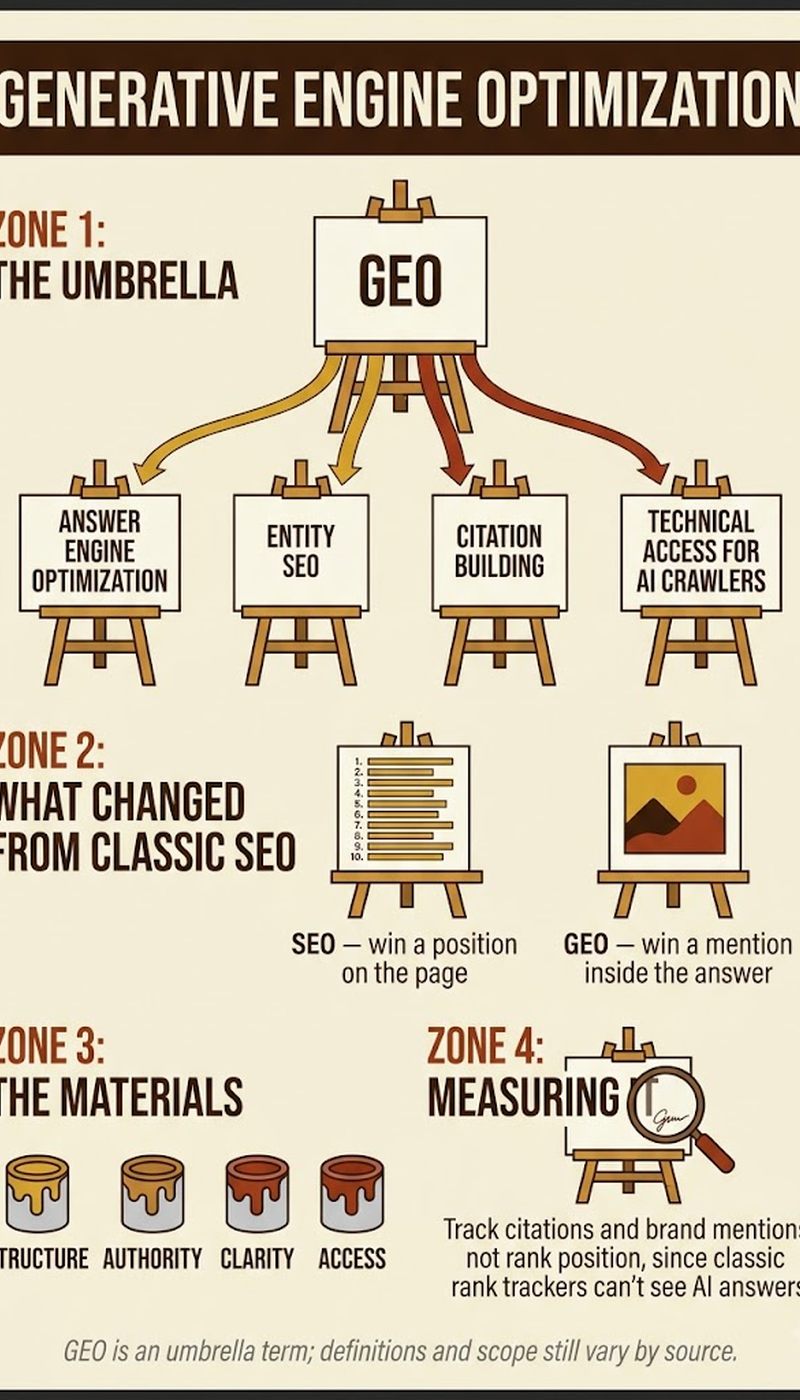
GEO versus SEO, and where AEO fits
The three terms get sold as rivals. They are really layers stacked on the same foundation.
Classic search engine optimization earns a ranked link and a click. It is still the base layer, because an AI engine cannot cite a page it never indexed.
Answer engine optimization wins the single answer box, the featured snippet or the voice reply, by formatting one passage as a direct response. Read the full breakdown of answer engine optimization for that narrower craft.
Generative engine optimization is the widest layer. It aims to be named inside an answer the model composes from many sources at once, often with no click at all.
- Unit of victory. SEO ranks a page. AEO wins a box. GEO earns a mention inside generated prose.
- Payoff. SEO sends a visit. AEO owns position zero. GEO builds presence and brand recall inside the answer, measured as share of voice.
- Click dependence. SEO and AEO still need the click. GEO often delivers value without one, through the citation and the named recommendation.
How each AI engine picks its sources
The engines rhyme, but they are not identical, and the differences decide where you spend effort. Google documents how its AI features select and link sources, and the other engines follow similar logic with their own tilt.
- Google AI Overviews and AI Mode lean heavily on pages already ranking near the top of classic results, then favor the ones with a clean, quotable claim high in the relevant section. Ranking first is close to a prerequisite.
- Perplexity rewards freshness and explicit citations. It will pull a recently updated, well sourced page over an older authority, and it shows its sources openly, so a strong page earns visible, clickable credit.
- ChatGPT Search favors pages it can quote without hedging, drawing on its index plus live browsing. Clear structure and unambiguous facts win, vague hedged prose loses.
- Gemini blends Google's index with its own reasoning, so entity clarity and structured data carry extra weight in what it chooses to surface.
The common thread is Google's long stated preference for helpful, people first content, which the AI features inherit wholesale.
How to optimize for generative engines
- Answer first, then explain. Open every section with a direct 40 to 60 word answer to the question the heading implies, then expand beneath it. Retrievers grab the top of a section far more often than the middle.
- Write one checkable claim per sentence, entity first, in present tense. "Core Web Vitals became a ranking signal in 2021" is quotable. "There have been various updates over the years affecting speed" is not.
- Add structured data for your entities, articles, FAQs, and organization, so machines read your facts and not just your prose.
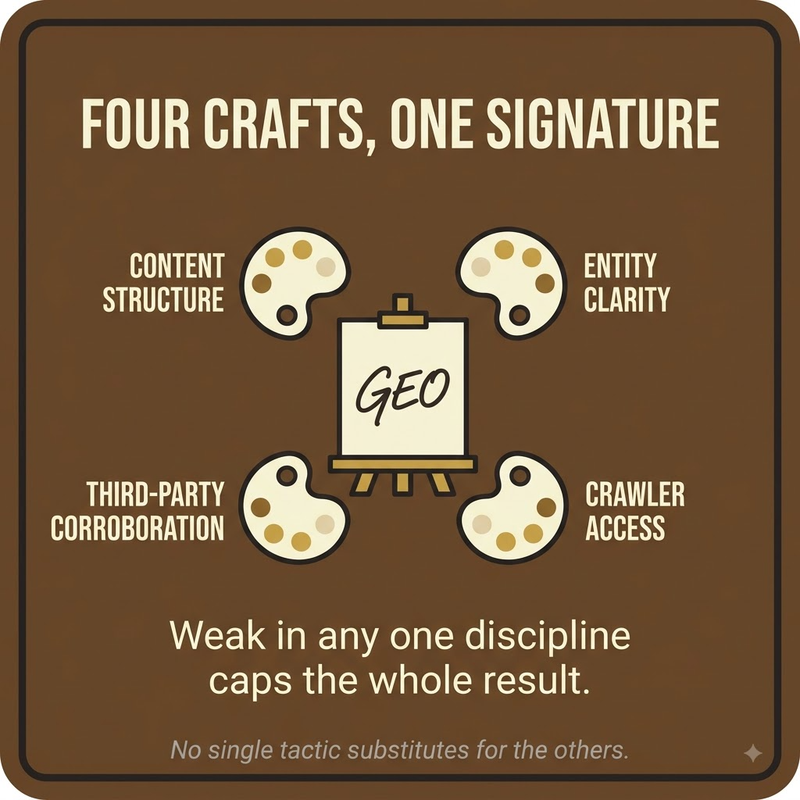
- Earn corroboration. Get named in third party roundups, comparison posts, and primary sources, so your claims are echoed off your own domain.
- Open the gate for AI crawlers. Confirm GPTBot, ClaudeBot, PerplexityBot, and Google-Extended are not blocked in robots.txt if you want those engines to cite you.
- Keep it current. Refresh numbers, dates, and examples on a schedule, because stale facts get quietly dropped from answers.
Underneath all of it sits entity SEO, teaching engines who you are and which topics you own, so your name is the one that surfaces.
How to measure GEO
You cannot manage what you refuse to measure, and most teams are flying blind here. Four numbers turn GEO from a vibe into a program.
- Citation share. For a fixed set of buyer prompts, how often each engine names you versus your rivals. Run the same prompts every month.
- Cited URLs. Which of your pages get pulled, so you can double down on the formats that actually win.
Free Chrome extension
A free AI citation checker for ChatGPT and Gemini
CitoSkeleton passively captures fan-out queries, cited and fetched sources, and brand mentions behind an AI answer — then tracks your GEO visibility against named competitors. 100% local, no account, no server.
- Answer sentiment. Whether the mention is a recommendation, a neutral aside, or a warning to avoid you.
- Referral and assisted conversions. Perplexity and ChatGPT send real, if smaller, traffic. Tag it and watch what it does after the click.
Dedicated tools like Profound and Peec help automate this, but a disciplined spreadsheet of prompts, engines, and mentions beats no measurement at all.
Common GEO mistakes
- Blocking AI crawlers by accident, then wondering why no engine ever cites you.
- Burying the answer. A brilliant point in paragraph seven never gets retrieved.
- Chasing every engine as a separate project. The same clean, sourced page tends to win across all of them at once.
- Faking authority. Models cross check, and a claim no one else supports is a liability, not an asset.
If I had to cut every tactic but one, I would keep corroboration. Being independently verifiable is the hardest thing to fake and the easiest thing for a model to reward.
Generative engine optimization statistics that matter
A few numbers explain why generative engine optimization moved from novelty to budget line in under two years.
- Gartner projects a 25 percent drop in traditional search engine volume by 2026 as users shift to AI assistants.
- Pew Research found in 2025 that people click a result on about 8 percent of searches showing an AI summary, against 15 percent when none appears.
- Google reported that AI Overviews reach more than a billion users, and has widened them across countries and query types since 2024.
- Adobe Analytics reported triple digit year over year growth in referral traffic from generative engines to retail sites through 2024 and 2025, from a small base.
Treat vendor figures as directional. Cite each number to its own source rather than blending several into one, since the methods rarely match.
Generative engine optimization tools
Generative engine optimization tools track how often AI engines mention your brand, which pages they cite, and how you compare against rivals. They turn a vague worry, are we visible in AI, into a measurable dashboard.
- Brand visibility trackers. Profound, Peec, and Otterly run your prompts across engines and log every mention and citation.
- SEO suites with AI modules. Semrush and Ahrefs now report AI Overview presence and cited pages next to classic rankings.
- Prompt and log analysis. A prompt panel plus server log checks reveal whether AI crawlers reach your pages at all.
My honest read. The category is young and pricey. For a single brand, a disciplined spreadsheet of prompts and mentions matches most paid tools. Buy software when you track many domains or need it live in client meetings.
Frequently asked questions
Is GEO just a rebranding of SEO?
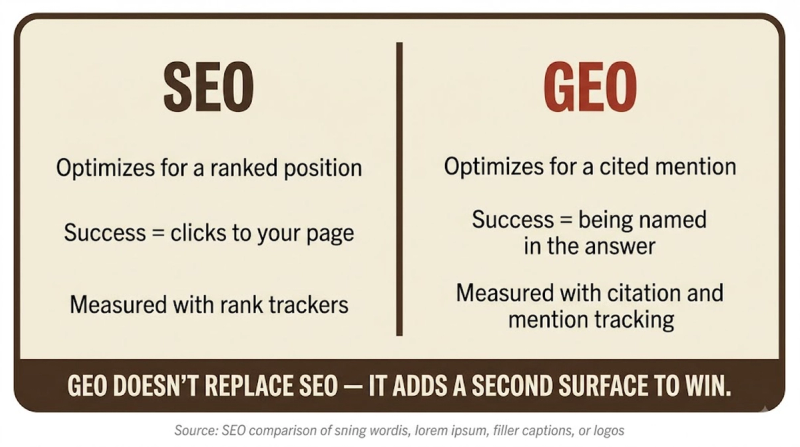
Not quite, though they share a foundation. Search engine optimization earns ranked links and clicks. Generative engine optimization earns a mention inside an AI generated answer, where the reward is a citation and brand recall rather than a visit. The skills overlap heavily, but the goal, the unit of success, and the way you measure it differ.
How do I know if AI engines are citing my brand?
Pick 20 to 30 prompts your buyers actually ask, then run them across ChatGPT, Perplexity, Google AI Overviews, and Gemini once a month. Record whether you are named, which page is cited, and how you are described. That panel becomes your baseline, and the trend over time tells you whether the work is landing.
Does GEO require creating new content?
Usually not at first. Most early gains come from restructuring existing pages so the answer sits at the top of each section, claims are quotable, and entities are marked up. New content earns its place only where a genuine coverage gap exists for a question your buyers keep asking and no page of yours answers cleanly.
Which pages should I optimize for GEO first?
Start with pages that already rank on page one for commercial or high intent questions, since AI engines pull disproportionately from top results. Definition pages, comparison pages, and how to guides get cited most, because they hold the clean, self contained claims that models like to lift.
Can GEO hurt my normal SEO?
No, done well it reinforces it. The same clarity, structure, structured data, and corroboration that earn AI citations also help classic rankings. The only real risk is over optimizing for extraction at the cost of readable prose, so write for humans first and format for machines second.
Is GEO replacing SEO?
No. Generative engine optimization sits on top of search engine optimization, it does not replace it. AI engines pull answers from pages that are already crawled, indexed, and ranked, so weak SEO means weak GEO. The two are layers of one job, not rivals.
Is GEO the same as AEO?
Not quite. Answer engine optimization targets a single direct answer, like a featured snippet or a voice reply. Generative engine optimization targets a mention inside a longer answer a model builds from many sources. GEO is the broader term, and AEO is one tactic inside it.


