
TL;DR. A vector embedding turns language into coordinates a machine can actually compare, a list of numbers that captures meaning well enough to measure similarity by position in space. OpenAI's text-embedding-3-large produces 3,072 dimensional vectors, and a shortened 256 dimensional version still outperforms the older, larger ada-002 model on the MTEB benchmark.
What is a vector embedding?
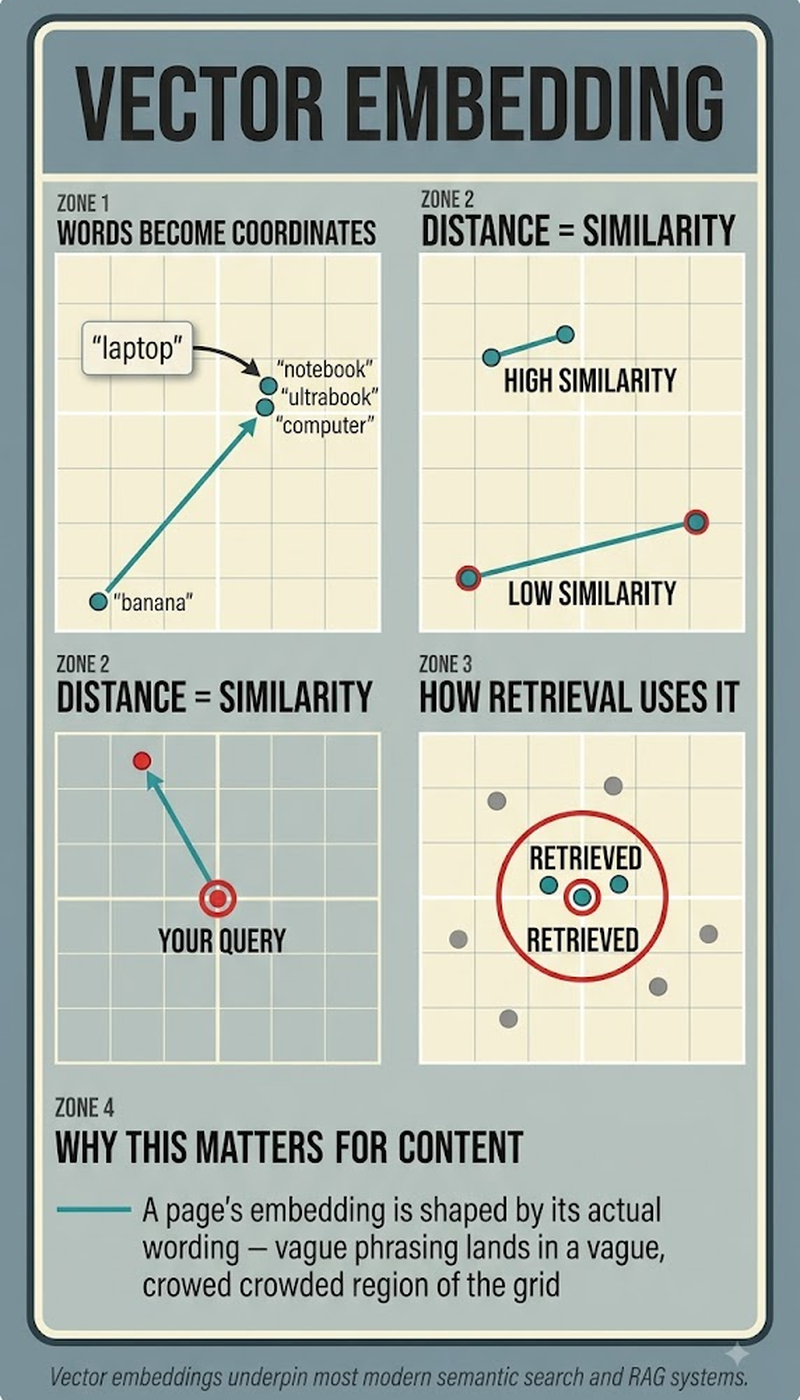
A vector embedding is a numerical representation of a word, sentence, or document, an array of numbers, that captures its meaning in a form a computer can actually process. Two pieces of text with similar meaning end up as vectors pointing in a similar direction, even sharing zero words in common.
Everything downstream of this translation runs on it: semantic search, retrieval, AI generated answers. A vector embedding is the bridge between human language and machine math, and nothing else in this stack works without it.
Key highlights
- Embedding vectors run from a few hundred to several thousand dimensions; GPT-2, for comparison, used 768.
- OpenAI's text-embedding-3-large produces 3,072 dimensional vectors and can be shortened to 256 dimensions while still beating the older, larger ada-002 model.
- Cosine similarity, the standard way to compare two embeddings, ranges from negative one to positive one, with scores near one signaling near identical meaning.
- The MTEB benchmark is the standard test for embedding quality, and it gets updated constantly as OpenAI, Google, Voyage, and open source teams keep pushing new models to the top of it.
How a vector embedding gets produced
A vector embedding is produced by feeding text into a trained embedding model, which outputs a fixed length list of numbers. The model learns during training that words used in similar contexts should end up with similar vectors, so cat and dog land closer together than cat and car.
Direction matters, not length. Two vectors pointing the same way represent similar meaning even if their magnitudes differ, which is exactly why cosine similarity, a measure of the angle between vectors, became the standard comparison method instead of raw distance.
What cosine similarity measures
Cosine similarity is a score from negative one to positive one that measures the angle between two vectors, where a score near one means the two pieces of text mean nearly the same thing. A search system embeds an incoming query, computes cosine similarity against every stored embedding, and returns whichever ones score closest.
Where vector embeddings show up
- Semantic search, where results get ranked by embedding similarity to the query rather than keyword overlap.
- Retrieval augmented generation, where a retriever finds the passages closest to a query before the model ever answers.
- Recommendation systems, clustering, deduplication, and classification, basically anywhere similarity between two pieces of text matters.
Vector embeddings vs keyword matching
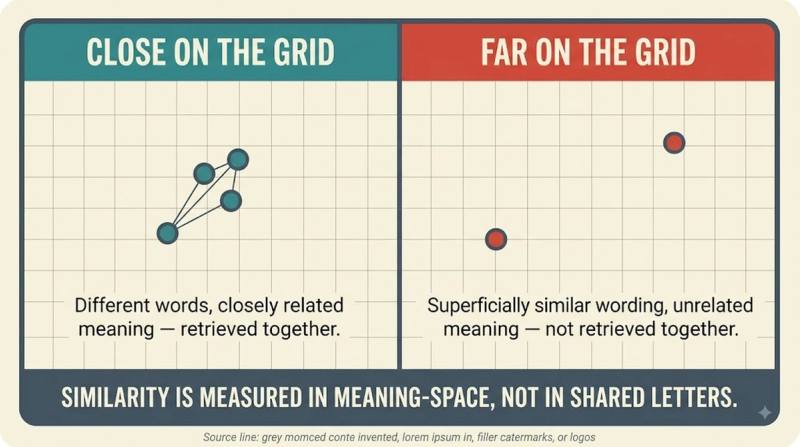
Keyword matching checks whether specific words appear in a document. Vector embeddings check whether the meaning is similar instead, so a query for device wont power up can retrieve a page about a laptop that will not turn on without a single shared keyword between them.
Free Chrome extension
A free AI citation checker for ChatGPT and Gemini
CitoSkeleton passively captures fan-out queries, cited and fetched sources, and brand mentions behind an AI answer — then tracks your GEO visibility against named competitors. 100% local, no account, no server.
The tradeoff is precision. Keyword search is exact and fast. Embedding search is more flexible but can occasionally retrieve something related without being quite right, which is why many production systems run both together as hybrid search.
How to use embeddings for SEO
- Cluster your existing pages by embedding similarity to spot duplicate or cannibalizing content before it costs you rankings.
- Compare a draft against top ranking pages by embedding distance to check whether topical coverage actually lines up.
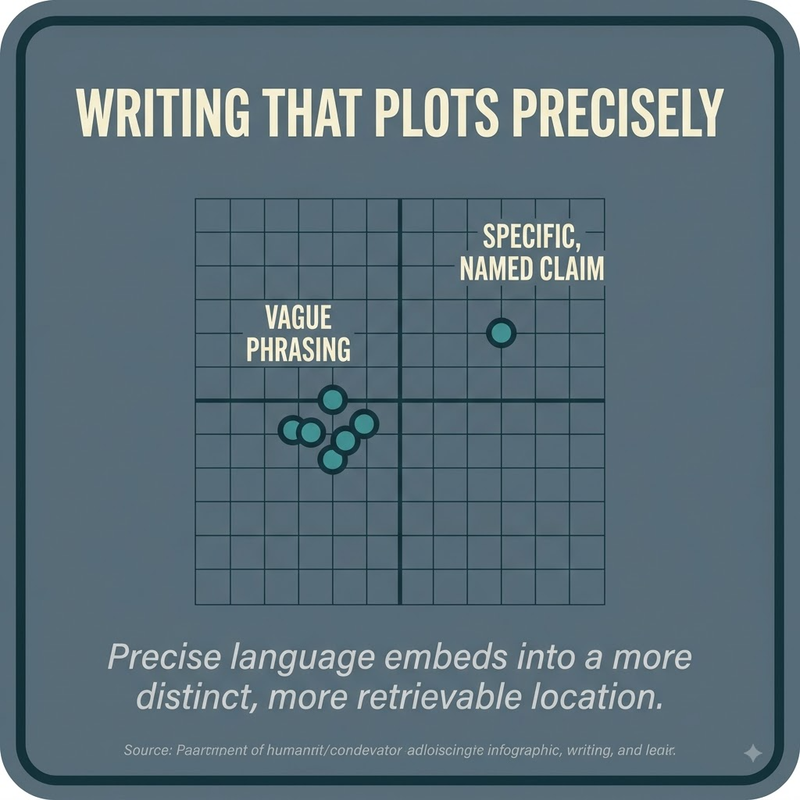
- Write naturally instead of stuffing exact phrases, since embedding based systems reward meaning over repetition.
- Keep passages self contained; even a strong embedding still needs a clean chunk of text to represent.
Frequently asked questions
What is a vector embedding?
Think of it as a coordinate. A vector embedding assigns text a position in a high dimensional space, and two pieces of text that mean similar things end up close together in that space. That coordinate is what lets a machine compare meaning the same way it compares any two numbers.
How many dimensions does a typical embedding have?
It varies by model and use case. GPT-2 used 768 dimensions, while OpenAI's text-embedding-3-large defaults to 3,072, though it can be shortened to 256 dimensions and still outperform older, larger models. More dimensions capture more nuance but cost more to store and search, so most production systems shorten vectors until quality actually starts to drop.
What is cosine similarity, and why not just measure distance?
Cosine similarity measures the angle between two vectors rather than the straight line distance between them, because two vectors can point in nearly the same direction while having very different lengths. Comparing angle instead of distance keeps the score focused on meaning rather than on how much text went into producing the vector.
What is the practical difference between embeddings and keyword matching?
A keyword search for device won't power up misses a page titled laptop troubleshooting entirely, since they share no words. An embedding based search catches it, because the two phrases describe the same underlying problem. That gap is exactly why most modern search and support tools have moved to embeddings, or a hybrid of both.
How do embeddings power RAG?
Retrieval augmented generation embeds an incoming query and compares it against embeddings of stored documents to find the closest matches before the model writes a single word of its answer. That retrieval step is what lets an AI system pull in current, specific information instead of relying only on what it memorized during training.
What is a vector database, and do I need one?
A vector database is built to store embeddings and search them by similarity rather than exact match, indexing millions of vectors so a query can find its closest neighbors in milliseconds. You need one once your embedding collection outgrows what a simple in memory comparison can handle quickly, which for most sites happens well before a million pages.


