
TL;DR. Semantic SEO treats a page as a network of entities and intent rather than a container for one exact keyword phrase, a shift built directly on how Google's own algorithms learned to read language. RankBrain arrived in 2015 as Google's first AI system for interpreting query meaning, BERT followed in 2019 and immediately touched 10% of all search queries by reading entire phrases in context, and MUM arrived in 2021 roughly 1,000 times more powerful than BERT and trained across 75 languages, together explaining why keyword density stopped being the primary signal it once was.
What is semantic SEO?
Semantic SEO structures and writes content around entities, concepts, and the intent behind a search rather than the exact string a searcher might type. An entity here means a unique, well-defined concept, a specific company, place, or idea, that a search engine can recognize and connect to related concepts in its Knowledge Graph. A page built this way reads as a network of meanings a search engine has to understand, not a container for a target keyword repeated at the right density.
Key highlights
- RankBrain in 2015 gave Google its first AI-based system for interpreting the meaning and context behind a query, rather than matching exact keywords sitting in a page's copy.
- BERT launched in 2019 and immediately affected 10% of all search queries, reading entire phrases bidirectionally instead of parsing keywords in isolation.
- MUM arrived in May 2021 as a multimodal system roughly 1,000 times more powerful than BERT, trained across 75 languages specifically to close the gap in international and cross-lingual search, a scale jump none of Google's earlier language systems approached.
- The three now work together rather than separately: BERT judges a page's relevance to the query, RankBrain reads how real users react once they land on it, and MUM rewards content that treats a topic with genuine, comprehensive expertise.
- Natural language processing lets Google connect phrases that mean the same thing even when the words differ, recognizing that affordable smartphone and cheap mobile phone point at the same underlying intent.
The three algorithms behind semantic search
- RankBrain (2015). Infers meaning from ambiguous or entirely novel queries instead of requiring an exact keyword match.
- BERT (2019). Reads a full phrase bidirectionally, so each word's meaning shifts based on the words surrounding it, which matters most on long, conversational queries.
- MUM (2021). A multimodal, multilingual system built to handle complex, multi-part questions and reward comprehensive expert content across 75 languages at once.
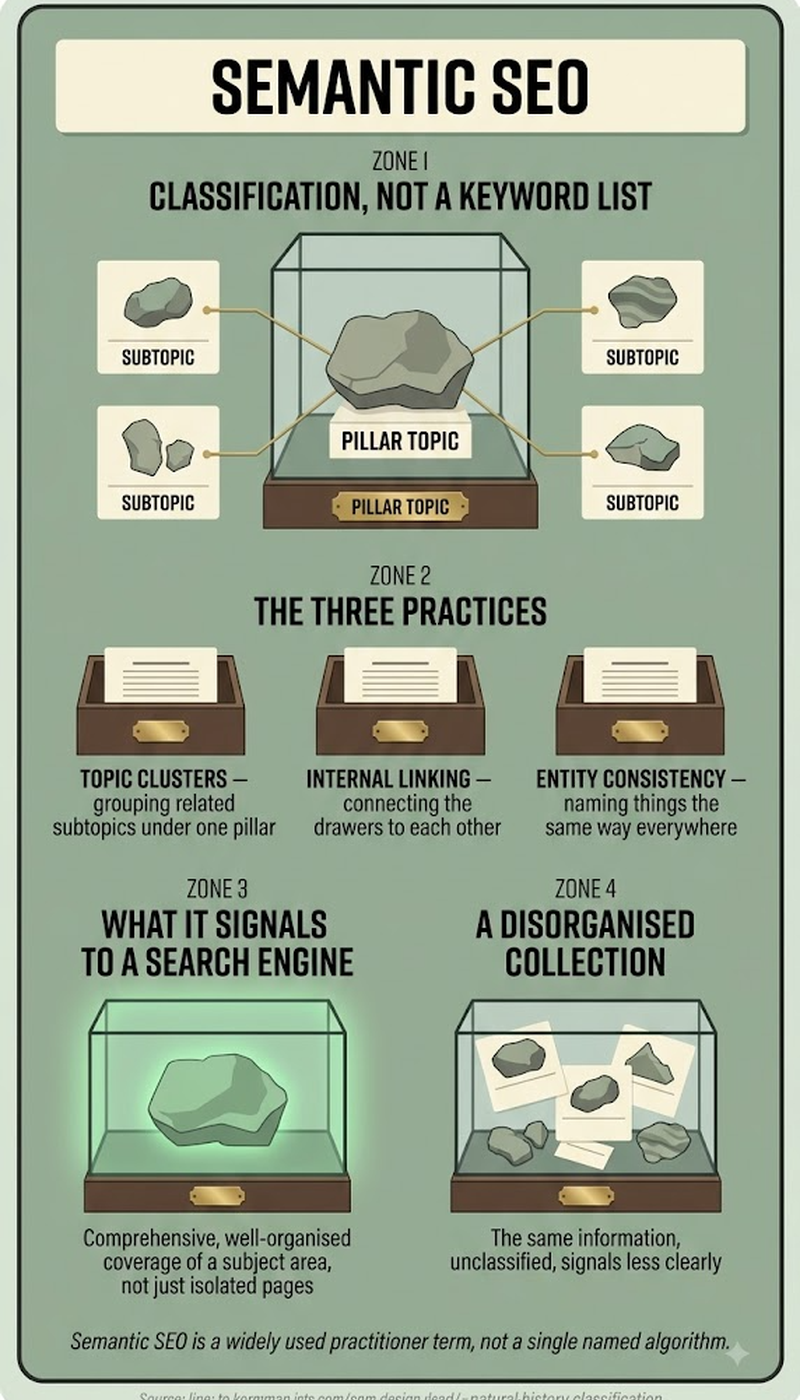
Semantic SEO against keyword-density SEO
Keyword-density SEO optimized a page around one exact target phrase repeated at a set frequency, on the theory that matching a searcher's literal words was what mattered most. Semantic SEO starts from the opposite assumption, that a search engine already understands synonyms, related concepts, and underlying intent, so a page has to demonstrate real topical understanding of an entity and its relationships rather than contain the right string of characters.
Practicing semantic SEO
- Identify the core entities a topic revolves around and research how a search engine's Knowledge Graph likely connects them to related concepts.
- Write toward the actual intent behind a query, covering the concept and its natural sub-questions instead of repeating one exact phrase.
- Vary language naturally, using synonyms and related terminology throughout instead of one fixed phrase.
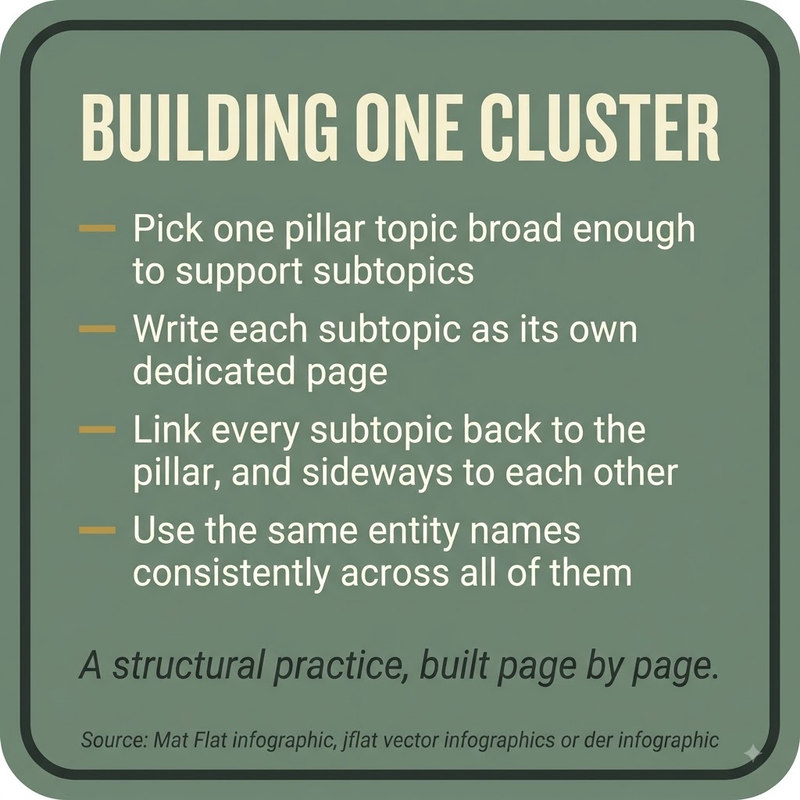
- Give related entities and subtopics their own clearly labeled sections, making the semantic relationships explicit instead of implied.
- Mark up key entities with structured data where it fits, giving search engines an explicit, machine-readable confirmation of the topic.
Semantic SEO next to topical authority
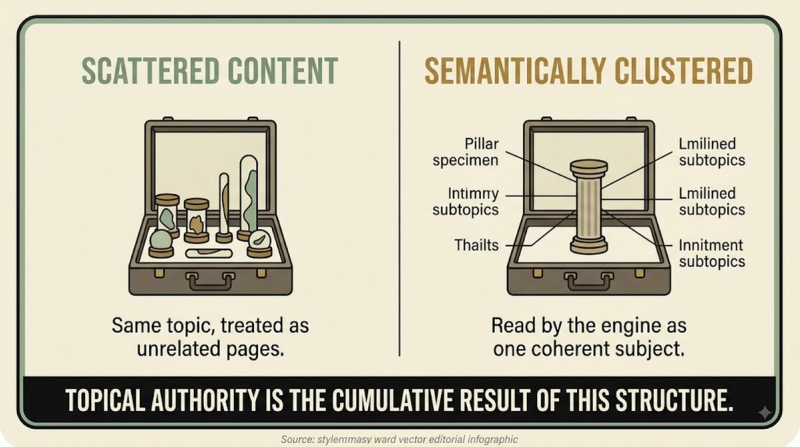
Semantic SEO and topical authority overlap but describe different scopes. Semantic SEO is the broad principle, optimizing around meaning, entities, and intent instead of exact keywords. Topical authority, the specific framework formalized by Koray Tuğberk GÜBÜR, applies that principle at the site level, describing how to organize an entire content library into networks that demonstrate comprehensive entity and topic coverage over time.
Frequently asked questions
What is semantic SEO?
Semantic SEO is the practice of optimizing content around meaning, entities, and searcher intent instead of exact keyword phrases, treating a page as evidence of genuine topical understanding rather than a container built around one target string.
What counts as an entity in semantic SEO?
An entity is a unique, well-defined concept, a specific company, place, or idea, that a search engine can recognize and connect to related concepts in its Knowledge Graph, independent of the exact words used to name it.
How is semantic SEO different from targeting one exact keyword?
Targeting one exact keyword repeats a fixed phrase at a set density. Semantic SEO instead demonstrates topical understanding through natural language variation and comprehensive coverage of the entity and its related concepts, since Google's systems already resolve synonyms on their own.
What did RankBrain, BERT, and MUM each actually change?
RankBrain, launched in 2015, gave Google its first AI system for reading query meaning. BERT, launched in 2019, reads full phrases in context. MUM, launched in 2021, is roughly 1,000 times more powerful than BERT and works across 75 languages at once.
Does semantic SEO replace keyword research entirely?
No. Keyword research still identifies what people search and how often. Semantic SEO changes what happens after that, shaping how the content is written and structured around entities and intent instead of around repeating the researched phrase itself.
Is topical authority the same thing as semantic SEO?
Not quite. Semantic SEO is the broader principle of writing around meaning and entities. Topical authority is a specific strategic framework built on that principle, describing how a whole site's content network should be organized to show comprehensive coverage of a subject over time.


