
What Is Topical Authority?
Topical authority is the degree to which search engines (and, increasingly, AI systems) recognize a website as a comprehensive, trustworthy source of information on a specific subject. It's built through genuinely thorough content coverage of that subject over time, rather than any single standout page. A site with strong topical authority in, say, personal finance doesn't just have one excellent article about budgeting. It has deep, interconnected coverage spanning budgeting, saving, investing, debt, and every meaningfully related subtopic, structured so search engines can recognize the site's comprehensive expertise across the entire subject area, not just isolated fragments of it.
Key Takeaways
- Topical authority is built through comprehensive content coverage across an entire subject area over time — not through any single piece of exceptional content, however well-written.
- It's distinct from domain authority (a third-party metric estimating overall site strength) — topical authority is specifically about depth and breadth within a particular subject, not a site's general authority across unrelated topics.
- The pillar-and-cluster content model, covered in depth on this site's dedicated page, is one of the most direct structural techniques for building topical authority, since it explicitly organizes content to demonstrate comprehensive subject coverage.
- Internal linking plays a critical role in topical authority — content covering related subtopics needs to be genuinely interconnected for search engines to recognize the site's coverage as a coherent, comprehensive whole rather than disconnected individual pages.
- Topical authority increasingly matters for AI-search visibility as well as traditional rankings, since AI systems synthesizing answers tend to draw more confidently from sources that demonstrate deep, comprehensive expertise across a subject rather than isolated, one-off coverage.
How Is Topical Authority Actually Different From Domain Authority?
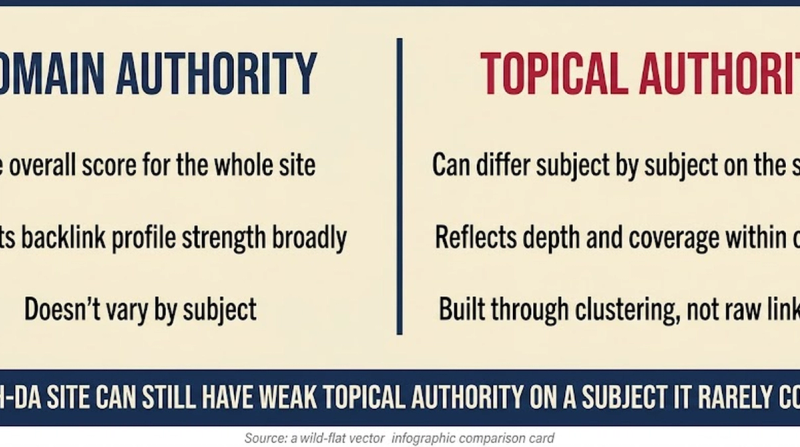
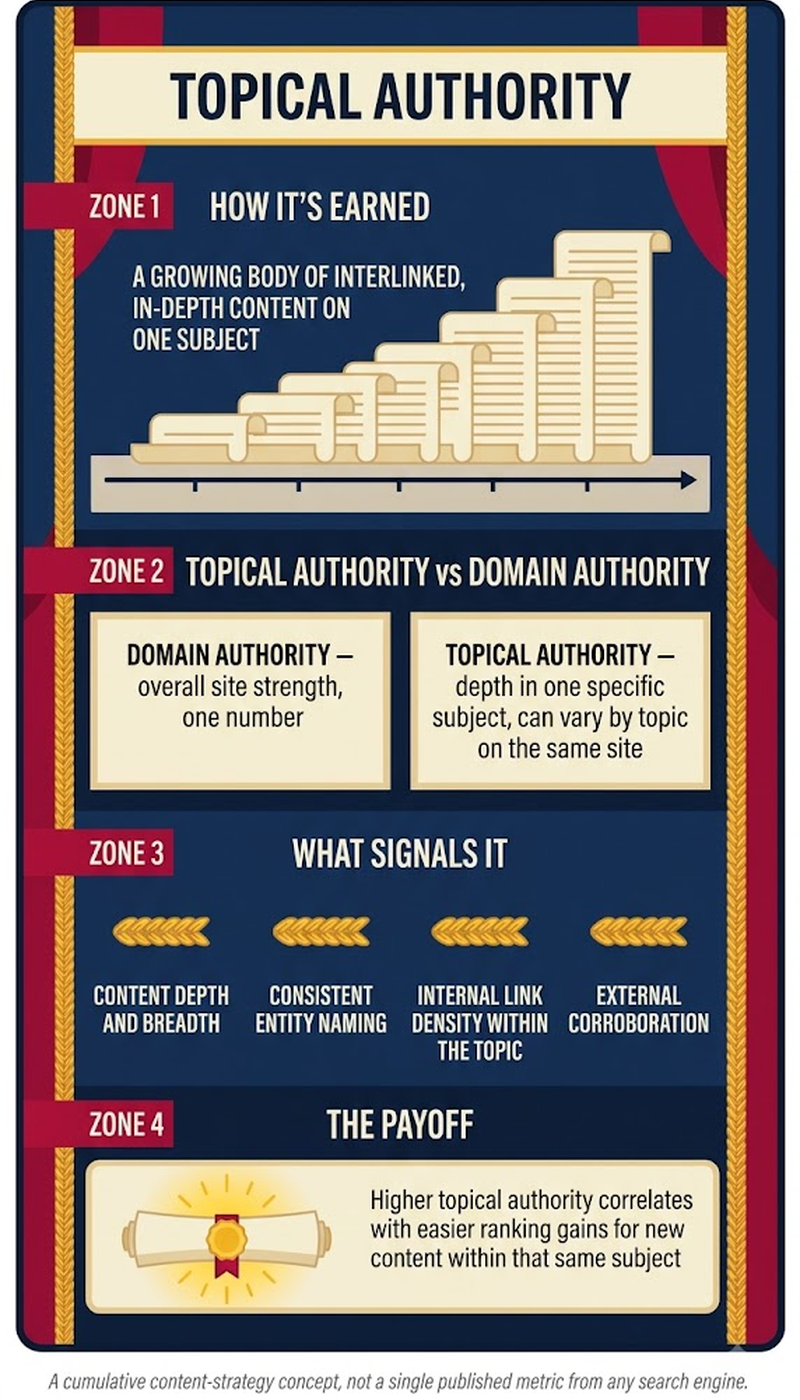
Domain authority is a third-party metric (popularized by Moz, though other tools have their own versions) that estimates a site's overall general strength and likelihood to rank, based primarily on backlink profile data. Topical authority is specifically about how comprehensively and credibly a site covers one particular subject area. A site can have relatively modest domain authority overall while still having genuinely strong topical authority within a narrow, well-covered niche. This distinction matters practically: a small, focused site covering one subject exhaustively can out-rank a much larger, higher-domain-authority site on specific queries within that narrow subject. That's precisely because the smaller site's comprehensive, interconnected coverage signals deeper subject-specific expertise than the larger site's more scattered, single-page treatment of the same topic.
Domain authority vs. topical authority, at a glance:
- What it measures — Domain authority: overall site strength (third-party metric). Topical authority: depth and breadth within a specific subject.
- Primary driver — Domain authority: backlink profile. Topical authority: comprehensive, interconnected content coverage.
- Scope — Domain authority: site-wide, general. Topical authority: subject-specific, narrow.
- Official Google metric? — Domain authority: no, third-party estimate. Topical authority: no, but reflects real signals Google evaluates.
How Does Content Structure Actually Build Topical Authority?
Topical authority is built primarily through comprehensive, interconnected content coverage of a subject's full range of subtopics. It's structured so search engines can recognize the relationship between individual pages as forming one coherent body of expertise, rather than a scattered collection of unrelated articles. The pillar-and-cluster model, a broad overview page linking out to focused, in-depth pages on each major subtopic, all reciprocally interlinked, is one of the most direct structural techniques for demonstrating this kind of comprehensive coverage explicitly. The linking pattern itself signals the topical relationship to search engines, rather than leaving it to be inferred purely from content similarity. A site attempting to build topical authority without this kind of deliberate internal structure, publishing genuinely comprehensive content but leaving it poorly interlinked, sends a weaker signal than the same content organized and connected intentionally.
Does Topical Authority Actually Matter More Than Individual Page Quality?
Not more than — but alongside, and in a genuinely different way. Individual page quality determines whether a specific page can rank well for its specific target query. Topical authority affects a site's broader credibility and visibility across an entire subject area, including for queries a specific individual page might not directly target but that benefit from the site's overall demonstrated expertise. A single excellent page on a topic a site otherwise has no other coverage of can still rank for its specific query. But it won't carry the same broader credibility signal that the same excellent page would carry if it existed within a comprehensive, well-linked cluster of related content. The two work together rather than substituting for each other: genuinely strong topical authority is built from individually strong pages, not from volume or breadth alone without underlying quality.
How Do You Actually Build Topical Authority for a New or Growing Site?
Building topical authority is a deliberate, sustained content strategy rather than something that happens incidentally through publishing volume alone:
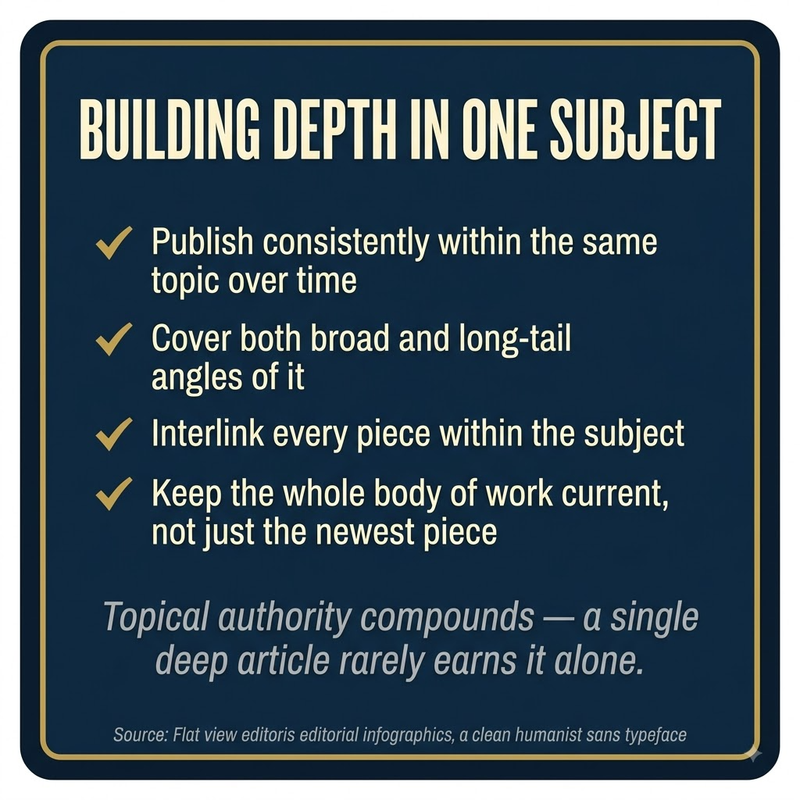
- Map out a subject's full range of genuinely relevant subtopics before publishing, rather than creating content reactively without an underlying structural plan.
- Prioritize comprehensive coverage of core subtopics before branching into more peripheral or tangential related topics, building depth in the subject's foundation first.
- Interlink related content deliberately and consistently, using the pillar-and-cluster model or an equivalent structural approach to make the topical relationships explicit rather than implicit.
- Maintain and update existing content as a subject evolves, since topical authority reflects current, accurate comprehensive coverage — not a one-time content push that goes stale.
- Earn external validation (backlinks, mentions, citations) specifically within the target subject area, since topical authority is reinforced by external signals recognizing the site's expertise in that particular subject, not just general site-wide authority.
Topical authority is the outcome the pillar page content model is specifically designed to build, and E-E-A-T evaluation criteria overlap significantly with what demonstrates genuine topical authority — both reward depth, accuracy, and comprehensive, credible coverage over isolated content pieces.
Frequently Asked Questions
How long does it typically take to build meaningful topical authority in a subject area?
There's no fixed universal timeline. It depends on competition within the subject, publishing consistency, and content quality. But it's generally a sustained effort measured in months to years, rather than something achieved quickly.
Can a site have strong topical authority in multiple, unrelated subject areas simultaneously?
Yes, though it requires genuinely comprehensive coverage within each separate subject area. Spreading effort too thin across many unrelated topics, without depth in any of them, tends to build meaningful authority in none of them.
Does topical authority apply differently to e-commerce sites than to content/blog-focused sites?
The underlying principle applies to both, though e-commerce topical authority often centers on comprehensive product category and buying-guide coverage rather than purely informational article content.
Is there an official Google metric that directly measures topical authority?
No — Google hasn't published or confirmed an official "topical authority score"; it's a concept describing patterns in how comprehensive, well-structured content tends to perform, inferred from ranking behavior rather than a disclosed metric.
Can acquiring another site's content help build topical authority quickly?
Acquired content can contribute to coverage breadth. But topical authority is also built through genuine internal linking, consistency, and ongoing maintenance. Simply owning more content on a subject doesn't automatically confer the same signal as content that's actively integrated and maintained as part of a coherent structure.
Does publishing more content always build more topical authority?
No. Volume without genuine depth, accuracy, or proper internal structure can actually dilute a site's perceived quality, rather than building authority. Comprehensive, well-organized, high-quality coverage matters more than raw content count.
How does topical authority relate to a site's ability to rank for new content in the same subject?
Sites with established topical authority in a subject often see new, related content rank faster and more easily, since the existing body of comprehensive coverage provides supporting context and credibility for the new addition.
Can topical authority be lost over time if content isn't maintained?
Yes. Outdated, inaccurate, or neglected content within a subject area can erode topical authority over time. That's part of why ongoing content maintenance, not just initial publishing, matters for sustaining it.
Does topical authority matter for AI-generated search answers, not just traditional rankings?
Yes, arguably more directly. AI systems synthesizing answers tend to draw more confidently from sources demonstrating deep, comprehensive subject expertise, since that comprehensiveness provides more context and cross-referenced material for the system to draw from.
Is topical authority the same concept as "content depth"?
They're closely related but not identical. Content depth typically refers to how thoroughly a single piece of content covers its specific topic. Topical authority is the broader, site-wide pattern built from depth across many interconnected pieces of content.


