
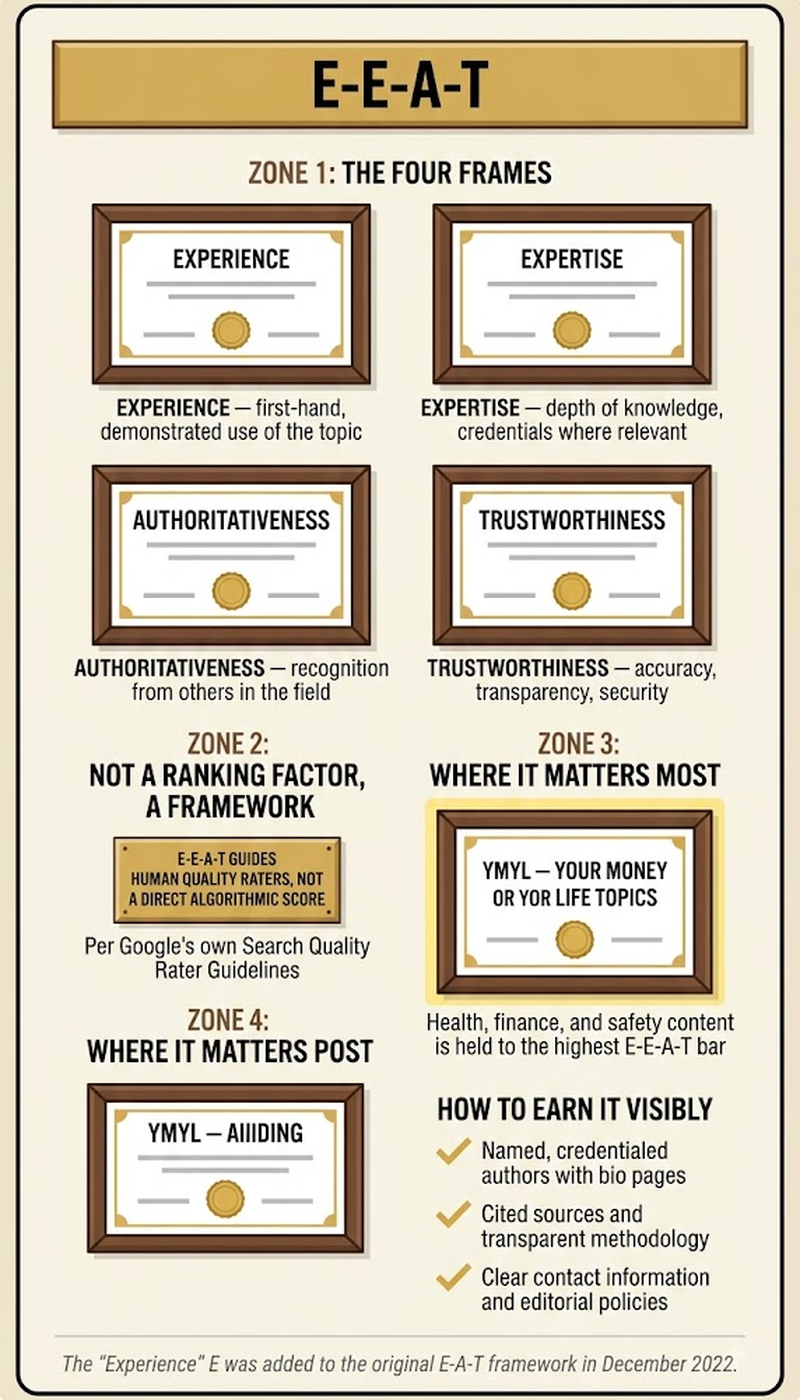
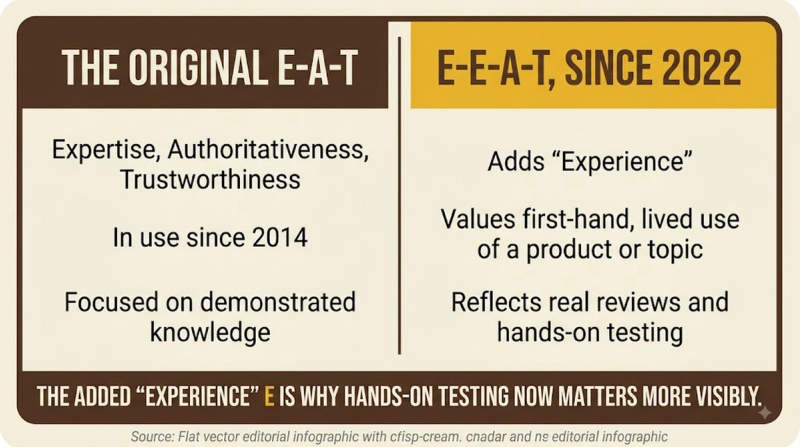
E-E-A-T stands for Experience, Expertise, Authoritativeness, and Trustworthiness — the four-part framework Google's Search Quality Rater Guidelines use to judge content quality, with Trust sitting as the foundation the other three build on. Google added the first "E," for Experience, on December 15, 2022, expanding the older E-A-T model to specifically reward content written by someone who's actually done the thing they're describing. It isn't a ranking algorithm you can directly measure or a score anywhere in Search Console. It's a rating framework — one that shapes what Google's automated systems eventually learn to reward.
Key Takeaways
- E-E-A-T has four components — Experience, Expertise, Authoritativeness, Trustworthiness — with Trust treated as the foundation the other three are built on top of, not an equal fourth pillar.
- Google added "Experience" to the older E-A-T framework on December 15, 2022, specifically to reward first-hand, lived knowledge of a topic over purely theoretical expertise.
- E-E-A-T comes from the Search Quality Rater Guidelines, a public document human raters use to score search results; raters don't move rankings directly, but their scores train the systems that do.
- There's no numerical E-E-A-T score to look up anywhere — it's a qualitative framework, not a metric in Google Search Console or any Google-provided tool.
- The current guidelines document was published September 11, 2025 and remains the active reference; it runs 182 pages and is publicly available as a PDF.
Topical authority and E-E-A-T reinforce each other on a well-built site — one measures depth on a specific piece, the other measures breadth across a whole content cluster. For sites competing on AI share of voice, E-E-A-T-grounded content tends to be exactly what gets cited, since the same specificity that satisfies a human rater tends to satisfy an AI system's extraction logic too.
Where Does E-E-A-T Actually Come From?
E-E-A-T comes from the Search Quality Rater Guidelines, a public document Google gives to thousands of contracted human raters worldwide, who use it to manually score search results as part of Google's quality-evaluation process. The document's been around in some form since the early 2000s, first released publicly in 2015. Raters don't touch rankings directly — that's a common misunderstanding worth correcting outright. Their scores train and validate Google's automated ranking systems instead, functioning more like a feedback loop than a lever any individual page's ranking pulls on. What raters flag today, in other words, the algorithm eventually learns to detect on its own.
Why Did Google Add the Second "E" for Experience?
Google added Experience on December 15, 2022 specifically because the older E-A-T framework rewarded expertise without distinguishing it from lived, first-hand experience — someone who's actually used a product, visited a place, or gone through a process the content describes. A well-researched article written by someone who's never touched the product being reviewed can be expert in tone without ever being experiential in substance. That gap is exactly what the new E targets. Practically, this shows up as content that names specifics: which model was tested, what actually broke, what the process felt like day-to-day — not generic claims dressed up as authority.
What's the Real Difference Between Expertise and Authoritativeness?
Expertise is about the depth of knowledge demonstrated within a specific piece of content, while authoritativeness is about the broader reputation of the author or site across the wider web — the two get conflated constantly, and they shouldn't be. A single article can show strong expertise (technically accurate, specific, well-reasoned) while the site publishing it has weak authoritativeness (no track record, no external recognition, no citations from other credible sources). Google's raters are explicitly asked to weigh both, which is why a technically excellent piece on an unknown site can still rate lower than expected — expertise alone isn't authority.
The four components:
- Experience — measures first-hand, lived knowledge of the topic. Shows up in: specific details, named scenarios, real outcomes.
- Expertise — measures depth and accuracy of knowledge in the content. Shows up in: technical correctness, nuance, precision.
- Authoritativeness — measures reputation of the author/site across the web. Shows up in: external citations, mentions, recognized credentials.
- Trustworthiness — measures reliability and safety of the content and site. Shows up in: accuracy, transparency, security, honest sourcing.
How Do You Actually Build E-E-A-T Signals on a Site?
Building E-E-A-T isn't a checklist you complete once — it's an ongoing set of practices that compound, and most of them fall into a handful of concrete categories:
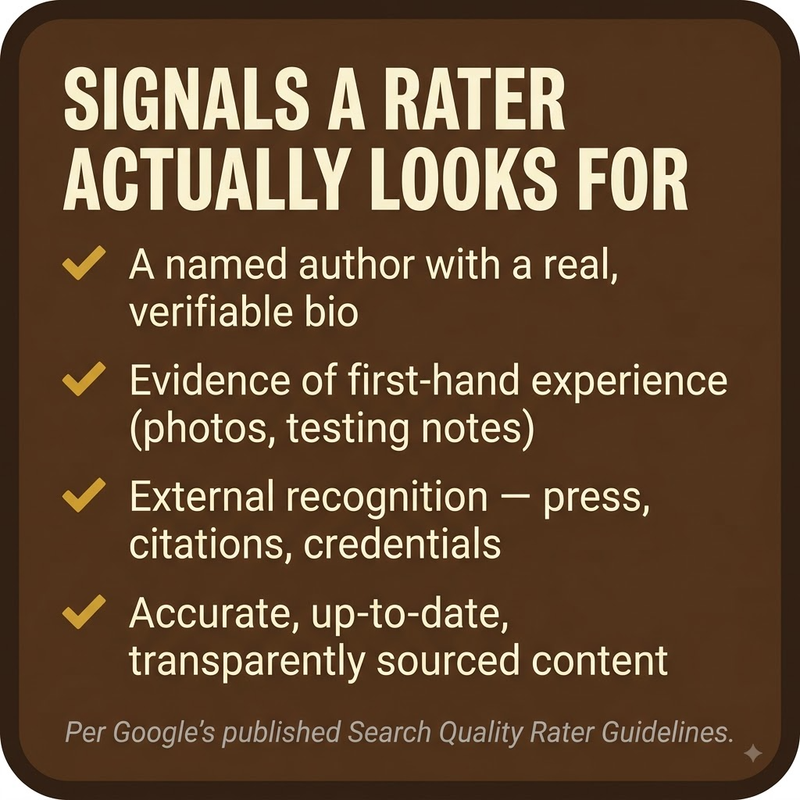
- Build genuine author profiles with verifiable credentials — a name attached to real, checkable expertise beats an anonymous "Team" byline every time.
- Create a transparent, detailed About page that states who runs the site, what qualifies them, and how content gets fact-checked.
- Cite credible external sources throughout content rather than making unsupported claims dressed up as fact.
- Keep content updated with visible dates, especially on fast-moving topics where stale information actively hurts trust.
- Earn mentions and links from other authoritative sites in the same space — this is largely how authoritativeness gets established externally, not just claimed internally.
- Maintain an honest, verifiable reputation across the web — inflated credentials that don't show up anywhere else Google can check tend to work against a site, not for it.
Does E-E-A-T Matter for AI Search, Not Just Traditional Google Results?
Yes — if anything, the specific-experience signal matters more for AI-generated answers, since systems synthesizing a response need genuinely reliable source content to cite, and generic, undifferentiated writing gives them nothing distinctive to pull from. AI Overviews, AI Mode, and third-party AI search tools are all, at some level, trying to solve the same trust problem the Quality Rater Guidelines were built for — deciding which sources are reliable enough to cite. Content that demonstrates real, specific experience (named scenarios, concrete outcomes, details a purely synthetic write-up wouldn't include) gives those systems a clearer signal to extract and attribute than content that reads as generic summary. The underlying logic transfers even where the exact mechanism differs.
Frequently Asked Questions
Is E-E-A-T a direct Google ranking factor, or something else entirely?
It's not a direct ranking factor in the way page speed or backlinks are — it's a rating framework human evaluators use, and their scores inform how Google trains its actual ranking algorithms over time.
Do all four E-E-A-T components carry equal weight?
No — Trustworthiness is treated as the foundational component underneath the other three; a page can show strong experience and expertise but still rate poorly if it fails on trust (inaccurate claims, hidden ownership, unsafe practices).
Can a brand-new site with no track record ever achieve strong E-E-A-T?
Yes, but it takes time — authoritativeness in particular is earned through external recognition (citations, mentions, links) that can't be manufactured instantly, which is why new sites often see E-E-A-T-adjacent signals improve gradually rather than immediately.
Does having a byline with a real name automatically improve E-E-A-T?
A named byline helps, but only if it's backed by genuine, verifiable expertise — an author name attached to no real credentials or track record doesn't move the needle much on its own.
How does YMYL (Your Money or Your Life) content relate to E-E-A-T?
YMYL topics — health, finance, safety, civics — get held to a stricter E-E-A-T standard than lower-stakes content, since inaccurate information in these categories carries higher real-world risk.
Can AI-generated content ever satisfy E-E-A-T requirements?
AI-assisted content can, provided it demonstrates genuine expertise and is reviewed and taken accountability for by a real, qualified person — content with no identifiable human oversight or attribution tends to struggle specifically on the trust and experience components.
Does E-E-A-T apply to product pages and not just blog content?
Yes — Google's raters evaluate E-E-A-T across content types, including product and commercial pages, where trust signals like clear return policies, accurate specifications, and transparent pricing carry particular weight.
How often does Google update the Search Quality Rater Guidelines?
Google updates the guidelines periodically, historically roughly once or twice a year, with the most recent confirmed major version published September 11, 2025.
Is there a tool that scores a page's E-E-A-T the way tools score readability or SEO basics?
No official Google tool provides a numerical E-E-A-T score; third-party SEO tools sometimes offer proxy scores based on signals like author bios and citations, but these are estimates, not an actual Google metric.
Does E-E-A-T weigh differently for anonymous or pseudonymous content?
Anonymous content faces a structural disadvantage under E-E-A-T specifically because Experience and Authoritativeness are difficult to establish without an identifiable, checkable author behind the work.
Can strong E-E-A-T signals compensate for technical SEO weaknesses?
Not fully — E-E-A-T addresses content and trust quality specifically, while technical issues like poor crawlability or slow load times are evaluated as separate signals that E-E-A-T strength doesn't offset.


