
A pillar page is a comprehensive, broad-topic page that covers a subject at a high level while linking out to a set of more specific "cluster" pages that each dive deeper into one subtopic — together forming a topic cluster that signals depth and organization to search engines. Think of it as the hub in a hub-and-spoke content model: the pillar page answers the big question broadly, and each cluster page answers one narrower piece of it in full depth, linking back to the pillar to reinforce the relationship between them.
Key Takeaways
- A pillar page covers a broad topic comprehensively at a high level, while cluster pages each cover one specific subtopic in much greater depth — together they form a "topic cluster."
- The model was popularized by HubSpot and has become a standard content-architecture approach for building topical authority around a subject rather than publishing disconnected, one-off articles.
- Internal linking is the structural glue of the model — pillar and cluster pages link to each other consistently, which is what signals the topical relationship to search engines in the first place.
- A pillar page isn't the same as a landing page — a landing page is built to convert a visitor toward a specific action, while a pillar page is built to comprehensively inform and organize a topic.
- "Content pillar" and "pillar page" are often used interchangeably, though "content pillar" carries meaningfully more search volume, worth reflecting in how a page's headers and FAQs are phrased.
Topical authority is the broader outcome the pillar-cluster model is specifically designed to build, and internal linking is the structural mechanism that makes the model actually function as intended rather than existing only as content strategy on paper.
How Does the Pillar Page and Cluster Model Actually Work Together?
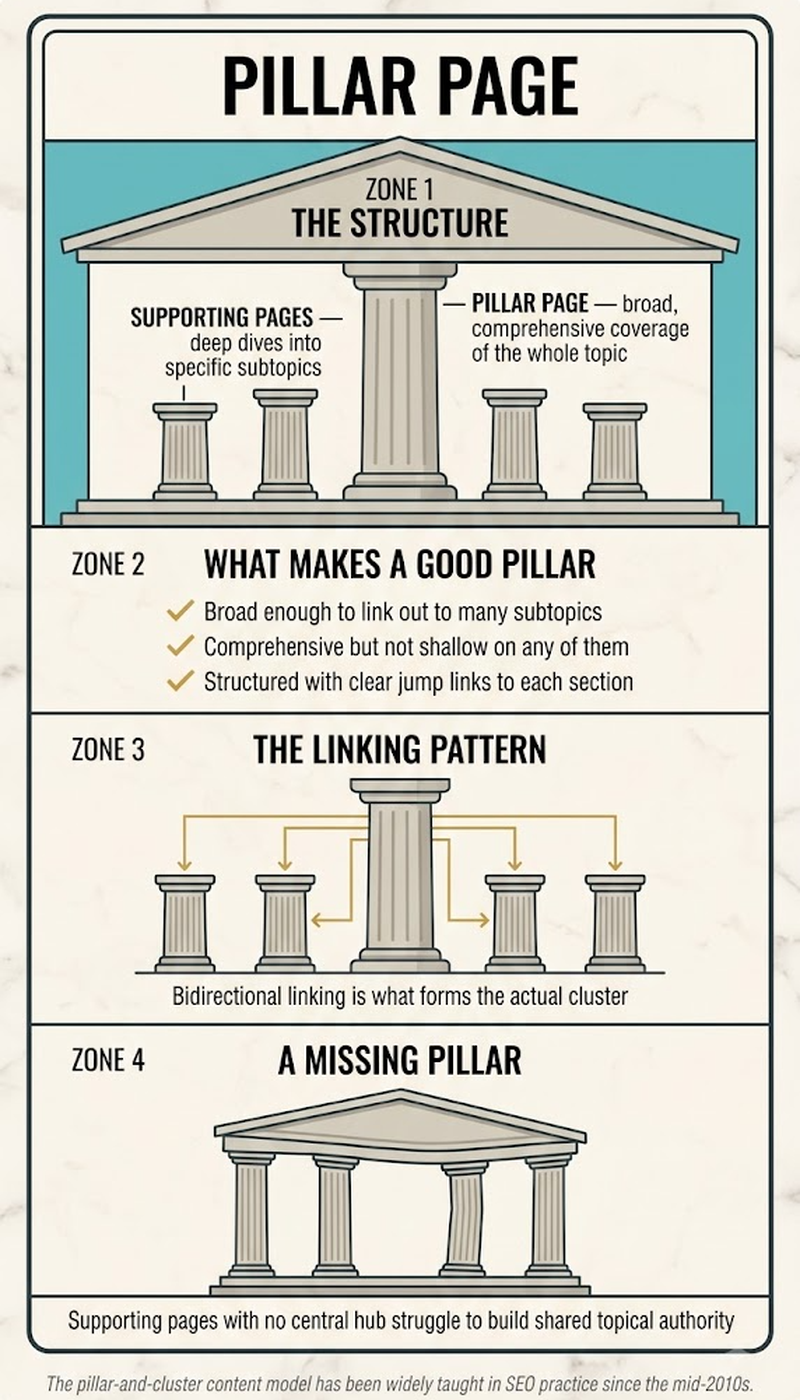
A pillar page covers a topic broadly enough to touch on every major subtopic within it, while each cluster page takes one of those subtopics and covers it in far greater depth than the pillar page has room for — and the two are connected through deliberate, consistent internal linking in both directions. A pillar page on "content marketing," for example, might briefly cover SEO, social distribution, email, and content types, while separate cluster pages go deep on each: one entirely on SEO content strategy, another entirely on email newsletter strategy. The pillar links out to each cluster page, and each cluster page links back to the pillar — that reciprocal linking pattern is what turns a set of individually decent articles into a structurally reinforced topic cluster search engines can recognize as a coherent, comprehensive unit.
Why Does This Structure Actually Help With Search Visibility?
The pillar-cluster structure helps because it concentrates internal link equity around a clearly organized topic, giving search engines a much clearer signal of topical depth and relationship than a set of disconnected articles covering similar ground ever could. A site with fifteen scattered, loosely related articles about a topic sends a weaker organizational signal than the same fifteen articles restructured into one pillar page linking to fourteen focused cluster pages, even if the underlying content barely changes. The structure itself is the improvement — it turns implicit topical relevance into an explicit, crawlable signal search engines can follow directly through the link graph.
Pillar page vs. cluster page:
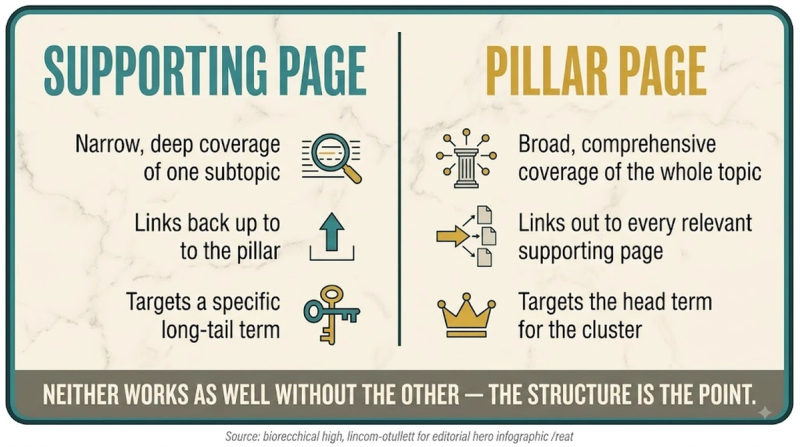
- Scope — Pillar: broad, covers whole topic at high level. Cluster: narrow, covers one specific subtopic in depth.
- Length — Pillar: typically longer, comprehensive overview. Cluster: varies, but deeply focused on one angle.
- Purpose — Pillar: organize and summarize the full topic. Cluster: answer one specific question thoroughly.
- Linking — Pillar: links out to every related cluster page. Cluster: links back to the pillar, and sometimes sideways to related clusters.
Is a Pillar Page the Same Thing as a Landing Page?
No — a landing page is built to drive a visitor toward one specific conversion action (a signup, a purchase, a demo request), while a pillar page is built to comprehensively inform and organize a broad topic, with far less emphasis on driving a single immediate action. The confusion is understandable since both are often long-form, prominent pages on a site, but their actual jobs differ. A landing page typically strips away distractions to focus attention on one conversion path; a pillar page deliberately links out to many other pages, which would undermine a landing page's entire purpose. Treating a pillar page like a landing page (over-optimizing for a single CTA) tends to work against the informational, exploratory role it's actually meant to serve.
How Do You Actually Build a Pillar Page From Scratch?
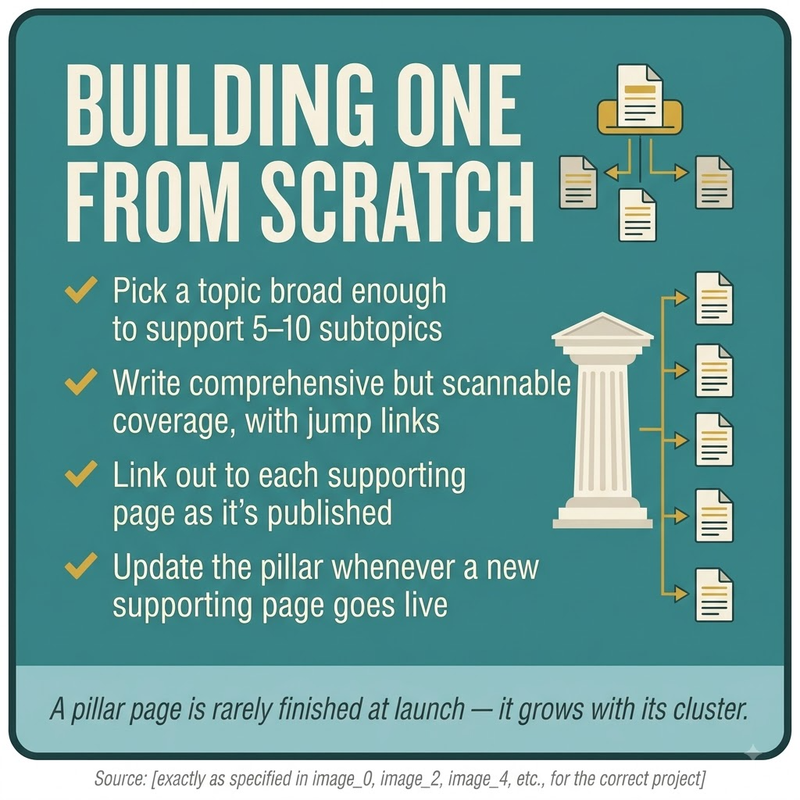
Building a pillar page is a structural project as much as a writing one — the sequence matters:
- Choose a broad topic with enough genuine depth to support multiple distinct cluster subtopics, rather than one too narrow to meaningfully break apart.
- Map out the specific subtopics that topic naturally breaks into — each one becomes a candidate cluster page rather than a section buried inside the pillar itself.
- Write the pillar page to cover the full topic at a high, comprehensive level, explicitly referencing each subtopic without going as deep as the dedicated cluster page eventually will.
- Build or identify the corresponding cluster pages, each covering its specific subtopic in real depth.
- Link consistently in both directions — pillar to every cluster, each cluster back to the pillar — since this reciprocal linking is what actually forms the structural signal, not just the content's topical relatedness alone.
Frequently Asked Questions
How long should a pillar page typically be compared to its cluster pages?
There's no fixed word count, but pillar pages are generally longer and broader than any single cluster page, since they're covering the full breadth of a topic rather than one narrow angle in depth.
Can a single cluster page belong to more than one pillar page?
Yes, if a subtopic is genuinely relevant to two distinct broader topics, a cluster page can reasonably link to and be referenced by more than one pillar, though this should be done deliberately rather than as a default pattern.
Does a pillar page need to be created before its cluster pages, or can existing content be restructured into the model?
Either approach works — many sites retrofit existing scattered articles into a pillar-cluster structure by writing a new pillar page and reorganizing internal links, rather than starting completely from scratch.
How many cluster pages does a pillar page typically need to be effective?
There's no strict minimum, but a handful of substantive cluster pages (roughly five or more) is generally needed to meaningfully demonstrate the topical depth the model is designed to signal.
Does the pillar page itself need to rank for the broadest, highest-competition keyword in the topic?
Ideally yes, since the pillar page is usually the page best positioned to compete for the broad head term, while cluster pages target the more specific, lower-competition long-tail variations within the topic.
Can a pillar page become outdated, and how should it be maintained over time?
Yes — since a pillar page often references time-sensitive aspects of a topic, it needs periodic review and updates, especially as new cluster pages get added and need to be incorporated into the pillar's structure and links.
Is the pillar-cluster model still relevant for AI-search visibility, or is it specifically a traditional-SEO concept?
The model remains relevant for AI search — the comprehensive topical coverage and clear internal structure it creates also helps AI systems understand a site's depth and relationships across a subject, not just traditional search engines.
Does every topic on a site need to be organized into a pillar-cluster structure?
No — the model makes the most sense for genuinely broad topics with multiple natural subtopics; forcing a narrow topic into an artificial pillar-cluster structure adds complexity without a meaningful benefit.
Can a pillar page include downloadable resources like PDFs or templates?
Yes — many pillar pages include supplementary resources (checklists, templates, downloadable guides) as an added value layer, though this is a content-strategy choice rather than a requirement of the model itself.
How is a pillar page different from a general category or hub page on an e-commerce site?
They're conceptually similar — an e-commerce category page performing the same organizing function for product listings that a pillar page performs for informational content, though the specific structures and goals differ somewhat by context.
Does updating a cluster page require also updating the pillar page it links to?
Not automatically, but significant changes to a cluster page's scope or key points are worth reflecting in the pillar page's summary of that subtopic, to keep the two consistent with each other.


