
TL;DR. Topic clusters follow a hub-and-spoke shape on purpose: one pillar page anchors the center, a ring of narrower pages surrounds it, and deliberate internal linking does the actual work of tying the two together. HubSpot's original research, which coined the framework, found organizations implementing it see an average 43% increase in organic traffic, and Digital Applied's 2026 methodology found well-structured clusters pull in 3.2 times more AI citations than single-page competitors covering the same ground.
What is a topic cluster?
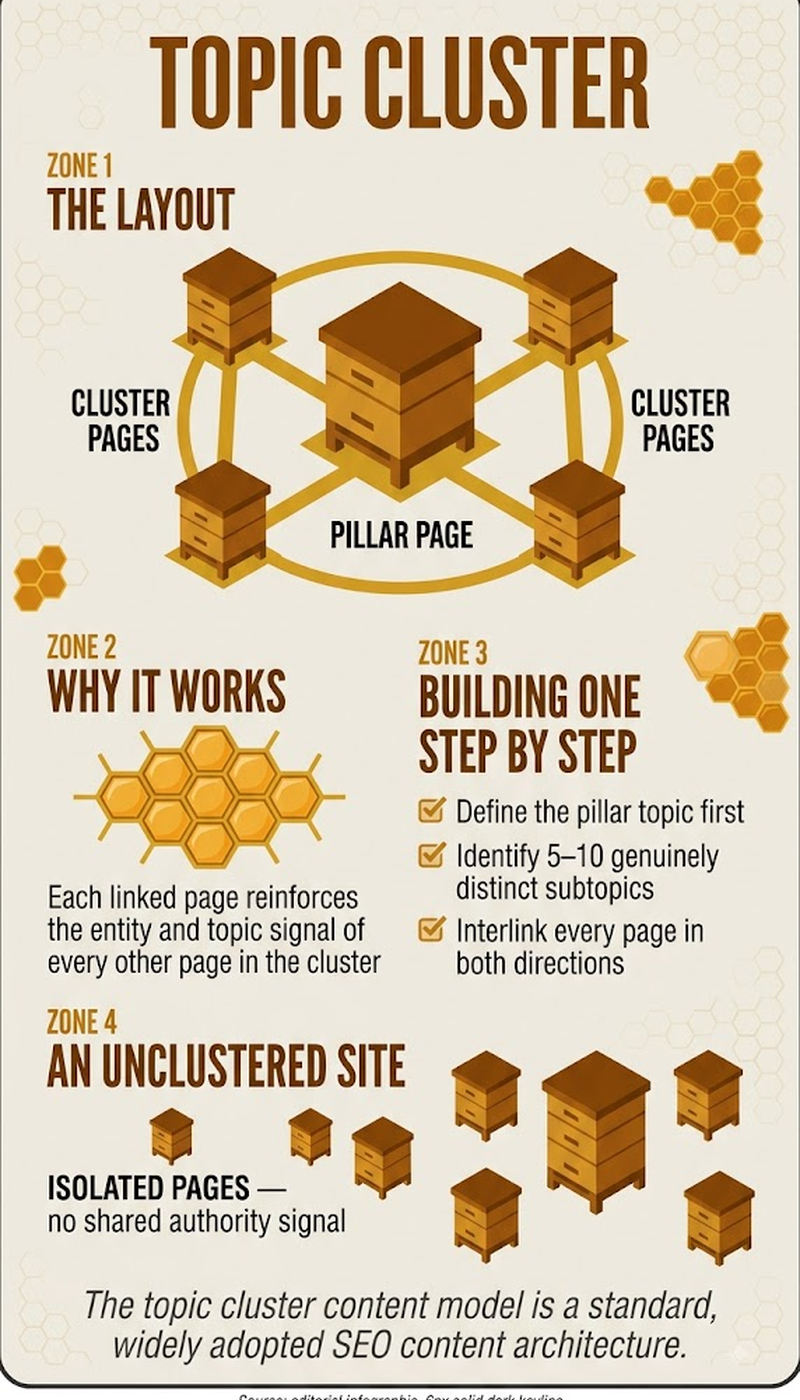
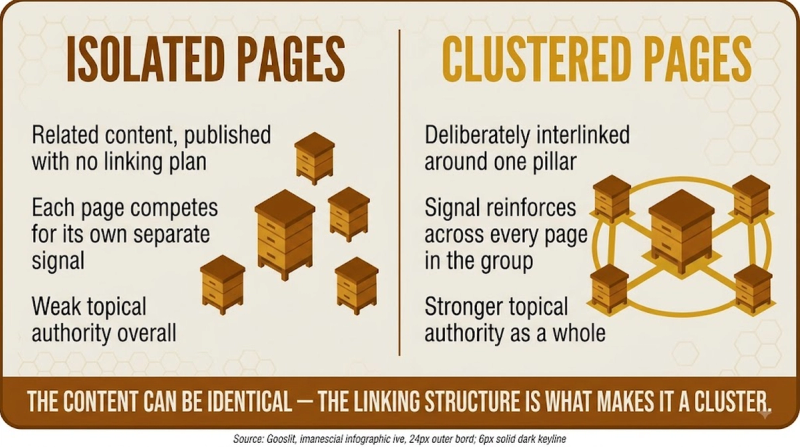
A topic cluster is a content architecture built from one pillar page covering a broad subject at a high level, several narrower cluster pages each going deep on one subtopic of that subject, and a deliberate internal linking structure tying every cluster page up to the pillar and out to its sibling pages. The pillar functions as the hub, the cluster pages function as the spokes, and together they give both readers and search engines a complete, navigable map of the subject instead of a scattered pile of unrelated posts.
Key highlights
- HubSpot's original research, the study that coined the pillar-and-cluster framework, found organizations implementing this structure see an average 43% increase in organic traffic.
- Sites with well-structured topic clusters receive 3.2 times more AI citations than single-page competitors covering the same subject, per Digital Applied's 2026 methodology.
- Clustered content drives 30% more organic traffic than standalone posts and holds rankings 2.5 times longer, according to the same 2026 research.
- Most successful topic clusters land at 8 to 12 supporting cluster pages per pillar, with HubSpot's own recommendation setting the floor at 6 to 10 subtopics.
- Internal linking within a cluster works best at 2 to 5 contextual links per 1,000 words, per Koanthic's internal linking guide, while a page's total outbound link count should stay under roughly 150 to keep link equity from getting spread too thin.
The three parts, and what each one is actually for
- Pillar page. A broad, comprehensive page covering the full subject at a high level, serving as the hub every cluster page links back to.
- Cluster pages. Narrower pages, each one covering a single specific subtopic of the pillar's subject in real depth.
- Internal links. Bidirectional connections tying every cluster page to the pillar and to each other, forming the hub-and-spoke pattern that gives the whole structure its shape.
Sizing a cluster to the subject, not to a formula
The right number of cluster pages depends on the topic's actual breadth, not a fixed rule, though most well-built clusters converge on a similar range anyway. A broad subject typically splits into three to five major subtopic groups, each holding three to eight supporting articles, which puts most successful clusters at 8 to 12 total cluster pages per pillar, roughly in line with HubSpot's recommended floor of 6 to 10 subtopics.
Building one from the ground up
- Choose a broad pillar subject with enough real depth to support at least 6 to 10 distinct subtopics.
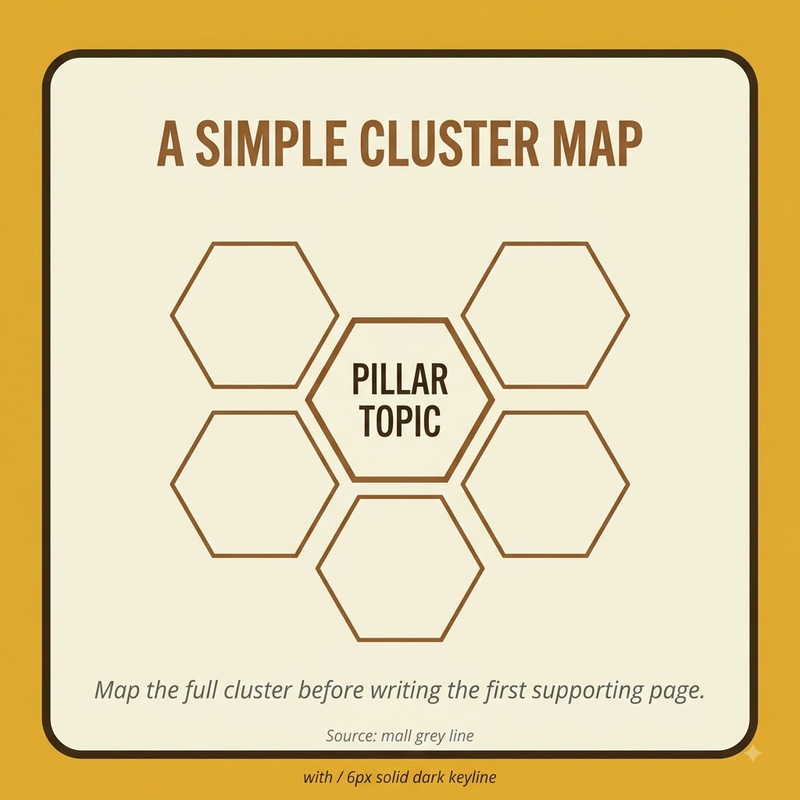
- Map the subtopics a comprehensive treatment of the subject would need to cover, grouping them into 3 to 5 major areas.
- Publish the pillar page first, broad enough to link out to every planned cluster page.
- Publish each cluster page with real depth on its specific subtopic, linking back to the pillar with anchor text close to its target keyword.
- Link cluster pages to each other wherever topically relevant, not only up to the pillar, since search engines reward contextual relevance between same-level pages too.
Topic cluster vs topical authority
A topic cluster is the concrete content structure. Topical authority is the outcome that structure is meant to produce. Building one well-linked topic cluster amounts to one implementation of the broader topical authority strategy, and a site typically needs several clusters, one per major subject it wants recognized authority on, to build topical authority across its full range of coverage.
Frequently asked questions
What is a topic cluster?
A topic cluster is a content structure pairing one broad pillar page with several narrower cluster pages, each covering a specific subtopic, connected through deliberate internal linking in a hub-and-spoke pattern.
Is there an ideal number of cluster pages, or does it vary by topic?
The ideal count genuinely varies by topic, though most successful clusters converge around 8 to 12 cluster pages per pillar, with HubSpot's guidance setting a floor of 6 to 10 subtopics as the practical minimum worth building around.
Does the internal linking inside a cluster actually need a specific pattern?
Internal linking inside a cluster works best bidirectionally, every cluster page linking up to the pillar and out to relevant sibling pages, not just upward. Koanthic's guide recommends 2 to 5 contextual links per 1,000 words while keeping a page's total outbound link count under roughly 150.
Does building a topic cluster actually move the needle on AI visibility?
Topic clusters show a measurable AI visibility effect. Digital Applied's 2026 methodology found well-structured clusters receive 3.2 times more AI citations than single-page competitors, likely because the interconnected structure gives an AI system more corroborating context to draw from.
How is a topic cluster different from topical authority?
A topic cluster is one specific, buildable content structure. Topical authority is the broader outcome that structure works toward, and it usually takes several topic clusters across a site's full range of subjects to build topical authority at any meaningful scale.


