
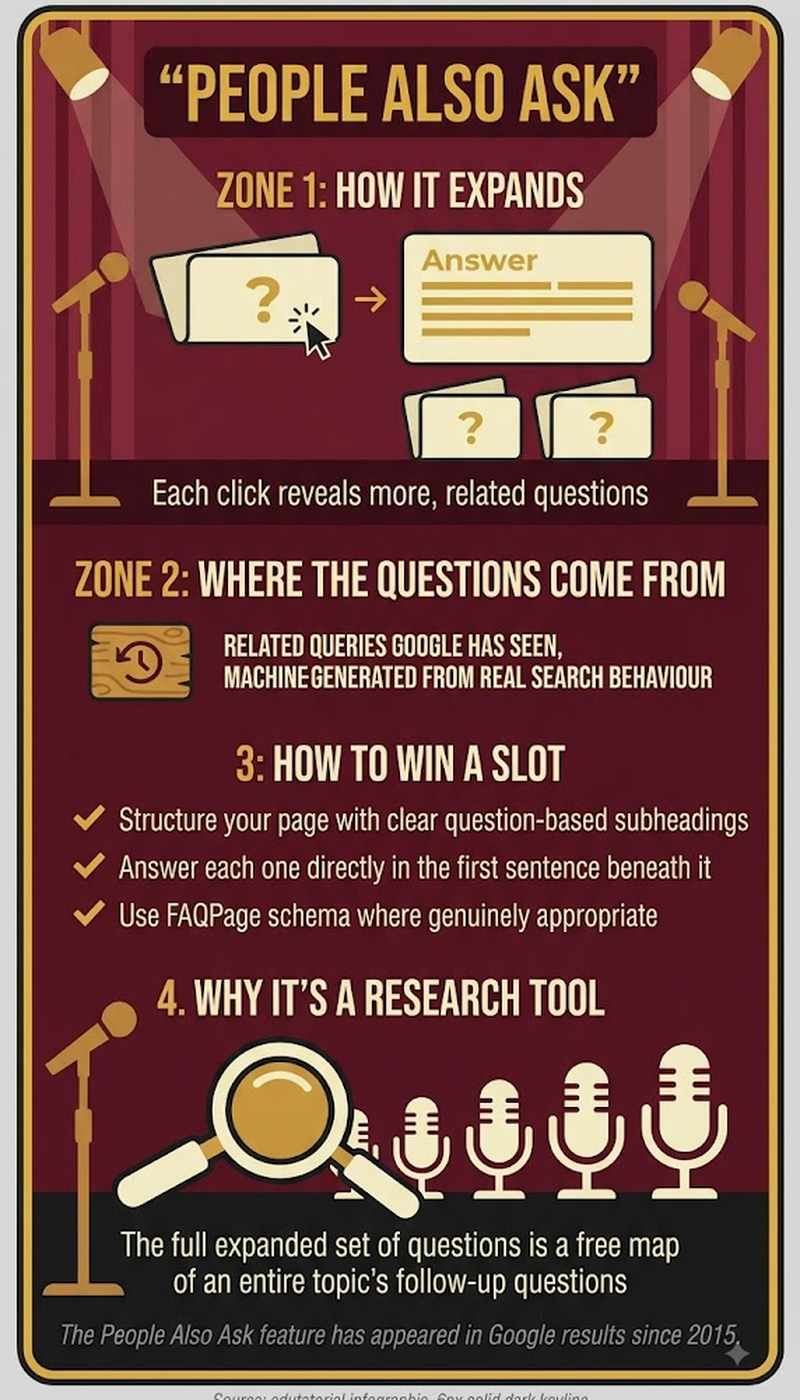
In short: “People Also Ask” (PAA) is an expandable Google search feature showing related questions, with a short extracted answer revealed when each one is clicked.
Key Takeaways
- PAA is an expandable, dynamically-growing box of related questions with short extracted answers — introduced by Google in 2015 and now common on most informational SERPs.
- A page can win a PAA placement without ranking in the organic top 10 — it’s a genuinely separate acquisition channel from primary ranking.
- Content wins PAA by answering a specific question directly in 40–60 words near a matching H2/H3 — rambling before the answer tends to lose the slot to a tighter competitor.
- PAA drives real but comparatively low click-through versus organic position one or a featured snippet — treat it as a visibility channel more than a direct-traffic one.
- Google Search Console doesn’t report PAA impressions as a separate dimension — third-party rank trackers are currently the practical way to monitor PAA ownership.
What Does the “People Also Ask” Box Show?
More specifically, it typically appears after the first few organic results and grows dynamically as a user interacts with it. Clicking one question reveals its answer and adds new related questions to the bottom of the box, so the box never really "ends."
Google introduced PAA in 2015, and it now appears on the majority of informational search results pages, making it one of the most common SERP features alongside featured snippets. Because it expands as the user interacts with it, a single PAA box can expose dozens of related questions during one search session. It functions as a live, constantly-updated map of what Google believes people want to know next.
How Is a “People Also Ask” Answer Different From a Featured Snippet?
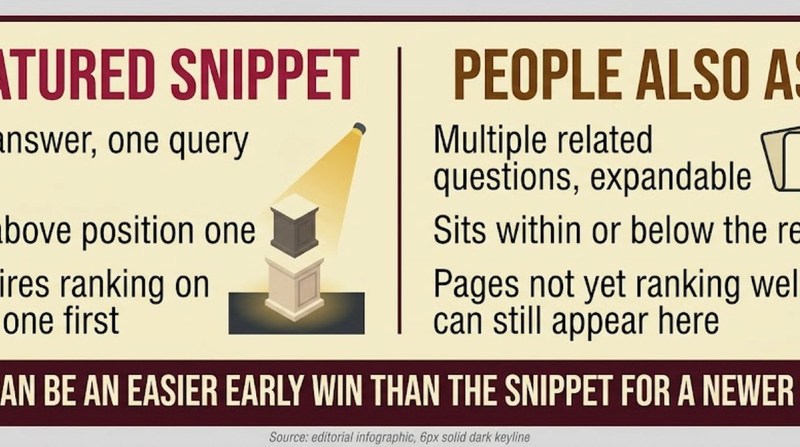
A PAA answer is a short extracted passage tied to one specific question inside an expandable box. A featured snippet is a single boxed answer that sits above all organic results for the entire query. Both pull content directly from ranking pages. But a page can win a PAA slot without ranking in the top 10 organically, whereas a featured snippet is generally pulled from a page already ranking on page one.
This matters practically: PAA slots are won primarily through direct, well-structured question-and-answer formatting deep within a page. Even a page ranking on page two or three of organic results can still surface in PAA, if its content directly and concisely answers a related question. That makes PAA a genuinely different acquisition channel than the primary organic ranking or the single featured snippet slot.
How Does Google Decide Which Questions Go in the PAA Box?
Google generates PAA questions using related-query modeling and its own knowledge base, not a fixed editorial list. The exact questions shown can shift based on the searcher's location, device, and search history. The questions are pulled dynamically at query time, which is why the same search can show a different PAA box to two different people, or even to the same person searching minutes apart.
For content purposes, PAA questions are a real-time signal of related search demand — closer to a live keyword research tool than a static SEO feature. Monitoring PAA questions for core glossary terms over time, rather than checking once, reveals which related questions are gaining or losing prominence. That's a more current signal than most static keyword tools provide.
What Content Format Wins a “People Also Ask” Placement?
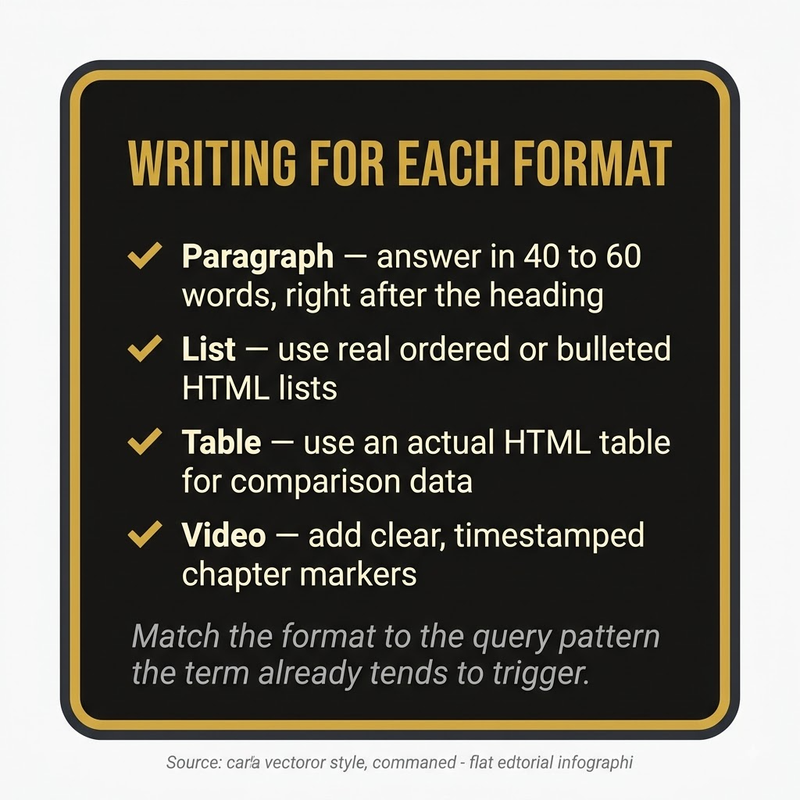
Content wins a PAA placement by directly and concisely answering a specific question, usually within 40–60 words, positioned near an H2 or H3 that mirrors the question’s exact phrasing. Google’s extraction systems favor content structured explicitly around question-and-answer pairs over the same information buried inside a longer, unstructured paragraph.
This is part of why glossary-style content performs comparatively well for PAA: each term-plus-FAQ page naturally maps a question to a tight answer. The failure mode is writing an FAQ answer that's actually 150+ words of hedge-everything prose. Google's extraction algorithm tends to select the most direct, complete-but-short passage available, so answers that ramble before getting to the point often lose the placement to a tighter competing answer.
Does Winning a “People Also Ask” Placement Actually Drive Traffic?
Winning a PAA placement drives meaningfully less click-through than a top organic result or a featured snippet. Many searchers read the visible question without ever clicking to reveal the full answer, and PAA impressions are counted even when the box isn't expanded. Industry click-through studies on PAA consistently show it converting a smaller fraction of impressions into clicks than organic position one.
That doesn't make it worthless — it's a visibility and brand-familiarity channel more than a direct-traffic channel. A term appearing repeatedly across multiple PAA boxes for a topic cluster builds repeated impression exposure. That has documented effects on both direct navigation and eventual click-through for later, related searches, even when the specific PAA click itself doesn't convert.
Can You Track Which PAA Questions Your Site Is Winning?
You can track PAA appearances indirectly, since Google Search Console doesn’t report PAA impressions or clicks as a separate, filterable dimension the way it does for standard organic results. A practical tracking approach looks like:
- Use a third-party rank-tracking tool that specifically flags SERP feature ownership (not just position) for target queries.
- Re-crawl target queries on a recurring schedule rather than a one-time check, since PAA composition rotates dynamically.
- Manually sample a query’s PAA box across a few different sessions and locations periodically to catch what automated snapshots miss.
- Cross-reference winning pages against the site’s own content to identify which structural patterns (question-format headers, tight direct answers) are actually correlating with wins.
PAA tracking comparison:
- Third-party rank tracker — Captures: which domain owns a PAA slot, tracked over time — Limitation: snapshot-based; misses mid-session box expansion
- Manual search sampling — Captures: real, live PAA box behavior including expansion — Limitation: not scalable across many keywords
- Google Search Console — Captures: standard organic clicks/impressions only — Limitation: no dedicated PAA reporting dimension
Should Glossary and Definition Pages Specifically Target PAA?
Glossary and definition pages are structurally well-suited to targeting PAA, because they already answer a single, bounded question in a compact format. That matches exactly what Google's extraction systems look for when selecting a PAA answer. A 2,000-word narrative article covering ten subtopics competes with itself for which passage gets extracted. A glossary page built around one term and a tight FAQ set doesn't have that internal competition.
This is a big part of the strategic logic behind building out a full glossary, rather than folding definitions into longer blog posts. Each term gets its own clean shot at winning both a standalone ranking and any PAA questions related to it. The tradeoff is that a glossary page alone often can't compete for a head term against a full-length authoritative guide. The PAA and long-tail opportunity is usually the more realistic win than the primary organic slot for a broad, competitive term.
Frequently Asked Questions
Do PAA questions and answers ever change without the underlying page content changing?
Yes. PAA questions are regenerated dynamically at query time, based on Google's current related-query modeling. The specific questions, and even which page is cited as the answer source, can shift over time — even if the source page itself is never edited.
Can a competitor’s page appear in your PAA box for your own branded search query?
Yes. PAA questions are generated algorithmically based on related search behavior, not manually curated per domain. A competitor's content can surface inside a PAA box triggered by a branded search, if Google judges that content directly answers a related question searchers are asking.
Is there a maximum number of questions a PAA box can expand to on a single search?
There's no fixed, publicly documented cap. PAA boxes can continue expanding as a user clicks through multiple questions, with Google dynamically appending new related questions to the bottom of the list. Practical expansion is limited though, by how many genuinely related questions exist for that search.
Do PAA boxes appear differently on mobile versus desktop search results?
PAA generally appears on both. Exact placement, the number of initially visible questions, and interaction behavior (tap-to-expand) can differ between mobile and desktop layouts, consistent with how Google adapts most SERP features across device types.
Can the same page win multiple different PAA question slots for the same search?
Yes. If a single page directly and concisely answers more than one of the related questions Google surfaces, that same URL can be cited as the source for multiple PAA entries within the same search results page.
Do PAA questions ever pull answers from forums or Q&A sites instead of traditional articles?
Yes. Google's PAA extraction isn't limited to traditional article formats. Forum threads, Q&A platforms like Reddit or Quora, and other user-generated content sources regularly appear as PAA answer sources, when they directly and clearly answer the question.
How long does a page typically hold a PAA placement once it wins one?
There's no fixed duration. Because PAA is recalculated dynamically, a placement can persist for an extended period if the content remains the best available direct answer, or shift quickly if a more concise or more authoritative competing answer becomes available.
Does having FAQ schema markup increase the odds of winning a PAA slot?
FAQ schema markup helps search engines parse question-and-answer structure more reliably, which can support PAA eligibility. Google has been clear though that schema markup alone doesn't guarantee any specific SERP feature placement — content clarity and directness remain the primary factors.
Can PAA questions reveal search intent for a term that doesn’t have its own dedicated glossary entry yet?
Yes. Reviewing the PAA box for an adjacent, already-covered term frequently surfaces related questions pointing toward genuinely separate concepts worth their own dedicated content. That makes PAA monitoring a practical, live source of content-gap discovery.
Do AI Overviews pull from the same underlying question data as the PAA box?
AI Overviews and PAA appear to draw on related underlying signals about what searchers are asking. But they are distinct systems with separate generation and citation mechanisms. A page winning a PAA slot doesn't guarantee inclusion in an AI Overview for the same query, and vice versa.
Is it possible to intentionally trigger new PAA questions by publishing content around a topic?
Publishing content doesn't directly create new PAA questions. PAA questions are generated from aggregate search behavior, not from published content. But comprehensive coverage of a topic area increases the odds of being selected as the answer source, once a related question does organically appear.
Do PAA questions differ meaningfully between a broad head term and a specific long-tail version of the same term?
Yes. A broad head term typically surfaces a wider, more varied set of PAA questions covering multiple angles of the topic. A specific long-tail query tends to surface more narrowly related follow-up questions, directly adjacent to that specific phrasing.


