
TL;DR. Keyword difficulty compresses a messy competitive picture into a single 0-to-100 number, an estimate of how hard it would be to rank on page one of Google for a given term. Ahrefs builds its score primarily from backlink counts to the top 10 results, Moz weighs the Page Authority and Domain Authority of those same pages, and Semrush blends referring domains, link ratios, and Authority Scores, which is exactly why the same keyword can show a meaningfully different score depending on which tool measures it.
What is keyword difficulty?
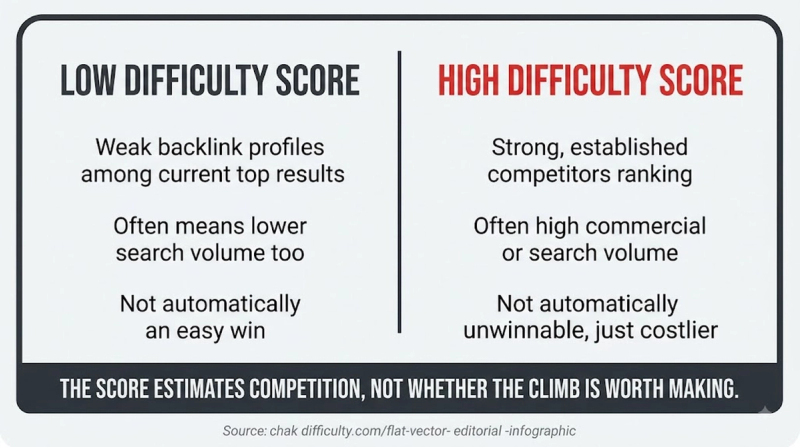
Keyword difficulty is a metric, typically scored 0 to 100, estimating how hard it would be for an average website to rank in Google's top results for a specific keyword. The score comes from analyzing the pages currently ranking: their backlink profiles, domain authority, content quality, and the SERP features present, then converting that analysis into one comparative number. A higher score points to a keyword dominated by strong, well-linked competitors, a lower one suggests more realistic opportunity.
Key highlights
- Ahrefs weighs backlink count to the pages currently ranking in the top 10 more heavily than any other factor in its difficulty score.
- Moz builds its score from the Page Authority and Domain Authority of those same top 10 pages instead.
- Semrush blends referring domains, dofollow-to-nofollow link ratios, Authority Scores, and SERP features like knowledge panels and local packs into a single calculation.
- Semrush also runs a Personal Keyword Difficulty score calibrated to one specific domain's own authority: a general KD of 50 might show as a PKD of 35 for an established site and 72 for a brand-new blog targeting the identical term.
- No standardized industry method for calculating keyword difficulty exists, which is the actual root cause of the same keyword returning meaningfully different scores across tools.
How each tool actually calculates it
- Ahrefs. Backlink count to the current top 10 ranking pages, weighted above everything else.
- Moz. Page Authority and Domain Authority of the current top 10 pages.
- Semrush. Referring domains, link ratios, Authority Scores, and SERP feature presence, plus a personalized PKD variant.
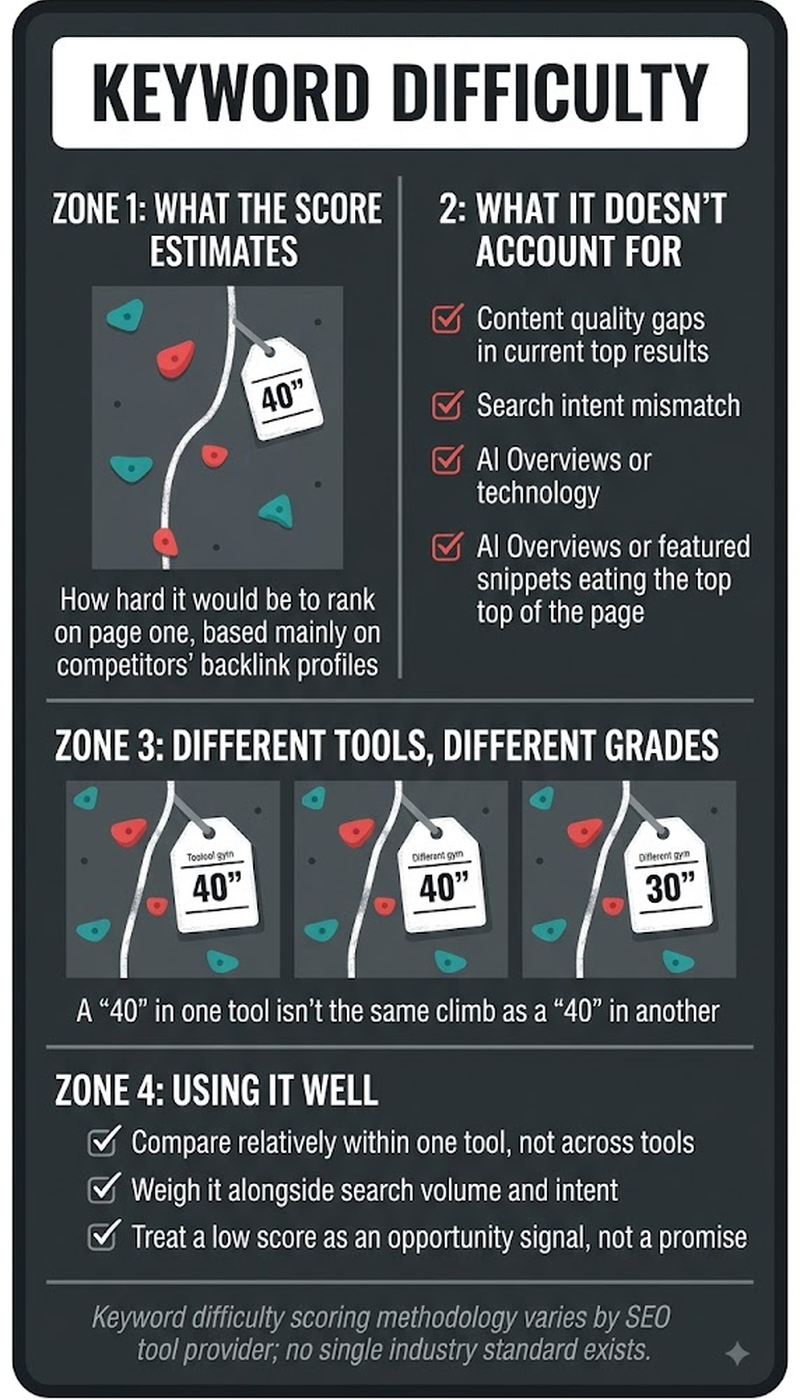
What the score doesn't capture
A keyword difficulty score describes an average website's odds, not any specific site's actual authority and resources. A score built mainly from backlink counts also tells an incomplete story, since content quality, search intent match, and SERP features can matter just as much as link volume in determining whether a particular page can realistically break into the top results. With no standardized calculation method across tools, the number is best treated as a rough comparative signal rather than a precise prediction.
Using difficulty scores without getting misled
- Compare scores within one tool, not across different tools, since methodologies differ too much for cross-tool comparison to mean anything.
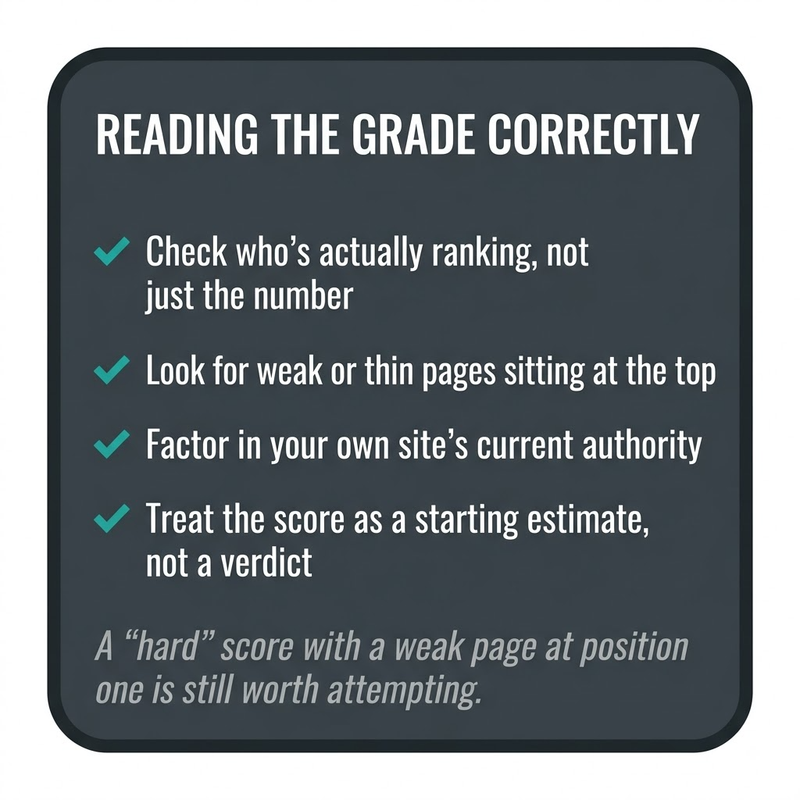
- Use a personalized difficulty metric where it's available, since it accounts for a site's actual existing authority rather than an average website's chances.
- Cross-check a difficulty score against a manual look at the actual top 10 pages, since content quality and intent match don't always show up in the number.
- Treat difficulty as one input alongside search volume and business value, not the sole deciding factor.
Frequently asked questions
What is keyword difficulty?
Keyword difficulty is a 0-to-100 metric estimating how hard it would be for an average website to rank in Google's top results for a specific keyword, based on the backlink profiles and authority of the pages currently ranking there.
Why does the same keyword show different difficulty scores in different tools?
Because there's no standardized industry method for calculating it. Ahrefs weighs backlinks most heavily, Moz relies on Page and Domain Authority, and Semrush blends several additional factors, so the same keyword can land at different scores depending on the tool.
What is Semrush's Personal Keyword Difficulty?
Personal Keyword Difficulty is Semrush's calibrated version of the metric that factors in one specific domain's own existing authority, showing a more realistic score for that particular site instead of an average website. A general KD of 50 can read as a PKD of 35 for an established domain and 72 for a new one.
Should I trust a keyword difficulty score on its own?
Not entirely. It's a useful comparative signal but not a reliable precise predictor, since it reflects an average website's chances rather than a specific site's, and it can undervalue content quality and intent match relative to backlink volume.
What's the safest way to use keyword difficulty when picking targets?
Compare scores within a single tool rather than across tools, use a personalized metric where available, and manually check the actual top 10 pages, since none of that context shows up in the raw number alone.


