
International SEO is the practice of configuring a website so search engines correctly serve the right language and regional version of a page to the right audience — covering URL structure, hreflang tagging, content localization, and technical signals that tell Google which version belongs in front of which searcher. Get it wrong and the damage is often invisible until it isn't: a French page ranking for German searchers, or worse, two near-identical pages quietly competing against each other in the same market. Get it right, though, and a site with genuinely global reach behaves — in Google's eyes — like a set of correctly separated local sites. Not one confused multilingual mess.
Key Takeaways
- The three core structural approaches — ccTLDs (country-code domains), subdirectories, and subdomains — each send a different geo-targeting signal, and the right choice depends on resources, not just preference.
- hreflang tags remain the standard mechanism for telling Google which language/region version of a page to serve to which searcher; no replacement mechanism has emerged as of 2026.
- International SEO and translation aren't the same thing — content that's merely translated but not localized (currency, idiom, cultural reference, local search behavior) tends to underperform even when the language itself is accurate.
- Duplicate content risk is the single most common technical failure in international SEO — near-identical pages across regions competing against each other instead of complementing each other.
- A misconfigured or missing hreflang implementation is often invisible in normal site checks; it tends to surface only when the wrong regional page starts ranking in the wrong market.
International SEO connects directly to geotargeting and technical SEO as the broader disciplines it sits within, and a properly localized international structure is one of the clearer ways a site demonstrates the kind of market-specific relevance topical authority depends on.
Which URL Structure Should an International Site Actually Use?
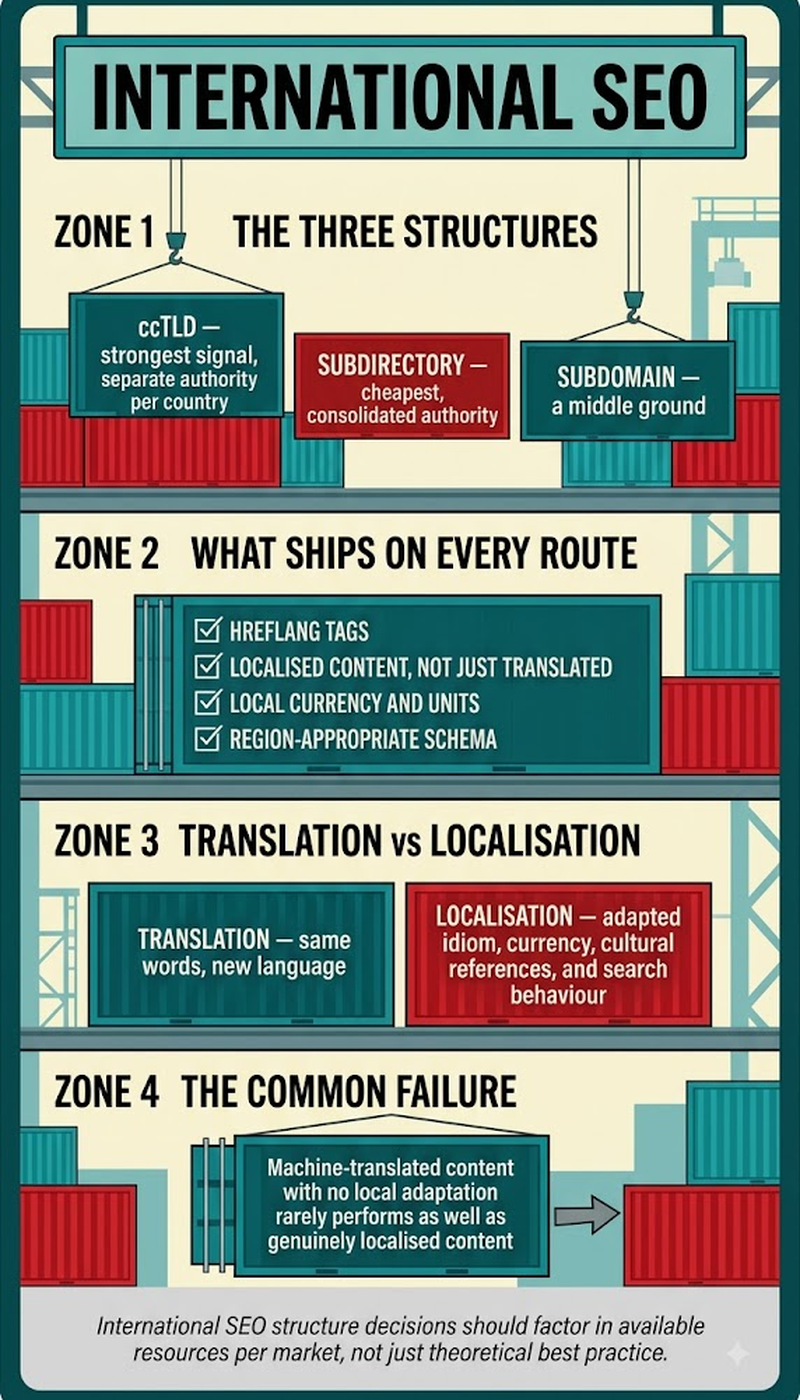
The three structural approaches:
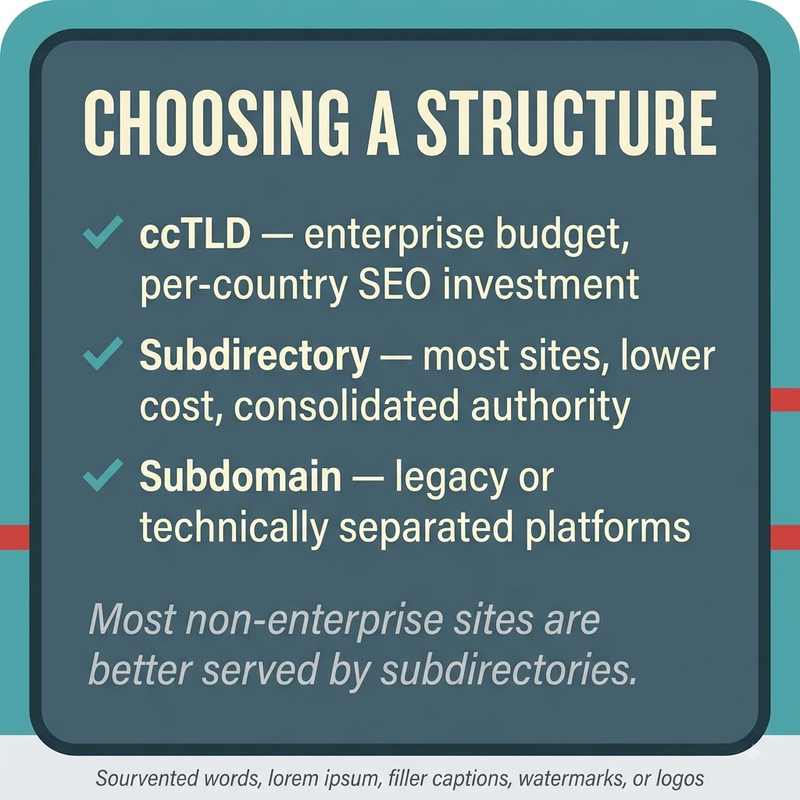
- ccTLD (example.de) — geo-signal strength: strongest, explicit country signal. Setup cost: highest (separate domains, hosting, authority-building). Best for: large brands with dedicated regional resources.
- Subdirectory (example.com/de/) — geo-signal strength: moderate, needs hreflang/geo-targeting. Setup cost: low, single domain, shared authority. Best for: most mid-size international sites.
- Subdomain (de.example.com) — geo-signal strength: moderate, treated somewhat separately by Google. Setup cost: medium. Best for: sites needing some infrastructure separation.
There's no universally "best" structure — the right call depends on available resources and how distinctly each market needs to operate. ccTLDs send the clearest signal but require building domain authority separately in every single market, which is a heavy, ongoing lift. Subdirectories consolidate authority under one domain and are the most common practical choice for sites without a large dedicated international team. Subdomains sit in between, sometimes useful when a market needs meaningfully separate infrastructure without splitting off a fully separate domain.
How Does hreflang Actually Direct the Right Users to the Right Page?
hreflang tags tell Google which language and regional version of a page exists so it can serve the correct one to each searcher, using a code pairing like en-us or fr-ca rather than relying on Google to guess from content alone. Every page in a set needs to reference every other page in that set, including itself — a self-referencing requirement that trips up a lot of implementations, since it's easy to correctly link outward but forget the self-reference. An x-default tag can specify a fallback for searchers whose language/region doesn't match any specific version. Google treats hreflang as a hint rather than an absolute directive, so a properly implemented hreflang setup dramatically improves — but doesn't strictly guarantee — the correct version showing up for each audience.
Is International SEO Just Translation With Extra Steps?
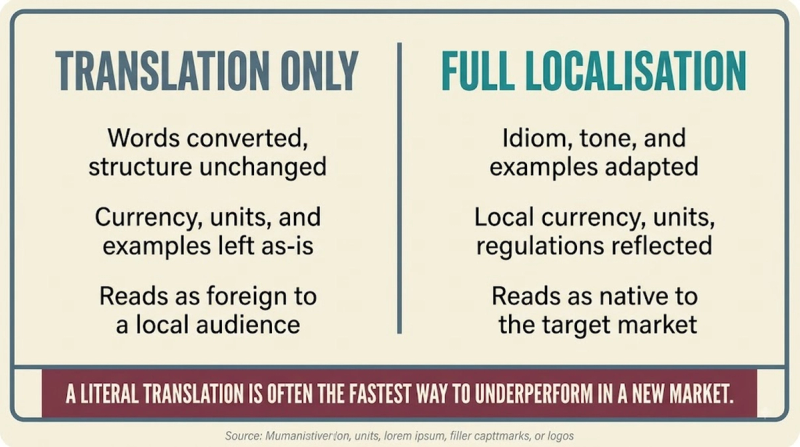
No — translation converts words from one language to another, while localization adapts the whole experience (currency, units, cultural references, local search behavior, even color and imagery conventions) to fit a specific market, and treating the two as interchangeable is one of the most common strategic mistakes in this discipline. A page translated word-for-word into Japanese but still quoting prices in USD, using Western idioms, or structured around search patterns that don't match how Japanese users actually query will underperform a properly localized page — even with flawless translation. The gap shows up specifically in engagement and conversion metrics, not necessarily in raw indexing, which is exactly why it goes unnoticed for a long time on sites that treated the project as a translation task rather than a market-adaptation one.
What Causes the Most Common International SEO Failures?
Duplicate or near-duplicate content across regional versions is the single most frequent technical failure, and it usually stems from one of a handful of root causes:
- Missing or incomplete hreflang implementation, so Google can't distinguish which version is meant for which market and picks one somewhat arbitrarily.
- Content that's translated but not localized enough to read as genuinely distinct to Google's duplicate-content evaluation, especially across closely related language pairs (US/UK English, for example).
- Inconsistent internal linking that doesn't reinforce the intended regional structure, sending mixed signals about which version is canonical for which audience.
- Geo-redirects that force users (and sometimes crawlers) into one version, blocking Google from properly indexing and evaluating the other versions at all.
- No clear canonical or hreflang self-reference strategy, leaving Google's systems to make the call without clear guidance from the site itself.
How Do You Audit an Existing International SEO Setup?
A basic audit doesn't require expensive tooling — most of it can be done with a crawler and Search Console:
- Crawl the full site and export every hreflang tag pair to check for missing self-references, broken reciprocal links, or incorrect language/region codes.
- Check Search Console's International Targeting report (where available) for hreflang errors Google has already flagged.
- Search Google directly from different simulated locations (or use a rank tracker with location-specific checks) to see which version actually surfaces for each target market.
- Review analytics for each regional section separately — flat or declining organic traffic in one region while others grow is a common early signal of a targeting problem.
- Confirm canonical tags aren't inadvertently pointing all regional variants back to a single "main" version, which would undercut the entire hreflang setup.
Frequently Asked Questions
Can a single-language site targeting multiple English-speaking countries still benefit from international SEO practices?
Yes — even without a translation need, hreflang can distinguish US, UK, Australian, and other English variants to serve region-appropriate pricing, spelling, and content, which is itself a form of international SEO.
Does switching from a ccTLD to a subdirectory structure hurt existing rankings during the migration?
A poorly executed migration can cause temporary ranking volatility, but a properly planned migration with correct redirects and hreflang updates generally preserves most existing authority over time.
How many languages or regions justify building a dedicated international SEO strategy versus just adding hreflang tags?
There's no fixed threshold — even two regions benefit from correct hreflang implementation, though a dedicated strategy (localized content, region-specific link building) becomes more valuable as the number of distinct markets grows.
Does Google's AI Mode or AI Overviews handle international content differently than traditional search?
AI-generated search features still rely on the same underlying indexed content and language/region signals, so a solid international SEO foundation supports AI-search visibility in each market the same way it supports traditional rankings.
Can a site use browser language detection instead of hreflang to serve the right regional version?
Browser-based redirects can supplement hreflang for user experience, but they don't replace it for search engines, since crawlers don't carry the same browser-language signals real users do.
Does international SEO require separate keyword research per market, or can the same keywords be translated directly?
Separate keyword research is strongly recommended — direct translation often misses how people in different markets actually phrase searches, even for conceptually identical topics.
What happens if two regional pages accidentally end up with identical content and no hreflang connecting them?
Google may treat them as duplicate content and choose only one to rank, effectively suppressing visibility in whichever market's version didn't get selected.
Does international SEO performance data show up separately in Google Analytics, or does it require special segmentation?
Regional performance can be segmented by URL path, language parameter, or geographic user data within standard analytics tools, though it does require deliberate segmentation setup rather than showing up separated by default.
Is a country-specific Google Business Profile part of international SEO, or a separate local SEO concern?
It's more accurately part of local SEO within each specific market, though the two disciplines overlap significantly for businesses with a genuine physical or service presence in multiple countries.
Can international SEO mistakes cause a site to be geo-blocked or hidden from an entire country's search results?
Technical misconfiguration alone doesn't typically trigger geo-blocking, but severe duplicate content or manipulative geo-redirect practices can lead Google to demote or restrict visibility in affected markets.
Does hreflang need to be updated every time content is translated into a new additional language?
Yes — every new language/region version added to the set requires updating the hreflang tags across all existing pages in that set, not just adding tags to the new page alone.


