
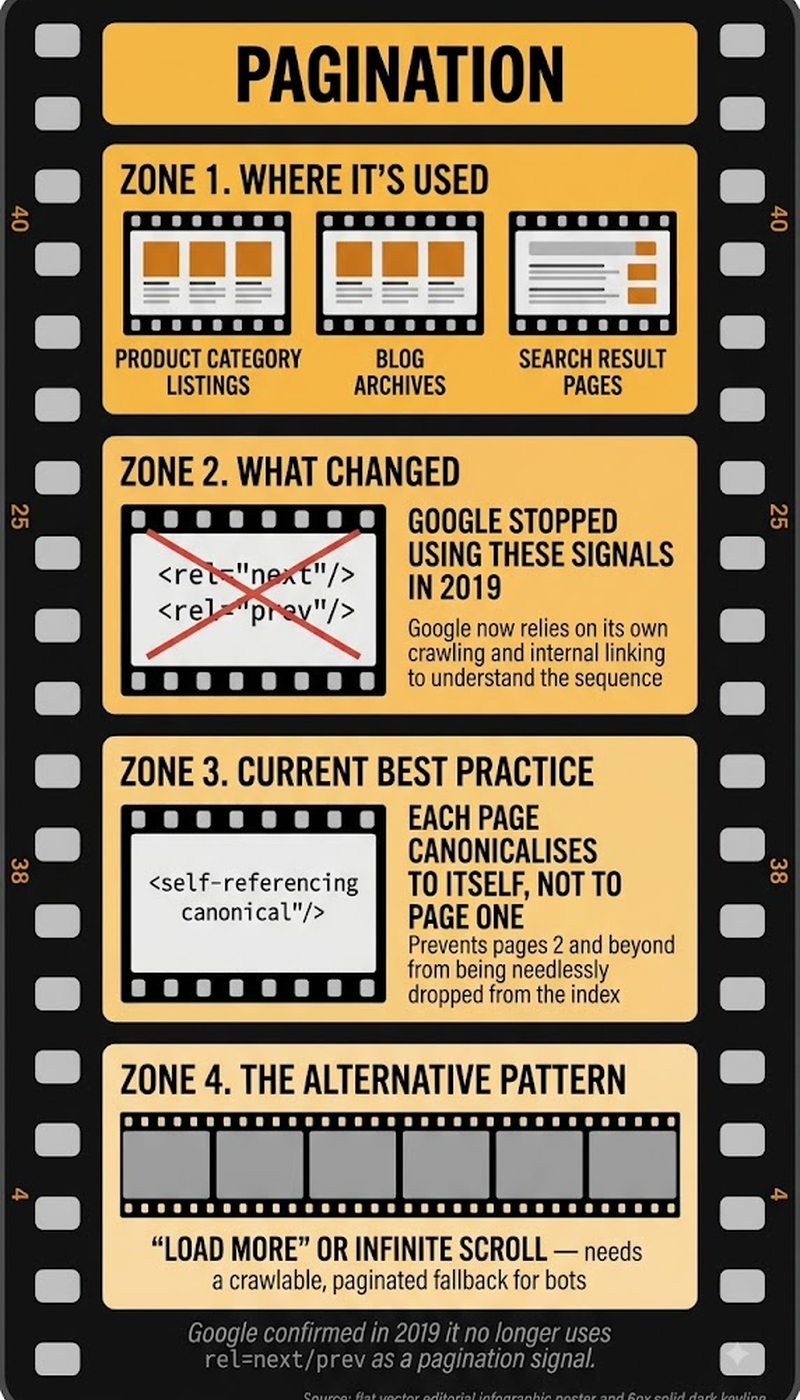
TL;DR. Pagination breaks a long list of content into a sequence of separate, indexable URLs instead of one sprawling page. Google dropped rel next and prev tags from how it reads pagination back in 2019, so the current playbook leans on self-referencing canonicals, real crawlable links, and genuinely unique content on each page instead, while infinite scroll needs a crawlable fallback underneath or everything past page one goes missing.
What is pagination in SEO?
Pagination in SEO means dividing a long list, product catalogs, blog archives, search results, into a sequence of separate URLs rather than loading the whole thing onto one massive page. Each paginated URL stands on its own as a crawlable, indexable page within that sequence.
Pagination exists because dumping thousands of items onto a single page is slow for visitors and wasteful for crawlers alike. Splitting it apart creates distinct entry points search engines can find, index, and rank individually rather than treating as one undifferentiated mass.
Key highlights
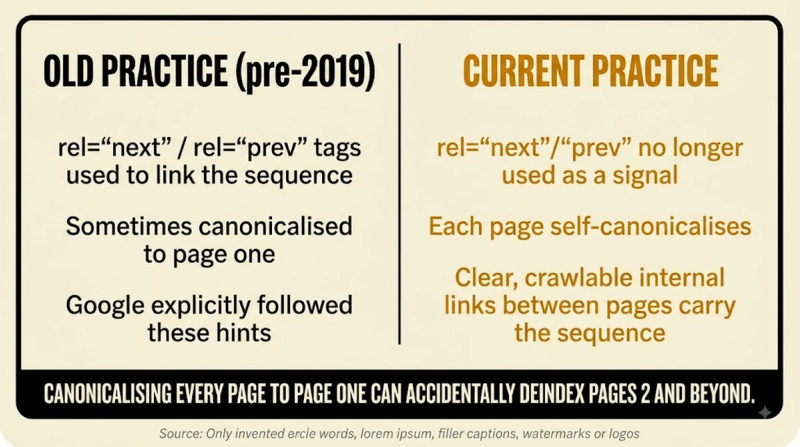
- Google confirmed in 2019 it no longer uses rel next and rel prev tags to understand paginated sequences, though leaving the tags in place causes no harm.
- Bing hasn't followed suit. It still uses rel next and rel prev signals for discovery, so the tags keep some value for sites that care about traffic beyond Google.
- Infinite scroll's core weakness comes down to one thing: Googlebot can't scroll or trigger the JavaScript that loads additional items the way an actual visitor does.
- Sequential pagination spreads link equity across multiple URLs and opens multiple entry points straight from search results, something a single infinite scroll page structurally cannot do.
How pagination should be handled now
With rel next and prev retired by Google, self-referencing canonical tags on every paginated page are the current standard, not funneling page two back to page one when page two actually holds unique products or posts of its own.
Every paginated URL needs real, crawlable anchor links, not JavaScript-only navigation, and a clear, unique title distinguishing it from page one, otherwise search engines have no reliable way to tell the two apart from duplicates.
Pagination vs infinite scroll vs load more
- Classic pagination: numbered pages built on real links. Fully crawlable, bookmarkable, and still the safest choice for SEO.
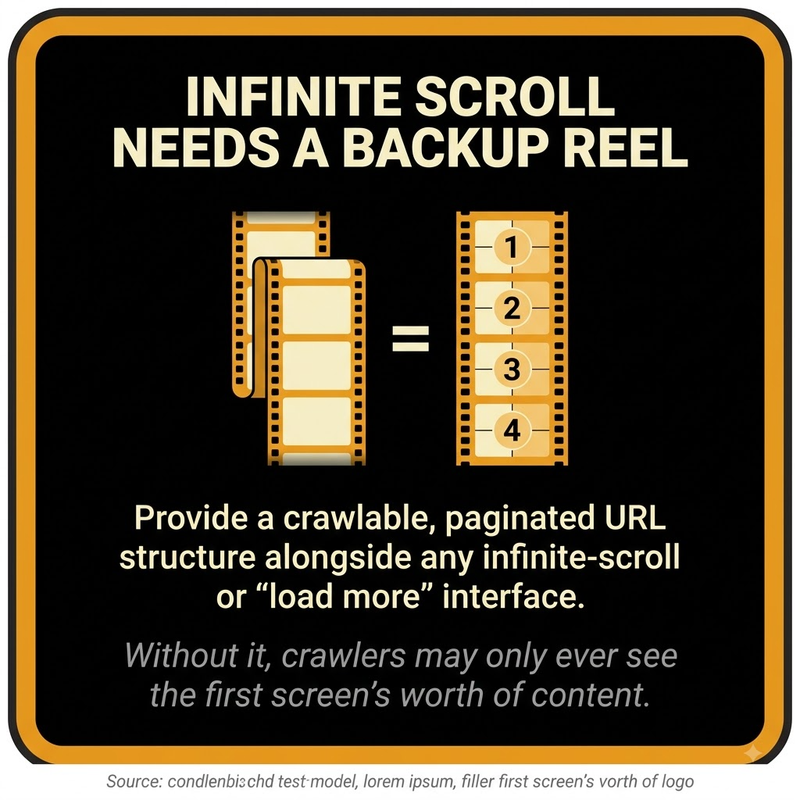
- Infinite scroll: content loads automatically as a visitor scrolls down. Smooth for people, invisible to crawlers unless a paginated fallback sits underneath it.
- Load more button: a middle ground between the two, though it still leans on JavaScript that Googlebot may or may not execute reliably at scale.
Pagination best practices
- Use a self-referencing canonical on every paginated page, never funneling every page back to page one.
- Give every page in the sequence real, crawlable href links, not JavaScript-only controls.
- Write a unique meta title for each paginated page, appending the page number rather than duplicating page one's title everywhere.
- If infinite scroll is in use, provide a crawlable paginated version underneath for search engines to follow.
- Consider a view-all page for shorter lists where load time allows, consolidating ranking signals onto one strong URL.
Frequently asked questions
Does rel=next/prev still matter for pagination?
Not to Google. It confirmed back in 2019 that it no longer reads rel next and rel prev to understand a paginated sequence, though leaving the tags in place isn't harmful. Bing is the exception, since it still relies on them for discovery, so sites chasing Bing traffic have a reason to keep them.
Should page two canonicalize back to page one?
Only if page two genuinely duplicates page one, which is rare. Current best practice is a self-referencing canonical on every paginated page instead, since funneling everything to page one tells search engines the later pages are duplicates and can suppress them from being indexed at all.
Why does infinite scroll cause SEO problems?
Because Googlebot can't scroll or trigger the JavaScript that loads additional content the way a person does, so anything beyond the first batch can go uncrawled entirely. Pairing infinite scroll with a crawlable, paginated fallback underneath fixes the gap while keeping the smoother experience visitors actually see.
What's a view-all page, and is it worth building?
A view-all page lists an entire collection on one URL instead of splitting it across a sequence, consolidating every bit of ranking signal onto a single strong page. It works well for moderate sized lists but becomes impractical once load time suffers under a genuinely large catalog.
How does sequential pagination help compared to one big page?
It creates multiple distinct entry points that search results can surface directly, rather than forcing every visitor through the same single URL regardless of what they're actually looking for. Link equity also spreads across the sequence instead of concentrating, and sometimes straining, a single oversized page.


