
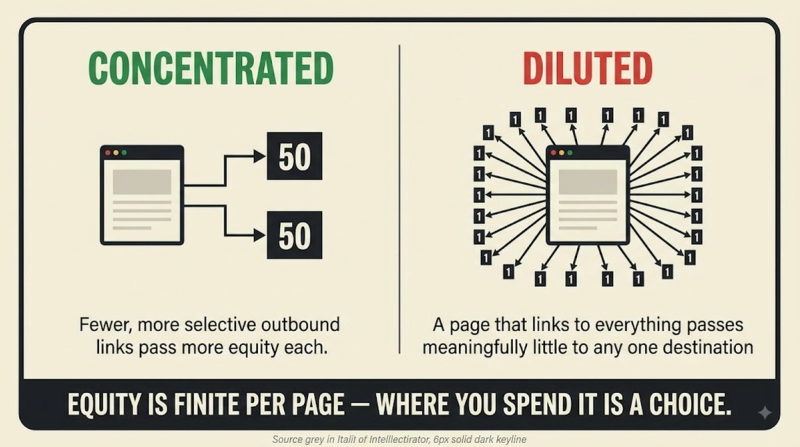
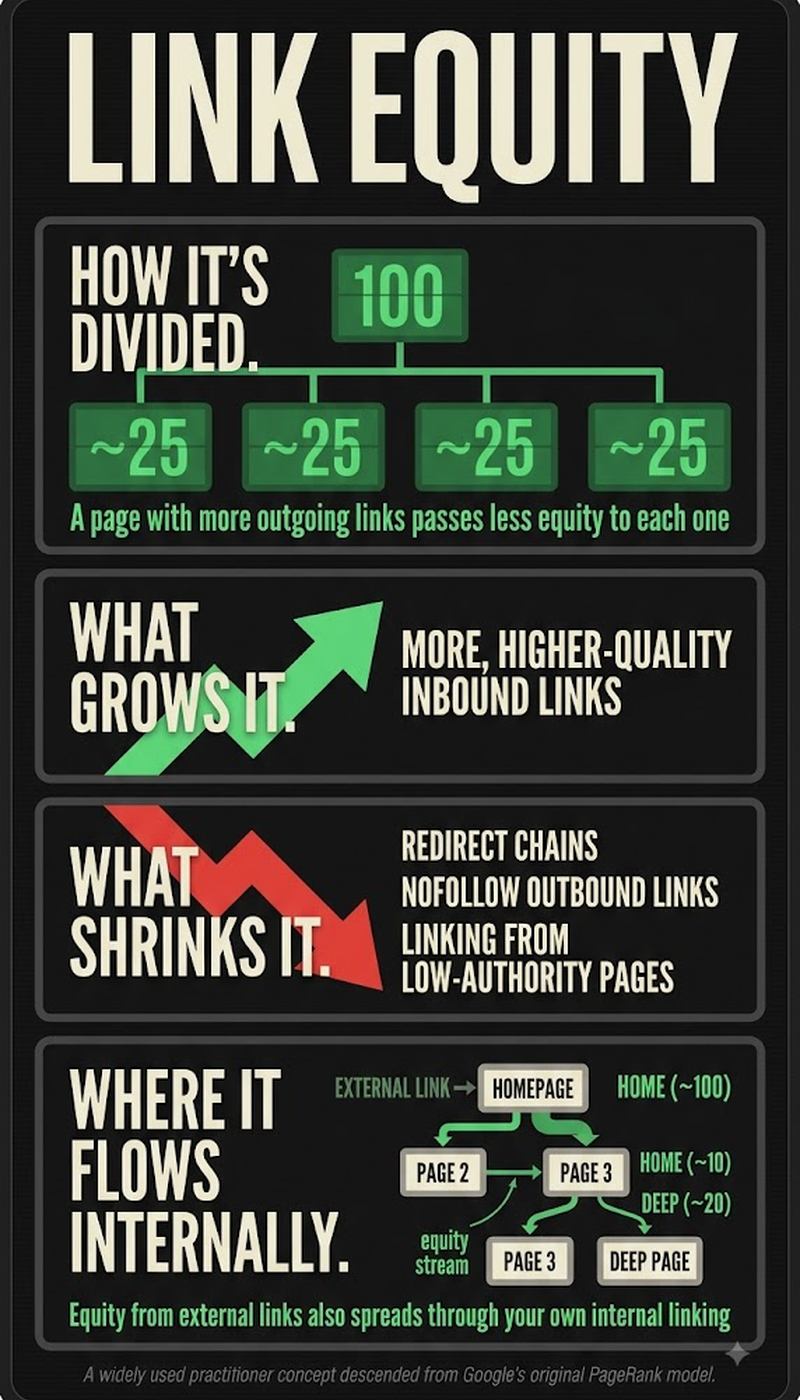
Link equity is the share of a page's authority that passes to another page through a link between them. The concept traces straight back to PageRank, the model Google has used since 1998 to judge how much a link is worth as a vote of confidence. A page earns equity mainly from external backlinks, then redistributes a portion of it through every link it sends out — internal or external. Fewer competing links on the sending page, more authority in that page to begin with — the equity through any single link grows on both counts.
Key Takeaways
- Link equity is the informal name for PageRank-style authority transfer; Google confirmed in 2020 it still uses PageRank internally, even though the public Toolbar score was retired in 2016.
- A page's equity comes almost entirely from earned backlinks — internal links only redistribute equity a site already has, they don't create new equity from nothing.
- Nofollow attributes stopped working as an equity-sculpting tool around 2008-2009; using nofollow to "save" equity for other pages doesn't concentrate it the way SEOs once assumed.
- Equity isn't split perfectly evenly across outbound links anymore — Google has described a weighted model where more prominent, in-content links pass more value than buried footer or sidebar links.
- 301, 302, 307, and 308 redirects all pass full equity to their destination, per Google's Gary Illyes; redirect type only signals permanence to Google, it doesn't change how much value transfers.
Internal linking architecture and backlink acquisition are the two levers that determine how much equity a site has and where it goes. Crawl budget is a related concept worth understanding alongside link equity, since Google's crawl prioritization is itself influenced by a page's position in the internal link graph.
How Does Link Equity Actually Flow Through a Site?
Equity flows outward from every page in proportion to that page's own authority, split across its outbound links rather than assigned as a fixed number per link. Picture a homepage that's earned strong backlinks: it has a large pool of equity to distribute, and every internal link it sends — to a category page, a blog post, a contact page — carries a slice of that pool. A page three clicks deep with no direct link from the homepage gets equity only through whatever intermediate pages bother to link to it. No inlinks, no equity. That's the entire reason "orphan" pages struggle to rank regardless of how good the content on them actually is.
The split isn't flat and even anymore, either. Google's own explanations of link evaluation have drifted toward what's sometimes called a "reasonable surfer" model: a link a real visitor would actually notice and click, sitting prominently in body content, carries more signal than one buried in a footer alongside fifty others. Worth sitting with that for a second, because it's a real departure from the 1998 PageRank paper's founding assumption — a random surfer clicking any outbound link with equal probability. Modern Google doesn't believe that anymore, and neither should anyone auditing their own site's link architecture.
Does Link Equity Actually Still Matter for Ranking in 2026?
Yes — Gary Illyes confirmed on Google's own Search Off the Record podcast in 2020, stating plainly that Google "still use[s] PageRank after all these years," and nothing since has walked that back. What's changed is how much weight it carries relative to everything else Google now evaluates: content quality signals, E-E-A-T-adjacent trust factors, user engagement patterns, and — increasingly — how citable and extractable a page's content is for AI-generated answers. Link equity hasn't disappeared as a ranking factor; it's become one input among many rather than the dominant one it was in Google's earliest years.
The practical takeaway: link equity is necessary but not remotely sufficient. Strong internal link equity plus thin, unoriginal content still loses to a well-linked page with substantively better content. Every time. Where equity actually decides the outcome is between two pages of roughly equal content quality — that's when the one sitting in a stronger position in the internal link graph tends to pull ahead.
What's the Difference Between Internal and External Link Equity?
External link equity arrives from other domains linking to a page and is the primary way new authority enters a site at all, while internal link equity is the redistribution of authority a site has already earned across its own pages. A site can't manufacture internal link equity out of nothing — every internal link is moving around a slice of equity that ultimately traces back to an external backlink somewhere in the chain.
Comparing the two:
- Source — External: backlinks from other domains. Internal: links between pages on the same site.
- Creates new authority? — External: yes, the primary source. Internal: no, redistributes existing authority.
- Control level — External: low (depends on other sites linking). Internal: high (fully controlled by site owner).
- Typical use — External: building overall domain strength. Internal: directing existing strength to priority pages.
- Risk factor — External: toxic/spammy backlinks can pass negative signals. Internal: poor architecture (orphan pages) wastes equity.
How Do Nofollow Links Affect Equity Flow?
A rel="nofollow" link tells Google not to pass equity or endorsement through that specific link. It does not "save" that equity to redistribute elsewhere on the page. That's the part people still get wrong. The sculpting technique died around 2008-2009 when Google changed how it calculates the outbound split, and yet the myth persists in enough SEO forums that it's worth stating flatly: nofollowing some links doesn't concentrate more equity into the remaining dofollow ones. Google's crawler still counts the nofollowed link when it evaluates the page overall — it just declines to pass ranking value through that specific link. Where nofollow earns its keep is on pages with large numbers of genuinely low-value outbound links (affiliate directories, sprawling footer menus): it controls what gets endorsed. It was never a lever for funneling equity to a handful of "important" links, and treating it as one wastes effort that would be better spent on architecture.
How Do Redirects Affect Link Equity?
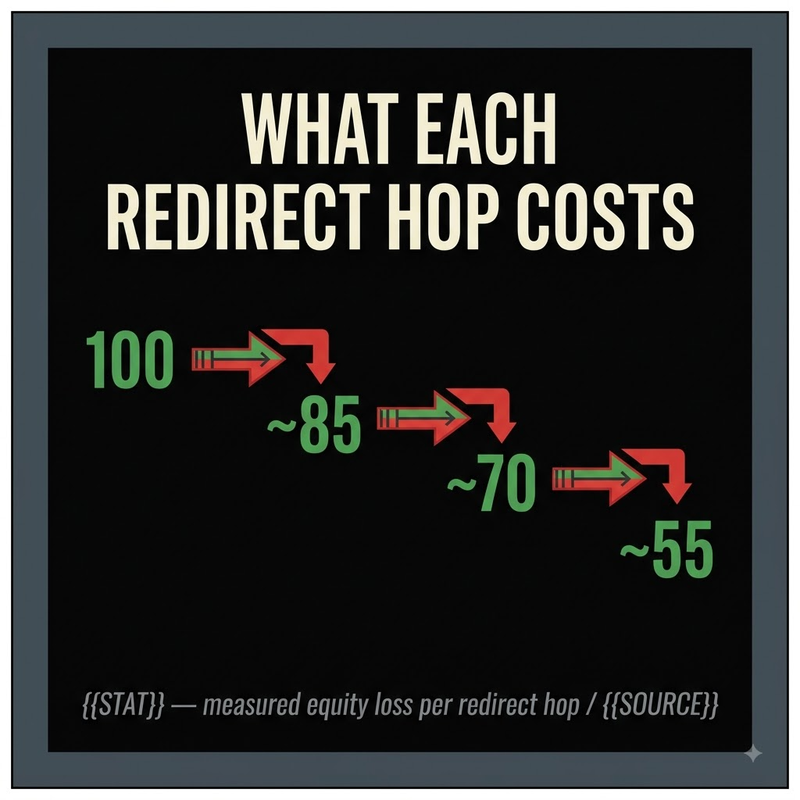
All standard redirect types — 301, 302, 307, and 308 — pass full link equity to their destination URL, according to Google's Gary Illyes. Redirect type is a signal about permanence, not a lever for controlling how much authority transfers. That corrects a persistent myth: that only 301s "preserve SEO value" and 302s leak equity somewhere along the way. Stopped being technically accurate years ago. Still shapes how some SEOs pick redirect types purely out of habit, though. The real reason to choose 301 over 302 for a permanent change isn't equity preservation at all — it's that a 301 correctly signals permanence to Google's indexing systems, which drops the old URL and adopts the new one faster. The equity math doesn't move either way.
How Do You Audit a Site's Internal Link Equity Distribution?
A basic internal link equity audit can be done with a crawler and a spreadsheet, without needing proprietary PageRank-modeling software:
- Crawl the full site with a tool that reports internal inlink counts per URL (Screaming Frog and similar crawlers do this natively).
- Flag orphan pages — any page with zero internal inlinks — since these receive effectively no equity regardless of external backlinks.
- Cross-reference inlink count against each page's business priority; pages you want to rank should generally sit within 2-3 clicks of the homepage and receive links from multiple high-authority internal pages.
- Check click depth alongside inlink count — a page can have several internal links but still sit deep in the architecture if those linking pages are themselves buried.
- Identify pages absorbing disproportionate equity relative to their priority (an old, rarely-updated blog post with hundreds of internal links pointing to it, for example) and consider whether some of those links should redirect equity toward more current priority pages instead.
Frequently Asked Questions
Does a broken internal link still pass any link equity, or does it lose the equity entirely?
A broken (404) internal link passes no equity to any destination — the equity that would have flowed through it is effectively lost until the link is fixed or redirected.
Can a page have too many internal links pointing to it, to the point where it becomes suspicious to Google?
There's no fixed suspicious threshold, but an unnaturally large concentration of internal links to one page relative to the rest of the site can look like manipulative link sculpting rather than organic architecture.
Does linking to the same page multiple times from one page pass equity multiple times?
No — Google generally counts only the first link to a given destination URL from a single source page for equity purposes; repeat links from the same page don't multiply the effect.
How does link equity interact with canonical tags?
Equity signals pointing to a non-canonical URL variant are generally consolidated onto the canonical version Google chooses to index, rather than being split or lost across duplicates.
Do links from a site's own subdomains count as internal or external link equity?
Google generally treats same-root-domain subdomains similarly to internal links for equity purposes, though the exact weighting can vary by how distinctly Google's systems treat the subdomain.
Does deleting an old, low-value page recover the equity it was passing along, or does that equity just disappear?
Properly 301-redirecting a deleted page to its most relevant replacement preserves the equity it held; deleting it outright with no redirect forfeits that equity entirely.
Can equity flow through JavaScript-rendered links, or only static HTML links?
Google can generally follow JavaScript-rendered links if they use proper <a href> tags and the page renders successfully, but links requiring click events or non-standard markup risk not being crawled or credited at all.
Does a link's position on the page (above the fold vs. footer) affect how much equity it passes?
Yes — Google's reasonable-surfer-style weighting treats prominent, in-content links as carrying more signal than links in footers or low-visibility areas of the page.
How long does it typically take for new link equity to affect rankings after a new backlink is acquired?
There's no fixed timeline; it depends on how quickly Google re-crawls both the linking and receiving pages, which can range from days to several weeks depending on those pages' existing crawl frequency.
Does equity from a backlink transfer differently depending on whether the anchor text is branded or exact-match keyword?
Anchor text affects the topical relevance signal a link passes, not the amount of equity itself — equity value and topical signal are related but distinct effects of the same link.
Can outbound links to external sites reduce the equity available for a page's own internal links?
Outbound external links do count as part of a page's total outbound link count for distribution purposes, so a page with many external links does have somewhat less equity to spread per internal link, all else equal.
Does merging two pages via redirect combine both pages' link equity, or does one page's equity get lost?
A well-executed 301 redirect from the merged-away page to the surviving page consolidates the equity both pages had earned, rather than losing either page's contribution.


