
TL;DR. Most sites that submit a disavow file to Google did not need to. That is the uncomfortable part John Mueller has repeated for years: the tool exists for one narrow case, a considerable volume of spammy or artificial links a site owner cannot get removed, links that are actually causing or risking a manual action, not for tidying up a profile that merely looks messy. Google's own systems already discount junk links algorithmically, so disavowing preemptively usually strips out whatever small positive signal those links carried while fixing a problem that was never really there.
What is a disavow file?
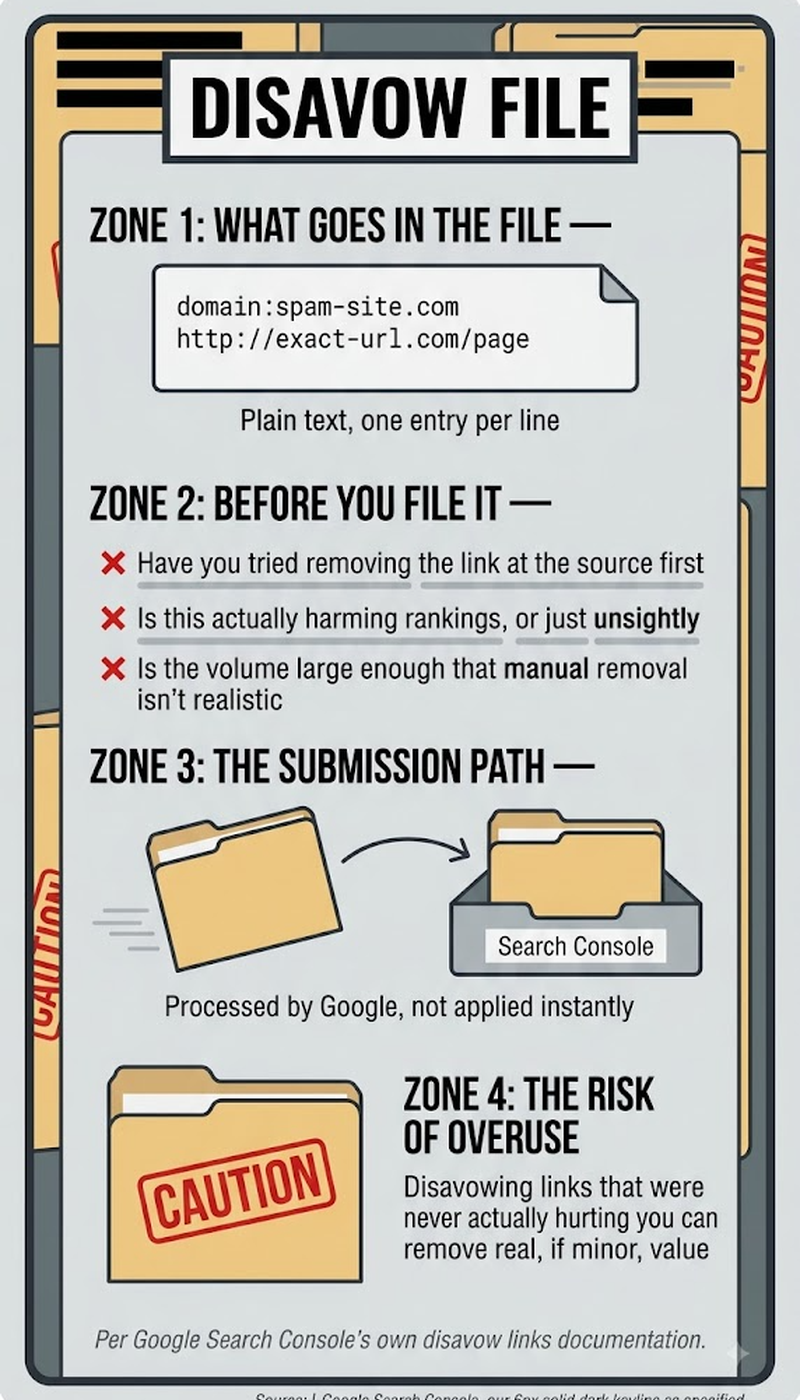
A disavow file is a plain text list, submitted through Google Search Console, telling Google which backlinks or entire domains to ignore when it evaluates a site. It has one real use case: cleaning up after negative SEO, a bad link vendor, or an expired-domain scheme the site owner never authorized in the first place. Google does not act on the list instantly, and it does not automatically lift a manual action just because a file was submitted. It simply stops counting those specific links the next time it recalculates the site's link profile.
Key highlights
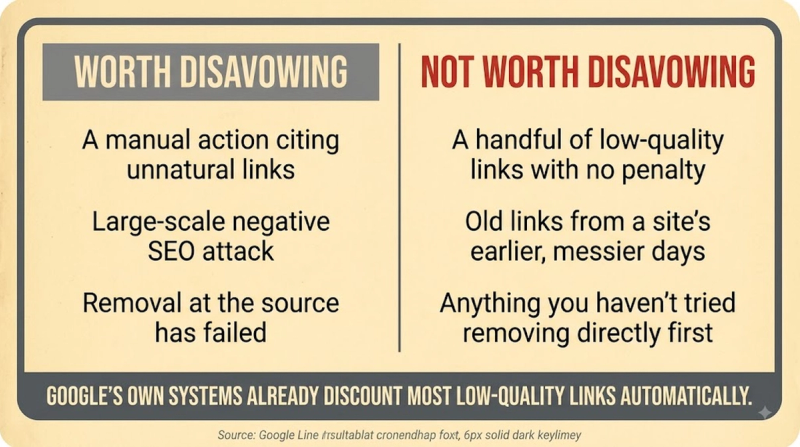
- Google limits its own guidance to one scenario: a considerable number of spammy, artificial, or low-quality links that have caused, or are likely to cause, a manual action.
- John Mueller has said some version of the same thing for years: use the tool only when you are confident harmful links are actually hurting rankings, never as insurance against a hypothetical future problem.
- Most sites do not qualify. Google's algorithms already catch and discount low-quality links on their own, which is exactly why most disavow submissions address a problem that was never really costing the site anything.
- Blanket disavowal has a real cost. Link Building Journal's 2026 review found that stripping out every low-authority link, the most common over-correction, removes small positive signals along with the noise, since not every weak link is actually harmful.
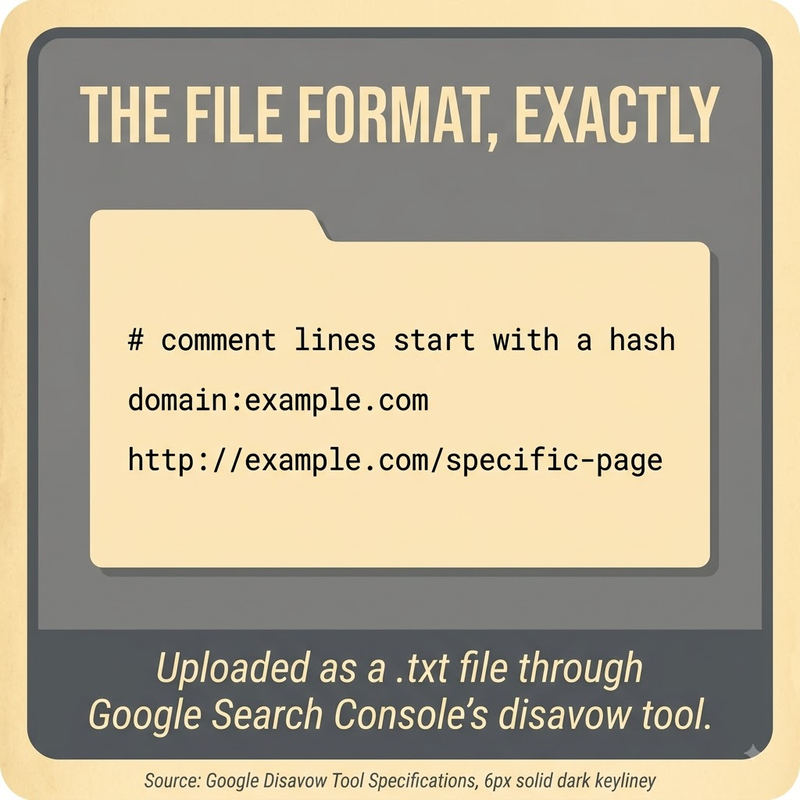
- The file format is unforgiving: plain text, UTF-8 encoding, a .txt extension. Search Console rejects a Word document or PDF outright, even with identical content inside.
When the tool is actually the right call
Two conditions need to be true at once. First, there has to be a considerable volume of links a site cannot get removed through direct outreach, not one or two suspicious backlinks. Second, those links need to have either triggered a manual action already or carry a credible, specific risk of doing so. Absent both, the tool is doing nothing useful, and there is a decent chance it is doing active harm.
Why the preemptive version backfires
Here is the trade a lot of site owners get wrong: Google's ranking systems are already filtering out most low-quality links without any help. Going through a backlink report and disavowing everything that looks weak does not clean up something Google was still counting, it removes signal Google had already decided to ignore, plus whatever small positive weight a handful of those links genuinely carried. Net result: effort spent, nothing fixed, occasionally something quietly made worse.
The file format, exactly
Plain text. UTF-8 encoding. A .txt extension, nothing else accepted. Each URL goes on its own line. To disavow an entire domain rather than one page, prefix the line with domain:, which is the more common approach in practice, since spam rarely arrives as a single isolated link.
How to actually build and submit one
- Confirm the site genuinely has a considerable volume of harmful links causing measurable damage, not a hunch based on a backlink report that looks unimpressive.
- Try direct outreach first. Removal at the source is cleaner than disavowal and avoids the risk of over-correcting.
- List only the confirmed offenders in the file, using domain: for whole-site spam rather than picking off individual URLs one at a time.
- Save as UTF-8 plain text with a .txt extension and submit through Search Console's disavow tool.
- Watch the results instead of resubmitting reflexively. A disavow file is not something to keep expanding every time a new low-quality link shows up in a routine crawl.
Frequently asked questions
What is a disavow file?
It is a plain text submission to Google Search Console naming backlinks or domains that should not count toward a site's link profile. Think of it less as a cleanup tool and more as damage control for links a site never chose to have.
Isn't it safer to just disavow anything that looks bad?
No, and this is the most common mistake. A link that looks low quality is usually already being ignored by Google's own systems. Disavowing it anyway does not add protection, it just risks discarding whatever small value the link actually had.
How do I know if my situation actually qualifies?
Two things need to be true together: a considerable number of spammy links you cannot get removed directly, and evidence, not a guess, that they caused or are likely to cause a manual action. One without the other is not a disavow situation.
What happens if I submit the wrong file format?
Search Console rejects it outright. The requirement is strict: plain text, UTF-8 encoding, .txt extension. A Word document or PDF with the exact same list inside will not go through.
Do most sites actually need to do this at all?
No. Google's algorithms have gotten good enough at discounting low-quality links automatically that the large majority of sites, even ones with a messy-looking backlink history, never have a legitimate reason to touch the tool.


