
In short: a dofollow link is a standard hyperlink with no rel="nofollow" (or other blocking) attribute, meaning search engines are free to follow it and pass ranking signals to the destination page.
Key Takeaways
- A dofollow link is just a normal link with no blocking rel attribute — there’s no rel="dofollow" tag to add; it’s dofollow by default.
- Google treats nofollow, sponsored, and UGC attributes as hints since 2019, not absolute directives — a meaningful shift from how nofollow worked before that.
- Not all dofollow links carry equal value — linking-page authority, topical relevance, and how many other outbound links dilute the same page all factor in.
- Paid dofollow links without proper rel="sponsored" disclosure violate Google’s link scheme guidelines and carry real penalty risk for both buyer and seller.
- Large UGC platforms (Wikipedia, Reddit, most forums) nofollow essentially all outbound user links by default — a dofollow link from them is often structurally unobtainable regardless of content quality.
What Does “Dofollow” Actually Mean?
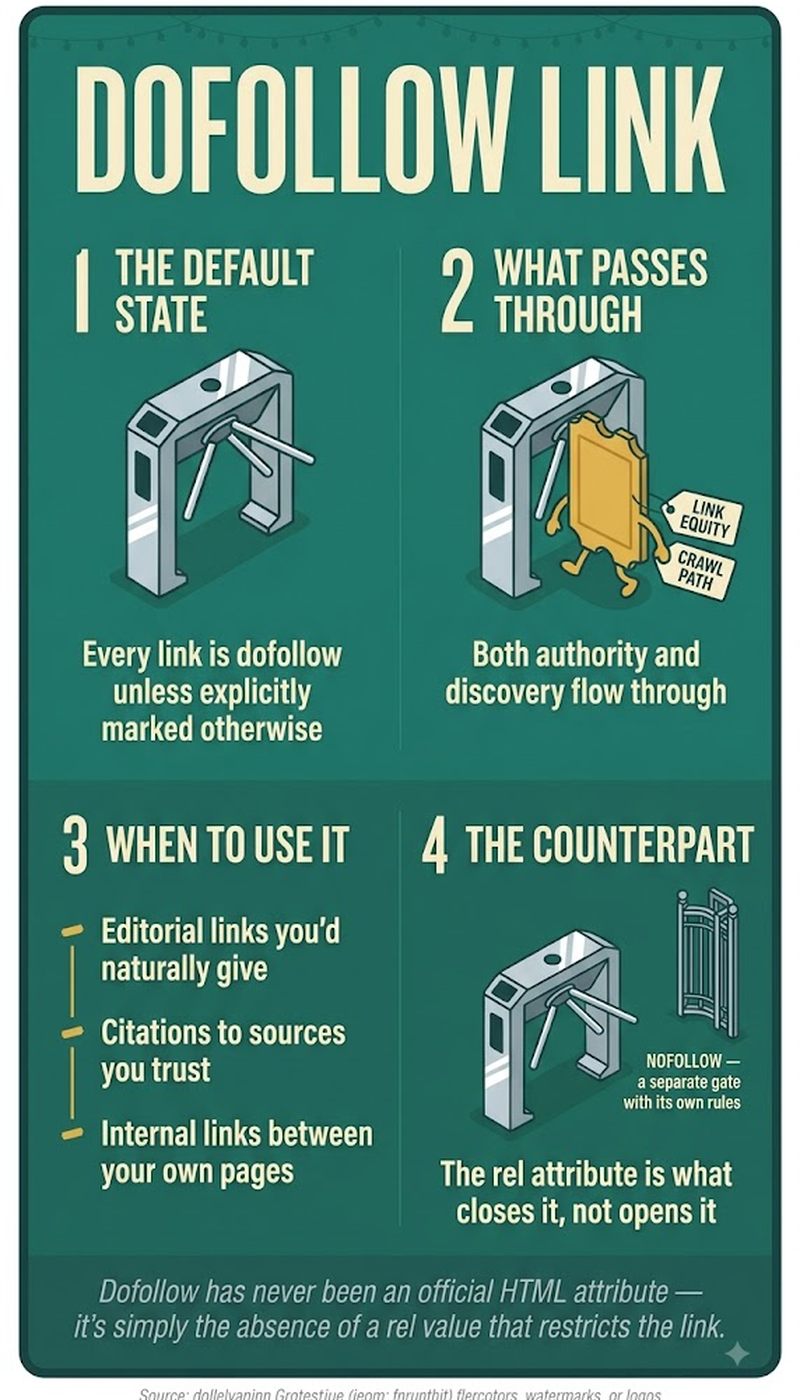
More precisely, “dofollow” isn’t an actual HTML attribute — it’s industry shorthand for the absence of any attribute that would tell a crawler not to pass credit. Every standard <a href="..."> link passes ranking signals, including link equity, by default unless a webmaster deliberately marks it otherwise.
Every standard <a href="..."> link is dofollow by default unless a webmaster deliberately adds a blocking attribute. There’s no rel="dofollow" tag to add — a link is dofollow simply by not being marked otherwise.
How Is a Dofollow Link Different From a Nofollow Link?
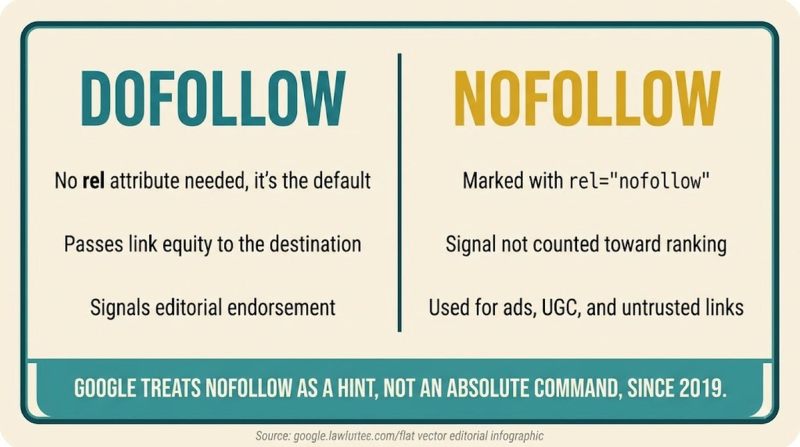
A dofollow link passes ranking signals to the destination page. A nofollow link, marked with rel="nofollow", tells search engines not to pass ranking credit. In Google's stated interpretation, it's treated as a weaker "hint" signal rather than a directive to ignore entirely. Google shifted its handling of nofollow in 2019, from a strict directive to a hint it may or may not follow, confirmed in Google’s own webmaster blog announcement at the time.
The practical difference for SEO strategy: dofollow links from relevant, trusted pages are the primary mechanism by which link-based authority accumulates. Nofollow links, common on user-generated content, paid placements, and many social platforms, generally don't contribute meaningfully to that accumulation — even under Google's post-2019 "hint" framing.
What Other Link Attributes Exist Besides Dofollow and Nofollow?
Beyond dofollow (the default) and nofollow, Google also recognizes rel="sponsored" for paid or advertising links, and rel="ugc" for user-generated content links like blog comments or forum posts. Both were introduced in 2019 alongside the nofollow policy change, to give webmasters more granular ways to disclose link context. All three — nofollow, sponsored, and UGC — are now treated as hints rather than absolute directives.
This granularity matters for compliance as much as SEO. Google's own guidelines state paid links should be marked with rel="sponsored" (or nofollow) to comply with its webmaster guidelines around link schemes. That means the attribute choice isn't purely a ranking-signal decision — it's part of how a site stays aligned with Google's stated policies on disclosed, paid placements.
Why Would a Website Ever Choose to Nofollow Its Own Outbound Links?
A website nofollows outbound links to avoid passing unearned ranking credit to untrusted, unmoderated, or paid content. The most common cases: user-generated content (comment sections, forums), affiliate or sponsored links, and any link a site doesn't want to vouch for editorially. This is standard, expected practice, not a red flag on its own.
Large platforms with heavy user-generated content, like Wikipedia, Reddit, and most major forums, nofollow essentially all outbound user-submitted links by default. They can't editorially vet the destination of every user-posted link, so a dofollow link from such a platform is often technically impossible to obtain, regardless of content quality. That's a common point of confusion in outreach campaigns targeting those sites.
Does Every Dofollow Link Carry Equal SEO Value?
No. Dofollow links carry varying amounts of ranking value, depending on the linking page's own authority, its topical relevance to the destination page, and how many other outbound links on that same page dilute the signal. A single dofollow link from a highly relevant, well-established page in the same topical area is generally understood to carry more weight than dozens of dofollow links from low-quality, unrelated pages.
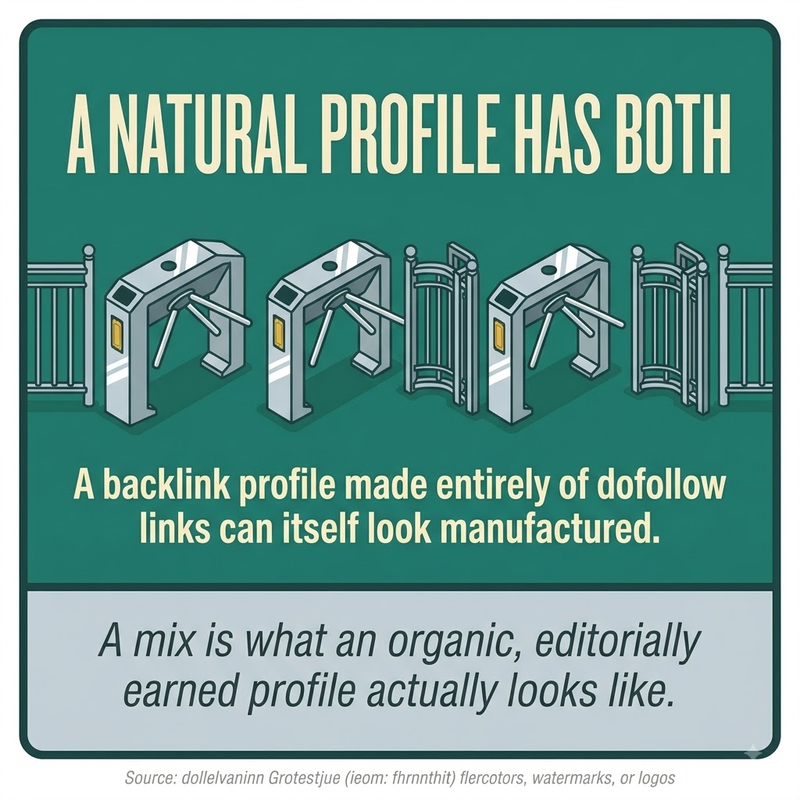
This is why link-building strategies focused purely on maximizing dofollow link count, without regard to source quality or relevance, tend to underperform more targeted approaches. In some cases, they can even trigger the kind of unnatural-link patterns Google's own link scheme guidelines explicitly warn against.
Can Buying Dofollow Links Get a Website Penalized?
Yes — Google’s link scheme guidelines explicitly classify undisclosed, dofollow paid links as a violation, with real risk on both sides of the transaction:
- The buyer’s risk: manual action or algorithmic devaluation of the purchased links, potentially affecting the buying site’s own rankings.
- The seller’s risk: the same link scheme guidelines apply to sites selling placements — Google has been explicit that this affects sellers too, not just buyers.
- The compliant version: paid placements marked with rel="sponsored" (or nofollow) are within Google’s guidelines — the violation is the undisclosed passing of ranking credit, not paid placement itself.
- A common accidental violation: a legitimate site running “sponsored content” without the correct rel attribute is technically in the same risk category as a deliberate link-buying scheme, even without manipulative intent.
How Do Dofollow Links Relate to Link Equity and PageRank?
Dofollow links are the mechanism through which link equity flows between pages — link equity being the ranking value derived from Google's original PageRank concept. A nofollow, sponsored, or UGC-tagged link is explicitly excluded from that credit-passing process, under Google's stated handling. Understanding dofollow links only makes full sense in the context of this underlying equity-flow model.
Modern link equity distribution is considerably more sophisticated than the original PageRank patent's link-counting approach. Google has layered in relevance, trust, and quality signals well beyond simple link counting since PageRank's original 1998 description. But the foundational principle the dofollow/nofollow distinction is built on remains the same: a link is either a vote of confidence a search engine can weigh, or it explicitly isn't.
Frequently Asked Questions
Can a link be technically dofollow but still carry a rel="ugc" or rel="sponsored" attribute at the same time?
No. rel="ugc" and rel="sponsored" are themselves link-attribute directives that function similarly to nofollow, signaling reduced or no ranking credit. A link carrying either attribute is, by definition, not a plain dofollow link — even though it lacks the literal nofollow value.
Does the position of a dofollow link on a page affect how much value it passes?
Google has indicated that link placement and context can influence how much weight a link carries. Links embedded naturally within main content are generally considered more valuable than links buried in footers, sidebars, or boilerplate navigation shared across every page on a site.
Can a redirect affect whether link value passes through from a dofollow link?
Yes. A 301 redirect generally passes the large majority of link equity through to the final destination URL. A 302 redirect, intended as temporary, has historically been treated with more caution regarding how much equity passes — though Google has stated its handling of redirect types has evolved to be more similar over time.
Do internal dofollow links between pages on the same site work the same way as external ones?
Internal links follow the same dofollow/nofollow mechanics technically. But they distribute a site's own existing authority across its own pages, rather than bringing in new external authority. Internal linking is about structure and equity distribution within a site, not acquisition of new link equity.
Is there a way to check whether a specific link on a page is dofollow or nofollow without viewing page source?
Yes — browser extensions and SEO toolbar tools exist specifically to visually highlight nofollow versus dofollow links on a rendered page, avoiding the need to manually inspect raw HTML source for each link.
Can a page have both a dofollow and a nofollow link pointing to the exact same destination URL?
Yes. If a page links to the same destination multiple times, using different link instances with different rel attributes, each individual link instance is evaluated on its own attributes. There's no rule collapsing multiple links to the same URL into a single combined status.
Does Google treat a dofollow link from a low-traffic but topically perfect niche site differently than a high-traffic but unrelated site?
Topical relevance is generally considered a meaningful factor, independent of the linking site's overall traffic or size. A small, highly relevant niche site's dofollow link can carry more contextual value for a specific topic than a much larger but topically unrelated site's link.
What happens to the SEO value of a dofollow link if the linking page itself later gets deindexed?
A link's value is tied to Google actively crawling and trusting the linking page. If that page is deindexed or removed, the link effectively stops contributing any ongoing ranking signal, since Google isn't processing that page as part of its active index anymore.
Can guest posting for dofollow links still be a legitimate strategy, or does it always risk violating link scheme guidelines?
Guest posting itself isn't inherently a violation. Google's concern is specifically with guest posts published primarily to manipulate rankings through unnatural link placement. Genuinely valuable, editorially reviewed guest content with contextually relevant links carries far less risk than mass-produced guest posts created purely for link acquisition.
Do social media links count as dofollow or nofollow by default on those platforms?
Most major social platforms, including X (Twitter), Facebook, and LinkedIn, apply nofollow to outbound links by default. That means links shared on social media generally don't pass direct link equity — though they can still drive referral traffic and indirect visibility.
Does link equity from a dofollow link diminish the more outbound links exist on the same source page?
Yes. The concept of link equity dilution means the ranking value a single dofollow link passes is generally understood to decrease as the total number of outbound links on that same page increases. The page's overall equity is effectively divided across all its outbound links, rather than fully passed to each one.


