
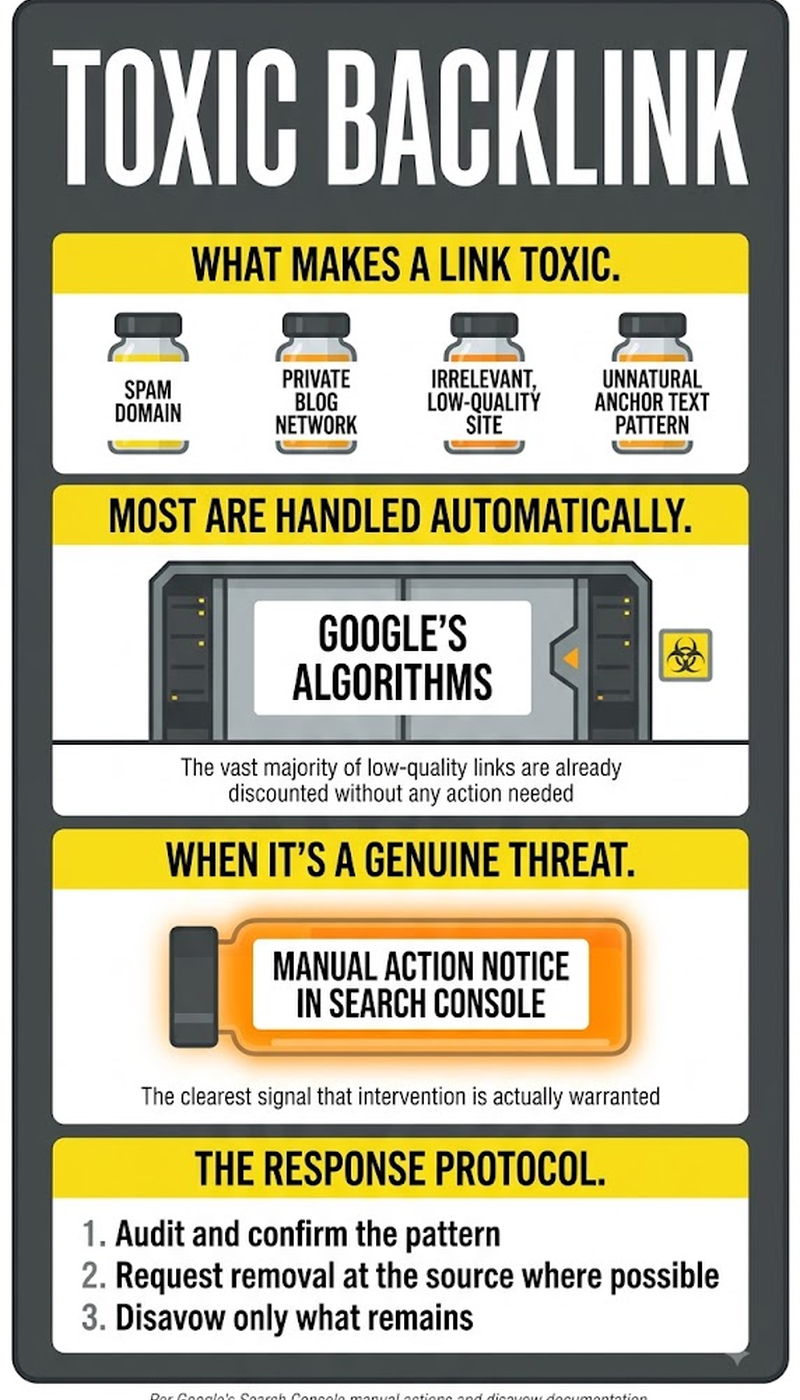
A toxic backlink is a link from a low-quality, spammy, or manipulative source: link farms, comment spam, paid link networks, or hacked sites. It could potentially be associated with search engine penalties or algorithmic distrust if left unaddressed. The practical reality is more nuanced than the term suggests. Google's consistent public guidance is that its algorithms are generally capable of recognizing and ignoring low-quality backlinks, without those links actively harming the site they point to. Toxic backlinks matter most as a genuine concern in specific scenarios: a documented manual action, evidence of a deliberate negative SEO attack, or a history of manipulative link-building the site owner is trying to clean up. They're not a background risk every site needs to obsessively monitor.
Key Takeaways
- Google's own guidance is that its algorithms generally ignore low-quality or spammy backlinks without those links actively harming the target site — toxic backlinks aren't presumed to cause automatic ranking damage.
- The Disavow Tool exists as a manual override specifically for cases of genuine concern: a documented manual action, evidence of negative SEO, or cleaning up a history of manipulative link-building. It's not a routine maintenance task every site needs to run regularly.
- Common toxic backlink sources include link farms, comment and forum spam, paid link networks violating Google's guidelines, and links from hacked or compromised sites.
- Disavowing backlinks incorrectly — removing links that were actually fine — can do more harm than leaving genuinely low-quality links alone, since disavowing tells Google to disregard a link's value entirely.
- Negative SEO (a competitor deliberately building spammy links to a target site to try to trigger a penalty) is a real but relatively rare scenario where proactive toxic backlink monitoring has clearer practical value.
Toxic backlink concerns connect directly to link equity — understanding how equity flows explains why Google's algorithms are generally described as capable of simply not passing value through low-quality links, rather than needing to actively penalize the receiving site. Disavow file covers the specific technical mechanics of building and submitting a disavow request for the cases where it's genuinely warranted.
Does Google Actually Penalize Sites for Having Toxic Backlinks Pointing to Them?
No, not automatically. Google's consistent public position, reiterated by John Mueller and Google's own Search Central documentation, is that its algorithms are generally effective at recognizing and simply ignoring low-quality or spammy backlinks, rather than treating their mere existence as grounds for penalizing the site they point to. This directly contradicts a persistent, older assumption in SEO circles: that any spammy link pointing to a site automatically puts that site at risk. A site generally can't be sanctioned purely because someone else built bad links to it, without its knowledge or involvement. The scenarios where toxic backlinks become a genuine, actionable concern are narrower: a documented manual action explicitly citing unnatural links, clear evidence of a deliberate negative SEO campaign, or a site's own history of having built manipulative links itself that needs cleaning up.
What Actually Counts as a Toxic Backlink?
Common source types and their risk:
- Link farms — networks built purely to manipulate rankings. Risk level: high if part of a documented pattern.
- Comment/forum spam — automated, irrelevant, mass-posted links. Risk level: generally low, Google typically ignores these.
- Paid link networks — violates Google's link scheme guidelines. Risk level: higher if the site itself participated.
- Hacked/compromised sites — links inserted without the site owner's knowledge. Risk level: generally low for the target site.
- Irrelevant, unnatural anchor text patterns — signals manipulative intent. Risk level: higher if pattern is extensive and consistent.
Link farms and paid link networks that a site actively participates in building carry genuinely higher risk. Google's guidelines explicitly prohibit link schemes, and a documented pattern of participation can trigger a manual action. Comment spam and links from hacked sites the target site had no involvement in, by contrast, are exactly the kind of low-quality signal Google's algorithms are generally described as capable of discounting on their own, without site-owner intervention.
When Does Disavowing Backlinks Actually Make Sense?
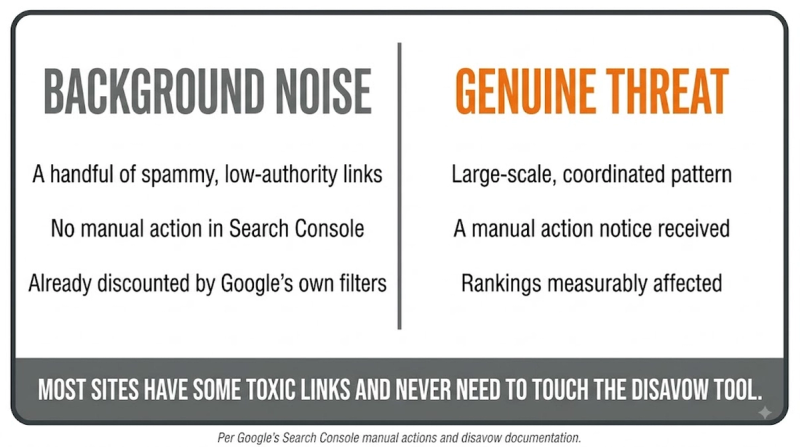
Disavowing makes sense specifically when a site has received a documented manual action citing unnatural links, has clear evidence of an active negative SEO campaign, or is cleaning up its own history of having built manipulative links. It's not routine, precautionary maintenance for every low-quality link a checker tool happens to flag. The Disavow Tool tells Google to disregard specific links entirely when calculating that site's authority, which is a genuinely blunt instrument. Disavowing a link that was actually harmless, or even mildly beneficial, removes any value that link might have carried, without providing any offsetting benefit. This is exactly why indiscriminately disavowing every link a toxic-backlink checker flags, without individual review, risks doing more harm than the toxic links themselves would have caused left alone.
How Do You Actually Determine Whether Disavowing a Specific Link Is Warranted?
A careful, case-by-case review process protects against the common mistake of over-disavowing based purely on an automated tool's flag:
- Confirm there's an actual documented reason to be concerned — a manual action notice in Search Console, clear evidence of a coordinated negative SEO pattern, or a known history of manipulative link-building the site itself engaged in.
- Review flagged links individually rather than disavowing an entire exported list from a checker tool without manual verification, since automated toxic-backlink scores are estimates, not confirmed Google assessments.
- Distinguish between links the site's own team built (which may warrant disavowing if manipulative) and links built by third parties with no site involvement (which Google's guidance suggests are generally safe to leave alone).
- Prioritize genuinely severe cases — clear link farm participation, purchased links violating guidelines — over borderline or ambiguous cases where the actual risk is unclear.
- Reserve disavowing as a targeted, documented response to a specific concern, not a recurring maintenance task performed reflexively on a schedule.
Frequently Asked Questions
Can a competitor actually hurt a site's rankings by building spammy links to it (negative SEO)?
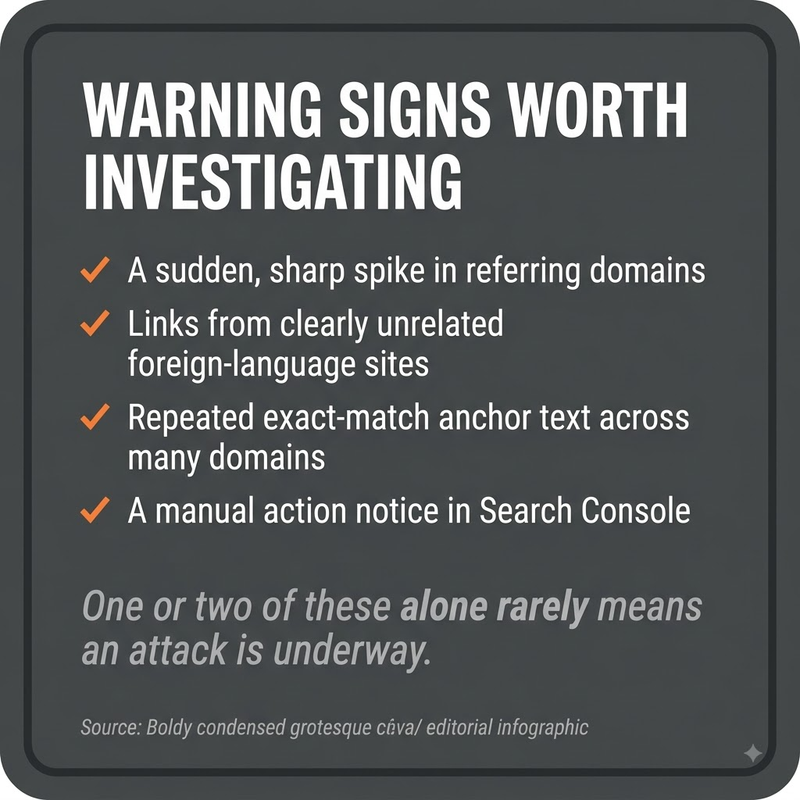
It's a real but relatively rare scenario. Google has stated its systems are generally resilient to this, though documented cases of negative SEO campaigns do exist. That's part of why monitoring backlink profiles for sudden, unexplained spikes in spammy links has some genuine practical value.
Does a high "toxicity score" from a third-party SEO tool mean Google will actually penalize a site?
No. Third-party toxicity scores are estimates based on that tool's own criteria, not a confirmation of Google's actual assessment. Google doesn't use or endorse any specific third-party toxicity scoring system.
How quickly does Google process a disavow file once submitted?
Google hasn't published a specific guaranteed processing timeline for disavow files, and processing can take weeks. That's part of why disavowing shouldn't be treated as an immediate fix for an urgent ranking concern.
Can removing toxic backlinks directly (asking the linking site to take them down) work instead of disavowing?
Yes, and Google's own guidance recommends attempting direct removal first where realistic, reserving the Disavow Tool for links that can't be removed through direct outreach.
Does having toxic backlinks affect a site's domain authority score (as measured by third-party tools)?
Third-party domain authority metrics can be affected by the composition of a site's backlink profile according to that specific tool's methodology, though this is separate from and not the same as Google's actual internal ranking evaluation.
Is it possible to accidentally build toxic backlinks without realizing it?
Yes. Participating in a link exchange program, using an SEO agency employing manipulative tactics without disclosure, or having old links from a previous, less careful era of a site's history can all result in toxic backlinks the current site owner didn't deliberately create.
Does the disavow tool remove the backlink entirely, or just tell Google to ignore it?
The Disavow Tool doesn't remove the actual link from the linking page. It only tells Google to disregard that link when evaluating the target site, leaving the link itself still live and visible on the source page.
Can a site recover from a manual action related to unnatural links without using the Disavow Tool?
Recovery from a manual action typically requires demonstrating genuine remediation effort, which commonly includes both attempting direct link removal and submitting a disavow file for links that couldn't be removed, alongside a reconsideration request.
Do toxic backlinks from expired or unrelated-niche domains carry more risk than active, relevant-niche spam links?
Risk assessment generally depends more on the pattern and intent behind the links (manipulative link schemes vs. incidental low-quality links) than on the specific domain's expiration status or niche relevance alone.
How often should a site's backlink profile actually be reviewed for toxic links?
For most sites without a specific documented concern, frequent proactive toxic-link auditing isn't necessary, given Google's stated ability to handle low-quality links algorithmically. Review becomes warranted specifically when a manual action, unexplained ranking drop, or suspected negative SEO pattern appears.
Can toxic backlinks affect a site's visibility in AI-generated search results the same way they might affect traditional rankings?
AI-generated search features draw on the same underlying trust and authority signals traditional ranking systems use. The same general principle applies: genuinely low-quality links are more likely to be discounted than to actively cause harm, consistent with Google's broader stated approach.


