
TL;DR. Page Authority puts a single number, 1 to 100, on how likely one specific page is to rank, built by Moz from more than 40 variables that include backlinks, content quality, and internal links. A score past 50 generally counts as strong, but the number only means something once it's checked against the pages actually competing for the same query.
What is Page Authority?
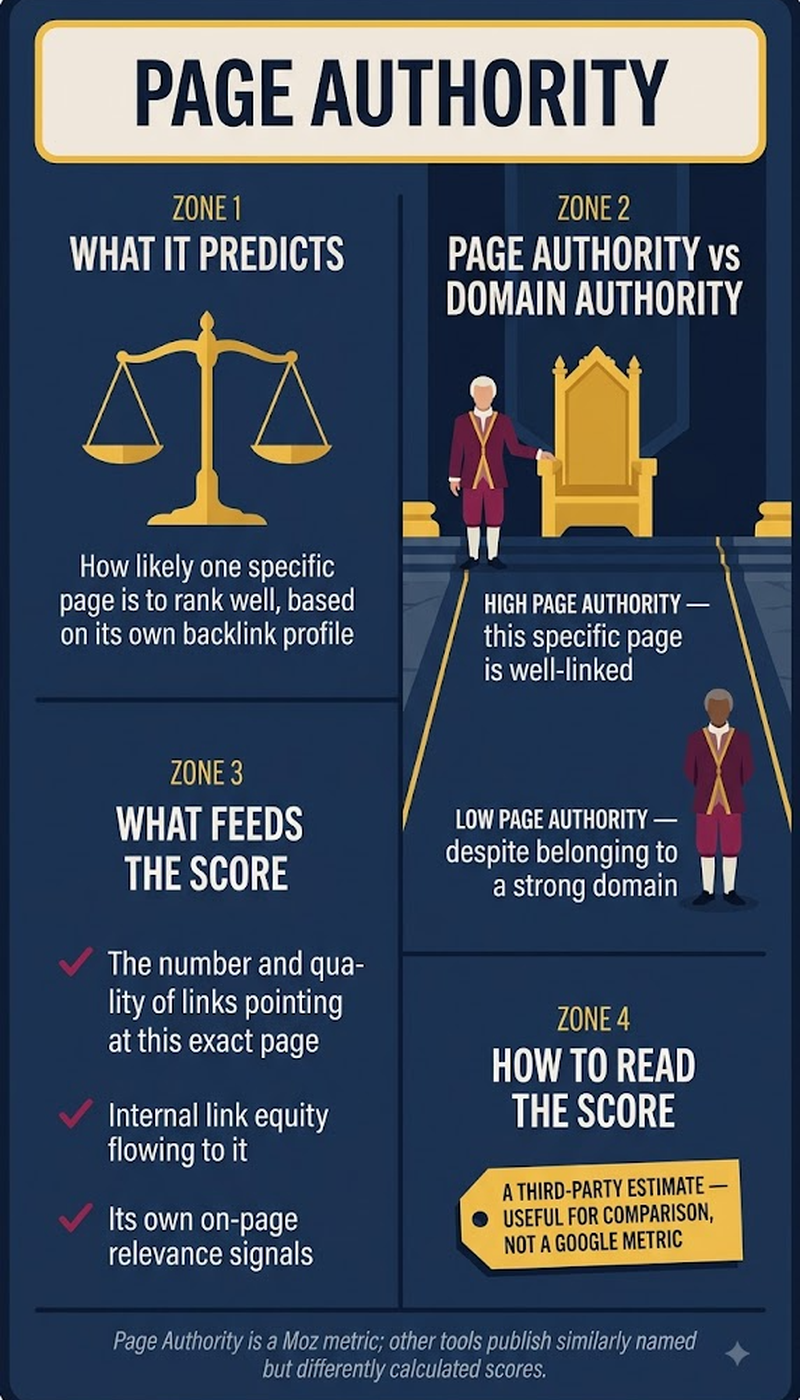
Page Authority is Moz's predictive score, running 1 to 100 on a logarithmic scale, for how likely a single specific page is to rank well in search. Unlike a domain wide metric, it looks only at the signals feeding that one URL, ignoring the strength of the rest of the site.
Page Authority carries no weight with Google itself. Moz built it as a third party estimate for comparing pages against each other, not a number the search engine calculates or factors into rankings.
Key highlights
- Moz's model pulls from more than 40 variables to build the score, weighted heaviest toward backlink profile, content quality, and internal linking, each measured at the level of the individual page rather than the domain.
- A score in the 50s or higher is the rough marker of a page considered strong, and that marker is useless on its own. The only fair comparison is against the pages already ranking for the query in question.
- An Ahrefs correlation study spanning 218,713 domains found that page level metrics, the category Page Authority belongs to, tracked actual ranking outcomes even more closely than domain wide scores when the comparison was one page against another.
- Moz trains Page Authority against real search results, calibrating the score to match observed ranking behavior. Ahrefs takes a different approach with its comparable metric, URL Rating, building it purely as a PageRank approximation from link data rather than tuning it against live SERPs.
How Page Authority is calculated
A machine learning model sits behind the score, trained by Moz on real search results and tuned to correlate dozens of page level signals with how pages actually rank. The heaviest inputs are backlink quantity and quality, content relevance and depth, on-page elements like headers and meta tags, and the internal links pointing at that specific page.
Because the scale is logarithmic, climbing from 20 to 30 takes far less than climbing from 70 to 80. Comparing a page against others in its own competitive space is the only benchmark that holds up.
Page Authority vs Domain Authority
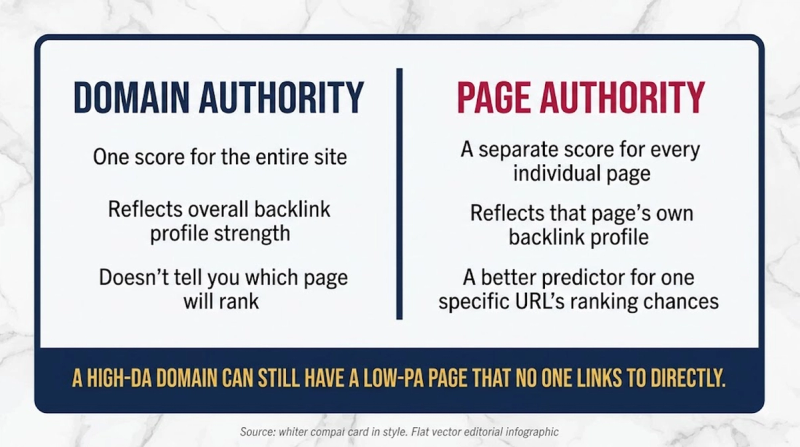
Page Authority scores one URL. Domain Authority scores the whole domain, pulling strength from every backlink pointing anywhere on the site.
A page can carry a low Page Authority sitting on a domain with a strong Domain Authority, and the opposite happens just as often. A single, heavily linked page on a fairly new domain can outrank pages on far more established sites for its specific query.
How to increase a page's authority
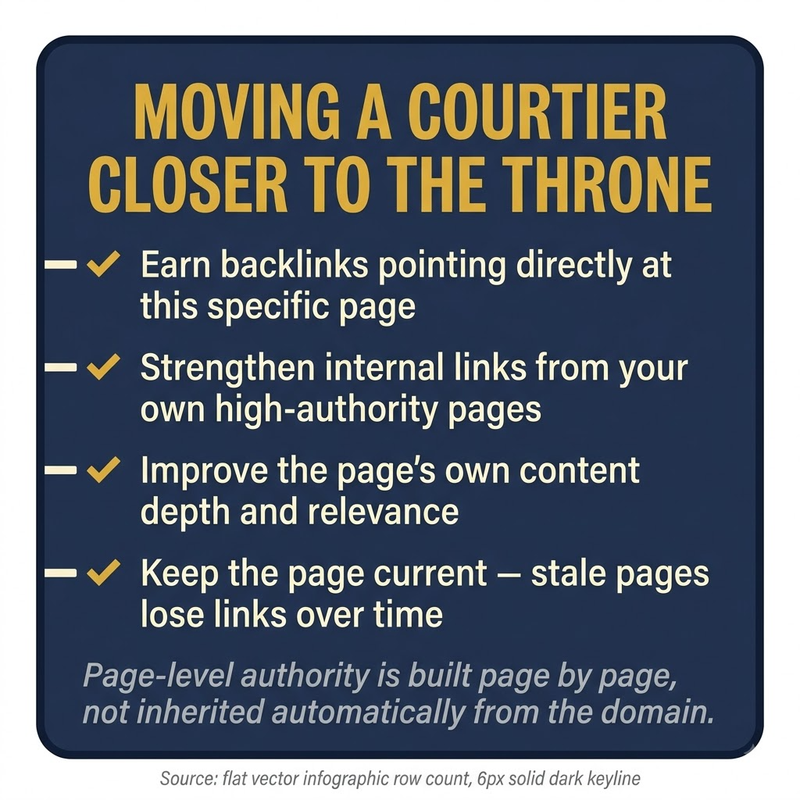
- Earn backlinks pointed directly at the specific page, not just the homepage.
- Add internal links from other strong pages on the same site into the target page.
- Deepen the content itself so the page earns links on its own merit rather than borrowed authority.
- Prune or consolidate weaker pages competing for the same links and internal linking budget.
Frequently asked questions
Is Page Authority something Google actually uses?
No. Page Authority is a Moz metric built entirely outside Google, useful for comparing pages against each other but never consulted by Google's own ranking systems. Treat it as a research tool, not a signal the search engine reads.
What's the real difference between Page Authority and Domain Authority?
Page Authority isolates the signals feeding one URL. Domain Authority rolls up every backlink across an entire site into a single score. A page's individual authority can sit well above or below the domain's overall number, which is exactly why checking both matters before assuming a strong domain guarantees a strong page.
How high does a Page Authority score need to be?
There's no fixed target worth chasing. A score above 50 is the commonly cited marker of strength, but the only useful comparison is against the Page Authority of whatever is currently ranking for your target query. Beating a 35 might be plenty in one niche and nowhere near enough in another.
What actually moves a page's authority upward?
Direct backlinks to that specific URL move it fastest, followed by internal links from your own strongest pages, then content depth that gives outside sites a reason to link in the first place. Splitting link equity across several near duplicate pages competing for the same signals works against all three.


