
In short: a local citation is any online mention of a business’s name, address, and phone number (NAP) on a site other than the business’s own — a link isn’t required for it to count.
Key Takeaways
- A local citation is any online mention of a business’s name, address, and phone number (NAP) — it doesn’t need a link to count, unlike a backlink.
- NAP consistency across citations is a confirmed local ranking signal, per Google’s own local search guidelines — mismatched details create verification friction, not necessarily a penalty.
- Citation quality and consistency matter more than raw volume — a small set of high-authority, relevant directories outperforms mass submission to low-quality ones.
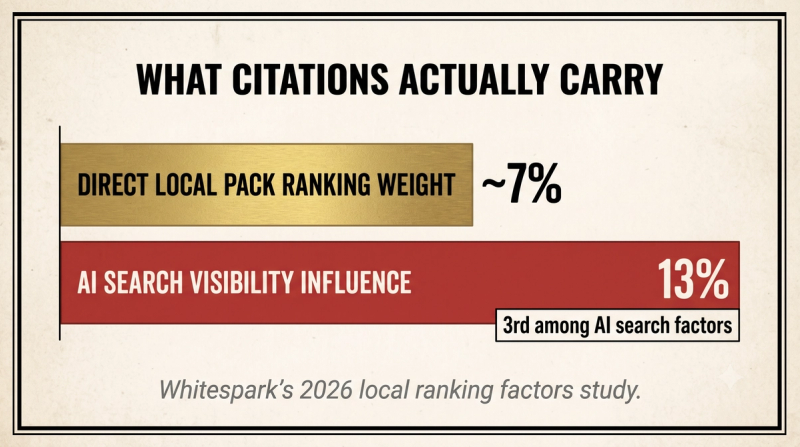
- Citations still matter for AI-powered local answers, since those systems rely on the same underlying structured business data traditional local ranking uses.
- LocalBusiness schema complements citations but doesn’t replace them — external corroboration carries different weight than self-reported on-site data.
What Counts as a Local Citation?
More specifically, a citation can be a directory listing, a review site profile, or a mention on an industry association page. The mention itself, if consistent and machine-readable, is what search engines use as a trust and location signal — with or without an accompanying link.
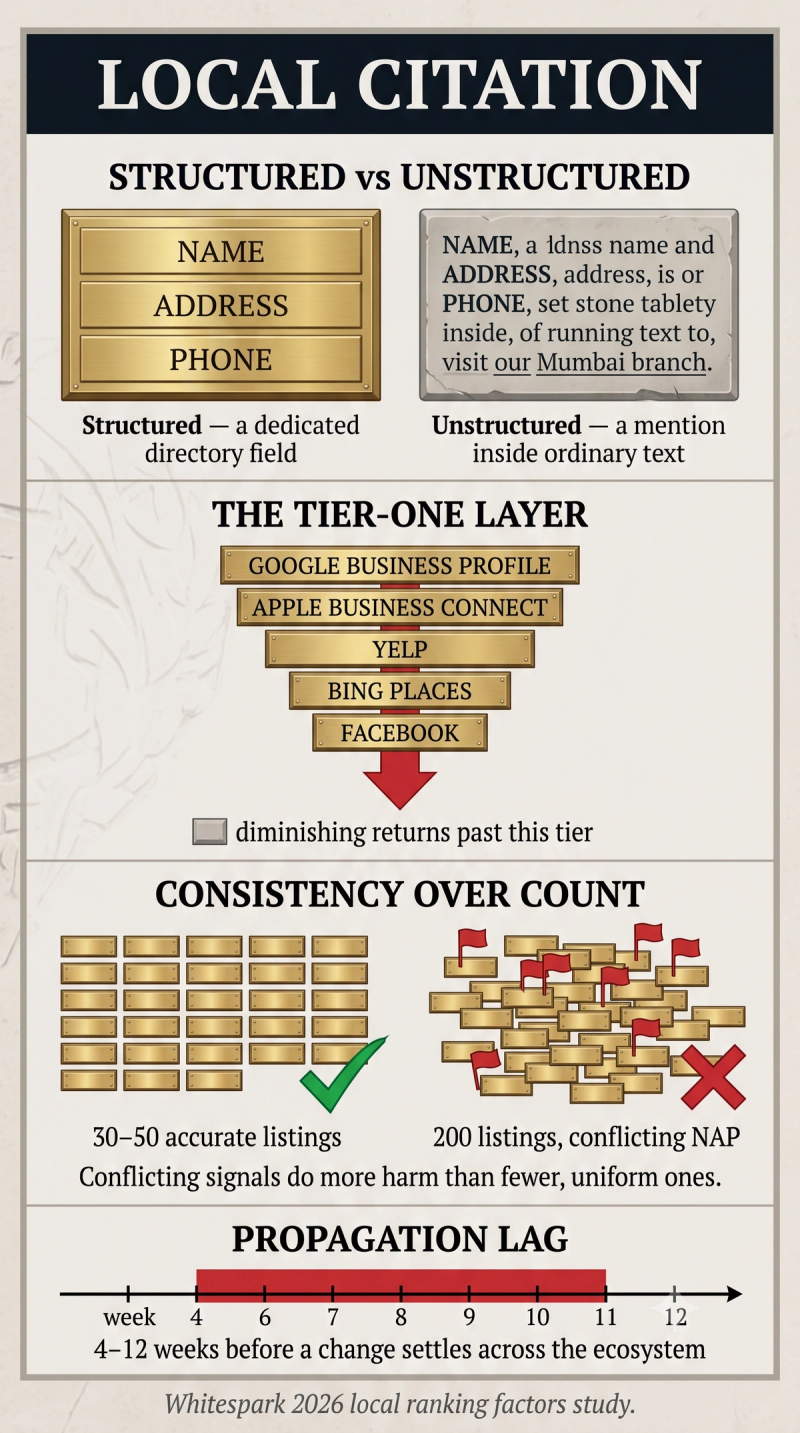
Citations fall into two broad categories: structured citations, appearing in dedicated business-directory formats (Google Business Profile, Yelp, Yellow Pages, industry-specific directories), and unstructured citations, appearing as a passing mention inside an article, news piece, or blog post. Structured citations are easier to audit and build deliberately; unstructured ones tend to happen organically through PR and are harder to control but often carry more topical relevance.
Why Does NAP Consistency Matter for Local Rankings?
NAP consistency matters because Google cross-references a business's name, address, and phone number across the web, to verify it's a real, stable entity. Mismatched details across citations create ambiguity that can suppress local ranking confidence. A business listed as "123 Main St." on one directory and "123 Main Street, Suite 2" on another isn't automatically penalized, but the mismatch adds friction to the verification process.
Google's own local search guidelines confirm consistency of business information across the web is one of the signals factored into local ranking, alongside proximity, relevance, and prominence. An outdated citation left over from a previous address or a disconnected phone number is a common, quietly damaging technical SEO issue. The business "shows up," but conflicting data actively works against the local ranking Google is trying to establish.
How Many Local Citations Does a Business Actually Need?
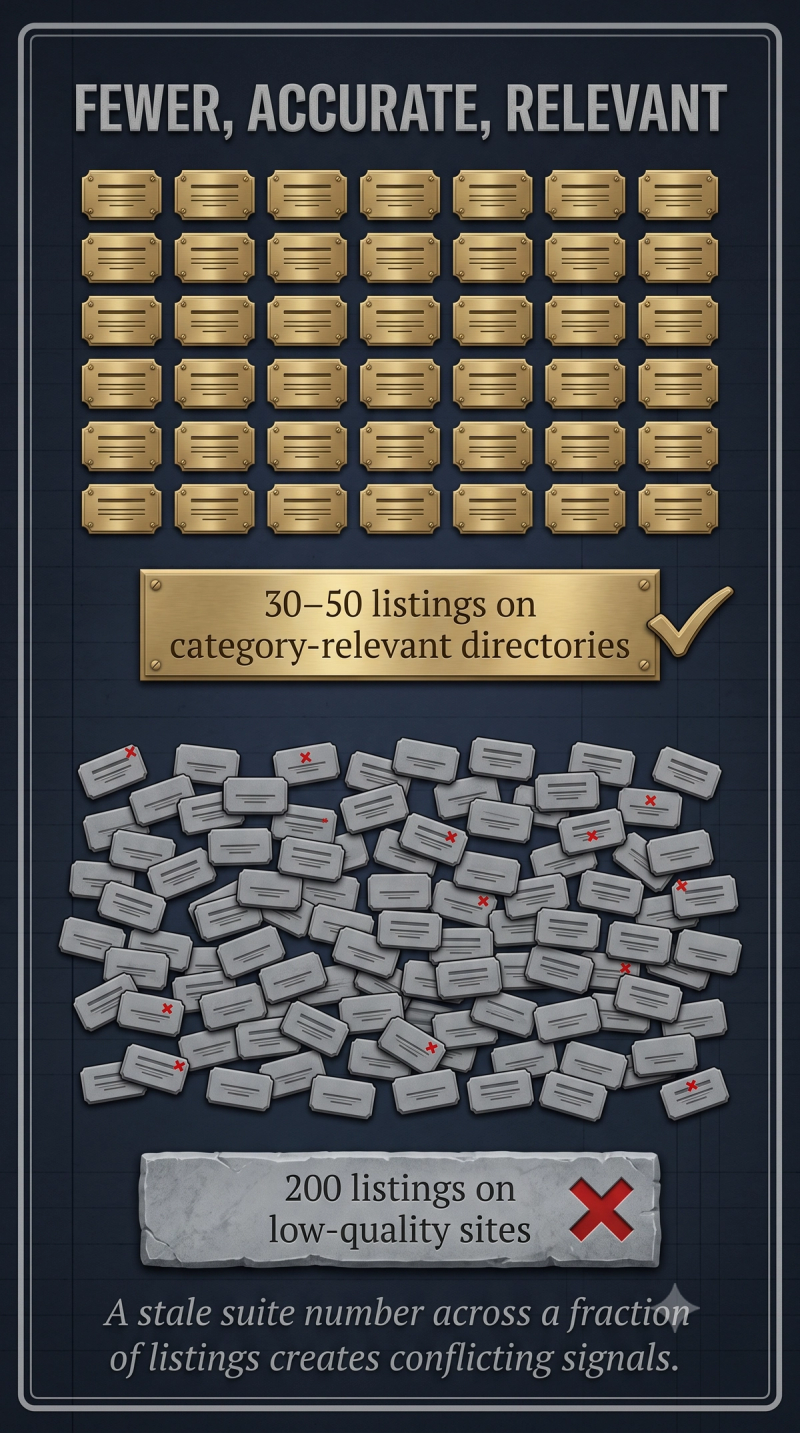
There's no fixed number of citations required for strong local rankings. Consistency and relevance matter more than sheer volume, and building citations on low-quality or irrelevant directories can dilute rather than help local SEO signals. Many local SEO case studies point to a core set of major, high-trust directories, like Google Business Profile, Apple Maps, Bing Places, and industry-specific or regional directories, mattering far more than dozens of low-authority listing sites.
The practical guidance most local SEO practitioners converge on is prioritizing accuracy on a smaller set of high-authority, relevant citations, over chasing citation count on low-trust directories. A large volume of citations on spammy directories has been associated in industry audits with negligible ranking benefit, and occasionally correlating with spam-signal flags.
What’s the Difference Between a Citation and a Backlink?
A citation is a mention of business information (name, address, phone), used primarily as a local trust and verification signal. A backlink is a hyperlink from another site, used as a broader authority and relevance signal across all of SEO, not just local search. A citation doesn't need a link to count; a backlink, by definition, requires one.
The two do overlap. Many citation sources also include a link to the business's website, meaning a well-placed local citation can function as both a citation and a backlink simultaneously. But treating citation building purely as a backlink strategy misses the point: an unlinked but consistent NAP mention on a respected local directory still contributes to local trust signals, even without passing link equity.
How Do You Find and Fix Inconsistent Citations?
You find inconsistent citations by manually searching the business name plus city, or by using a citation audit tool that cross-references listings against canonical NAP data. The process typically runs:
- Manually search “[business name] + [city]” across Google, Bing, and major directories for a small, single-location business — or use a dedicated citation management tool for multi-location or franchise businesses.
- Compile every found listing alongside its listed NAP data in one tracking sheet.
- Flag any mismatch against the business’s canonical, current NAP data.
- Submit a direct correction through each directory’s own claim/update process — most major platforms (Google Business Profile, Yelp, Bing Places) allow a verified owner to edit directly.
- Recheck aggregator-fed directories after a few weeks, since they often pull from a data aggregator rather than accepting direct edits, and propagation isn’t instant.
Citation correction by source type:
- Major platform (Google Business Profile, Yelp) — Correction method: direct owner edit — Typical time to update: days
- Aggregator-fed directory — Correction method: update at the aggregator level — Typical time to update: weeks to a few months
- Unstructured mention (article, blog) — Correction method: direct outreach to the publisher — Typical time to update: varies, often slow
Do Local Citations Still Matter With AI-Powered Local Search?
Local citations still matter for AI-powered local search, because AI systems generating local answers, including Google's AI Overviews and voice assistants, still rely on the same underlying structured business data (NAP, categories, hours) that traditional local ranking uses to verify and describe a business. The delivery format has changed; the underlying trust signal citations provide has not disappeared.
What has changed is that AI-generated local answers increasingly synthesize information from multiple sources, rather than simply linking to a top-ranked listing. Citation accuracy affects not just whether a business shows up, but whether the AI-generated summary about it is factually correct. An inconsistent phone number across citations doesn't just risk a lower local ranking anymore — it risks an AI assistant reciting the wrong number to a user directly.
How Do Structured Data and Schema Markup Relate to Local Citations?
LocalBusiness schema markup on a business’s own website works alongside external citations by giving search engines a machine-readable version of the same NAP data that citations reinforce elsewhere on the web. Schema doesn’t replace citations; it’s the on-site counterpart to the off-site consistency citations establish.
A search engine cross-references a business's own structured data against what third-party citations say about it. Agreement between the two strengthens confidence, while disagreement introduces the same ambiguity inconsistent citations alone create. A business with perfect LocalBusiness schema but wildly inconsistent external citations still faces the trust gap citations exist to solve. Schema alone isn't sufficient proof to third-party verification systems, which weight self-reported data less than independently corroborated mentions.
Frequently Asked Questions
Can a business have too many citations pointing to an old, closed location?
Yes. Leftover citations pointing to a closed or previous location create the same NAP-inconsistency problem as any mismatched listing. They can be especially damaging, because they actively point users and search engines to incorrect, unreachable information, rather than simply being outdated content.
Do citation aggregators like Data Axle or Foursquare actually feed Google directly, or are they separate systems?
Data aggregators feed a wide network of secondary directories and apps, rather than feeding Google's index directly. Google Business Profile is managed and verified separately. But inaccurate data sitting in a major aggregator can still propagate to dozens of smaller directories, which do factor into a business's overall citation consistency picture.
Should a business with multiple service areas but no physical storefront still pursue local citations?
Yes. Service-area businesses (plumbers, cleaners, consultants) can and should build citations using a service address or defined service area. Google's local ranking system explicitly supports service-area business profiles, without requiring a public-facing storefront.
Can a negative or outdated review platform still count as a valid citation source?
Yes. A citation's value comes from consistent, accurate NAP data being present, not from the sentiment of reviews on that platform. A review site with negative reviews but correct business information still functions as a legitimate citation source for trust-signal purposes.
Do citations in industry-specific directories carry more weight than general business directories?
Industry-specific directories (legal, medical, real estate) are generally considered to carry stronger topical relevance signals than broad general directories. They demonstrate the business is recognized within its specific professional or industry context, rather than just existing as a generic listing.
What happens to existing citations after a business changes its legal name?
A legal name change requires updating every existing citation individually, similar to an address change. It's often a slower, more error-prone process than an address update though, because name variations (abbreviations, "Inc." vs. "LLC," old DBA names) are harder to catch consistently across dozens of directories.
Can duplicate Google Business Profile listings for the same location count as conflicting citations?
Yes. Duplicate GBP listings for the same physical location actively confuse both users and Google's local ranking system. Google's own guidelines explicitly prohibit maintaining more than one listing per location, which makes duplicate-listing cleanup a priority fix ahead of broader citation-building work.
Do citations help e-commerce or online-only businesses, or are they purely for physical-location businesses?
Citations are primarily valuable for businesses with a physical location or defined service area relevant to local search intent. A purely online, non-local e-commerce business generally gets more value from traditional backlink-building than from local citation building, since it isn't competing in local map-based results.
How long does it typically take for a corrected citation to actually update across directories that pull from aggregators?
Propagation time through data aggregators commonly takes several weeks to a few months, since many smaller directories only periodically resync with the aggregator's data rather than updating in real time. Directly editable major platforms like Google Business Profile update far faster, often within days.
Is there a risk to local rankings from paying a citation-building service that mass-submits to hundreds of low-quality directories?
Yes. Mass-submission to low-quality, irrelevant directories provides minimal ranking benefit, and can occasionally correlate with spam-pattern flags in industry audits. A smaller, curated set of high-authority citations is generally a safer and more effective investment than volume-focused mass submission.
Does adding LocalBusiness schema to a website remove the need to build external citations?
No. Schema strengthens a business's own on-site data signal, but doesn't substitute for the independent, third-party verification that external citations provide. Search engines weight corroboration from multiple external sources differently than a business's own self-reported structured data.


