
TL;DR. NAP consistency measures whether a business's name, address, and phone number match exactly across every place they appear online, down to abbreviations and punctuation. Businesses that hit above 95 percent consistency across their top 50 citations rank an average of 3.2 positions higher in the Local Pack than competitors with scattered, conflicting data, according to local SEO benchmarking research, which makes this one of the least glamorous and most measurable local ranking levers available.
What is NAP consistency?
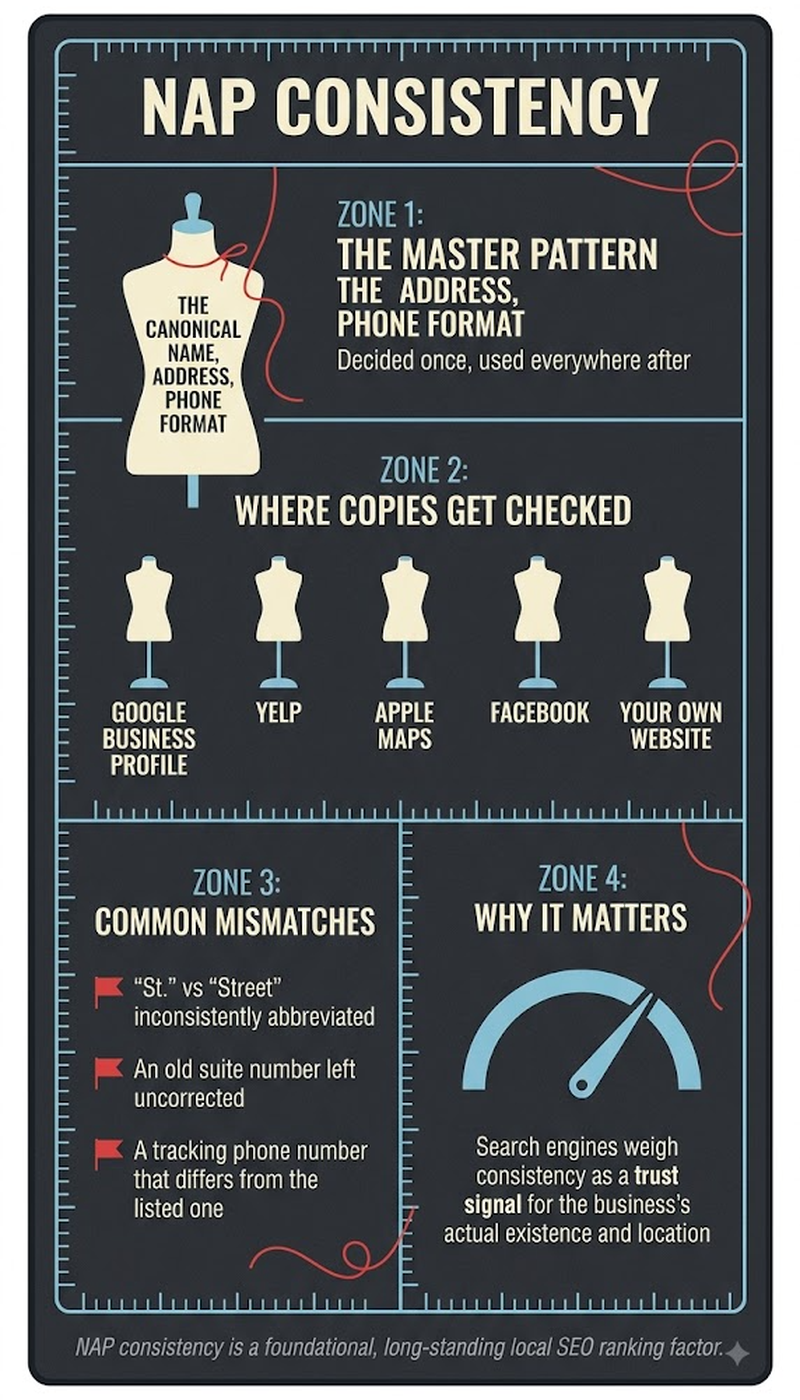
NAP consistency is the practice of keeping a business's name, address, and phone number identical, character for character, across its website, Google Business Profile, and every directory or citation source that lists it. NAP stands for Name, Address, Phone, the three fields Google and AI-driven local search systems cross-reference to decide whether a business's claimed location can be trusted. A mismatch as small as "St." versus "Street" or an outdated suite number counts as an inconsistency, even when a human reader would recognize both as the same business.
Key highlights
- Businesses above 95 percent NAP consistency across their top 50 citations rank an average of 3.2 positions higher in the Local Pack than businesses with divergent listings.
- Consistent NAP data correlates with up to 25 percent higher local search visibility and roughly 15 percent more referral traffic compared to profiles with scattered discrepancies.
- AI-driven local search adds a second layer of exposure. Businesses with clean, matching NAP data see meaningfully higher visibility in AI-generated local answers than businesses whose listings disagree with each other.
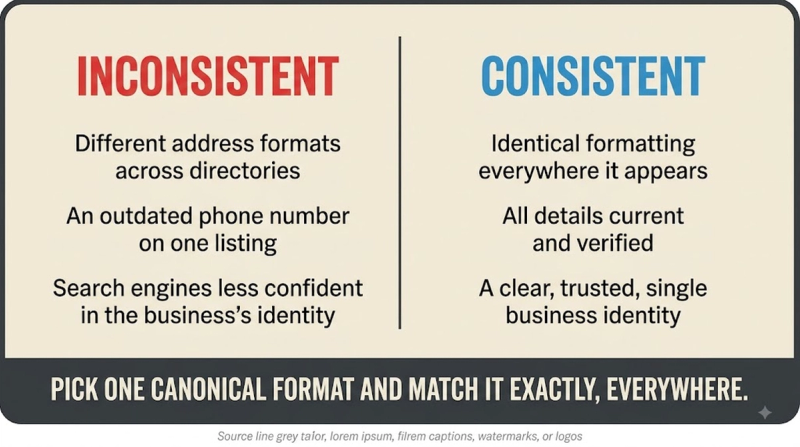
- Format mismatches count as real inconsistencies even when a human wouldn't notice: abbreviation choices, suite number placement, and area code formatting all get parsed literally by matching algorithms.
Why a tiny formatting difference actually matters
Matching algorithms compare citation data as strings, not as meaning. "123 Main St, Suite 4" and "123 Main Street, Ste. 4" describe the identical location to a person, but a strict matching system can register them as two different entities until enough corroborating signals resolve the conflict. Multiply that across dozens of citation sources built at different times by different people, and small formatting drift becomes the single most common cause of a fragmented local trust signal.
NAP consistency versus citation building
A local citation is any single mention of a business's NAP data on a directory or platform. NAP consistency is the property of how well every one of those individual citations agrees with the others. Building 50 new citations without auditing the existing ones first tends to import old errors into new places rather than fixing anything, which is the most common way well-intentioned citation building backfires.
How to run a NAP audit
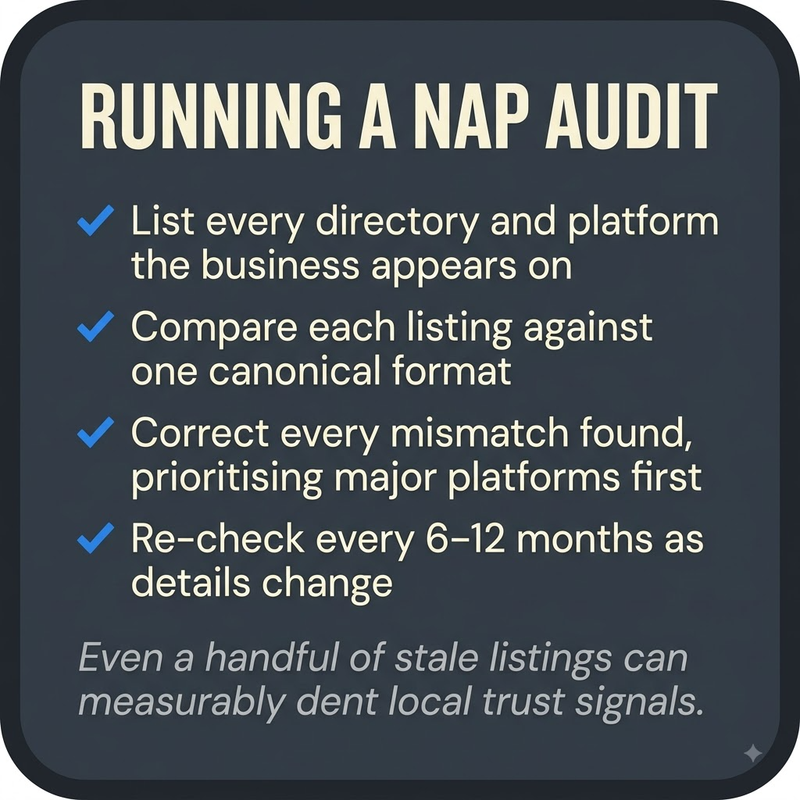
- Establish one canonical NAP format on the business's own website first, since every other listing should match this exactly.
- Pull the top 30 to 50 citation sources and compare each field against the canonical version, not against each other.
- Flag anything that deviates, including abbreviation differences, outdated suite numbers, and disconnected phone lines from past relocations.
- Correct listings directly where the business controls them, and submit update requests through each directory's process where it doesn't.
- Allow four to twelve weeks for aggregator-fed directories to reflect the correction before re-auditing.
Frequently asked questions
What does NAP stand for?
Name, Address, Phone: the three core identifying fields local search systems cross-reference across every citation to verify a business's location.
Does a minor abbreviation difference really count as an inconsistency?
Yes, in the eyes of a matching algorithm. "St." versus "Street" reads as identical to a person but as two different strings to a system comparing data literally, which is exactly why standardizing format matters more than it feels like it should.
How long does it take for a NAP fix to affect rankings?
Four to twelve weeks in most cases, since aggregator-fed directories update on their own schedule rather than instantly reflecting a correction made at the source.
Is NAP consistency still relevant now that AI handles more local search?
More relevant, not less. AI-driven local search systems rely on the same cross-referenced NAP signals to determine which business to surface with confidence, so a fragmented profile now risks losing visibility in two channels instead of one.


