
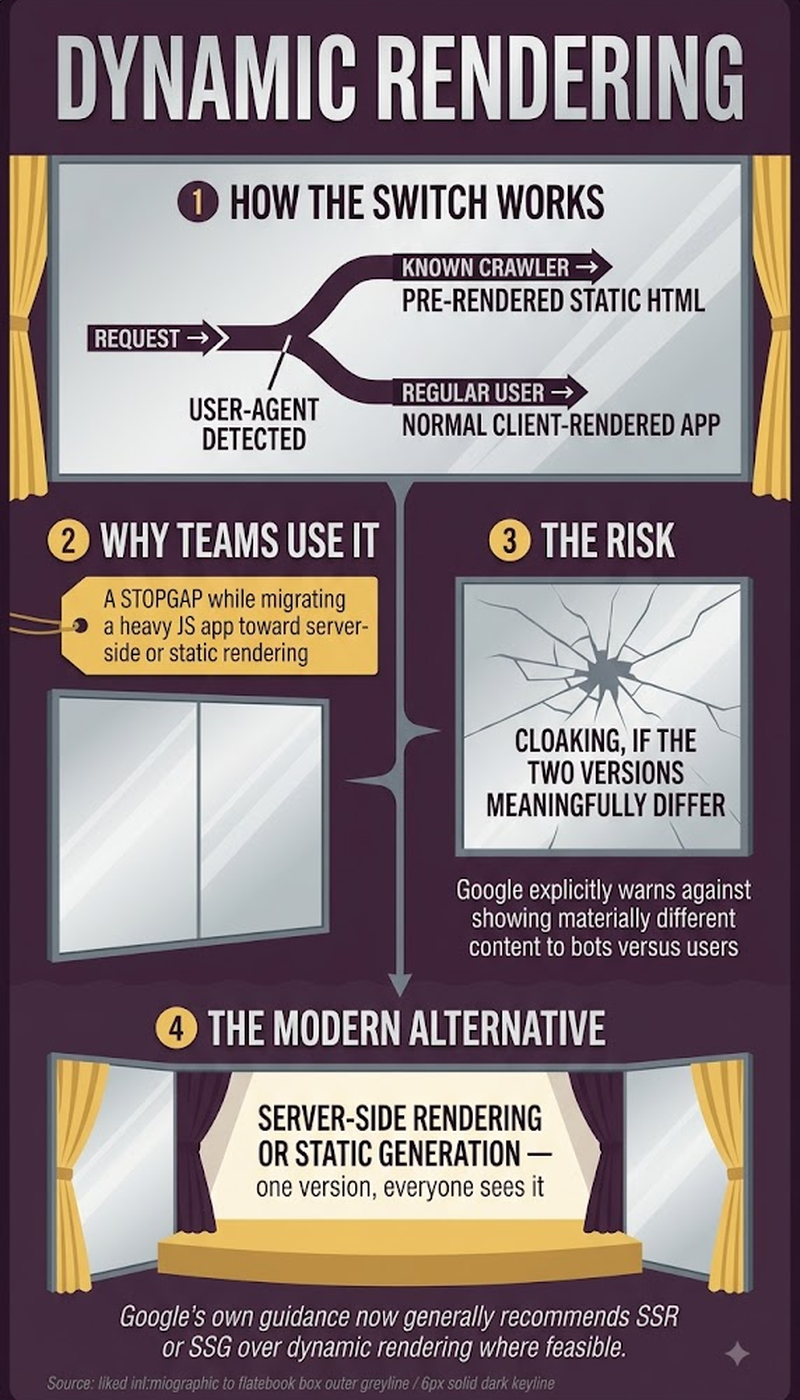
Dynamic rendering is a technique where a server detects whether a request is coming from a search engine crawler or a real user, then serves the crawler a pre-rendered static HTML version of the page while the user gets the full, JavaScript-heavy interactive version. Google introduced it in 2018 to help crawlers reliably see content on JavaScript-dependent sites. Then walked it back. Google's own documentation has called it a "workaround and not a long-term solution" since 2022, and that verdict still holds through 2026 — worth knowing before anyone recommends it to you as a fix.
Key Takeaways
- Google introduced dynamic rendering in 2018, then explicitly downgraded its recommendation status in August 2022, calling it a workaround rather than a long-term fix.
- Server-side rendering (SSR), static site generation (SSG), and hydration are Google's currently recommended long-term alternatives, and are the default choice for new site builds in 2026.
- Dynamic rendering is not cloaking, as long as the content served to crawlers accurately represents what real users see — the distinction is content equivalence, not identical code.
- Rendertron, Google's own open-source dynamic rendering tool, was archived and deprecated back in 2022; current implementations typically use commercial services like Prerender.io instead.
- Dynamic rendering still shows up in 2026 primarily as a migration-period workaround for existing legacy sites, not as a strategy anyone recommends starting a new project with.
Dynamic rendering sits alongside client-side rendering and prerendering as related rendering strategies covered elsewhere on this site, and connects directly to JavaScript SEO as the broader discipline it's one tactic within.
Why Did Sites Start Using Dynamic Rendering in the First Place?
Sites adopted dynamic rendering because early search crawlers struggled to execute JavaScript reliably, meaning bots often saw an empty or incomplete page where a human visitor saw a fully rendered one. Frameworks like React, Angular, and Vue.js generate much of their visible content client-side, after the initial HTML loads — a process a browser handles instantly but that historically left crawlers looking at a near-blank page if they couldn't run the JavaScript themselves. Dynamic rendering solved this by routing crawler requests to a separately generated, fully-rendered HTML snapshot, sidestepping the JavaScript execution problem entirely rather than fixing it.
Is Dynamic Rendering Still Recommended by Google in 2026?
No. Google has explicitly called dynamic rendering a workaround rather than a long-term solution since an August 2022 documentation update, and that position hasn't moved through 2026. The updated Google Search Central docs added a direct warning: workaround, not a long-term solution, server-side rendering or static rendering or hydration recommended instead. Current 2026 guidance from technical SEO practitioners agrees almost unanimously — dynamic rendering is a migration workaround, useful for stabilizing an existing legacy site's crawlability while a proper rendering fix gets built, never a starting-point architecture for anything new. If a vendor pitches it as the modern answer to your JavaScript SEO problem, that's a red flag worth pushing back on.
Is Dynamic Rendering a Form of Cloaking?
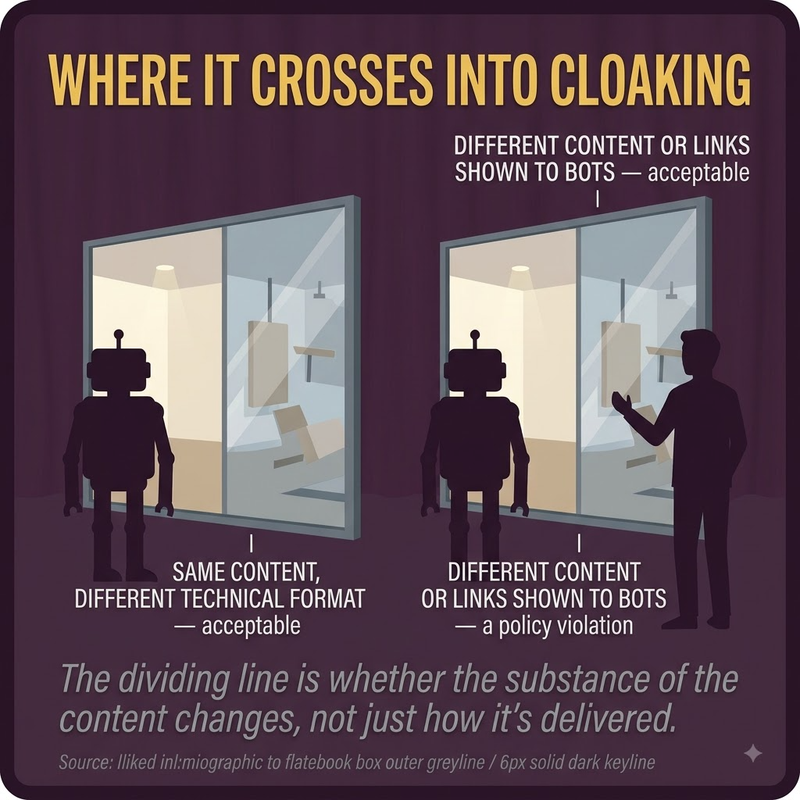
No — not if it's done right. Dynamic rendering is not cloaking, provided the content served to crawlers is genuinely equivalent to what real users see. The distinction that matters is content equivalence, not whether the underlying delivery mechanism differs. Cloaking specifically means showing search engines meaningfully different content than users see, usually to manipulate rankings. Dynamic rendering serves the same substantive content through two different technical paths — one pre-rendered, one client-side — and Google has said explicitly that doesn't violate its guidelines as long as the two versions match in substance. The risk shows up only when a site abuses the crawler-facing version to sneak in content, links, or keywords real users never see. That's cloaking. The technique itself isn't the problem; what someone does with it is.
What Are the Real Alternatives to Dynamic Rendering?
Comparing the main approaches:
- Server-side rendering (SSR) — server generates full HTML per request, before sending to browser or bot. Best fit: dynamic, frequently-updated content.
- Static site generation (SSG) — full HTML pre-built at deploy time, served identically to all requests. Best fit: content that changes infrequently.
- Hydration — server sends pre-rendered HTML, then JavaScript "hydrates" it interactive. Best fit: apps needing both SEO and rich interactivity.
- Dynamic rendering — separate rendering path per user-agent (bot vs. human). Best fit: legacy sites mid-migration only.
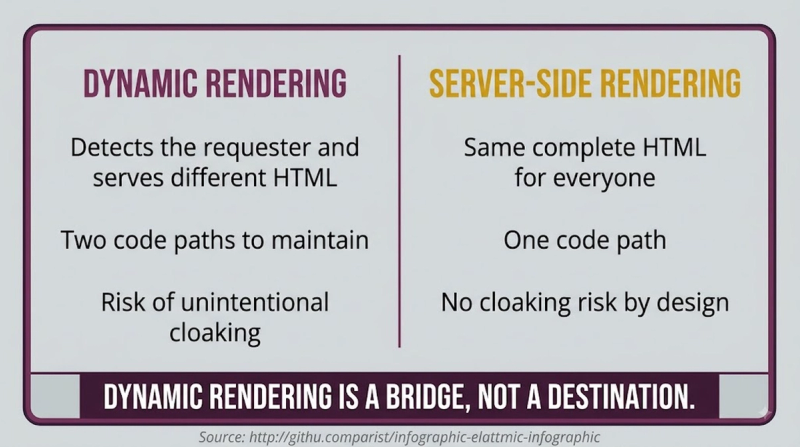
Google's current guidance treats SSR, SSG, and hydration as the durable long-term choices, with dynamic rendering positioned specifically as a stopgap for sites that can't immediately rebuild their rendering architecture. The practical difference is maintenance burden: dynamic rendering requires running and maintaining two separate rendering systems indefinitely, while SSR/SSG/hydration approaches converge on a single rendering path that serves everyone.
How Do You Know If a Site Actually Needs Dynamic Rendering?
Most small or relatively static sites never need dynamic rendering at all — it's specifically relevant to JavaScript-heavy sites with content that's difficult or slow to server-render through standard means. A site is a realistic candidate if it meets several of these conditions:
- The site is built on a JavaScript framework that renders most primary content client-side, with no SSR/SSG layer already in place.
- A crawl test (comparing View Source to the rendered DOM) shows a meaningful content gap between what's in the raw HTML and what actually displays to users.
- Rebuilding with SSR or SSG isn't feasible in the near term due to development resource constraints or legacy infrastructure.
- The business impact of delayed or incomplete indexing is high enough to justify running dual rendering paths as an interim fix.
- There's a realistic migration plan toward SSR, SSG, or hydration already scoped, since dynamic rendering isn't meant to be a permanent architecture.
Does Dynamic Rendering Work for AI Crawlers, Not Just Google?
Dynamic rendering can technically serve pre-rendered content to AI crawlers the same way it does to Googlebot, but it requires manually maintaining an accurate, current list of AI user-agents (GPTBot, ClaudeBot, PerplexityBot, and others) to route correctly — a list that keeps growing and changing as new AI search products launch. This is a meaningfully different maintenance burden than routing for Google alone, since AI crawler identification isn't standardized the way search engine bot detection has become over two decades. Sites relying on dynamic rendering specifically to support AI visibility need an ongoing process for updating that user-agent list, not a one-time setup.
Frequently Asked Questions
What happened to Rendertron, Google's original dynamic rendering tool?
Google archived and deprecated Rendertron in 2022; most current dynamic rendering implementations use commercial alternatives like Prerender.io instead.
Does dynamic rendering slow down page load for real users?
No — dynamic rendering doesn't affect the user-facing experience at all, since real users still receive the full client-side rendered version; only crawler requests are routed differently.
Can dynamic rendering be implemented at the CDN level instead of the application server?
Yes — several commercial dynamic rendering services operate as a CDN-layer middleware, intercepting bot requests before they reach the origin server rather than requiring application-level routing logic.
Is dynamic rendering compatible with a site that also uses a robots.txt AI-crawler block?
Yes, but the two need to be configured consistently — blocking an AI crawler in robots.txt while also trying to serve it dynamically rendered content is contradictory and typically means the block should take precedence.
Does Bing require dynamic rendering the same way Google historically has?
Bing's JavaScript rendering capability has also improved significantly, and Bing's guidance has followed a similar trajectory to Google's in treating dynamic rendering as a workaround rather than a first-choice solution.
How do you test whether dynamic rendering is actually serving the correct content to bots?
Fetching a URL with a bot user-agent (via a command-line tool like curl, or Google Search Console's URL Inspection tool) and comparing the returned HTML against what a browser renders is the standard verification method.
Can a single page use dynamic rendering while the rest of the site uses standard client-side rendering?
Technically yes, but maintaining a partial implementation adds architectural complexity without a clear benefit — most sites that adopt dynamic rendering apply it site-wide rather than selectively.
Does dynamic rendering help with Core Web Vitals scores for bots specifically?
Search engines don't measure Core Web Vitals from the pre-rendered bot version — those metrics are measured from real user experience data, so dynamic rendering doesn't directly affect Core Web Vitals scoring.
What's the typical maintenance cost of running dynamic rendering long-term compared to migrating to SSR?
Dynamic rendering requires ongoing maintenance of two separate rendering paths and a current bot user-agent list indefinitely, while a one-time SSR migration converges to a single system — which is precisely why Google frames dynamic rendering as more expensive over time despite a lower upfront lift.
Can dynamic rendering cause duplicate content issues between the bot and user versions?
Not if implemented correctly with genuinely equivalent content, but a poorly maintained dynamic rendering setup that drifts out of sync between versions can create inconsistencies that look like duplicate or manipulated content to search engines.


